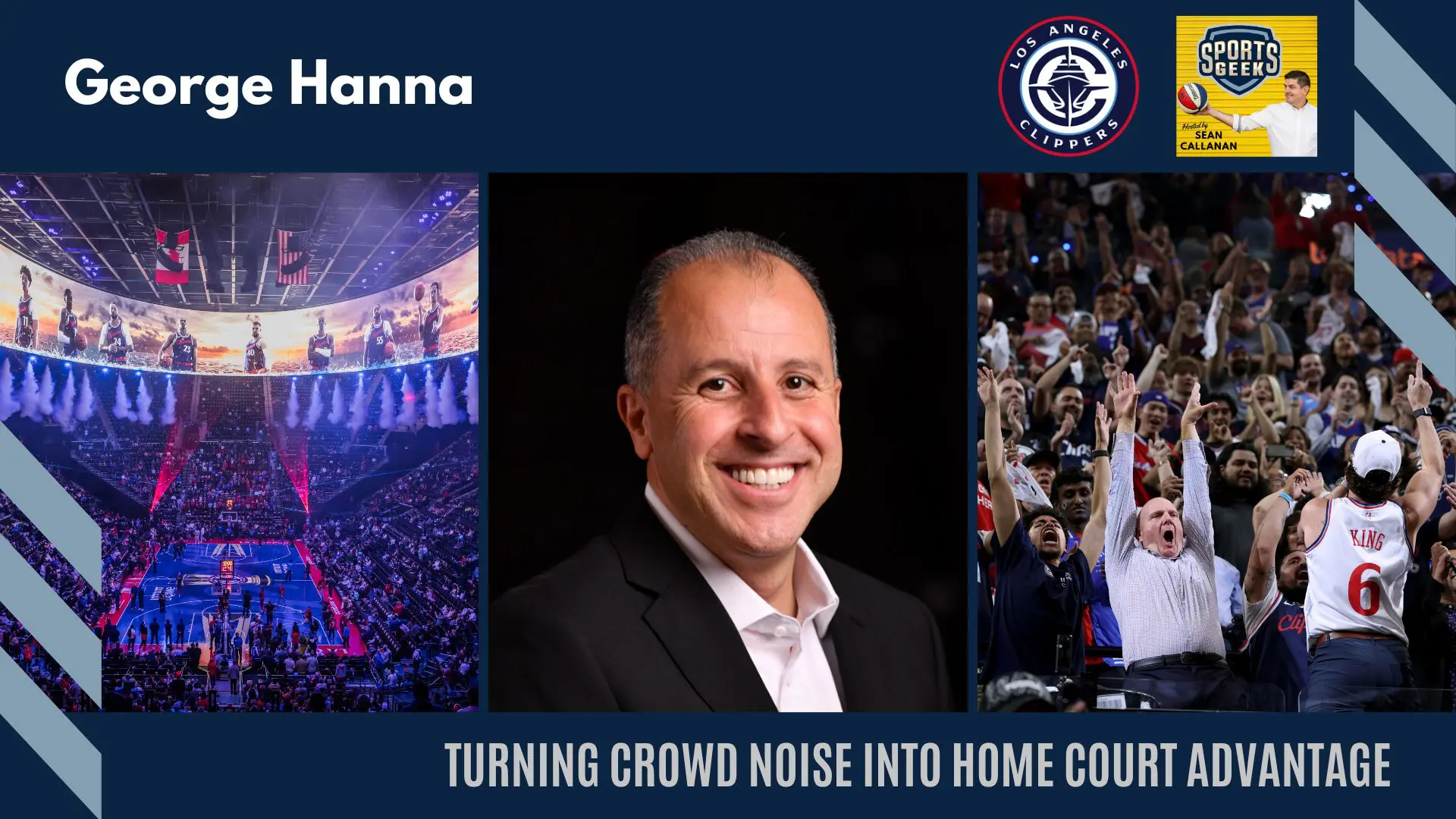
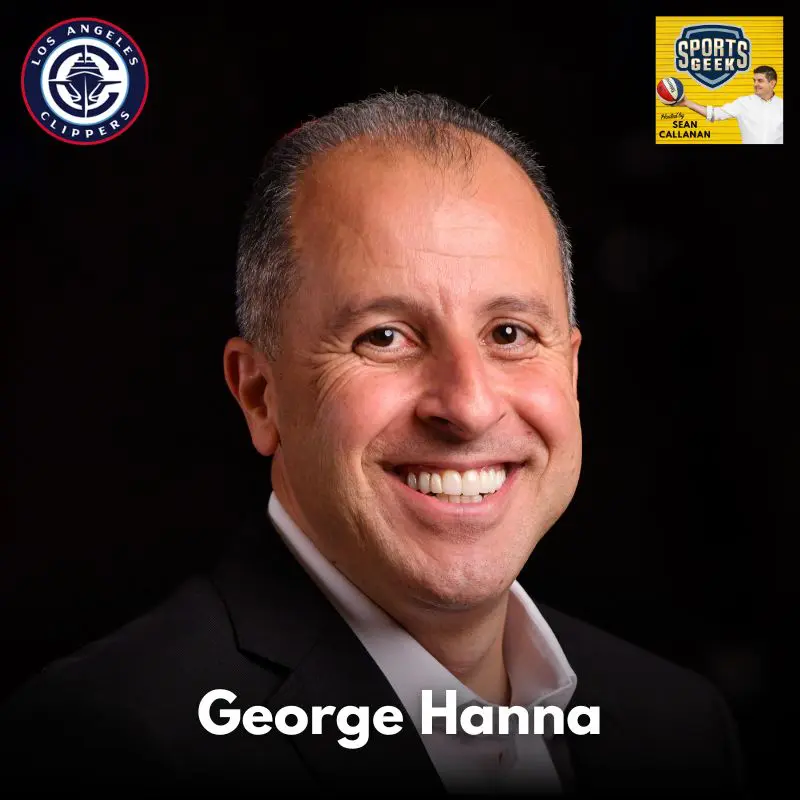
In episode 456 of Sports Geek, George Hanna brings a technology career at IBM, Toyota, and Disney to his first role in sports, where he helped build one of the most talked-about venues in the world: Intuit Dome.
In this conversation, you’ll discover:
- Why a clear North Star “to get the point” of home court advantage is the single filter for every technology and design decision at Intuit Dome
- How the Clippers turned “70 per cent of our fans are anonymous” into a solvable problem by adding friction on purpose
- Why the hardest part of a 230 million pixel scoreboard wasn't the engineering; it was deciding what to show
- How a Candy Crush activation lifted return-to-seat rates and won an NBA award for best sponsorship activation
- What the “contagion effect” in their crowd data revealed, and why it led to giving free playoff tickets to their most infectious cheerers
- How George decides when the answer is technology and when it genuinely isn't
- Where AI is doing real work behind the scenes, and the guardrails the technology team puts around it
Listen to George Hanna on Sports Geek
Can't see podcast player? Click here to listen
Watch on YouTube
Interview Transcript
This transcript has been transcribed by Riverside.fm, no edits (please excuse any errors)
Sean Callanan (00:03)
Very happy to welcome George Hanna. He's the Chief Technology and Digital Officer of the LA Clippers and the Intuit Dome. George, welcome to the podcast.
George Hanna (00:12)
Sean, thanks for having me.
Sean Callanan (00:14)
Not a problem at all. For those watching on on YouTube, sometimes guests turn up with a with a with a generated background or a or a fake background or a virtual background, but you're actually sitting in outside in front of the Intuit Dome, just for just for context for the people who are listening from a from an audio point of view.
George Hanna (00:31)
I am, real real background it's a beautiful day here in Southern California and I instead of sitting in my office I figure I'd come outside.
Sean Callanan (00:39)
absolutely. Why why wouldn't you when you've got when you can enjoy enjoy the weather? I always start people asking them how they got their start in the world of sports and entertainment. How did your you know IT career end up at Intuit Dome?
George Hanna (00:52)
Yeah, so I've been I've been in technology my entire career. This is actually my first role in sports. so before this I was I was at Disney and happy to talk about that, but I got a call. the Clippers were looking for somebody, and I wasn't looking to leave Disney. I guess that's the best time to to get a job is when you're not looking to leave your current one. and learned a little bit more about what they were doing and and the people that I'd be working with and for and couldn't say no. So here I am.
Sean Callanan (01:18)
Yeah, so I mean, there is a lot of people that do come into sports from other industries. Your your background was IBM and then Toyota and then Disney now now the MBA. is there is there a thread there from a either a technology point of view or a a customer co point of view from, you know, enterprise IT to cars to theme parks and now a basketball venue that you can sort of carry through?
George Hanna (01:39)
Yeah, I guess the one I'd say less about sort of the industry through line, more about the companies that I specifically work for within those industries. all of them very, very sort of customer focused and you can call it guest experience, fan experience, whatever that may be. so Toyota Disney and and here at the Clippers, very much focused on kind of what that end consumer experience is like and what do we need to do to make that the best we can. And
And in technology, there's that you know, you can have a ton of roles that either are directly tied to that or have nothing to do with that. Super important, but just aren't necessarily directly tied to that consumer experience. so I was fortunate enough. and I found it was actually very important to me to have a technology type role that impacted the the actual end consumer experience and and I got that here as well.
Sean Callanan (02:24)
I mean I've been lucky enough to have a few like ex Disney folk that that talk about, you know, the almost the NBA and customer experience that you get working working at at Disney. and again you've you know, Toyota has a real big customer focus. Was are there things that you have taken from those those experiences that really work well for you now working in the world of sports, but especially at the Clippers?
George Hanna (02:49)
Yeah, I mean I think so. I think I think we're all consumers in our in our everyday life and consumers of of line veteran and and experiences that sort of touch you, right? Touch your heart, touch your emotion, sort of really speak to you and and I think when you appreciate that and really look at sort of the details of that interaction, that experience through and through.
you see things from a different lens. And it's it's really hard to do that and it's hard to consistently do that. And some of the best companies in the world c you know are able to consistently do that. And I I got the sense in my conversations with Steve and Gillian, our CEO and others here, that that's what this organization was like and turns out to be true and and it's been great. and so it's it's sort of that maniacal focus on what the w what you're you know ultimately
consumer sort of experiences and if you keep that in mind, kind of everything else I'll say falls into place.
Sean Callanan (03:40)
And landing at the Clippers for your for your first role, I mean it's a very different experience for the for the world of sports, but then also you've got a very technologically savioner in Steve Barber with a you know with a v very much a technical lens. What's what was your sort of first impressions coming into sports, but then also into an organisation that has such a big focus on technology?
George Hanna (04:02)
Yeah, I'll I'll t I'll tell you a quick story. my actual first interaction with Steve during the interview process, and a few minutes in, he asked me, you know, you've been to a lot of games and and events, where would you use technology? And I and I sort of gave him an answer. but is essentially to make a long story short, his answer was, Yeah, you don't need technology to solve that problem. You could solve it with in our case, more bathrooms, right? It was just long lines of bathrooms. Solve it more bathrooms. We don't need technology for that. So it sort of while he obviously
very into technology and knows know but very knowledgeable, you know, his answer was you d that's not necessarily the right answer for every problem all the time. And so that was my actually my first ex exposure and experience. So in my role, I've taken that to heart and said, you know, how can we solve the problem in the best and easiest way for us and for our fans? And obviously in a lot of times that ways that's technology and a lot of times it's not. So I should also qualify my data points for sports
are one. My data for for sports even small, small, small companies, you know, at the end of the day the Clippers, you know, famous owner, famous name, a few famous employees, right, that wear jerseys. And but at the end of the day, in a lot of ways we're a small, mid-sized company. so that also is a new you know, new experience for me in that I came from very large organization. So our ability to be nimble and and see and interact with our customer directly and react to that quickly.
I don't know I don't think that's a sports specific thing. I think sports and live events sort of make that much easier to do in some ways. but all that put together has has made this a pretty pretty great experience for me, for sure.
Sean Callanan (05:32)
So a big remit for your role is directly behind you, the Intuit Dome. you know, when the when Steve Bummer took over the Clippers, they were at crypto dot com arena down the road sharing. they are a tenant. How did what was the journey like going from hey we're a tenant, we're in someone else's building to hey we want our own we want our own space?
George Hanna (05:54)
Yeah, and actually one of the things that he said, I want to say he said publicly when he bought the Clippers was he was very excited to not have to build an arena. That wasn't his intent.
Sean Callanan (06:03)
Mm-hmm.
George Hanna (06:04)
and a few few months in, literally, he said, We don't really control anything about our own destiny. We you know, we have very little say on schedule. we can't control the fan experience, the food, the mirt, anything like that. And so I'd say within six months, he said we we need to start looking at alternatives here. And so
It's been sort of a ten year journey from that point to when we opened into a dome. and and and obviously the the focus on doing all those things and having control over them and delivering the the ultimate experience we want was was the goal. And I think we didn't have that control. So in a lot of ways it's great, right? But just like a sort of a renter or tenant in an apartment, right?
Yeah. You need to worry about more things than you did before. So in most ways it's great, some ways like I it'd be great if if I get to call somebody to just say come fix this thing now I'm the person that they call to
Sean Callanan (06:55)
Yeah.
George Hanna (06:55)
say, Come fix it.
Sean Callanan (06:57)
and very much the North Star for both Steve and the Clipzorg is that fan experience and like that was the driver for the arena. We can't control these things. And so that becomes the North Star for for all of your decisions. Like what is this for the fan?
George Hanna (07:12)
Yeah, exactly. So so there's data to suggest in an NBA game home court advantage is worth a point or two. So part of that is, you know, fan the the players sleep in their own bed and they're on their own time zone and things things we can't control. Say that's half of it, one point. The other point, things we can control, the arena atmosphere and how loud, you know, can the players feel it, can the opposing team players feel it? Do the referees, you know, when they make a fifty fifty call that doesn't go away, they hear it from our fans and so
So much of what we do is tied to getting that point, that home court advantage. And so, you know, we want to eliminate all the reasons and the barriers you know, for people to sit at home, you know, watch the game from home, and and come to the arena, wear our gear, show up early, cheer loudly, get us our point. And so there's a lot of things we do, like, you know, frictionless markets in in the entire arena to get you in and out, a lot of bathrooms as I previously mentioned.
to help support that. It's not to show off cool tech or it's not to say, yeah, we've got more bathrooms than everybody else. It's to get you in your seat cheering for a team to get us that point. So it's amazing, by the way, any organization, and I've been I've been at Disney Intoy and IBM where a few things have happened where sort of the organization rallied around something. It's amazing how how much more you can do with sort of a shared common common goal like that.
And that's what we sort of all went after and and never really wavered from that from day one.
Sean Callanan (08:40)
And part of and part of that in in creating habits and getting getting the right data is understanding who's who's coming in. And you know, we hear a lot of talk about frictionless, but what I really loved, the stuff that you were talking about at Seat was adding some friction so you get enough information to make that frictionless experience possible possible ongoing. It sort of goes against saying frictionless, but you need some information to start with to be able to
George Hanna (09:08)
Yeah.
Sean Callanan (09:08)
to give that best experience.
George Hanna (09:10)
Yeah, exactly right. you know, I had been going to to games and sporting events my entire life, but it wasn't until I got here that somebody told me, you know, sort of we know 30 percent, 30 ish percent of the people who come to a one of our games and seventy percent are anonymous. And I I basically said that can't that can't be right. What do you mean? I said, Yeah, 30 percent by and and so I think that's generally common in the industry, may you know give or take a few points.
But I I was thinking about sort of all the things that we wanted to do to deliver on that personalized fan experience. I said, that's kind of impossible, right? If we don't know most of our fans. And so you can almost think of any business, any industry, and say, go do a bunch of things to talk to your fans, to resonate with them, to you know, market to them whatever it is. And and if you don't know who most of them are, that's kind of an impossible task. So we made a decision early to do just that, as you said. everybody that comes in should have their own ticket, their own account.
and their own you know ticket tied to that individual account, which is again friction up front. So for a frictionless menu, the first thing we're asking you to do is something maybe that you wouldn't have had to do otherwise. but the idea is A, we want to make that as quick and easy as possible. and B, you'll get that time back even if you just come to one game or one concert. you'll get that time back in the rest of your time savings in the in the in the arena itself. but as a result of that we can now
You know, if we know who you are, we don't let's say you're coming to a clipper game, are you wearing our gear? Did you show up early? Did you get to your seat? Are you cheering for our team? There's some technology we have in the seats that allow us to know that. And then we can incentivize that behavior, right? We want you to come back, we want you to continue to cheer for the team because again, it's all about that home court advantage getting our point. And turns out I think when you do all those things in the context of of of basketball or a sports arena, lots of lots of
benefits as well for a concert goer. Same same sort of concept, right? You don't miss a sh a song from the artist, right? You you get to your seat, you cheer for it, if you wanna go to the bathroom or grab food or whatever it is, you're back and you're not missing any of the action.
Sean Callanan (11:09)
How important is like that initial point of getting that info, but then that implementation piece? There's a of people will capture the data and then say, cool, we've got this data, but it's like, well, if you don't give someone the personalized offer or tell them that there's something at this concession or give them the offer as they're walking back to their parking to go to the next game, it's sort of it's sort of left. Like so how how important is that like that 80% tail of you've got to do that work as well. You can't just do the shiny stuff at the front.
George Hanna (11:38)
Yeah, I think I think there's probably two things, two things, two parts of that tail. One is sort of the transactional, can they feel a benefit? and so in our case that's if you've enrolled your game face, you know, essentially your biometric, which is optional. you can walk into any market. You don't have to really stop. If you've got your payment method and your biometric, walk right in, grab what you want, leave, we'll charge you for it. Can they feel that transactional benefit in the moment? so that we we have a whole bunch of things in our arena that
hopefully make you feel like, yep, I got the benefit r right quickly. And we have a data point to support why people think that. And then the second is sort of the after after the event, after the fact, right? So we're not necessarily trying to sell you something or market to you, but can can we can we personalize either an offer or some you know, w come back or hey, we saw you you really you went to the store and and looked at this Kawhi jersey and you didn't buy it.
H here's an offer for 10% off of that jersey or something like that. so I we've we focused especially in the first year on that transactional execution, making sure that was as smooth as it can be. And we got a lot better at that as we learned. and now we're starting to unlock the data a little bit more. but we're we're the you know, we're being very cautious about what we do with the data and how we do anything with it, because you know, we've earned a lot of trust, I think, in the market, in our in in our industry.
and we don't want to abuse that. So we don't want somebody to say, man, I gave this up and I thought it would just make my experience better, but instead they're trying to sell me a whatever. so we're trying to really step slowly into that. I would argue we're probably a little too conservative, like just because we're a little too cautious. So but we're we you know, that's that's trust we don't want to lose. And so I I'd rather us be cautious than go than go the other way around. But sure. If at the end of the day you spend all the time, the effort, the money, the pain and suffering, you collect it all and you don't do anything with it, then you've helped nobody.
Sean Callanan (13:28)
Yeah, but it's also that part of that trust building exercise because again it's if you know, if the if you push the needle too far, then you do you do get that pushback. So that's the I guess the personalization and the and the the flow into into the into the venue. I guess the big thing is is the is the halo, the two hundred and thirty million you pixels, double sided, you know, angles, everything, you know, getting everything mapped to every seat.
What was what was the hardest thing? The the engineering of getting it there or deciding what to show on that on that board?
George Hanna (14:02)
Yes. Yeah,
Sean Callanan (14:03)
Yeah no.
George Hanna (14:05)
yeah. you know, obviously we started with the eng the physical part of the engineering and luckily, you know, a people a lot smarter than than me had to figure that out. But l lots of lots of smart folks worked really hard. The the roof had to be as part of the design structurally reinforced, right, to handle the weight of the halo and so physically building it, getting it in there. but then we quickly turned our attention to the content and
mapping again every pixel to the seats that can see it, every seat to the pixels that you can see. and and it's it really really was a much harder problem than we thought to to figure out what content to show because you don't want you don't want it all repeated a bunch of times, but at the same time you don't want somebody to worry that there's a bunch of content they don't get to see that somebody else gets to see. So that became a a pretty sizable math problem to figure out and a balance to draw and and I think we we found that
but just showing content again. I have a saying by the way, I I I came up with it soon after I joined. We like to have our cake eat it too and then have dessert after. so that's
Sean Callanan (15:06)
Yeah.
George Hanna (15:06)
us. Right. And it's zero calories, by the way, our our special cake that we eat. So just showing the content and making sure it's unique enough but doesn't repeat, right? was one thing. But then we wanted sort of interactive content and how do we how do we add that in la layer of interactivity so we have, you know.
things in the seats that you can you can do and we could talk about that. But that also added a layer of complexity. So instead of a standard sort of content pushing system for the board, you know, we have a real time game engine that powers the entire thing. And so yeah, that that's that's complexity upon complexity that we we I had a lot more hair when when I started working on that. But here we are and it's working.
Sean Callanan (15:47)
But that's also going back to that that that point, you know, trying to get that point, whether it's you know, like I've spoken to people in the NFL that, you know, the video operator will show controversial decisions to for the, you know, the the coach to throw the flag. The same, you know, if you wanna if there's something that the coaches need to see, why should they be looking at the iPad when you've got a big screen there? It's like you wanna show those things is whether a coach is challenged. So there's some of the technical stuff, but then also, you know, getting people back in their seats
for the second half to make sure the second half starts with energy, is a you know, is a constant problem. And, you know, at your venue, people get back in their seats 'cause they want to be playing p Candy Crush.
George Hanna (16:26)
It's cra it's great. Actually, the our our sponsorship team would just won an NBA award for the the I think best sponsorship activation. Yeah. And so you rush to your seat, play Candy Crush, you see your name sort of on the drop of candy after you push your button and sort of act so essentially you're checking in your seat before the third quarter starts. and we saw a pretty drastic lift in how many people were back at their seats to start the game. And people loved it. And if enough people the way the game's designed, if enough people do that.
The entire arena can win. And if enough people aren't back in their seats and and we don't crush the the board, the arena doesn't win. And it's it's not funny math. We're not, you know, it's not h smoke and mirrors, it's actual math and based on
Sean Callanan (17:04)
Yeah.
George Hanna (17:05)
percentage of people. and they love it. And it's such a simple sort of activation that hit on all cylinders. and and ultimately, again, our North Star was get people in their seats, cheering for the team and get the get the point. So
that was that was we're pretty excited about that one. But we've d we do so many sort of little things like that where w when you have that goal and you don't sort of waver from that, the the the answers, the decisions be become sort of clear on here's what you want to do. So for example, we don't have TVs that are playing the game in the concourse, in the suites, and the clubs. You can't watch the game from anywhere in the arena except for your seat. Not what most arenas do, not what most stadiums
Sean Callanan (17:44)
Mm-hmm.
George Hanna (17:44)
do. You can probably watch the game from a hundred different places.
Not what we're want not what we're after, right? We're after you to get in your seat and cheer for the team. So again, keeping that keeping that North Star in mind, has has helped us, I think.
Sean Callanan (17:57)
And then it is about having technology like as an enabler for, you know, striving for that point or for that fan experience to have someone say, you know, I did have that adrenaline spike, 'cause I was at a clippers game. You know, whether it be, you know, the decibel sensors and understanding what people are doing and how the noise is and then connecting that to the halo. And so when the noise gets to a certain point, you're showing different content to to to lift that.
George Hanna (18:24)
Yep. Yeah. Our our s you know, sound meter isn't isn't a graphic or an animation. It's it's legit decibel read and it and it collects it from every individual seat, right? So we get a in the in the catwalk we have these decibel readers. ten times per second per seat we get a reading. And so it's collecting all that and it's showing at the section level. and the the place goes nuts, right? And they see real time bisection, decibel levels. and there's a winner, and by the way, the winning section.
Everybody who's in in who's in you know enrolled into our loyalty program, they get something, right, pushed to their point XP and and things like that. And so I wanna say we've gamified it's sort of a game within a game a little bit,
Sean Callanan (19:02)
Mm-hmm.
George Hanna (19:03)
whether it's that or some of the interactive games we have using the buttons on the halo, but it basically keeps you engaged when the ball's not live, so that w we don't give you a reason. We're not driving you to the phone, right? A second screen,
Obviously you're gonna use the restroom, you're gonna go grab something to eat. We've made it as easy as possible for you to do that. The goal is get back to your seat and be there for for the the ball going live or the song, you know, the next song starting from your favorite artist or whatever the case may be.
Sean Callanan (19:32)
I mean the other thing that I really love about Intuit Dome is is the the fact you've built out sections for different types of fans. You've got the wall for the absolutely crazy fans and you know, if it was me 30 years ago, that's exactly where I'd be s I'd be sitting behind behind the goals and distracting someone during a free throw. That's what I did in you know, in my twenties and and try all different tricks. But like building out a specific part of the stadium f for that.
Was that again big driver to sort of that home court advantage, but also k a completely different experience that someone is, you know, mid court or at a or at a or at a different level?
George Hanna (20:11)
Yeah, and you know, I think we took some inspiration from a bunch, you know, obviously European football does a lot of this, college basketball here in the States does a lot of that. and actually the I I want to say the inspiration for the wall came from San Diego State. Steve was at Kawhi Leonard's jersey retirement. and so just though you know, you have to be a Clipper fan to sit there and you can't wear opposing team gear. And even a s a section of that, a subsection of the wall, the supporter section, which is three hundred seats right behind the basket.
Your seats are dynamically assigned based on when you show up. and so we worked internally in with our ticketing provider, Ticketmaster, to fill the building, to fill that section from the bottom up. So the earlier you get there based on how many people are in your party, did you re you know, request to sit with somebody and they accepted? So now we're we're gonna group you together and there's some logic to say next best available seat and we fill it. so we're incentivizing those fans either to get you know, to get here early. But that aside, it is a it is a
a a section for Clipper fans and Clipper fans only. And it was funny, you know, when we when we opened the arena and we had these sort of rules in mind, we're like, how like how how are we gonna enforce them? So everyone has to click and agree and there's disclaimers, whatever. But at the end of the day, somebody comes in with an opposing team of jersey, what do we do? and it happened for the first few games and, you know, there were a handful of folks and we had ushers that, you know, our hosts that were, you know,
gracefully asking you, you know, you can take it off, you can put something else on, we can relocate you, whatever it is. and then it soon became a nobody really did it. And anybody that did, the wall would get kind of excited about watching them, you know, take take the jersey off or leave to go sit somewhere else. And so it's turned into its own little sort of mini ritual. but yeah, I think I think that has the wall has been at least in our mind a tremendous success on on what we're trying to do as far as the the environment.
that it that it created.
Sean Callanan (21:57)
absolutely. one thing I want to talk to you about from a technology point of view is is the the swinging for the fences. Like there's always new tech available, you know, either you it it's probably getting pitched to you all the time, but but you're always on the lookout. How d how do you you know, you spoke about the Misapplied Sciences parallel reality board that you went, that looks amazing, not quite sure how to use it. How do you how do you go about, hey, that looks like great tech.
We're either gonna figure it out or or I can apply a use case. How do you know what to, I guess, put bets on?
George Hanna (22:30)
Yeah. Gosh, I wish I wish I had a formula or or a way to answer that question succinctly. I'd say that was the one of the few examples where we saw a piece of tech and we said, wow, we're gonna find a we're gonna find a business case and and a sort of a problem to solve or a customer experience we want to deliver using it. in fact that may be the only one. everything else has been here's what we're trying to deliver, here's the problem we're trying to solve or or the fan experience.
element we're trying to deliver and say, how can we get that done? And again, in the example I give you, maybe it's just, well, yeah, you don't want lines for bathrooms, have more bathrooms, right? That's the answer.
Sean Callanan (23:05)
Mm-hmm.
George Hanna (23:05)
and some of it is okay, you don't like want lines for concessions. There's tech out there that can make that. and by the way, so so I'd say we take each sort of problem we're trying to solve and then what you know what products are in the market that can do that. We hit you know constant sort of build versus buy internal, right? And
And our our goal from the beginning was let's partner with companies that either have products that work or have the right people and roadmap that we can maybe accelerate and and shape a little bit so that we end up with a product that that is theirs essentially that we're using. because that they'll make it better over time and we'll get to benefit from that versus we go build something and now we've gotta sort of maintain it ourselves. and so we've you know, we we
Again, no magic formula. You're doing you're doing that work. and and it you know better than anybody, sort of lately that answer was different, you know, it's gonna be different next week than if I did that asked that same question last week with just the rate of change that this especially in the data space and things like that, of what's out there, and what can be done with how quickly you can sort of design something and and build something with with the tools that are available today. So the answer changes.
constantly, but we're in that insatia we were sort of insatiable appetite to learn. You have to be curious. You have to have an organization that's willing to sort of go that way. and also be okay to get it wrong occasionally and recognize that quickly. And and we sort of everyone says fail fast, whatever that means, but
Sean Callanan (24:29)
Mm-hmm.
George Hanna (24:29)
kind of get you know, be ready to do that. take some bets and and you you may miss one occasionally, but minimize that and recognize it quickly and and move on to the next thing.
Sean Callanan (24:39)
you mentioned your sort of first chat with Steve wasn't, you know, technology is the answer. and you've got a whole bunch of staff that are at the Intuit Dome. you've you're how do you how do you give them tools and technology enable them to do their best job? Because not everyone's touch point is a phone or a screen or a board. A lot of it is, you know, through the staff. So how do you how do you help it enable them?
George Hanna (25:04)
Yeah, I I mean I think there's so when it comes to there's sort of my, you know, tech product data team and then there's the broader clippers organization. So I mean I think the in general, the the knowledge worker, they're getting more savvy, right? They've they've got the tools as a consumer, they've got the tools, they've got the AI tools at their fingertips. And so how do we enable that as a as you know, we're we're about to to
signed a deal here with with a company to help us with our fan facing interactive interactivity on you know inbound calls for service or help or questions like that. So AI enabled and maybe it's voice, chat, email, things like that. And so putting putting the tools in the hands of our of our knowledge workers. But I'd also say, you know, that comes with it a level of risk and so you've got a you know, there is security implications and privacy implications and things like that that we work through. So
We're we're like everybody else where we want to be careful about that. and then when it comes to sort sort of my actual tech and development team, we're probably one step further than we're playing with some of the things that are out there that we're not gonna unleash to the in the wild and we're gonna put in some sort of air gapped style system, using the term loosely a little bit, but some sort of contained system where we can play around with it low risk and and see what works. But and and again we between Gillian and Steve, lots of
flexibility to go try those things, see what works. And I I I don't know if I mentioned this when we started, but sports is super you know, as f as far as an industry goes, very willing for people to help each other. So I get a ton of help from my peers and counterparts, whether it's other teams in the NBA or just in sports in general, on here's what we've tried, here's what worked, here's what didn't, here's what we're gonna do next, and I do the same. And that I'd say accelerates a lot of the learning because we're kind of learning
as a collective industry, which I don't know of any industry that does that other than ours. maybe education to some extent, they don't compete in the same way. but it's been it's that's been super helpful.
Sean Callanan (26:59)
So getting a new build and moving into a new stadium is part marathon, part sprint, to get there. But then once it's open, it becomes like what's next and it's less about the hardware and more more about the like the software and what changes you can bring in. What have you learned since it's opened and and you know what does it what does an experience at Intuit Dome look like now compared to, you know, opening night?
George Hanna (27:24)
Yeah, it it's funny. I would have guessed I would have been completely wrong on a bunch of things, but right after our season ended, it was, you know, we didn't really have an off season. Leading up to this, I've been here five years. We've been building the arena, and then we had our first season. And so this you know, last at the end of our first season, we met as a as a group with Steve and Gillian and a couple others, and it it sort of was a brainstorming session on
What would what did we learn? What would we do differently? And it could be physical things in the building, how our app interacted with such and such or frictionless this, that, or the other. and it was sort of a we had a couple hour brainstorming session, and that turned into great, that's your roadmap for the off season. Like, yep, those are all things we've learned, we can do better, we want to enhance, or a new product out there. And so it was like we were off to the races. We got about three days to pat ourselves on the back after opening the venue, and had our first successful season.
And then we went running. and and then I I so shocked, but we did it and we went into the second season. The from a from a fan experience, I'd say it's significantly better than it was. I I'd say the first season my team and I were running around most games and concerts, making
Sean Callanan (28:32)
Mm-hmm.
George Hanna (28:32)
sure and fixing and changing whatever. And season two, we enjoy sat there and enjoyed for the most part the games. And so that's that's been a great great you know.
stability for us that we've seen. and then going into get going into season three, we've got some new things in store that we're we're working on as we speak. Steve actually said it, he was at a he was speaking at some conference and he said, kind of like software, right? The building's hardware, kinda like software. Version one, a little rough. Version two gets a little more stable. Version three, kind of season three, that's when it gets great. And I feel like we've been following that trajectory and and away we go. So
Never a dull moment here and for better or for worse, we always are we always want more or different or s or something. What's the next thing? And so it's not it's you know, five percent exhausting, ninety five percent pretty awesome.
Sean Callanan (29:20)
And it is all powered by, you know, you talked about that thirty percent, seventy percent issue of not knowing who's in. One, you n you know who is in the building, but then also you know so much about their behaviour, whether they're you know, like you said, whether they're cheering, whether they're playing Candy Crush, how often how often they're look you know, getting up and leaving their seats. Is it how do you you know, you've you'll be is there overwhelmed with some of that data in
Hey, what are we going to do with it? What should we do with it? How can we action it? How do you I guess have that thirty thousand foot view of this is what's everything coming at us? What are the things we should be picking for the next season?
George Hanna (29:59)
Yeah, well I mean we started with we started with here here are the you know here are the experiences we want to deliver and here's the things that we sort of the behavior we want to incentivize like that just get there early, you know, cheer for the team, wear your gear. So kind of at the basic level, what a what a fan sort of when you think of what does a good fan do and how to a bunch of fans change the atmosphere in the arena, that's kind of what we wanted to measure and incentivize. Through that, we've we've learned some things for sure.
and then the data has also told us some things that maybe we weren't expecting. So here here's an example. we we found so we can measure again you have to opt into this stuff. So if you don't opt in, we have no idea where you're sitting and we have no idea how loud you are, so it doesn't matter. But for those who have opted in, we found in the data this this thing called the con we call it the contagion effect. So basically somebody who's cheering super loudly and the people around them, just not not who came with them, strangers around them, weren't cheering.
But over the course of the game, started cheering, right? Because essentially this person gave them license or agency to hey,
Sean Callanan (30:57)
Permission. Yeah.
George Hanna (30:58)
yeah, exactly. You can get loud, you can get crazy, you can wave your hands, whatever. And we found in the data, like people where it was a consistent pattern. Like this person, wherever they were sitting, people around them would start cheering more and more as the game went on. So for our first playoff game against Denver this last season, we looked
we sort of identified this pattern and we said, who are the top twenty people that fit into this category that don't have a ticket to this game? And we're gonna give them a ticket. Them plus one come and we just put them in around the arena, 20 right smack in the middle of 20 sections. This is and with nothing other than come enjoy the game like you do. and so there's little sort of nuggets in that data. We keep finding
Sean Callanan (31:36)
Uh-huh.
George Hanna (31:37)
those little nuggets. we're now trying to figure out how do we get better at finding those nuggets.
weeding out the noise, finding the nuggets. I think obviously the AI tools that that can go through our data, come up with meaningful insights and correlations has been a you know a godsend to us. because it is an overwhelming amount of data. I'd say the flip side to that is we're so cautious about what we do with it that w we we we we are treading very lightly and we want to make sure what we're doing is is you know gonna gonna be in the best interest of the fan and and without sort of
compromising what what you know the integrity of what we said we would do the data and how we did obviously as you can imagine.
Sean Callanan (32:16)
Hmm.
George Hanna (32:16)
And it's secure and all that good stuff. So we're we're we're we're tra we're we're dipping our toe. We a little bit more than dipping our toe, but we have we have plenty of plenty of ways to go in in which we can use the data to help help the fans and the experience.
Sean Callanan (32:29)
I love that. They're they're effectively a a cheering influencer 'cause you've got the you've got the data the the the data for it. if I put this person here and they start a chant or or they're yell you know, they're they're they're yelling and and at the right moments if it gets a whole section up and up and going, like the fact that it k
George Hanna (32:46)
Which it do I mean
sorry, as fan we see that. I as fans, you see the person who can just kinda get get the folks around them excited. And so, like when when we saw sort of saw the data, not surprising, right? Yeah, it makes sense, but now we now we s now we have data to support it and we can say, Yep, it's actually Jimmy and Jimmy doesn't have a ticket to this game. You guys should invite Jimmy back, essentially is what the data told us. And we're like, sounds good, we will.
Sean Callanan (33:10)
absolutely. Well, George, I really do appreciate you taking the time spending your warm LA afternoon with me. I want to get to the sports geek closing five. do you remember the first sports event you ever attended?
George Hanna (33:23)
I do, ironically, my dad the first event I ever took, my dad brought me to a Lakers game at the Kia Forum, which is two blocks up the road in a building we also own and and and run. so it's a it's a strictly a concert venue now, but yeah, a a Lakers game at the forum. And by the way, when I was young,
Sean Callanan (33:40)
true.
George Hanna (33:41)
I used to, you know, the King the Kings hockey team played at the forum and the Lakers and a few others. And so in my mind I'm like,
How big is this place? That they must they
Sean Callanan (33:48)
Yeah.
George Hanna (33:49)
have there's a hockey rink and whatever. And I went, I'm like, I don't get it. And so he had to sort of explain how that worked. But anyway, yeah.
Sean Callanan (33:56)
absolutely. And
there's obviously been a big upgrade in the in the food offering at at sports events and I'm sure there's the same at Intuit Dome. But do you have a do you have a favorite food memory or a or a go to food at a sports event?
George Hanna (34:08)
I'd say here at Intuit Dome, I I I love churros. so I'm a big churro fan, so I'd say here it's definitely the churros or at Disneyland it's the churros. Not that common at sports events, although it's getting more and more common. for for just sort of a typical fair, I'd say I I still love opening cracking open on a a peanut and and having peanuts during a game.
Sean Callanan (34:30)
absolutely. What's the what's the first app you open in the morning?
George Hanna (34:34)
It's the Apple News app. and I just kinda scan scan the it's pretty curated to kind of the stuff I wanna see and so I just kinda scan that to see, you know, is the world on fire or something about gonna gonna change my day in a drastic way and then I move on to my day.
Sean Callanan (34:50)
absolutely. It it is something you need
to check in most days, unfortunately. is
George Hanna (34:54)
Right.
Sean Callanan (34:55)
i is there someone that you follow? It might be it might be a former colleague, it might be an author, it might be someone on on social or or the internet that the podcast listeners should follow and why?
George Hanna (35:06)
You know, I'm a recent fan, or I'm a fan of recently Ben's Bytes. and so yep, so so I just find you know, I get a bunch of those AI sort of targeted newsletters and stuff like that. TLDR is a pretty good one too, and there's a bunch of different facets within that. But Ben's Bites to me is just kinda short, sweet and I generally get something out of each one of those and so I'm a fan of that one right now.
Sean Callanan (35:28)
Yep, I I can put myself down as a fan and and a subscriber. Then the last one, and you can answer this from a personal point of view or or from a from a venue point of view, but what what social media platform is your is your VP?
George Hanna (35:41)
Mm. Yeah, I'm I don't know, 'cause of my age, I'm gonna date myself. Like I'm not a massive social media person. so I guess personally I'd just say LinkedIn, like obviously professionally I do. I just made a decision early on and I you know, early on, like a f couple of my friends got very into it very fast. I'm like, Yeah, I can't I can't, so I'm not going to and then I just never really did. so I I do, but LinkedIn probably more than anything else.
Sean Callanan (36:07)
LinkedIn is is is a valid is a valid answer and and you know
George Hanna (36:10)
All right.
Sean Callanan (36:11)
and it has been and it has been a you know a conversation I think since you know Microsoft took it over. I guess it ha you know, I think it's a better, you know, professional networking, what are people up to site. So yeah, it's completely completely valid answer. And that's also where I normally reach out and say, George, if people are trying to reach out to you, is there a is there a bit is there a platform
that they can do so. so would that be LinkedIn?
George Hanna (36:36)
It would be, yeah, and just you know, you know, in the in the comments or something, just l you know, i the introduction should be the where you where you heard me if if this is where it was and let me know that so I I had a little context.
Sean Callanan (36:47)
I always ask people if they're gonna reach out, they reach out, say they listen to podcasts and say thank you. So if someone doesn't do that, let me know. I will hunt them down. Geor
George Hanna (36:52)
Perfect. Sounds good.
Sean Callanan (36:56)
George, thank you very much for coming on the podcast. So hopefully I'm in your part of the world. the Intuit Dome remains on my on my list of venues to check out. and and you know, I've heard lots of great things about it, so it's something I wanna check out in real life sometime.
George Hanna (37:11)
O open invitation whenever you wanna come and and for your listeners, you know, if you're if you're coming this way and and it works out and I can walk you around a little bit and and show you some of the cool things we got, happy to do it. and thanks for having me. What you' you're doing is great and and I'm a I'm a big fan, Chump. Those thanks for having me on.
Sean Callanan (37:26)
I appreciate it.
And I hit stop.

Turn 15 minutes a day into sponsorable content your partners will pay for
Sports Geek AI is a done-with-you content system that creates daily newsletters, podcasts, and social posts—giving your commercial team new inventory to sell.
Resources from the podcast
- Please connect with George Hanna on LinkedIn. Let him know you listened to the episode. Please say thank you if you do connect.
- Learn more about event schedules, fandom, and announcements of Intuit Dome here.
- Yes, Sean mentioned the Tiger Hoodlums; watch the video.
- Give our new Daily podcast a listen – Sports Geek Rapid Rundown.
- Check out Digital To Dollars – our self-serve program to help you drive more revenue from your digital fan base.
- Podcast episodes you should listen to:
- Throwback episodes you may have missed:
Podcast highlights
Highlights from episode 456 with George Hanna:
-
- 02:07 From enterprise IT to the NBA: George's first job in sport
- 02:50 The through-line from IBM, Toyota and Disney: customer experience
- 05:48 Ballmer's “you don't need technology, you need more bathrooms”
- 07:27 Why the Clippers left a shared arena to build their own
- 09:17 Home court advantage is worth a point or two
- 11:18 The 30/70 problem: 70 percent of fans are anonymous
- 13:30 Capturing the data is nothing without acting on it
- 16:32 The Halo: 230 million pixels and mapping every seat
- 17:59 Building a real-time game engine for the board
- 19:07 The Candy Crush activation that won an NBA award
- 20:06 Why there are no TVs anywhere but your seat
- 21:12 Decibel sensors reading every seat 10 times a second
- 22:24 The Wall: a Clippers-only section inspired by San Diego State
- 24:58 Swinging for the fences: the parallel-reality board
- 26:29 Build versus buy, and failing fast for real
- 28:19 Giving staff AI tools, safely
- 32:20 The building is hardware, the experience is software
- 33:42 The contagion effect in the crowd data
- 35:06 Handing free playoff tickets to the most infectious cheerers
- 37:06 Sports Geek Closing Five

Digital To Dollars is the five-pillar process pro teams and leagues have used for a decade to turn digital audiences into revenue, and it’s about to be available as a self-paced program.
Listen To Sports Geek
Recent Sports Geek Reads
- Women’s Sports Viewership, ABG’s $38B IP Playbook & Lakers as an AI Bet
- Norway’s $6.4B Sports Portfolio, Wall Street Loves the New York Knicks & AI Payments
- Disney’s Sports Strategy, Netflix’s MLB Deal & Lakers’ $12.5B Sale
- Bezos Buys Liverpool, Lakers Sell for Record & NFL’s Media Timing Play
- LA Lakers’ $12.5bn Sale, Rams & 49ers in Australia, and OpenAI’s Ultra-Fast AI
- LIV’s Finances, Cowboys’ $15B Valuation & Disney+ x The Overlap
Listen to Sports Geek Rapid Rundown daily