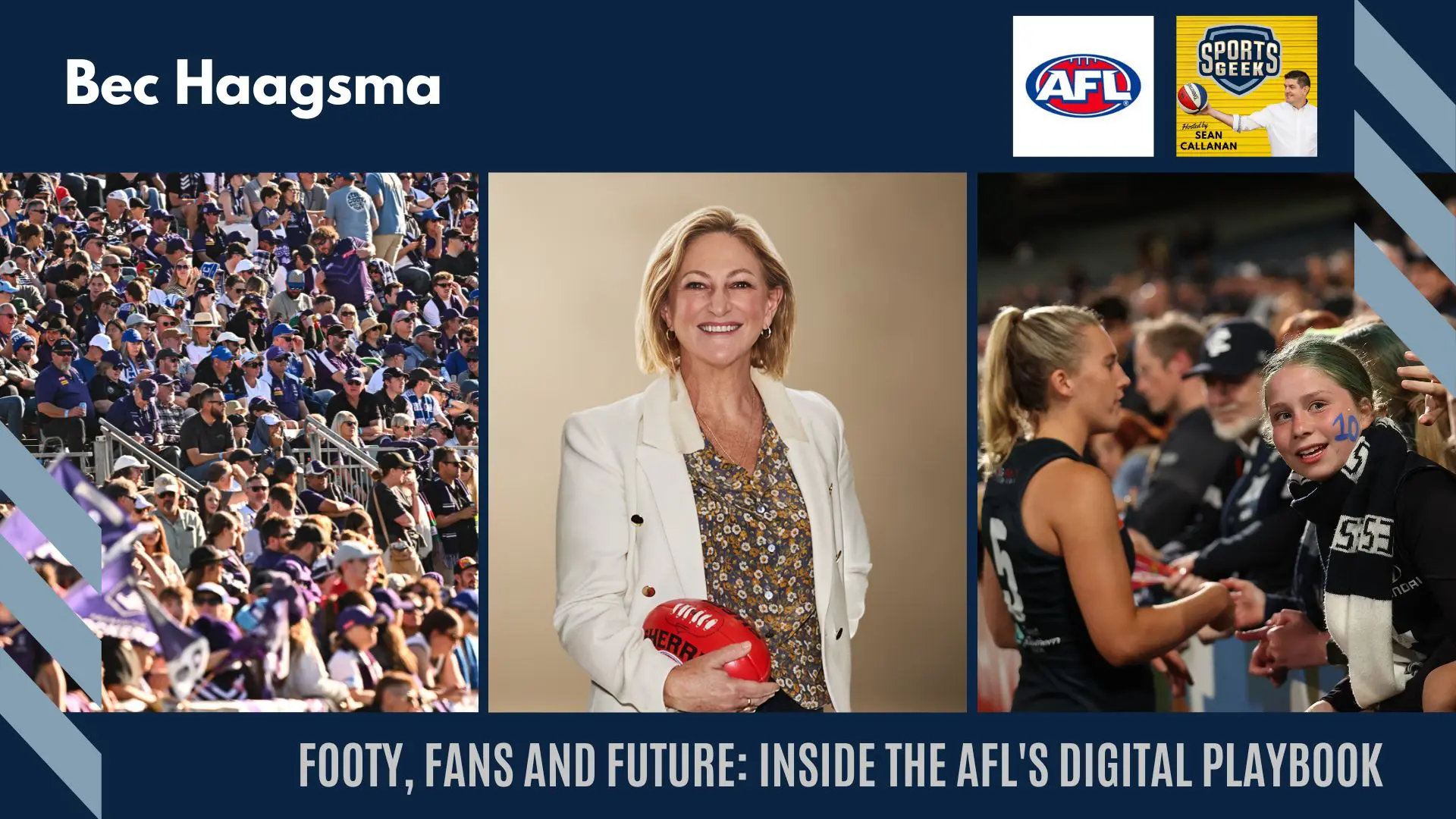
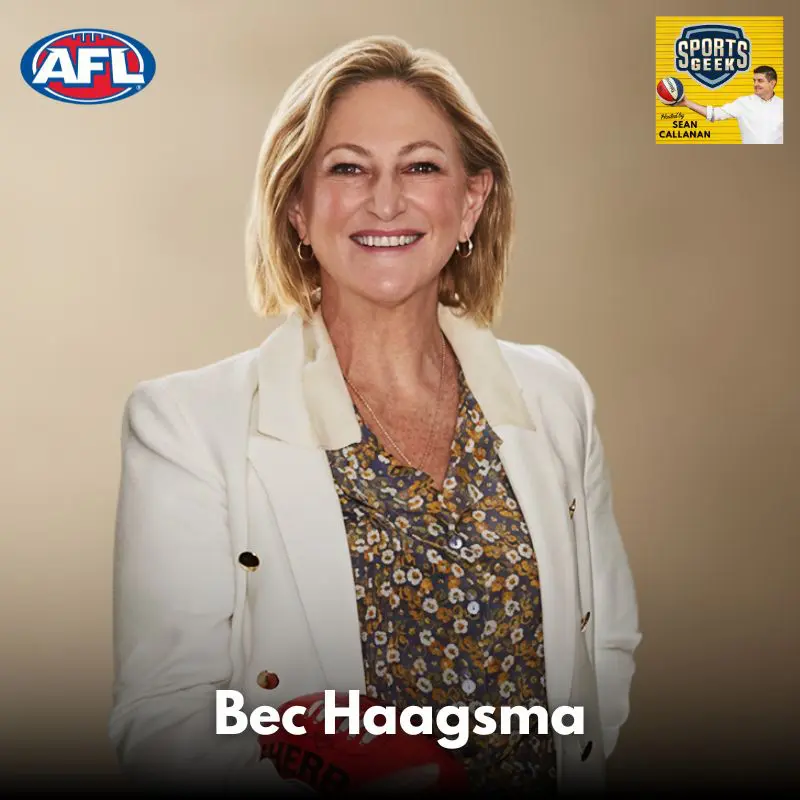
In episode 454 of Sports Geek, Bec Haagsma brings a rare cross-industry perspective – from museums to digital publishing, streaming and telco, and now leading customer, commercial and technology at the AFL.
In this conversation, you’ll discover:
- Why you need “a season, not a 90-day plan” to truly understand a sport or league
- How to get crisper about which fan you're building for – and why content for everyone becomes content for no one
- How the AFL used a creator watch-along (an Australian first) to reach audiences someone else already owns
- Why consolidating product, fan and technology under one roadmap kills silos and sharpens investment
- How to roll out enterprise AI responsibly – investing in training over tools, and setting up AI champions across the business
- A practical, emotional AI use case: bringing the AFL's historic photo archive to life to build fan belonging
- The honest state of play for women in tech and leadership – the progress made and the work still to do
Listen to Bec Haagsma on Sports Geek
Can't see podcast player? Click here to listen
Watch on YouTube
Interview Transcript
This transcript has been transcribed by Riverside.fm, no edits (please excuse any errors)
Sean Callanan (00:02)
Very happy to welcome Bec Haagsma. She's the EGM of Customer Commercial and Technology at the AFL, otherwise known as the Australian Football League. Bec, welcome to the podcast.
Bec Haagsma (00:13)
Thank you, great to be here.
Sean Callanan (00:15)
Well, I always start my podcast trying to figure out people's sports business, origin story and how they got into the world of sports. what about yourself? H what was your first foray into the how did your career end up in the world of sports?
Bec Haagsma (00:29)
I am.
first sports admin role here at the AFL, but I had a lot of history when I was working at Telstra, running the media portfolio there, worked very closely with the AFL there, the NRL, Australian football and netball. We ran a year long program for fans and audiences with live streaming products at the time before KO existed. So had a lot of exposure there, but I'm a lifelong fan of sport and participant in sports.
always very keenly interested from the sideline.
Sean Callanan (01:05)
And you definitely c y you came from you know, even pr prior to Telstra, you're in that you're in that broadcast space, you worked at you worked at nine, and then and then at Telstra, so obviously when you're on the broadcast side and then you're in yeah then you're in a telco side, you can't really avoid sport in in Australia, can you?
Bec Haagsma (01:23)
No, and I would probably say wasn't in the broadcast side. I was lucky enough to be on the digital side of businesses. So I started, I actually started my career in museums. you logical step to sport from a museum, but,
Sean Callanan (01:37)
Hey, so so did I. My first my first job
was at ScienceWorks, so yeah, yeah.
Bec Haagsma (01:41)
wow, how cool. So
I was at the Historic Houses Trust of New South Wales and instrumental, I was the second employee at the Museum of Sydney which opened in 1996 and museum experiences are all about connecting with people and telling stories and so sport, right? So all through that journey and transitioning into publishing in the digital space, when I went to Nine, I set up what was called Nine Jump In and is now Nine Now.
So we became that streaming vehicle to allow even more Australians to connect with sport and you can see some of the incredible numbers that streaming platforms now drive and opportunity to open up anywhere anytime experiences for fans and audiences. yeah, I was sort of really at that transformative intersection I think of both print publishing and then television broadcast as they moved into the digital age through my career and I
I'm not a fan of saying I was lucky to be somewhere because lucky is winning Powerball. But I think maybe I was a little bit lucky with how old I actually am because I just sort of hit my hit roles and hit industries at a time of where transformation was needed and had the skill set to be able to either participate in that transformation or lead it.
Sean Callanan (03:03)
And yeah, I I agree with that luck piece. It is a matter of getting your skill set and having your skill set ready at that right time and you know, even though I said, you know, nine and telco are media and that you've very much been on the on the technology side and the product side and that early streaming piece.
Bec Haagsma (03:20)
Yep.
Sean Callanan (03:21)
like what was 'cause, you know, I I remember those days when, you know, streaming was just coming on board and and broadcast was still like really much over the air as the main thing.
But then you also needed to make sure the infrastructure was there to to d to deliver it. So what was it like, I guess, on the on the tech side as a as a product and technology officer in that space?
Bec Haagsma (03:43)
Yeah, interesting. Every single day is different.
And the challenges are always different. so, I mean, I think that's what keeps us all engaged on the inside when we're working in the industry because we're still today finding new problems to solve and things that, it's a complicated space. And I think when you're moving and transitioning businesses from a traditional format into a digital format, people think it's faster and easier, but it's actually very complex. And when you're dealing with a board
in a C-suite who are like well you know it takes ages to print something or to create a broadcast product just plug it in and put it on a screen how difficult can it be but I distinctly recall a holiday I was on years ago I was in a botanical gardens in Lucca in Italy it was a very special birthday for my husband so he did not want me working and we got a priority one tech alert we had an issue with a stream that many many people were watching and the issue
was actually related to the load for the login into the service and so I'm sitting in the botanical gardens in the war room trying to pretend, I don't know what I was pretending I was doing, looking up floral species maybe to put my husband off the scent and you've got people clamouring from all sides going well you know like we've got to let people in, how complex is it and we all know those of us that work in the tech space that finding a root cause of something is incredibly, it's a
It's a real maze and I think that's challenging at times and complex but it's incredibly interesting and the people that you get to work with are incredibly intelligent and clever and have all sorts of different skill sets. So you have to surround yourself with so many different kinds of skills and people and a real diversity of talent. And so it's incredibly exciting to be a part of it and always has been from that. still remember, I think it was 1999, I was working at Reed Elsevier,
publishing global B2B publisher and I remember one of the engineers said, has anyone here heard of Google? Like we should give it a try as a search engine and like that's, know, it feels like it was five years ago, it was obviously a long time ago, 27 years ago and just that moment of finding something new and always exploring. But the challenges for us here too in Australia in a tech perspective are, you know, we're constantly trying to find ways from a streaming perspective to have access to the right amounts
of storage and the right delivery and the right service from our providers to enable an experience that is second to none. And geographically sometimes that's difficult too. So lots of different things to deal with and stakeholders to
Sean Callanan (06:33)
And s
Bec Haagsma (06:34)
manage.
Sean Callanan (06:35)
and so that you know, sort of go back that on that luck piece, like those experiences both with Nine, you know, with Telstra, building out building out mobile apps and and digital experiences for multiple sports as like as new phones come out every every eighteen months and new opportunities and and new builds have to happen. Was that sort of the perfect, I guess, background?
to your role now at the at the AFL.
Bec Haagsma (07:05)
Yeah, definitely. Let's be super clear for you and all your listeners, Sean. I am by no means a technologist. My degree is in political science. I'm a humanities person. History and literature are my sort of home ground in EPUB trivia. But…
But that said, I think a very, very strong grounding in product and product delivery. And of course, that means you need to understand the tech well enough to get there. And so, yes, for the AFL role, think it's interesting because I manage the commercial portfolio, the events portfolio, the content portfolio, as well as technology and product. But if you think about where we are today in 2026 and where we need to go, what we need to do to attract
a new fan and what we need to do to make sure we're servicing our avid fans is provide them with an experience on every platform that is seen. They don't care, they don't care the complexities behind it all. They just want what they want when they want it and we have a job to do to find new fans and a lot of that job starts in a social media feed really. It starts in a feed and that's where the funnel really opens up for us. So coming into the AFL, I'm not from Victoria.
I'm not a traditional AFL, I'm a woman, I'm a grandmother. So I probably don't fit the bill, but I really fit the bill in terms of the background of attracting audiences, retaining them and using our digital platforms. We have millions of people a week visiting us on our digital platforms and what we do with those and how we build that connected future for the AFL is really important for us.
Sean Callanan (08:50)
absolutely. I don't think I think you are a technologist because the best technologists can actually talk to the geeks. Like there's a lot in that translation. So understanding the tech, but able to talk to talk the tech, but then also be able to talk to the business and say, Here's how they b like that's the best skill of a of a technologist. Abs
Bec Haagsma (09:09)
The translator. Yeah.
Sean Callanan (09:11)
ab absol absolutely. And and really from a sports point of view, we're all in the audience business. We're all in the how
Bec Haagsma (09:17)
Yeah.
Sean Callanan (09:17)
to how do we reach new fans. So
You came into the AFL in in Feb twenty twenty twenty five, as you said, sort of an outsider, you know, from an from an AFL point of view. What what was your first sixty to ninety days like in trying to understand the organization what they'd what they'd tried? You'd obviously seen things from the outside as a as a partner with Telstra and and seeing things
Bec Haagsma (09:40)
Yep.
Sean Callanan (09:41)
from the outside. What was it what was your first sixty to ninety days like?
Bec Haagsma (09:45)
Let's say a couple of things to clarify. Always been an AFL fan. It was the first sport I sort of connected with and knew as a child. And so I didn't have to learn the sport, which was good. Although I do remember my first, I think on day two, was a commission meeting and sitting inside an AFL commission meeting as an AFL exec, I felt pretty, it was a really privileged place to be and the conversations around footy, we were going into the, for the first time in a long time,
stars game over in Perth to open the season up. So my first 30 to 60 days were experiencing
and a product in All-Stars in Perth that was like nothing I'd ever experienced before. Incredible connection to First Nations people over in WA and to the game and some incredible moments pre-game. So felt really, really privileged to be in that situation as an incoming fan, but very wary of being, you having those fan headlights on and coming in professionally. A real assessment of
what was our product suite. I was also pretty familiar with the digital product suite having run it from the Telstra side of the business about eight years ago but obviously a fair bit of time had gone by in that period and so I spent my first year let's be honest I'm not going to say it was 60 days getting around the business of 18 soon to be 19 clubs
Vendors commercial partners the AFL organization in and of itself and attending as many games and being with as many fans as I could possibly be with so I Don't think my feet touch the ground So it wasn't like a traditional first 90 days I remember I went back to nine from Telstra so I'd spent seven eight years at Telstra and then went back to nine and Had a pretty pretty traditional 90-day plan get you know get reacquainted with the business some clear goals
and this is what I'll achieve in 90 days.
the breadth of the AFL across Australia and understanding the different markets, sorry, starting to understand that I needed to understand very different markets, very different clubs, the technology landscape across the clubs is, and the fan landscape is obviously different club by club. And then experiencing a game at many different venues on many different digital platforms.
You need a season at the AFL and maybe at every sporting organisation. You need a season, not a 90-day plan, I think, is what I learnt.
Sean Callanan (12:25)
absolutely and you've already sort of touched on the I guess the different fan segments. You've got the you know, the rusted on fans that go every week, you know, like myself, the you know, my great grandfather played for Collingwood, I didn't have a choice, my son didn't have a choice, and then you've got these newer segments of of of fans coming on board and you've got you've been charged to keep those happy and also keep getting new ones. How do you how
Bec Haagsma (12:48)
Mm.
Sean Callanan (12:48)
do you tackle that you know, across your role and across all the channels that you've got available?
Bec Haagsma (12:54)
We tackle that with data and with a rigor and a discipline around.
our understanding, our building of a fan segment model and anyone who's running a business would have one of those but being really clear around the work that we're doing and so we're starting on that journey, we're on that journey but getting crisper and more disciplined about that journey is a key focus of mine at the moment and I think one of the things that we've done, we've been able to do for a long time is we do a great job of catering for the avid fan.
We have an amazing app experience that if you want to go in and watch the Pies against North Melbourne this weekend or that Carlton Collingwood game that's coming up in a few weeks, that'll be an absolute cracker for you and track every player, every piece of… you're great. But if you're my granddaughter, who I took to a Giants game the other weekend, is now an avid GWS fan, she's just also learning how to do maths, how do we help her on the beginning of her journey, understand how our scoring works? What's the…
what's the link in for her her mum and dad and her sister to start to start their fandom journey and then what's the journey for someone who's kind of in the who dips in and out of footy at times and so we would have seen we would have seen a lot of new fans coming in through lots of different podcasts and social media this year we've been working with Dan Gorange a lot we did a really good pace with Fremantle Sydney game with Dan and a watch along and so those fans that hook into
that and that then and how do they continue our journey we have to be led by we have to be led by our data and our understanding of who's in that funnel and how do we move them along and when if we succeeded what are our metrics for success as we move along is that followers is it a deep engagement and belonging and how do we measure that they're things that are critical to every action we take in the next couple of years
Sean Callanan (14:56)
Yeah, absolutely. I mean I was I was gonna touch on that. We're recording this the day after the the Dan Goringe watch along, which is the second time they're doing a a popular YouTuber and and social and and podcaster, sort of like delivering footy differently is what is sort of his his point. Was that really that pie piece of well that's where a whole bunch of our fans are, they're they're consuming it with Dan. We wanna we wanna figure out way to I think the term
Hutchie uses is pinch audiences. How do we go over and and and talk to
Bec Haagsma (15:27)
Yeah, yeah.
Sean Callanan (15:28)
that audience? Was that sort of part of that I guess that strategy to engage someone like Dan Gorange?
Bec Haagsma (15:32)
Yeah, definitely. mean, we had a Australian first last night because we had a watch along with Dan, but we also had the light. We had with very big thanks to our partners at KO and at Seven, we had the live vision on the screen with Dan. So it was a first for Australian sport to do a watch along in that way. And absolutely, like, you know, our ultimate goal is to get people to love the game and to attend the game and to watch the game on a screen live.
and ignoring that audience that comes in through YouTube or through social because they're in a different place and someone else owns that audience would not be in our best interests. And to be able to tap into that audience and to be able to work together with creators and influencers.
to drive, who ultimately all love the game and love the sport and want to introduce more people to it is just something that we're really passionate about. You will have also seen last night, for instance, he had some special guests on and at halftime he had Patrick Beech in the studio
Sean Callanan (16:38)
Yep.
Bec Haagsma (16:38)
and we thought about, so, you know, I don't know if we would have done that a year ago. I don't know if we would have said, let's cross over with another sport. Like, let's stay in our lane and what's our lane? But having Patrick Beech come on board and he plays for Melbourne City when he's here and
and he talked about talking about footy when he came to Melbourne and he was like yeah the the rabbit ohs and his teammates like mate you need to pick a team and you need to and so he's a Western Sydney boy and he talked about GWS and his fan and there and that's great like it's it's you know rising rising ships tides that saying that I never get right that's it
Sean Callanan (17:11)
Yep. ab abso no exactly. Rising tides lift all ships is the exact is is the exact thing and
and it is a case of like we've sort of seen that in other sports like the NBA is very much you know, really pushes its creators out there and gives them access and and really but also the the conversation has to happen with your partners like Seven and KO that have, you know, paid for the ride for that for that match vision.
Bec Haagsma (17:35)
Totally.
Sean Callanan (17:36)
you know, it's it's
getting, I guess, their heads around it and also the legals and all of that kind of stuff, but to say, Hey, we this is a new audience, th they will be they will be tuning in. They might they might slide and sit on the couch with their with their parents or they might become a new subscriber or, you know, they will only they will only watch via seven plus. those kind of things. It's a real I guess whole of industry sort of understanding to say, you know, there is there is more out there and
you know, opportunities via via these new channels.
Bec Haagsma (18:08)
Yeah, I mean, we have.
We have fans from those that don't even know about our sport yet because maybe they've just arrived in Australia or maybe they're like Elka, my granddaughter, who's just starting to become aware. And then we have fans who tap in and out and then we have avid fans and all of those things in between. And our job and my job is to make sure we're catering for every single one of those at every single point in the ways that we can. so we're developing a suite of product that will increasingly do that and connect to fan all the
along and then that data that plays that role in how do we convert just like in any other industry you know conversion retention attraction is is the sort of discipline focus that sits underneath all of the creative things that we're doing at the moment.
Sean Callanan (18:55)
And so we've been discussing a lot around the digital and broadcast piece, but you've got a lot of a lot a lot of folders in your portfolio. one, how do how do you manage them all and how do you like help them intersect and and help one another?
Bec Haagsma (19:10)
Yeah.
That's a big question that I ask myself across season one. How do we manage that and how do we bring it together? How do we make sure that we don't have silos where people are doing great work and pursuing great prioritisation and roadmaps, but are they actually connected? And so we've actually, I've actually recently just made a change where I'll connect all of the portfolios together. So product, fan and technology will be connected together under one leader in my organisation.
and those organisations will come together with one roadmap and that'll mean some pretty tough prioritisation decisions but ultimately it means we're directing our investments and our efforts with a lot of clarity and one clear set of goals and we're seeing a lot of organisations bring that kind martech view, that technology view, that backbone of what drives that fan engagement and the fan piece and the customer
piece all into one portfolio and so we're heading
Sean Callanan (20:14)
And and the sorry.
Bec Haagsma (20:16)
that way.
Sean Callanan (20:17)
And the and the fan remains like the North Star. Like we we want people
Bec Haagsma (20:20)
Perhaps 100%.
Sean Callanan (20:22)
to consume it. We want them to come to a game. You know, and and in the AFL's terms, you know, membership is a big thing. We you know, if you say you're a member, like your data says, Hey, people lock in, that's pretty much
Bec Haagsma (20:34)
Yep.
Sean Callanan (20:34)
your look your roadmap to say how can we get that person to eventually be a be a member?
Bec Haagsma (20:39)
To
be a member, to play, watch or go is really kind of the things that we think about. And our strategy at the AFL is now, is very clear. It's bucketed into footy fans and future. And so we use that as the North Star and the fans journey through footy fans and future sort of underpins all of that. And then the way I think about technology is it's the enabler of all of those things.
you run a danger sometimes, organisationally, in the way that you're structured, that maybe one of those things drives its own agenda and the others sit outside and you end up with investment and more of a scattering and less of a focused approach. So yeah, the fan is absolutely. But when we say the fan, we need to get crisper, all of us, every sporting industry and probably every industry when they say audience or customer, but we have to get crisper about which fan.
So when Ed Bowman who heads up our AFL digital network is talking to his team about creating a piece of content for afl.com.au or a social post on TikTok with our TikTok team or an Instagram post, which fan segment are we targeting that to and where's the conversion going to happen and when do we know that it's worked and when do we say okay we tried it, it didn't work, let's move on. Rather than maybe five, six, seven, eight years ago we might have just talked about the fan and we probably meant you avid
Sean Callanan (22:07)
Yep.
Bec Haagsma (22:07)
rusted on Piesfan.
Sean Callanan (22:10)
No, exactly. That that is the thing in you know, I when I'm talking to a digiteam, it is like a you can't produce a piece of content, it is for everyone. And when you do it just becomes for no one. And whereas if you say, this is for the avid fan and this is for the you know, for the for the new fan b you know, because as an avid fan you don't need to explain the rules to me or the scoring, but but for someone internationally or a new
Bec Haagsma (22:29)
Yeah, yeah, you're
probably very happy to explain them to me, aren't you, Sean? Yeah.
Sean Callanan (22:34)
No, I I'm happy to explain them to my friends in the US and and and America. So like you know, I think there's
a lot of AFL fans that are that are advocates in that in that sense. But it is really
Bec Haagsma (22:43)
Yeah.
Sean Callanan (22:44)
important to go, you know, and again you always get the some fans complaining about s you know, certain things. It's like, well it's not for you. It doesn't have to be for
Bec Haagsma (22:51)
Yeah.
Sean Callanan (22:51)
you. You don't have to consume it. and so it's sort of that that that piece. On the future front and on the on the technology front, obviously AI is looming large and and getting bigger and bigger and
And the opportunities in that enablement space. How do you how are you looking at it and and looking at some of the opportunities and also making sure things are protected from a from a cybersecurity point of view?
Bec Haagsma (23:14)
Yeah, so we are currently rolling out enterprise AI for all team members at the AFL and
we did a lot of work to sort of get to this point and a lot of thinking. And so we have an AI steeco at the AFL and on that steeco is myself, Walter Lee, who's the head of strategy and data and our people and culture EGM as well, because it's really, it's so much of AI for us is about our people and enabling them to make sure that they have the skills that they need to do their jobs and to be, you know,
valid in the workforce of today and tomorrow.
And so what we see AI doing for us is many things. Like I recently went to the US and attended a couple of conferences. AI note taking is thank you for whoever developed all of those different tools. it's so great. I wondered if it would, for instance, make me less focused in a conference environment. It made me more focused because I wasn't worrying about capturing that note and thinking about when was I going to type up my notes and what were they going to look like. I really digested the information.
more and I came back with so much more information that I would have that I can easily
represent in different forums with the right relevancy. So that to me is a great efficiency that AI provides to me as a worker. But it also enables us to do things that we talk to a lot of partners that we have across the board around their use of AI before we made our commitment. We're investing probably a lot more in training than we are in the tools itself and finding the specific tools that we need as we go through the journey with our people about where those efficiencies are. But we work with our partner Telstra a lot
on our digital platform for instance. So introducing an AI companion into our digital experiences is a bit of a no-brainer. So how do we make it easier for people to find the things that they're looking for in our platforms using AI will be something that we incrementally roll out on the platform starting at the back end of this year. And everything in between, the use of AI, mean, it's there and has been there. mean, AI is data, right? So it's been
Sean Callanan (25:30)
Yep.
Bec Haagsma (25:30)
their champion data obviously provide a big part of the
ecosystem for sport and for the AFL and so match stats and data and the ability to crunch that data and to look at it but you can imagine all the realms across the sporting organisation where AI will be useful but AI, you know, everyone's having this discussion around the dinner table, around the workplace.
and responsible use of AIs, the governance and the principles with which we use it at the AFL are really important to us. Setting up AI champions across the organisation.
is something that we're really passionate about and that many of our people are passionate about being and learning from each other. I think the more naive use of AI or the early adoption of, help me plan my holiday or my diet through
Sean Callanan (26:25)
Mm-hmm.
Bec Haagsma (26:26)
to those personal use cases. I worked really hard on those conference notes that I mentioned. I captured them.
put them into a format that I felt happy with. I probably spent five days prompting and setting it up in a way that I feel confident I can now use really efficiently. So it's not a, give me a recording and I'm done and here you go, I'll present a slide. There's a lot of work and brain power from each of us that needs to go into the responsible use of AI in our view.
Sean Callanan (26:59)
yeah, absolutely. I just got back from from seat in in Charlotte and yeah, all the way through the conference I was just chatting with my agent to take all the notes of all the things that to follow up with, when previously that just would have been a a handful of business cards, not that people have business cards anymore, and me
Bec Haagsma (27:15)
Yeah.
Sean Callanan (27:15)
trying to remember, what did I talk to him about that? So, like
Bec Haagsma (27:19)
Yeah.
Sean Callanan (27:20)
it was about me, you know, improving my experience there to be able to get to get more out of it. And yeah, the it it it is a bit of a
I think it is a superpower for your staff. It's it's one, you can give them the tools, but you know, we've had tools for many years. It's like how do you go about using the tools? What's the best
Bec Haagsma (27:36)
Yeah.
Sean Callanan (27:37)
way to use them? is is the e easy early is the e easy early lift.
Bec Haagsma (27:42)
Yeah, think also, you know, it is…
It is, I'm old enough to remember pre laptop workplaces and some people had laptops, some people didn't and then, I mean, can you imagine not having access to a computer or a laptop in the work that we do today? And so I think that fear of what AI will do, I mean, it's a very rapid industrial revolution though, that said. So another evolution and revolution of
curiosity and learning in a career space which is interesting and then we just need to lead responsibly through it. I think is the key
Sean Callanan (28:26)
Yeah, absolutely.
Bec Haagsma (28:27)
for us and find the benefits and really be aware of that as we move through and adapt and iterate.
Sean Callanan (28:35)
I mean, we're both in the you know, the way I've described it and we've both been through these revolutions, but that that first one was the web and everyone finding the web and figuring out how to use the web. And then the you know, I started Sports Geek at the at the start of that social media, what do these platforms do to us, how do we reach our fans? And we've you know, and that vastly changed b it changed businesses, it changed the way that you talk to fans. And I think the AI revolution and the way it's going to is gonna have that same sort of transformation both
in the way you do your job and and that kind of thing, but also how we, you know, communicate with our with our fans.
Bec Haagsma (29:11)
Yeah, I think my sort of last point on AI, if we're going to move on from it,
Sean Callanan (29:15)
Hmm. Mm-hmm.
Bec Haagsma (29:17)
is, you know, think a big part of my job, it's growing the fan base, of course, and ensuring the fan base is there for the future of footy, but it's also deepening and creating a sense of belonging and an attachment to it. then I go, OK, well, how does AI play a role in that? One of our photography team, and you know, the AFL has this amazing photography team and archive, recently showed me this piece where they
gone back into the archives and the ability to sort of bring to the fore these beautiful historic images of a young Richmond fan, this young girl, you a hundred years ago, yeah, we can retouch those photos but actually we can make them come alive now through the use of AI and it's a beautiful, like emotional connection moment. I'm not even a Richmond fan and I got a bit teary
Sean Callanan (30:05)
Mm-hmm.
Bec Haagsma (30:05)
looking at it and going, wow, the power that this gives us to be able to create a moment
connection with the past and something that makes you think about sport as this permanent thing that is a real life, in real life experience and always will be, that is unpredictable. It's the best piece of reality TV you could ever commission and yeah and then we can also connect you with the past through the use of AI and create a sense of belonging and engagement in a way that we wouldn't have been able to before AI is beautiful. It's so powerful
Sean Callanan (30:38)
Yeah.
Bec Haagsma (30:39)
and really emotional.
So that's a great use of AI and will continue to be and a beautiful story for the fan.
Sean Callanan (30:51)
absolutely and and the fact that you can put those layers over the top of your current tech stack and your storage, like just the finding that photo is normally a human thing. It's like, Barry, our historian knows that that photo's there and he goes and finds it and he knows where it is. Whereas, you know, as we get to a point where you know, we can say, give us photos from the seventies that fit this and it goes into your archive and finds it,
Bec Haagsma (31:16)
Yeah.
Sean Callanan (31:16)
like then it allows your creative people to to do amazing creative things.
Bec Haagsma (31:20)
Yeah. Yeah, that's right.
Sean Callanan (31:21)
But if you can't find it, you can't do it. And so like
that's where I think that that unlock is gonna be, you know, amazing for for for, you know, sports teams but but for everyone to be able to go, we've got that resource somewhere, we can find it now.
Bec Haagsma (31:34)
Yeah, the scale of what we can do and to your point the queries that we can now, know, the questions we can ask of the material that we have and as you know, as data storage scales and allows us to do that, it's incredible, it's really exciting.
Sean Callanan (31:54)
So you've been in the in the world of media and tech and now sport for for over twenty five years. as a woman in tech and a woman in leadership, you've seen you would have seen some progress. but what one, what progress have you seen and what work is still to be done?
Bec Haagsma (32:11)
Yeah, I don't know if the work will ever stop, it's a hard question to answer because there's some great examples of loads of progress.
And then there's examples where I go, can't believe this is still happening. So recently a friend and colleague of mine in a different organisation texted me from somewhere in the US and said, I just had to text you, I can't believe this. I'm hosting a meeting.
with a partner over here in the US and I'm with two of my male colleagues, she's female. The guy we're meeting with said, are you the secretary? Have you come along to take notes? And you're like, no, she's leading the meeting. so that's unbelievable to me that that still happens and that is just a part of life. But equally, equally the…
The number of women in our organisation is strong. We are 50-50.
Sean Callanan (33:15)
Mm-hmm.
Bec Haagsma (33:16)
The number of women on our exec team is strong and we are evenly balanced. The number of conversations that I'm in…
in telco, in media, in sport, traditionally male dominated, increasingly meeting with female CEOs, female leaders, and male leaders who are very, very cognizant of the opportunity that they have to lead a diverse workforce and to encourage diversity across the board. So as I've gotten older as well, you become more aware of a range of different diverse opportunities and challenges that we face in the workforce, not just gender, but also
I often hear is that person too young for that job? I think imagine if someone said to me, I'm not sure you might be too old for that job, how I'd feel. so it's both end of the age scale, by the way.
Sean Callanan (34:12)
Yeah.
Bec Haagsma (34:13)
And so there's just, I just think we just have to stay super aware as leaders and as participants in the workforce and look around us and ask ourselves the question, are we ensuring that we're making the opportunity the right opportunity for someone
who's from a different background, so maybe you're not from footy. My favourite quote about footy is, went to this school and I'm of this gender and so I'm applying for this role because I was born for this job at the AFL and I'm like, went to Coffs Harbour High School, I'm a grandmother from Sydney and I feel like I was born for the role that I'm in now and that's not what those other people are saying that think they're ready for the role. So we just need to make sure that we're open to people with the right, you know, we need capability.
that sit across the scale and we need…
we need every kind of skill set in the business and that comes from a diverse workforce. It doesn't come from a workforce that all looks the same and we're all responsible for that. you know, as a female leader, I've got four daughters who are now also in the workforce and I look at the journey they're on and some of their experiences. so I'd love to say, it's totally changed. It's completely different. You know, it's just, it's an even road for everyone, but it's just not. We have to be aware of pay gaps. We have to be aware
of opening the door, we have to be aware of the perceptions like I said at the beginning of this question that are in the room and you have to sometimes I'm like should I have spoken up then or shouldn't I? Maybe it's in a social setting or maybe it's in a work setting and I think it's always the right thing to do if you're promoting equity.
Sean Callanan (35:54)
Ab ab absolutely. And other than calling it out calling out the rubbish that you got i got in the text, what advice do you have for listeners to help champion that, whether they be, you know, old white guys like myself or or or or or people, you know, people of diverse backgrounds trying to work their way into the industry?
Bec Haagsma (36:15)
It's, mean, it's just that constant check on your bias, like constantly.
I'll often say I've got a conscious bias and then I'll be like, well, I'm saying it, but it's actually unconscious because I had to pull it out and claim it in that way. And yeah, I think it's looking around the room going, or looking at that panel and going, hang on a sec, what's happened here? We're all of one gender on the stage or we're all of this experience. So we've just put that working group or that steer group, steer co together and everyone's got 20 years experience and they're from the same
suburb or of the same gender and it should just be a constant question. Maybe AI can help us with that Sean, maybe there's some agents and some prompts that actually bring it right to the front because sometimes you like you get there but 10 steps too late.
Sean Callanan (37:09)
So so yes it could, 'cause it does like we said, it does give you that superpower, but I've been reading a a a book on AI and you've also got to be mindful of the biases that AI has for the data
Bec Haagsma (37:22)
Yep.
Sean Callanan (37:23)
that it's ingested. Like if it's ingested a lot of content and it's come from a male point of view or a certain point of view, that's that's
Bec Haagsma (37:30)
Yep.
Sean Callanan (37:31)
what it's gonna re report back. So even that tweak of you know, it it it gives you your analysis of the fan or the project or the product.
Like going back to the going back to the prompt or going back to the LM and saying, you know, does this cater for a br a diverse group or, you know, have you looked at it from a diversity point of view is still a question you still gotta ask ask AI.
Bec Haagsma (37:53)
Yeah, yeah. think the other, and the other angle for us at the AFL is, you know, the AFLW competition is now into its 11th season. And we, when we think about fandom and everything we've been talking about, there's the fandom funnel and the fandom scale, and it's different for AFLW, and that's actually, so the question actually we asked and we spoke to a lot of sporting organisations in the US about is, should the fan funnel be the same, should you try to replicate the men's in women's,
or not.
Actually fandom in the W game, it's player led across all sports but very player
Sean Callanan (38:31)
Yep.
Bec Haagsma (38:31)
led in W and allowing and encouraging and sitting in that sense of we want W to be bold and we want the players to be bold and we don't want to constrain that. We want them to be who they are and some of them might want to be bold and some might not want to be bold and that's okay and freeing up and having a different lens to how we approach fandom.
the brand of footy that sits in W is also important as well and it's complex to negotiate creating something that from a brand and a fandom perspective, it's not a cookie cut of the same thing that's been happening for 150 years and making sure that you're respectful of the athletes and the code and driving growth and athleticism and fandom
in a maybe a different way, not because they're women, but because the fans of the game are coming from different places and are in some ways more diverse, is a really interesting and exciting opportunity for us.
Sean Callanan (39:41)
absolutely, but like how has like you've been in the AFL now for for obviously on the side but now internally, like relearning how to do that when you've had a hundred and fifty years of this is how we've done it and this is what's worked and look at us how well it's gone in the on the men's side, how's that transformation like 'cause it's a bit like baby giraffe walking. You've you've got to learn to walk again because it is, you know, you've sort of gonna say, we are gonna have this as a clean slate either
Bec Haagsma (40:08)
Yeah.
Sean Callanan (40:08)
because this is what we want to do or
these are the fans that are coming and they don't fit in this model. They just get stuck because they don't they don't fit. How's
Bec Haagsma (40:15)
Yeah, yeah.
Sean Callanan (40:16)
that learning and I guess changing of behaviour been for W? Because I think it's I think it's happened with AFL W and a lot of the W sports and the women's sports in internationally in here that it that it is a different model and the fandom journey is different. How hard has
Bec Haagsma (40:33)
Yeah.
Sean Callanan (40:33)
it been or that transition period to get the org, you know, to get the AFL to change its behavior a little bit to understand that?
Bec Haagsma (40:40)
I think I'd say my one word summary of it is it's exciting. it is,
because you have to go into a slightly different gear and lane, but it's a really exciting one to be in. Women's sport is on a huge growth trajectory globally. So that's how exciting to be here in season 11 and to know that we're moving in a trajectory that looks like this. And to know that we're in an age and a world where sport is an entertainment product and this product is led by the game, but also by culture.
by fashion, by music. So bringing those elements in is really exciting and Laura Kane is an exceptional leader of AFLW and exceptional executive and and her you know she's in the embracing of let's just go for it like let's not let let's absolutely go for this and what that means and the opportunity for us to offer this growth opportunity to what is the
largest playing group in women's sport in the world. AFLW has over 540 athletes that are part of the professional ecosystem which is bigger than any other sporting league in the world. It's incredible. So it's exciting but yeah it's hard at times and challenging and we have to check ourselves and you know there's a sort of like should we really be going with that? Like it's easy it's easier to go the other way so it's harder but harder things generally give you a better results and they're more exciting to be part of.
So keeps you fresh.
Sean Callanan (42:20)
absolutely. I normally finish by asking what's excited you over the next eighteen months. I think you answered a lot of it there with with with what W but looking at both W and your and your broader role, what does excite you over the next twelve to eighteen months and what you what you've got in your roadmap?
Bec Haagsma (42:35)
I think being halfway through season two for me at the AFL and having a clear vision, strategic vision, Footy fans future, and then in my own portfolio of customer, consumer and commercial and technology, being really clear around our vision to unite the fan and technology and marketing piece now, having done a fair bit of work in the content and digital side at the back end of last year, I'm excited that we're set up organisationally to now
start to really deliver different experiences for fans and starting to see them roll out.
I'm a Swans fan so I was going to say last night's game was pretty exciting up until the last little bit. So excited to see where the season goes for men's and then the England, the Australia Island game. The World Cup's got me all confused about
Sean Callanan (43:28)
Yeah.
Bec Haagsma (43:29)
my sports. The Australia Island game, the first international for AFLW is going to be an absolute cracker at North Sydney Oval so can't wait to experience that in the crowd with the fans. Our chairman does a great job, our new chairman Craig Drummond.
has this thing, he goes out into the crowd, he goes to the official functions and then just off he goes and occasionally we go with him and I spent a lot of games on the weekends just sitting in the crowd not at a function and just watching that evolution that we're going to deliver for fans and the next iteration of what we do on the digital platforms like things like last night. I'm just excited to do it with the organisation set and the strategy set underneath us.
Sean Callanan (44:11)
absolutely. Well I wanna get to the sports geek closing five, Bec. Do you remember the first sports event you ever attended?
Bec Haagsma (44:18)
So I was like, I can't remember which one it is. So my dad was a professional runner. So we used to travel all around the country going to gifts, but he also
Sean Callanan (44:26)
Yep.
Bec Haagsma (44:26)
played footy for Eastern Suburbs in Sydney, Eastern Suburbs Bulldogs at Trumper Park. And I distinctly remember I was about three or four waving the red, white and blue paper streamers for dad. Hopefully he was playing in a grand final or maybe it was just a normal game. So was either that or attending the Coon and Barabarang gift watching dad run.
Sean Callanan (44:45)
terrific. and you would have been a lot of sports events in your time. do you have a favorite food or a a go to food at a sports event?
Bec Haagsma (44:54)
So I'm very happy that food has evolved a lot at sporting events, so I'm a bit of a protein freak. And so now my go-to is a chicken and chive dumpling, which most venues do either through a food truck or at venues now really, really well. So used to be hot chips, but then I got older and had to rely on protein more.
Sean Callanan (45:13)
yeah, absolutely. And and and we are thankful that food has evolved all you know,
Bec Haagsma (45:17)
you
Sean Callanan (45:18)
at at sport. what's the first app you open in the morning?
Bec Haagsma (45:22)
Okay, this is going to live up to my at Werdel. I'm a Werdel freak still. So I open up
Sean Callanan (45:28)
That's
Bec Haagsma (45:29)
my Werdel and my mum, my husband and I compete.
Sean Callanan (45:33)
so what's your streak up to?
Bec Haagsma (45:35)
Oh gosh, so when I was in the US I dropped out, because you know when you're in a time zone it drops you out? So I'm only up to about 20 now,
Sean Callanan (45:41)
Yeah, you lose your time zone. Yeah, I know. That's the
Bec Haagsma (45:45)
but I've been going since 2022 I think.
Sean Callanan (45:50)
No, no exactly. That is a pain when you're when you're you know, you're happy to be gamified and and the and the d time zone breaks it for you.
Bec Haagsma (45:57)
Yet,
Sean Callanan (45:58)
is there is there someone that you follow, it might be a it might be a colleague, it might be an author, it might be someone online, that the podcast listeners should give a follow to and why?
Bec Haagsma (46:08)
I've got two faves at the moment and it changes obviously all the time but a constant for about the last 18 months, two years is Evan Shapiro. He maps the media universe, he's a cartographer
Sean Callanan (46:23)
Okay.
Bec Haagsma (46:24)
of the media universe and he is…
He's a predictor of the future of media and he has these amazing maps that look like maps of the world and if you look back over the last five years where the money is and where the audiences are in the media space and the role that sport plays in that I find him incredibly interesting. He's very very opinionated. He has no halfway with Shapiro and so E-SHAAP is one
Sean Callanan (46:52)
Mm-hmm. Yep.
Bec Haagsma (46:53)
to follow.
Sean Callanan (46:55)
Absolutely. I'll check I'll check him out. Sends a little
Bec Haagsma (46:56)
Kate, and my
other favourite at the moment is Sophie Cunningham plays for the Indiana Fever and I just love her vibe and her energy on her socials. I was lucky enough to go see them play recently. She was injured, Caitlin Clark was playing, but Sophie Cunningham and her pointing finger is my, I wake up in the morning and go, what's she done?
Sean Callanan (47:11)
Yeah, I will yeah, well that's that'll be the promo image for this podcast. It'll be Sophie pointing to this episode. we'll we'll we'll go with that. And then lastly
I always ask, you can put your AFL hat on and you can put your personal hat on, but what social media platform is your is your VP?
Bec Haagsma (47:29)
I'm an Instagram. I'm a prolific poster myself and and I just It would be my second opening of the morning word or and then a quick check of Instagram Whether it's to see what my kids are up to to follow what's happening sport overnight Although I'm not a snapchatter, but but I'm super interested in Harland the Norwegian players snapchat It's it's been pretty intriguing to watch the people fall in love with him over the World Cup and his snapchat
Sean Callanan (47:58)
Yep.
Bec Haagsma (47:59)
Snapchat is like really short and sharp and pretty cute so I'm tempted to venture to Snapchat just for that.
Sean Callanan (48:06)
Yeah, but the good thing is about it, Instagram, like all the stuff that ends up on TikTok or Snapchat normally ends up on Instagram anyway. It sort of seems to be the final
Bec Haagsma (48:13)
Yeah, yeah.
Sean Callanan (48:14)
the final landing place for mo for most. Bec,
Bec Haagsma (48:17)
Yep. Yep.
Sean Callanan (48:19)
thank you very much for coming on the podcast. I always ask people who listen who get some value to to reach out and say thank you. What's the what's the best platform for people to do that for you?
Bec Haagsma (48:30)
For me, you can find me on LinkedIn at Bec Hagsma and yeah, I think that would be a great place to connect with any listeners and yeah, happy for any feedback as well.
Sean Callanan (48:42)
Well, thank you very much. All the best for the rest of the AFL season with the with the finals coming up.
Bec Haagsma (48:48)
Thank you, Sean. All the best to you and your pies. And thanks for having me. Really enjoyed it.
Sean Callanan (48:55)
And I'd stop.

Turn 15 minutes a day into sponsorable content your partners will pay for
Sports Geek AI is a done-with-you content system that creates daily newsletters, podcasts, and social posts—giving your commercial team new inventory to sell.
Resources from the podcast
- Please connect with Bec Haagsma on LinkedIn. Let her know you listened to the episode. Please say thank you if you do connect.
- Head to AFL's website for more
- Give our new Daily podcast a listen – Sports Geek Rapid Rundown.
- Podcast episodes you should listen to:
- Throwback episodes you may have missed:
- Check out DanDoesFooty Watchalong discussed on the podcast
Podcast highlights
Highlights from episode 454 with Bec Haagsma:
-
- 01:59 Career origin – a lifelong fan who started outside sport
- 03:10 From the Museum of Sydney to Nine Jump In (now 9Now)
- 07:18 Has anyone heard of Google? – being early, at Reed Elsevier
- 08:34 I am by no means a technologist – a humanities leader in a tech role
- 10:19 Why the best technologists are translators
- 10:49 First days at the AFL – the All-Stars game in Perth
- 13:15 The big lesson: you need a season, not a 90-day plan
- 16:26 The Dan Gorringe watch-along
- 18:41 Rising tides lift all ships – collaborating with creators
- 20:40 Consolidating product, fan and technology under one roadmap
- 22:09 Footy, fans and future – membership as the North Star
- 23:37 Getting crisper about which fan
- 27:03 AI is data – governance, responsible use and AI champions
- 30:41 Bringing the photo archive to life – AI and fan belonging
- 32:20 Unlocking the archive so creatives can create
- 33:23 Women in tech and leadership – progress and the work still to do
- 33:41 Are you the secretary? – the story that still happens
- 34:58 A 50/50 exec team, and bias at both ends of the age scale
- 35:58 I was born for this role – reframing who belongs
- 37:45 The constant check on your bias
- 38:39 Watching for bias baked into AI
- 39:22 AFLW season 11 – player-led, bold, and unapologetically different
- 41:10 Relearning fandom for the W game (the baby giraffe)
- 43:48 What excites Bec over the next 12-18 months
- 45:40 Sports Geek Closing Five

Digital To Dollars is the five-pillar process pro teams and leagues have used for a decade to turn digital audiences into revenue, and it’s coming soon as a self-paced program. Those on the waitlist will get 20% off upon launch.
Listen To Sports Geek
Recent Sports Geek Reads
- From EQT’s €341bn Sports Portfolio to LIV Golf’s Bankruptcy and NFL Rights Unbundling
- Man City’s Guilty Verdict, YouTube’s Live Sports Strategy & Federer on Reaching Gen Z
- Man City’s Financial Scandal, Bucks Launch DTC Streaming & Disney’s Super Bowl Ad Strategy
- Purpose-Led Sponsorship, AI & Sport Tech, and DAZN’s Boxing Play
- Man City ‘Sham’ Sponsorships, Nike’s Global Reset & Purpose-Led IOC Partnerships
- Bundle Economics, Manchester City’s Hidden Billions & AI-Powered Basketball
Listen to Sports Geek Rapid Rundown daily