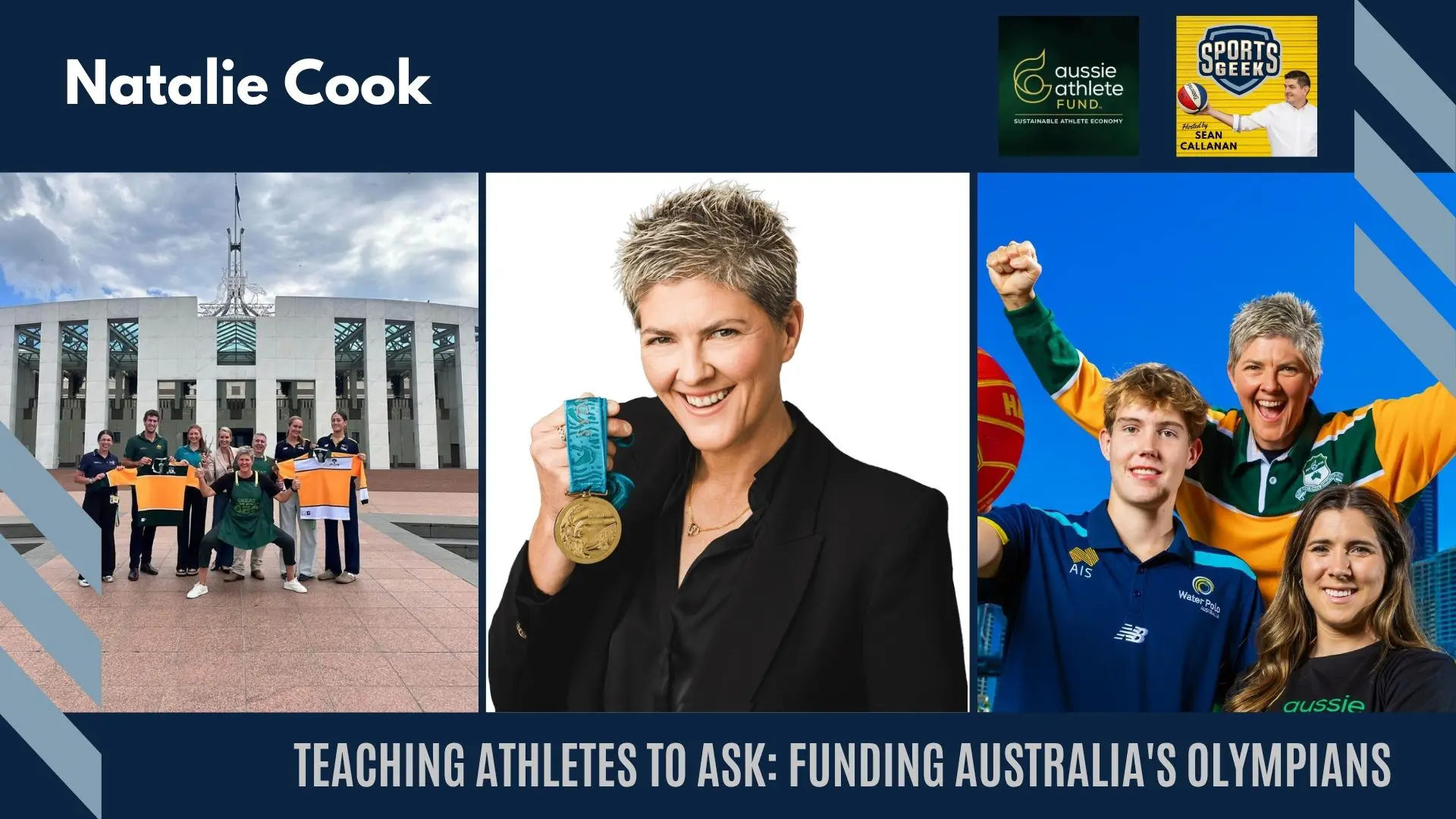
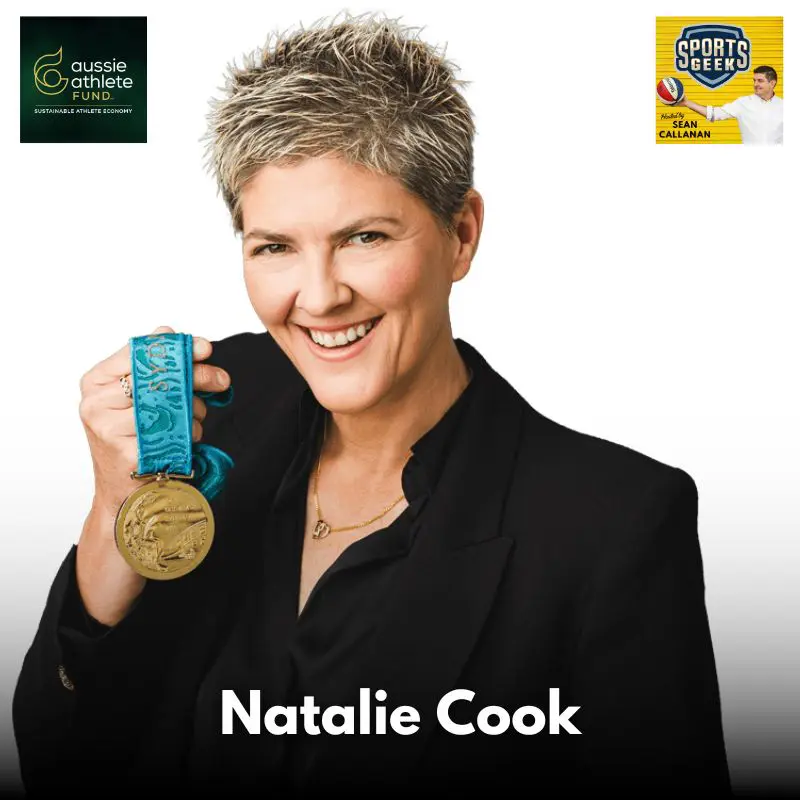
In episode 463 of Sports Geek, five-time Olympian and Sydney 2000 gold medallist Natalie Cook brings a rare mix of elite performance experience and hard commercial insight to the conversation.
In this conversation, you’ll discover:
- How to reframe a career pivot as a genuine “second act” instead of a retirement
- Why teaching people to ask for support is a skill that can be built, not just a personality trait
- How the Aussie Athlete Fund matches athletes with businesses at scale, instead of one sponsorship coffee at a time
- Why a livable wage, not a one-off payment for medals, is the real fix for athlete funding
- How Rule 40 restrictions are loosening, and what that means for brands building long-term athlete partnerships
- What a sustainable, corporate-backed funding model looks like next to a government-only one
Listen to Natalie Cook on Sports Geek
Can't see podcast player? Click here to listen
Watch on YouTube
Interview Transcript
This transcript has been transcribed by Riverside.fm, no edits (please excuse any errors)
seancallanan (00:01.314)
Very happy to welcome an Aussie Olympic legend, the first woman to compete in five Olympic Games in beach volleyball and founder of the Aussie Athlete Fund. Natalie Cook, welcome to the podcast.
Nat Cook OLY (00:14.399)
Thanks, Sean. Pleasure. I love being a sport geek. And you must be the biggest of us all.
seancallanan (00:20.466)
I I would hope so. I would hope so. I build a business around it. I always start my podcast trying to figure out people's origin story and how they got into the world of how they got into the world in sports. In my part of the world, you're very well known as a as I said, as a as a g gold and bronze medalist in beach volleyball. But how did you get your start in the world of sports?
Nat Cook OLY (00:42.526)
Well, my first sport was swimming. born in Townsville and it's very hot up there and you've got to learn how to swim. my mum was an infant swim teacher and dad was a semi professional footballer for Crystal Palace. so I got thrown in the deep end, literally, and and learnt to swim. And swimming was the first one. And then I proceeded to play every single sport there was at school and PE and every time you got an opportunity.
I would put my hand up and be first in to try every single sport. and volleyball seemed to be the last one I picked, but that might be for another question.
seancallanan (01:15.947)
No, that's fine. You can go wherever you want because, you know, not like in Aussie it is swimming and and footy and cricket and netball, they were like the traditional sports and beach volleyball wasn't potentially wasn't even on the list when you when you started playing sports.
Nat Cook OLY (01:17.989)
Huh.
Nat Cook OLY (01:30.789)
No, well I was doing soccer, BMX. I rode a BMX bike to like Saya, Sakakabara. I wish I I I often think that was one of my favorites. I loved getting air over the jumps. and then there was a notice on the school notice board that said volleyball trip to Canada and America. So I raced upstairs to the P department and I said, What's volleyball? And that's how it started and and ironically, it was for that trip.
seancallanan (01:37.045)
Yeah.
Nat Cook OLY (01:58.886)
To go to America. All I wanted to do was go to Disneyland and I saw volleyball as the vehicle. I was 15 years old. I fell in love with traveling and Disneyland. And the thing about volleyball that got me, and that was six aside indoor volleyball, was it was probably the only sport, Sean, that I couldn't play. And it haunted me. I went to bed at night going, why is this so difficult? How do we want the ball to go forward and it goes 90 degrees sideways?
seancallanan (02:18.581)
Okay.
Nat Cook OLY (02:27.691)
Nobody could do it. The teachers couldn't teach it. And so I decided then that I'd spend the next twenty five years trying to master it.
seancallanan (02:36.619)
Okay. Just just just frustrated by the sport and decided we wanted to g become one of the best in the world. So how do you go from volleyball on the court, indoor volleyball, to to beach volleyball?
Nat Cook OLY (02:49.289)
trying to find six on the court and potentially ten to twelve with substitutions was difficult to play for Australia, especially in the Asian zone. we were never getting a spot in the Olympic qualification. But then beach volleyball was new. It was announced soon after the winner is Sydney in nineteen ninety three that beach volleyball would be part of the nineteen ninety six Olympics for a a real medal.
In ninety two it was a demo sport and so you won't see it listed in the history books, but nineteen ninety six was its first time and I guess at the time there was a volleyball beach volleyball player called Anita Palm and she was on the hunt for a tall, aggressive, young, upstart volleyballer, I guess, and sh and she found me. So she asked me to play and I had to get used to a very different sport in the sport of beach volleyball where you had to do everything.
seancallanan (03:20.105)
Mm-hmm.
Nat Cook OLY (03:45.731)
be dig, set, spike, you weren't a specialist. and of course the sand and two aside was a very different prospect. It was pretty overwhelming as a seventeen, eighteen year old at the time, but I was up for the challenge.
seancallanan (04:01.243)
And then, as you said, the Sydney Olympics, iconic Olympics for everyone in Australia, but to be a to to be an athlete and play an Olympics, you know, on your home soil or in your case the home sand must have been must have been remarkable.
Nat Cook OLY (04:19.513)
Yeah, well ninety six was special because it was the first time in the games in the US and we win a bronze medal. And then of course Sydney's coming and and the only place is up. You're really excited that potentially you could go one or two better and and get a gold or or a silver medal. And of course, all eyes are on gold at that point. And Kerry and I between Atlanta and Sydney, we actually split up for a year because it wasn't quite going to plan. There was a lot of pref pressure under high performance.
Teams like that, there are only two of us, there are no substitutions, so we weren't getting along at the time because it like I said, it wasn't going to plan. So we threw each other out and we said, well right then, go and find somebody else. Eventually about a year and a little bit to go for Sydney, we realised we'd be the best team together and we came back together with a very focused purpose, single minded purpose that we were gonna go from bronze to gold.
And so to play in front of a home crowd on your homestead, ten thousand screaming Aussies at Bondo Beach, to win an Olympic gold medal four hours before the great Catherine Freeman meant everybody had nothing else to do but watch the beach volleyball. So it's pretty exciting.
seancallanan (05:34.072)
absolutely, and like a iconic part of a Australian history and one of the things I love doing is is talking to people who've worked at the high you know, at the highest level. And you sp you spoke there about you know, having that little bit of separation and then coming back and we were both at SportNet's the other week, hearing Ben Crow talking about perspective and and and mind shift and that kind of stuff. How much was like that a big part of, you know, the success of both you and Kerry and coming together
you know, under the in like intense pressure of a of a home, you know, of a home Olympics and and the expectations of a nation.
Nat Cook OLY (06:13.386)
Yeah, Ben, I love listening to Ben and obviously Ash Barty talk about the manifestation of Ben's coaching. We had a gentleman by the name of Kurik Ashley and he was a world record firewalker and a bit under the Tony Robbins philosophies. So we had to shift our mindset drastically. we had to even though we'd never won an international event at that level, we had to act like we had. We had to put ourselves in a position of
What would a gold medalist do? Say, eat, how much sleep would a gold medalist have? And we try really tried to live into our manifestation and do all the hard work and all the recovery and and really it was a difference from bronze to gold for us was a mindset shift and really not taking victim approaches when the you know when you didn't win a point. Sometimes you can have a cracking point and lose it.
And other times you can have luck on your side and win it. So how did you bring the mindset to a place of positivity at all times? getting releasing the negativity, going on to the next thing and acting, feeling, breathing like a winner at all times was really the philosophy we used. And it didn't it meant we didn't lose runs of points. It meant we didn't feel sorry for ourselves when something went wrong.
seancallanan (07:12.921)
Yeah.
Nat Cook OLY (07:40.914)
And we really supported each other and our differences because Carrie and I were very different. She was very insular, liked to be focused, I like to talk to the crowd, get distracted. I was a bit of a larrican and engage the the the crowd. So it was a big shift from ninety six to two thousand. And at the end of the day, we weren't the most skillful, but we were the most robust and we were the most resilient and and we enjoyed the process along the way, which I think was very important.
seancallanan (07:53.368)
Yeah.
seancallanan (08:12.16)
So one of things I like to do is sort of talk about athletes in career but then out of career and we could just spend a long time talking about your longevity in the game and and going you know, going to five Olympics, but how did you you know, how did you sustain that? I mean obviously being successful in Sydney two thousand brought its rewards and some sponsorships, but not every year is gonna be like Sydney two thousand. So as an athlete, how did you, you know, sustain the ability to to still compete?
but also make sure that you you you're having a a living and bringing in some money and and you know, paying the bills because th they're all things that that athletes need to do.
Nat Cook OLY (08:53.341)
Yeah, I think the holistic well being, because often it's one thing. The straw that breaks a camel's back is one thing, whether that's financial stress or physical stress or mental, emotional, sometimes it's being picked for the team. And so trying to I mean, you never balance them all. You're always in a balancing act, and it is an act. It's it's like the more attention you give to something, usually you're better in that space. So we had to be
Very focused on trying to be the best athletes we could be and winning, because as we know, winning brings success off the field as well financially. it creates momentum. People want to watch you. The further you go in a tournament, the more people watch, and the more money you can make. And then financially we would Carrie and I both decided early on that we weren't going to do a hourly paid job. We were gonna search for sponsorship.
We're basically hunting and we were gonna spend it could take us three months before we found a sponsor, but it would be more sustainable, more long term for us. It could be a two or three year deal off the back of three months of hard work. So we didn't have social media, so that we couldn't monetize our social media. We couldn't we didn't focus on increasing our following. We worked on finding
a small amount of partners that were going to support us at a at a deep level. And so if we didn't make the money, we didn't travel. That was the reality of it. So we worked just as hard off the court, fundraising and sponsorship hunting as we did on the court. And I think when we got that in balance, when our success was as much as we could on the court, get a return off the court, I think was our best. And and ultimately that's why now
seancallanan (10:29.588)
Yeah.
Nat Cook OLY (10:47.908)
I'm spending most of my time helping the next generation learn how to fundraise. Now that could be from from a job to a sponsorship to an influencer role on social media, or to public speaking, keynote speaking, and everything in between.
seancallanan (11:03.389)
Yeah, well that that does lead to the Aussie Athlete Fund. Is you started in twenty twenty twenty twenty three and that and and sort of that be your your second act to help athletes at all at all levels, but especially, you know, as part of the Olympic Olympic movement to have a few more strings to their bow so to so to speak, so they can focus on their on their sport. tell us a little bit about I guess the Aussie Athlete Fund and why you started it.
Nat Cook OLY (11:30.455)
In twenty twenty one, during COVID, I was a part of the bidding team to win the Brisbane twenty thirty two Olympics and we were doing that bid via Zoom and it was an amazing time actually. It it gave us a ten year runway into Brisbane twenty thirty two. And then I was fortunate enough to be invited onto the board, the organizing committee board for three and a half years I served on that and
What I realized early on was there was a lot of economic value that the games brought to not only Southeast Queensland, but Queensland and ultimately Australia. Melbourne had its time in 56 and the MCGs and Olympic Stadium and legacy of that. Sydney had its time in 2000 and we have Homebush and and an amazing tourism play for Sydney. and it's Brisbane's turn. I feel like it's the third child.
And it's Brisbane's turn to shine and the whole nation will benefit from that and it's Queensland's time in the sun. But I saw, Sean, that none of the economic equation was going to be distributed to an athlete. And the athlete participates at the Olympics for free, putting all of our heart and soul into this and the not just for the two weeks of the games, but it takes six to eight to ten years sometimes to
for that one moment to qualify. So I saw the economics and I wanted to find a way to pull the economic spreadsheet down to include the athletes individually of all the sports, horizontally in the green and gold, from archery to taekwondo to diving to gymnastics to beach volleyball, hockey, water polo, and not just those big sports of which some are professional, tennis, golf,
And others are we're expected as Olympians and Paralympians to be professional in every aspect except our bank account. And I'm trying to change that.
seancallanan (13:31.038)
absolutely and and yeah, we were discussing at SportNet's that the world slightly is changing 'cause we've seen in the US the name image likeness sort of un unshackling the the collegiate athlete scene which has been the same. Hey, you come and you you're at our school and, you know, the big T V deals for for all the sports, but you know, the the big ones are now that that money is starting to flow to some of some of the athletes. Do you think there's a there's a there's a strong case that the
that the Olympic movement, the IOC should be, you know, looking to reward the athletes, pay the athletes, considering the amount of funds that do both thro flow through the games, but then like you said, the the the organizing committees and and where it gets run really the the the athletes are the last to last at the table with their handout.
Nat Cook OLY (14:21.439)
Yeah, it's a very complex ecosystem, the Olympic movement. And the NIL is fantastic, but it really is direct through the college system, right? So it's it's one bank account, it's one supplier. the IOC has many mouths to feed across the two hundred and ten plus national Olympic committees. And now the inclusion within the Olympic family of the Paralympic movement writes as well. So
It is quite complex and we've known that as athletes, but it it the world has changed and I truly believe it's time. the IOC's president, Kirsty Coventry, announced a ten thousand US dollar payment, not for performance and that's the thing, you know, she got in trouble when she talked about she doesn't think you should pay athletes to play. it's a grant after the fact that you can apply for. Should an athlete not need the funding, then
seancallanan (15:08.663)
Mm-hmm.
Nat Cook OLY (15:19.304)
may not apply for the $10,000 US dollars. The Australian Olympic Committee in return, and it's a different proposition, has also is now paying athletes $5,000 when they compete for the country. appreciating that if you divide $5,000 by four, which is a four year cycle, that's twelve hundred and fifty dollars a year for the for your service. Now it is a start and I really think once you're on the spreadsheet like that, we can increase
the money. But I I do think there is a way to feed all mouths and it is a challenge. It's a complex problem that we're all trying to be a part of solving. So the way I decided was get out my little tin, start rattling the tin locally, local communities, get local support and and start to find ways where you could monetize your own local brand. just initially just enough, Sean, to get your costs covered.
seancallanan (16:15.884)
Yeah.
Nat Cook OLY (16:17.266)
There is no way we should be paying to represent Australia and as we speak and as we f record this podcast, there's archers going away paying eight thousand dollars to play for Australia. There's a gymnast going away to pay twelve thousand dollars to represent Australia. And for me that's unAustralian. We've got to find a way to fix that.
seancallanan (16:38.195)
absolutely. I mean and you do see that in other sports, but there is a payoff at the end. Like you hear of of F one drivers like Liam Lawson and their parents mortgaging their house to put them through all the all the series, but at the end goal he d he ends up in a a Formula One seat and gets ha and paid handsomely to do so. That that that piece is the of the puzzle isn't quite there. So you talk there about, you know, local audience and and local stories and and
The connection to community and the fact that, unlike yourself, a lot of these athletes can tell their stories and use social to build their audience and we've seen some sort of breakthrough in that in that in that instance. Is that is that one thing that now athletes can can push out and start, you know, telling one telling their story, but then also bring their partners along as a as a sponsorship option?
Nat Cook OLY (17:33.188)
Absolutely. And I think it's fantastic for those that like that or learn to like that. not everyone wants to get in front of the camera and not everyone wants to build this big audience and some of them y you know, are trying to find other ways. But right now that is one of if not o it's not good enough anymore to just be good at your sport. You have to be good at telling your story and you have to be good at sharing it. And so we are trying to help all of our athletes with their
Assets, which is their photos, their video opportunities, their storytelling opportunities. We're trying to get them in front of physical audiences too to leverage that opportunity. And their digital audience. How do we get their storytelling? See the the bit that's exhausting for me here is imagine you're a dick athlete, you're training for 10 sports, and then you've got to daily produce content now, Sean. It used to be
Even big brands would would make a T V ad and it'd last four or three months. Now you've got to do that on the daily. You've got to make your own T V ad of what you've been up to, share your story and build consistency over your platforms. And that's exhausting. But I think if they can work out their genuine, authentic story about themselves and it becomes a part of their daily routine.
Then there's a great opportunity f to monetize the journey, not just the result.
seancallanan (19:00.367)
a absolutely and like like we discussed, that's you know, that's what we've got with digital to dollars and you know, want to figure out a way to to to help athletes to understand how they can better commercialise their their digital audiences. So how does an athlete work with with you and the Aussie Athlete Fund? Is it a process, you know, cohorts, that kind of thing?
Nat Cook OLY (19:22.924)
Yeah, we tend to r we have an annual cohort that runs in what we call the million dollar challenge. The goal is to have a hundred athletes on the start line and together we raise with them and for them hund ten thousand dollars each, which in theory is a tour of duty overseas to represent Australia, so that so that they don't have to go in debt for that or use their savings for that. so
Every Mar ev no, every March we start applications. Every May to the end of October we run the challenge and then December, January and February is sort of the master class. It's the top gun of the hundred and we take thirty-two through through a master class programme. And we're on our third complete year of that. and I think this is probably let a secret out of the bag. Don't tell anyone except your listeners.
that this might be the first year come October that we hit our million and we're three years in, we're pretty excited and and then it'll become the two million dollar challenge. So we're just constantly trying to unearth opportunities for our athletes to to monetize their speaking, their appearances, their results, their storytelling and and so we educate, we engage, we connect.
seancallanan (20:19.067)
Terrific.
Nat Cook OLY (20:40.918)
we match them with businesses, we teach them how to leverage events and to get in front of many people, not just one on one. One on one coffees to do sponsorship is too hard. Like social media, you want one one to many. So if we can get in front of a hundred businesses at once doing a question and answer and a one business says, Hey, I I'd like to support you, then that's a win.
seancallanan (20:50.971)
Yeah.
seancallanan (21:04.654)
absolutely, and it is a matter of like you said, not not everyone wants to pull out the phone and and put their face there or not everyone feels like, you know, can they can publicly speak and those kind of things. It's about one giving them avenues to do it, but then also show them that you know, you don't public if people ask me about public speaking, it's like, Well, if you're just talking about what you know and you know it really well and you're passionate about it
And the you know, all of the discipline that it takes to be an athlete, all of the goal setting, all the mindset, it's all very applicable to businesses and schools. And so just opening up those opportunities and sort of opening their eyes to say, Well, it's only an hour you know, to go and make this talk and you know all this stuff. Is it a bit of a is there a bit of pushing and prodding sometimes to to help them to realise that that is an opportunity for them that potentially is high value but that you know, low risk for them to tackle?
Nat Cook OLY (22:02.208)
Yeah, it's an education process and it's effectively holding their hand a little bit to go with them, to s have them understand it's not so scary. I actually had one call me last week and say, Are you here yet? And I said, I'm I'm not there, I'm at another event. You're on your own for the first time, right? And we'd there'd been three or four times where we'd always been together and and I either didn't communicate that he was on his own and he smashed it out of the park. He loved it, he'd
You know, he got to do all the talking and part of a podcast and on radio. And and I think that's really important to know. It's not that scary. You've got to have an ally and a buddy and someone with you and so that was a good ex lesson for me in making sure they that when they're on their own and I've let them fly that that they have enough confidence to do that. And that's what we're building, ultimately. We're building confidence in their own storytelling because
They don't need a lot of preparation. It's just telling their story, how it is, what's going on, what the challenges are, what the excitement is, and they all have wonderful stories.
seancallanan (23:09.334)
And then the other part, like 'cause I've been lucky enough to do some social media training and stuff with Olympic teams. actually the water polo water polo Australia did in the lead up to Olympics also did did it with hockey. social media has its upsides, and we're talking about this of building an audience and and everything like that, but it also has all the feedback. how do you do you do stuff in managing them to go well
Your job or your goal is high performance and ability to, you know, push that to a s push that to a side and, you know, not read every response and that kind of thing when they're in, you know, I guess game mode.
Nat Cook OLY (23:51.687)
Yeah, and every athlete has a different way of dealing with it as well. Some delete the apps, you know, when it comes to really important world championships, Olympics, Commonwealth Games, Paralympics. others have someone else monitor it and manage it and respond. And I think, you know, you have to learn what's appropriate for you. It's it's quite you know, we're addicted to all of us are addicted. Anybody that says they're not addicted to their device is lying to you, right? so
at the end of the day, even if you put it down or turn it over, you'll pick it up. It's like this thing, you pick it up and have a look. So there there's many ways for athletes to do that and we do guide that. But at the Aussie Athlete Fund we are unashamedly one hundred percent about finances and money because I think it's the at the Australian Institute of Sport they do a great job. All the institutes do a great job with everything except finances. And so we took
seancallanan (24:47.979)
Yeah.
Nat Cook OLY (24:49.478)
We took straight from the hip, I don't even say hello anymore. I'm like, How much money do you need? How much money have you got? We're there to fill a gap. So if I can get athletes up to a livable wage, not to buy an apartment penthouse. This is a livable wage to not have to go in debt. then I'll move I'll get to that and then I'll move on to the next one. And that's ultimately we're filling up buckets to get to a livable wage. So, Sean, it'd be great.
for me to understand what do you think's a livable wage in society today?
seancallanan (25:20.798)
You're asking me?
Nat Cook OLY (25:22.832)
Yeah.
seancallanan (25:23.806)
That is that is a good question.
knowing what knowing what graduates are now getting probably around fifty five thousand dollars maybe?
Nat Cook OLY (25:36.667)
Great. So yeah, and so graduates are getting livable wage, depends on what city you're in. We're sort of aiming for seventy five, to get an athlete to a sustainable seventy five mark and forty six percent of our athletes are living below the poverty line and most of them are scrounging up enough money that's about twenty three thousand dollars a year, that forty six percent, right? So we're trying to close that gap to try and get
seancallanan (25:45.17)
Yep. Yep.
Nat Cook OLY (26:06.211)
I find if we can get up to seventy five eighty, then if they have a a bad year it's back to the fifty instead of dipping into savings. So most people live off the bank of mum and dad, which I did until I was thirty-five. and I mortgaged my father's house to go to my fifth Olympics. I retired three hundred thousand dollars in debt, no super, because remember if you're not getting paid to you're not getting any super. So we've got that challenge as well. And
seancallanan (26:20.414)
Yeah.
seancallanan (26:30.473)
You not get any super? Hmm.
Nat Cook OLY (26:35.268)
So it's a big monster of a problem and I'm just gonna as they tell you how do you eat an elephant, one bite at a time, I'm helping one athlete at a time over a scalable system to see if we can get their head above water so they're not drowning in financial debt.
seancallanan (26:52.184)
abs absolutely and like, you know, I'll take that question without notice, not knowing what the that what the what the number is. And I'm sure there's a lots of people that way. Is there a 'cause a lot of people don't like talking about finances and how much people get paid and you know, or or don't want to tell people that they're poor or that they you know, that they can't afford or, you know, they have insecurity because of financial circumstances. How
How do you sort of break through that and say, Hey, we're hi one, we're here to help we're here to educate you on all things financial, but also like find that you know, get that gap and get you to that level.
Nat Cook OLY (27:32.236)
Yeah, my dad said at an early age, you don't talk to people about money, politics, religion, right? and so I got very curious about money and had no problem because ultimately at the age of fifteen my mum and dad said they couldn't afford to send me on my volleyball trip and we fundraised for us to go to Canada and America and that's how it started for me. And so I share that story.
people that come to us are in financial or under financial pressure. And so it it makes it an easier conversation. And I'll say we are absolutely here to talk about money. Get comfortable with being uncomfortable. And I need to know. So, you know, in the chat it's like how much money do you need? What's your next trip? what equipment are you trying to fund? Do you have a job? We talk about all of that. And ultimately I'm here to help bridge that gap. but we see
ads in the paper for jobs and they have money. Not the paper, the old fashioned paper online. it says how much people are getting paid, all of that's published right now. And and so I'm just trying to get people's expenses covered so they don't have to go into debt to play for Australia.
seancallanan (28:48.714)
And how can businesses help support your efforts from an Aussie Athlete Fund?
Nat Cook OLY (28:57.022)
well it'd be great if people reached out and said, I heard through the sports geek podcast that you're looking for businesses or anybody that gets a tap on the shoulder. Any support is great. So to come and talk to us at the AussieAthletFund dot com, reach out to me on LinkedIn or socials, say, Hey, we'd like to support an athlete. We try and match geographically, we try and match the sport that they might have a child in or they played as a school. We work a as a s
an athlete at school. We work very hard at matching so that the the journey can be beneficial for both sides. And sometimes it leads to jobs. So we try and match in the field, you know, if it's an engineering firm, we try and have someone that's an engineering student at university. And a lot of our athletes are training full time, studying full time and working full time. And that equation, as you can tell, doesn't really add up. So any relief in there we can give from jobs.
to donations, to sponsorship, to free product. if you've got like if you own a bike shop and you can give equipment, any business that wants to be part of the journey to Brisbane for twenty thirty two is absolutely welcome to help us and just reach out and we'd love to hear from you.
seancallanan (30:19.112)
absolutely like like you said, it is a gigantic problem. but definitely someone with your determination and and persistence shown in your in your career, I've no doubt there will be six there there will be continued success. Congrats on the on the first meeting. A are you you must be like a like a proud mum seeing these athletes leave the cohort and both you know get
fill those gaps but then take some of those tools to to be a little bit more comfortable.
Nat Cook OLY (30:53.554)
Absolutely. And I'm seeing it every every day, right? We teach and their first challenge, Sean, is to go and get a free box of fruit from the local fruit shop. And you their little eyes like go to like the p size of sauces and they think, What am I doing that for? And ultimately, you've got to be brave enough to go and ask, you've got to have a story to tell them, you've got to have a reason to ask for it. and more importantly, if they say no, there's a fruit shop down the road. So keep going until you get a free box of fruit.
And from you go from fruit to sporting equipment to cars to flights and accommodation and local hotel chains and they just it builds this amazing momentum. I've sort of created some professional askers right now. They're pretty amazing. And they keep coming back every I invite them back every year. They they're always gonna need some support and they can help train the next generation. And it'll go from a box of fruit a
seancallanan (31:41.025)
Yep.
Nat Cook OLY (31:52.268)
once to how do you get a box of fruit a week? And then how do you get meat from the butcher? And and so all of that starts to go into their training and and so I'll have some of them that will be with me for ten years and hopefully that culminates in them going to the Brisbane twenty thirty two Olympic and Paralympic Games. It's pretty awesome to be part of actually.
seancallanan (32:13.883)
And you know, if there was gold medals for asking, you'd you'd be right up there for that. I mean that's just taking from your own lessons of yourself and and Kerry pitching sponsors, take you know, taking y you know, every no is is is only a couple away from your next yes. Is that pretty much the the slog that you did over the over the years as your journey as an athlete?
Nat Cook OLY (32:18.869)
Ha
Nat Cook OLY (32:35.955)
absolutely. And a new mentor of mine said that asking is free and it is. So if you can be okay with the no and you can be okay with asking, well, is it okay so we teach them the recovery sentences, we call it, because if you get brave enough to go in there and someone says no and you're like, what do I do now? The response is, well, thanks, Sean, for thinking of it of me. Would it be okay if I come back in a month and s share where I got to in my event?
And maybe there's an opportunity there. And if they say yes, then you've got another chance to go back. Or the other parts are, Do you know anyone, Sean, that might want to help me? You've heard my story now. Have you got any businesses or friends that might want to support me? So now you've got secondary questions. so we give them some of those lines and then that seems to arm them with a bit more confidence.
seancallanan (33:28.388)
absolutely. And and are there particular businesses that you're finding that that are attracted to the the one, the stories, want that athlete connection, you know, want that connection to the athlete, you know, to their business. Is there particular types, whether it is a butcher or a fruit shop or or or or anyone in particular?
Nat Cook OLY (33:52.611)
I'm finding right now it's the ones that wanna be part of Brisbane twenty thirty two. So whether that's you know, we have stadiums being constructed, we have villages being constructed, they want to be able to give back as well. And I'm reminding them of how important that is. So they are very helpful in that space. And then other businesses that are going to join along the way that will benefit themselves, right? So what's their ESG or CSR component of
their procurement or their opportunity to be part of the games, knowing that there's a whole cohort of athletes dedicating their lives, dreaming every night about being in a green and gold tracksuit and representing Australia. And so that's where I'm finding the most success. Or, but this is where I'd I'm flying blind, is people that had the dream to be Olympians or Paralympians themselves. And they're like, I really wanted to go in my sport.
And I couldn't or I didn't make it, but I'd really like to support someone along the way because I know how how hard it is. So they're the two big cohorts we're finding and yeah, it's really great to see the level of support coming through.
seancallanan (35:05.871)
Absolutely. I was going to talk about the you know the the CSR piece of it because effectively, you know, via an athlete or via the Aussie Athlete Fund you can, you know, have an athlete, you know, representing you, you know, sharing your story, or you can be part of their story and be very, very proud of that to say, Hey, I'm helping support an an Olympian get to get to do what they do. And, you know, you get those fourteen days
or so of those of those stories coming out and you can be putting your hand up either as an individual or as a business and say, we we help that. that you know, that's that that's the opportunity.
Nat Cook OLY (35:45.399)
Yeah, and then you have come in every quarter and do a morning tea or a trivia or share their story, or your annual function. and through the Australian Sports Foundation, it's tax deductible as well. So there's an opportunity for tax deduction for businesses or individuals. we really have built a great vehicle to support these athletes and we're excited by what's coming, people's journeys.
Then and imagine if there's an event in Australia over the next six years that they're in, which there will be lots of test events, you'll get to be courtside, pool side, track side, as the number one supporter if you can get in and back the green and gold.
seancallanan (36:28.173)
Absolutely. I I guess one of the things that I mean I'm sure you would like change, I would like change in working with with Olympic teams is I think it's called Rule Forty, which pretty much the Olympics l sort of lock out the period and say, Hey, you can't talk about any of your sponsors, you can't you can't mention any of your partners, which which really does limit what an what an athlete can do. You can still have your competitive outfit or, you know, if you're wearing shoes you can wear those wear those shoes, but it they really do protect the the the Olympic sponsors.
is there is there a hope that that b that rule may may loosen in in the future?
Nat Cook OLY (37:07.397)
I think so. I think the Olympic brand is the most protected and the largest in the world and it does demand high fees to be partners and therefore they protect it well. Rule forty has loosened a little bit, but part of the challenge is that you don't actually know how to use the loosening of the rule. so getting a you can thank a partner on a given day. I think you get one day and and they're quite strict on the rules. So
seancallanan (37:26.329)
Yeah.
seancallanan (37:34.585)
Yep.
Nat Cook OLY (37:36.415)
I think it's loosening. Our problem at an Olympic cycle is it's four years. So then you wait four years for that moment of either your hundred meter sprint or your Cam McAvoy, fifty meters in the pools, twenty seconds, right? there's not a premiership every year. It is and that's why it's so awesome and that's why the games are so amazing and everybody wants to watch because athletes have dedicated their lives for this moment. So if we can continue to loosen
seancallanan (37:54.084)
Yeah.
Nat Cook OLY (38:06.301)
Rule forty, so that it can support the athlete. I think that'll be of great benefit to the International Olympic Committee. I know they're working on it. It is hard, like I said, it's very complex. so that that's why I think a lot of people ask me whose responsibility is it? Everyone wants to throw it back to government. I don't think it is purely government. They give a lot of money to the system. I think that equation could be changed on where the money goes. but that I'm fighting separately.
seancallanan (38:32.941)
Mm-hmm.
Nat Cook OLY (38:34.876)
I think the business community, a little bit from a lot of businesses, makes light work. And so if we had a thousand businesses in Australia provide an FTE for one person, then we are we've been taken care of, right? So I don't know how many businesses there are in Australia and I can probably go back and look at that. But then that's all we're looking for. a little bit of support by a lot.
seancallanan (38:40.823)
Yep.
Nat Cook OLY (39:03.804)
versus trying to find half a dozen companies that are going to support everyone. That's what the Olympic movement's got the high end. We have a billionaire out there in the market supporting sport philanthropically. I think we need a few more of those. And the the Aussie Athlete Fund is trying to be a syndicate of money to help fund the athletes directly, which will be my whole purpose for the next
seancallanan (39:10.786)
Does
seancallanan (39:19.126)
Yeah.
Nat Cook OLY (39:32.956)
Six years.
seancallanan (39:35.165)
absolutely, I I absolutely love your passion and for mine the way around Rule forty is to do so much work with the athlete in the six years leading up to the major event that everyone knows that you're associated with that athlete. They don't even have to say your name, they don't have to mention you, like there will be the association and either your customers all know it or the Greater Australia or the Greater World knows it. Like that's the way around like Rule forty and if you you know, if you invest in
in athletes year round and not just, hey, I'm going to invest in you for this two two week period when the world's attention is there. Like that's the opportunity because you get to do a whole bunch of things that you potentially can't do with a AFL footballer or NRL footballer that have got weekly commitments and all that kind of stuff. So there's there's definitely opportunities there. but it you as a as a brand or a or a company, you you want to take advantage of where that clean space is.
And then have people know, you are involved, you are it you are supporting athletes. so when the Olympics come along, like Rule forty doesn't shut everything down and and you've already got that association.
Nat Cook OLY (40:43.227)
Yeah, and spot on, and I think it starts now. There are some people still thinking there's time, but when the torch gets handed over in LA in twenty twenty eight, that the next Olympic city is Brisbane, I think you're too late. It absolutely is starting now and starting to build that authentic, genuine connection with the athlete journey, being part of it yourself, getting your staff to go and try archery or getting your staff to try and play water polo.
And engaging with that audience with authentic content that gets to tell your business story too. and your willingness to support the green and gold and back the Aussie Battler, right? That that I think is priceless and we've got to get people on board now and we're here to help. So if anybody's interested, look us up, Aussie Athletefund.com. We're here to support.
seancallanan (41:36.109)
absolutely I want to get to the Sports Geek closing five. Really do appreciate you taking the time. do you remember the first sports event you ever attended?
Nat Cook OLY (41:48.838)
I well, it was a swimming carnival, mine, my swimming carnival. So there were two ways I looked at your question. My swimming carnival, under eight gold medal in the 50 metre breaststroke in Cairns. That was my Queensland title. but the first sporting event of any significance would have been an NRL match with my father, who was a semi professional soccer player who wanted me to go and watch NRL with him. So would have been the Broncos.
here in Suncourt.
seancallanan (42:19.067)
Yep. terrific. you would have been to a lot of s sports events in your time. Do you have a favorite food memory or a go to food at a sports event?
Nat Cook OLY (42:31.596)
the egg and salad sandwich at Augusta. That's a that was a bucket list. And and it it was only a dollar fitty and it and I bought a Georgian Peach Sunday ice cream with it and that was a dollar fitty and it was the best three bucks I've ever spent. And Augusta was pretty good too.
seancallanan (42:35.73)
Okay.
seancallanan (42:49.062)
No, they do do a pr they do a pretty good job of going, We're not changing the prices so everyone takes a photo of the prices board every single year and and it becomes a moment like that. Absolutely. what's the first app you open in the morning?
Nat Cook OLY (43:04.247)
My Gmail to see all of my emails I've got to answer to. Hopefully there's a business deal in there and someone said yes to sponsor an athlete.
seancallanan (43:14.321)
an absolute yep, that's a a terrific answer. is there someone that you follow or you might be an author, or might be an athlete doing some amazing things that the listeners should follow and why?
Nat Cook OLY (43:28.074)
I love following Adam Scott, and he just continues to play golf and be a the consummate professional at a high level. And just when you think, you know, might you think Adam might be stopping soon, he just keeps getting better. So I love his content. I love I follow him on the PGA app and so I get up to his scores whenever he's playing and and he's great to watch. And
Great for our athl our tello athletes to follow his content because it's very diverse too around his sponsors, his golf, his what he does off the ball and I think it's awesome. So go follow Adam.
seancallanan (44:09.037)
Absolutely. I mean I use the phrase steal with pride and that's an ex great example of hey this athlete's doing you know Adam's doing what's good for him. What's your version of that? is, you know, the best e best example of like how can you do a version for yourself. lastly, what social media platform is your VP? And you can answer it personally, but then you can also maybe put in the in put your current athlete's hat on and what it would be for a current athlete.
Nat Cook OLY (44:38.529)
Well, me personally is LinkedIn. it's where the content is probably you would say not as fun as an Instagram. It's a it's more professional, it's where businesses hang out, which is where I am operating in. And as a keynote speaker myself, that's where, you know, all the the connections come from. I think for the athlete it's well only because I'm not on TikTok, I hear TikTok is where where it is, but Instagram
I I thought I nailed Facebook and then they said that's for old people and so Instagram is probably where most of our athletes in the Aussie Athlete Fund operate on, because I don't see TikTok and I have no intention to go and be in there.
seancallanan (45:22.861)
Well, TikTok's probably where stuff's happening first and then you when you're seeing it on the reel, it probably happened on TikTok two weeks ago. But it does seem to be the happy medium of far enough away from TikTok but also reaching more like dare I say it, older people and more mainstream. And so it is the it is the platform of of of of record for all athletes. Like, you know, the the top follow accounts are either
you know, entertainers or or they're Messi and and and Ronaldo. So it is still the it is still the platform. I do want to I agree with you on LinkedIn. more athletes should be on LinkedIn and just be more active on LinkedIn. Like you know as an as an athlete you meet you get to meet a lot of different people from from government stakeholders to to sponsors at functions. I mean s people still hand out business cards. Like that that if I've had any advice from athletes like just connect with everybody
You don't know when you'll need that connection. It might be a sponsorship pitch later. It might be, you know, hey, I'm running a fundraiser, or it could be a future job. and you don't know you know, you don't know where that that connection will come back. And so even sharing a few snippets of, Yep, I'm off to Canada for this meet, and you put that on LinkedIn, you'll find you'll get these little digital pats on the back that, you know, that are people cheering you on. They could be your next sponsor or
you know, your next employer or your next you know, keynote speaker booking.
Nat Cook OLY (46:52.272)
And to that point people are watching. They might not even do an like comment or pat on the back. They watch and then they engage. And if you're connecting with people, we tell the athletes always put a note. So you know where you have the choice to skip, always put a note because you say, Hi, my name's Nat and I am a beach volleyball awa aiming for Brisbane twenty thirty two and I'd love to connect, right? They want
you have to have the respect to say hello. You never just go up and shake hands and not say hi, I'm Sean. so that's what happens on LinkedIn. And also what I find there is you don't have to be as frequent. I feel like on Instagram it's all the time. So in LinkedIn you can put a very well crafted picture and a few comments and even once a week, even for an athlete once every couple of weeks could potentially it's not enough, but you at least start to get a presence.
seancallanan (47:33.74)
Yep.
Nat Cook OLY (47:47.236)
And once a week would be great for them to start. So we we help athletes too get photos, get some because you don't own your photo either, Sean. So I'm out there in in my bikini jumping around a sand pit. People are taking photos of me and I can't find them. I can't get the photo, it's not mine. So then we take photos for our athletes and cool, fun, engaging photos that they can use on LinkedIn and socials and that's all part of it as well. So even if there's a
seancallanan (47:56.599)
Yeah.
Nat Cook OLY (48:15.326)
photographer out there or a videographer that wants to support and take some pictures of athletes, that's helpful too.
seancallanan (48:23.28)
absolutely. Well if you if you were posting one week one post on LinkedIn a day, I think you're in the top five percent. if you're posting once a week. So like it it most people don't post. Like you said, most people are lurkers, they're just reading, they might not even click and like, they're just watching. so yeah, if any athlete out there is posting once a week, whether it's here's what I'm doing at training, here's what I'm s you know, here's what I'm speaking at, or, you know, here's what my new pair of shoes looks like, it doesn't need to be
groundbreaking or massively storytelling, but by just again, it's just like the consistency of tr you know, training reps, it compounds. So yeah.
Nat Cook OLY (49:02.275)
Yeah, like training was training was great this week. I hit a P B. Training was crap this week. I fell off my bike. Train you know, like that's the bit that it's commentating on your journey. and we never used to do that. We used to try and get in the paper once every six months and and now I just think that's really important and get on podcast 'cause then you can say, Hey, I was on a podcast with Sean at SportsGeek and that's good content for me for the next week. So thank you.
seancallanan (49:30.447)
It it it is, thank you, and I really do appreciate I really do appreciate it. I mean, and I agree with podcast 'cause it allows an athlete to go further than the the seven minute the seven second sound bite they get in the coverage or you know the grab that they might get on the news, which is great, reaches mainstream, but it's like if someone, you know, can learn your story more, that deeper connection, you you start finding your tribe. So Natalie, I really do appreciate you coming on the podcast. I always tell people to reach out
And connect and say thank you if if if they enjoyed the episode as much as I did. I'm assuming I'm gonna be sending everyone to your LinkedIn. Is that the best way for people to reach you and find out more about the Aussie Athlete Fund?
Nat Cook OLY (50:12.193)
Absolutely. And we have an Aussie Athlete Fund LinkedIn page as well. So Natalie Cook, or the Aussie Athlete Fund page, and both will find us.
seancallanan (50:23.088)
Absolutely. I really do appreciate your efforts, both in the sand and now in your second career helping Aussie athletes with the Aussie Athlete Fund. Thank you very much for coming to the podcast.
Nat Cook OLY (50:34.713)
Cheers. Thanks, Sean. And we have to do a high five. Every beach volleyballer does a high five. Thank you.

Turn 15 minutes a day into sponsorable content your partners will pay for
Sports Geek AI is a done-with-you content system that creates daily newsletters, podcasts, and social posts—giving your commercial team new inventory to sell.
Resources from the podcast
- Please connect with Natalie Cook on LinkedIn. She's said she'd love for you to reach out, especially if you're a business considering backing an athlete, so let her know you listened to the episode and please say thank you if you do connect.
- Catch athlete stories, event updates, and more — plus details on the $2 Million Challenge, the Aussie Athlete Fund's flagship program pairing athletes with purpose-driven businesses on their website.
- Listen to our new Daily podcast – Sports Geek Rapid Rundown.
- Check out Digital To Dollars – our self-serve program to help you drive more revenue from your digital fan base.
- Podcast episodes you should listen to:
- Throwback episodes you may have missed:
Podcast highlights
Highlights from episode 463 with Natalie Cook:
-
- 01:31 Welcome and introducing a five-time Olympian
- 02:12 Origin story: swimming lessons in Townsville
- 04:19 Bronze in Atlanta, splitting with Kerry, and coming back for Sydney gold
- 07:43 The mindset shift: act like a gold medallist
- 10:23 Hunting sponsors instead of taking an hourly job
- 13:00 Why none of the Olympic economics reach the athlete
- 17:47 “That's unAustralian”: archers and gymnasts paying to represent their country
- 20:52 Inside the $1 Million Challenge
- 25:21 “We are unashamedly 100 percent about finances”
- 27:06 46 percent of athletes live below the poverty line
- 27:36 Mortgaging her father's house and retiring $300,000 in debt
- 34:05 “Asking is free”: the recovery sentence for handling no
- 37:58 Rule 40 and the future of athlete sponsorship
- 43:18 Sports Geek Closing Five

Digital To Dollars is the five-pillar process pro teams and leagues have used for a decade to turn digital audiences into revenue, and it’s coming soon as a self-paced program. Those on the waitlist will get 20% off upon launch.
Check out The SEAT Report
We’ve launched a new monthly podcast in collaboration with SEAT.
Sean Callanan hosts The SEAT Report with Josh Barney. Check it out
Listen To Sports Geek

Recent Sports Geek Reads
- AFL Bans AI Player Likeness, Netflix Locks World Cup Rights & Fans Build Custom Sports Apps
- L’Oréal’s Sports Strategy, Olympic Economics & Why Kim Kardashian Matters to F1
- 2036 Olympics, SeatGeek’s Rise & Nike’s Strategic Missteps
- MLB Realignment, WNBA Revenue Records & AI-Powered Ad Targeting
- Consumer-First Sports, Manchester City’s FFP Storm & DAZN’s U.S. Streaming Gamble
- From NRL Fan Data to Super Bowl Streaming: Revenue Innovation in Sports
Listen to Sports Geek Rapid Rundown daily