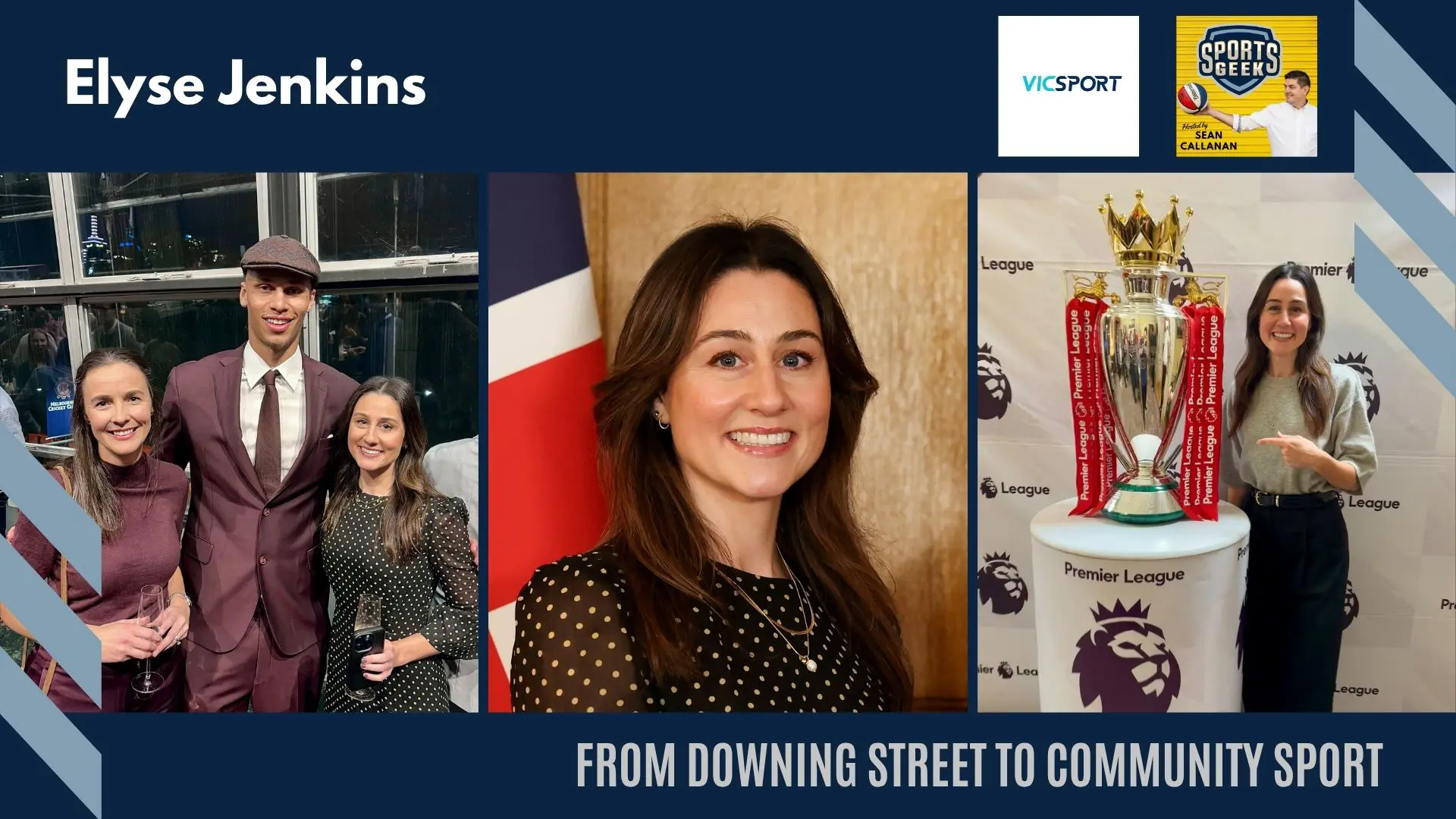
In episode 465 of Sports Geek, Elyse Jenkins, who advised the UK Prime Minister at 10 Downing Street and now leads Vicsport, Victoria's peak body for sport, shares insights on community sport, advocacy, and building a sports career from outside the industry.
In this conversation, you’ll discover:
- How to break into sport from another industry, and why Elyse says it was not luck
- Why a network built one coffee conversation at a time compounds, including how Elyse built her Australian network from the UK through early morning calls
- What the first State of Victorian Sport and Recreation Report revealed: confidence in child safety, integrity and governance, with volunteers, workforce, participation and retention the weaker areas
- How VicSport's Future Sport Labs bring sports, experts and academics together to move from talking about problems to building a toolkit or program
- Why under-resourced sports, some with fewer than five full-time staff, benefit from learning from each other
- Why volunteer burnout is a growing risk as expectations rise, and why every elite athlete starts in community sport
- How to make the case for investment in community sport to government, corporates and philanthropists, including why Elyse wants sport seen as part of the preventative health agenda
Listen to Elyse Jenkins on Sports Geek
Can't see podcast player? Click here to listen
Watch on YouTube
Interview Transcript
This transcript has been transcribed by Riverside.fm, no edits (please excuse any errors)
seancallanan (00:01.253)
Very happy to welcome Elise Jenkins. She's the CEO at Vic Sport here in Melbourne. Elise, welcome to the podcast.
Elyse Jenkins (00:08.898)
Thank you, Sean. Happy to be here. Thanks for having me.
seancallanan (00:12.567)
Not a problem at all. I always start asking people how they got their start in sport. We will f we'll we'll find that out because this is your your first job, but I also always like to find out more about more about the journey and how you got there. So you've had a really interesting background. Do you want to sort of give us an idea of, you know, how you got to where you got to?
Elyse Jenkins (00:33.122)
Yeah, so it's a bit of a journey but let me sort of take you on it. But I suppose it all started. Like many of your listeners or many of the guests that have been in your podcast, I was like sport obsessed as a kid. So not just watching sport but playing sport. I had my parents visiting the other weekend and we were talking about this. I think at one point I was either playing or training for like 13 different times a week, which is absolutely ridiculous. But I think, know, between I was like swimming a lot as a kid, played water polo,
seancallanan (00:57.723)
Okay. Yep.
Elyse Jenkins (01:03.076)
polo netball, athletics, like absolutely sport obsessed. it had, playing sport had such a huge positive impact on my life as a kid. It gave me friends for life. It teaches you valuable life lessons, gave me a positive thing to engage with. I don't think I was too much of a rat bag, but think having something positive to do and a sort positive outlet to keep me stimulated and entertained was definitely a good thing for me. But I also had like my parents.
were brilliant, were very supportive, I had supportive coaches so early days sport was such a positive experience for me. It was something that I did a lot and I really enjoyed.
I then got to sort of that crossroads at 17 and had the choice and I did think about, know, do I want to go in and do sport as a career? But I didn't really know what that looked like. I thought about, you know, do I want to do physiotherapy, want to do dietetics and sort of wasn't quite sure. And then law was the other path. And again, like I didn't really know what that meant. I didn't really want to be a lawyer, but I was probably more interested in, you know, law and its role in like law or government and the
seancallanan (01:56.057)
Yeah.
Elyse Jenkins (02:14.742)
role in like solving problems in society and making society better so I ended up going down that path and so studied law and I grew up in Tassie so I studied in Tassie and then moved to the UK not long after finishing and started my career over there and
I was working at the first job I had was sort of very stereotypical work, know, working in bar in London. But then my next job was working for a community pharmacy organization. And it was when I was doing that I was at the party. I went to the party conferences. So I can't remember if it was the Conservative or Labour Party conferences, but I came across this organization called Street Games.
seancallanan (02:45.167)
Mm-hmm.
Elyse Jenkins (02:57.076)
And Street Games are an organisation, they're charity in the UK and they work with either kids in disadvantaged communities or kids that are on the cusp of offending and they engage them through sport. And that was the first time that I'd seen this thing that I love, being sport, sort of teaming up with my other interests which is like how can we make society better? So I was quite interested in that and that was sort of the first thing that sort of piqued my interest in, okay maybe I do want to like go back into sport and
seancallanan (03:10.255)
Okay.
Elyse Jenkins (03:26.96)
you know make that part of my career but fast forward a few years still in London, joined a run club, I was playing Aussie rules over there and then I landed a job in number 10 Downing Street as an advisor to the Prime Minister.
on the policy side, not the political side. when I joined, my brief was crime or justice and home affairs. So I had all of the crime and justice portfolio and then all of the immigration portfolio as well. And I started under Boris Johnson. I had about two months under Boris Johnson. I joined in a very tumultuous time for UK politics. don't know. I bet that probably made the news a little bit over here in Australia, but had two months of Boris Johnson, the 49 days of Liz Truss,
seancallanan (04:05.815)
Yeah. Yeah.
Elyse Jenkins (04:14.04)
us and then Rishi Sunak came in and when he joined his team sort of sat me down and said crime is a massive issue for our country, it's priority as is immigration. We're going to split this brief up, which one do you want? And I said I'll take crime and justice but can I also have sport? And sport was sort of floating around and no one within number 10 was owning it and then yeah that was the first time that sport was officially yeah part of my job.
seancallanan (04:41.423)
Well, like I said, amazing backstory of s sort of getting working through the UK government system, but then to be at at at number ten. I mean, that's a lot of I mean, we've seen you know, TV shows like the West Wing and and we see what it is from the from the outside. What is it like that in a working stakeholder management? you know, you've got this goal of I want to make change, but you know, there's a lot of moving parts and that, you know.
Democracy and bu bureaucracy sort of go hand in hand. How do you how do you work in those sort of scenarios?
Elyse Jenkins (05:13.614)
Yeah, I mean it was an absolute privilege, I don't think I'll ever do another job like it. And also in a pretty tumultuous time, so I ended up doing all of Rishi Sunak's time in number 10 and a year under Keir Starmer. But it's chaotic, it's humbling, you work with some incredible people on some really knotty issues.
know, crime, same as Australia, was a big deal in the UK. So we were trying to do things there. We had a prison capacity problem. we were sort of basically running out of prison places. So that was something I was dealing with most days. yeah, you are sort of at the forefront. you know, the UK, same as Australia, has departments that will sort of run the day to day policy. But if anything reaches crisis point, or it's a political priority for the Prime Minister, then it comes to number 10. So just a huge range of stuff that came
across my desk but yeah definitely saw some things, met some really interesting people yeah incredible job.
seancallanan (06:12.419)
And so what from the you know, to sort of move to your current role now as CEO of Xport one, what what triggered that move and sort of what sort of made you look at that job? Were you were you headhunted or did did you we did you want to move back and you were looking for something? Like how did how did that move come about?
Elyse Jenkins (06:31.918)
Yeah, so this was I'd done 12 years in the UK and I was starting to think about coming back and I did want to move into sport full-time. I was doing some volunteering, so I still have the sports brief in number 10. I was volunteering with an organisation called the Youth Sport Trust and getting more and more interested in making sport my full-time job. When this role came up I thought like this feels like such a perfect opportunity because the role in Vic's sport is, it's community.
Community sport so it's something where like my day to day is talking about this thing that I love and I believe in which is the power of community sport and how you know that can improve lives and make society more you know connected and make us happy and healthy and all of that so So yeah, it just it came up when I was sort of already looking at things And yeah, it just was I think the perfect fit sort of coming from number 10. I've got a lot of experience being lobbied
people, everyone has a cause and you know lots of experience with people, of experience of being lobbied and now sort of I'm on the other side and now my job is talking to government or talking to the industry about the value and power of community sports so yeah it's interesting to be on the other side and definitely nice to be. I love my time in government but it's definitely nice to be outside of government for a bit.
seancallanan (07:54.638)
And a lot of times when I've spoken to the people, either on the podcast or just in the industry, you know, and trying to break into sport, there is a bit of a you've got to be a sport lifer or you've got to be in sport from the from the get go. It's really hard to break into from another industry. You obviously had some exposure in, you know, having the sport portfolio in from a government point of view. But what were some of the things that better prepared you for this role and and sort of and and you know
I guess gave you a a a soft landing somewhat or better been able to transfer some of those skills.
Elyse Jenkins (08:28.106)
Yeah, so I think some people say, you're so lucky to get this job. It was not luck. I was grafting for a long time. And before this job came up, the transition was hard. I knew the transition coming back to Australia was going to be tough, just in the sense of that I'd built such a strong network in the UK. And so I tapped into that network first to try and learn about the sector, learn about what my gaps are, things that I…
You know maybe need to work on and sort of those sorts of things. So yeah, tapped into my network in the UK first and then it was just using that network to start building a network in Australia. So there was a point where I think because of the time difference like 7 a.m. at least a couple of times a week I was having conversations with people in Australia and you have conversations with someone and then they'll put you in touch with someone else and the thing I took from that I'm really trying to to give back now that I'm on the other side but people were so generous with their time, really generous with their time.
and I think you can get something from every conversation. So there was definitely a long period of building that network, understanding the sector, and then also working out, coming from government to sport, I spent a lot of time working out how do my skills translate and how does my experience translate. I don't have experience working in the sport industry in Australia, but I do have experience working in very high-pressured, fast-paced,
lots of times chaotic situations. So you know those schools are transferable and a big part of the journey was yeah learning I guess how to sell myself and then also building that network back in Australia.
seancallanan (10:10.849)
absolutely. A mate of mine, Steve Samatino has a has a 10 coffee strategy, which is pretty much what you did, you know, have 10 coffees with 10 random people, and quiz them, understand them, you know, offer them something, and it's it it compounds. Like you know, they'll introduce you to someone else. You can get that deep knowledge either on an industry or on a sector or on a or on a topic just just via those coffee chats.
Elyse Jenkins (10:37.902)
Yeah, absolutely. I really do think you take something from every conversation. I reckon I played the 50 coffee game, 50 class, so many coffees, but it's always worth it. It's been the same since coming back as well. Like I think I've had, again, like I've probably had like hundreds of coffees with people in the industry in Australia, I do, yeah, I do think you take something from every conversation. And then it's important to give back as well. So I'm really, trying to do that.
seancallanan (10:44.058)
Yeah.
seancallanan (11:03.673)
And so you took over from a mate of mine, Lisa Hasker, was in the role for for seven years and you know, and a longtime sports administrator and and very much connected in the industry. How do you take over from someone like Lisa for the foundation she set and then start setting, I guess, your own stamp on the role and what you want to see for Vic Sport?
Elyse Jenkins (11:24.32)
Yeah, you know people said you these are big shoes to fill and I definitely I definitely sense that Lisa is so well respected in the industry. So yeah, I would say that was it is a little bit daunting coming into a role like this and not knowing the sector. But Lisa had done such a brilliant job like Vic Sport for the past like under Lisa's tenure has done so much work and really focused on capability building in the sector. So how do we make Victoria or you
know, sport in Australia, the best place to be involved and how do we support the sector? How do we make sure that sport is well run, it's well governed, it's governed with integrity, that we're retaining people, that, you know, when people come to community sport, it's a nice place to be. So Vic Sport has done so much work in that space. So part of my role is making sure that we keep building on that and keep doing that work.
But the other half of what we do, and I think this is new for Vic's sport, I think the fiscal climate is sort of no secret and our sector is heavily relying on government funding, different sports to different levels. But if we're gonna keep the cost of sport down and keep it accessible for everyone, we do need government to help support the sector. So a big part of my role has been,
talking to government and trying to or making the case for investment in community sport and investment in our sector and it's not just a government like we'll be going out to industry and corporate and philanthropists as well but that advocacy function of Vic's sport is something that we've started building out this year ahead of the Victorian state election at the end of November and then something that we will just build on more and more in the years to come.
seancallanan (13:15.321)
And is that and is part of that, I guess, some of the foundation and the basis and the way you push it is the state of Victorian sport and the recreation report that sort of gives you the data to say, hey, this is what sport does, this is what sports does to the community. But then also here's here's what it can do with the right funding, whether it comes from government or, like you said, philanthropy or or private, to say, hey, this is how you can support your community.
Elyse Jenkins (13:39.065)
Yeah, absolutely. So the State of Sport report is, I'm glad you mentioned that, it's the first time we've run it this year and the purpose was to see, to get a sense of how sport in Victoria is feeling. And one of the reassuring things that came out of it is the areas where people felt most confident were around child safety, integrity and governance. And they're the areas where over the past four years we've really focused on supporting the sector.
The bits that we're doing less well on are around volunteers, workforce, participation and retention. So that's helped us inform how we do things differently going forward. We work really closely with Sport and Rec Victoria and they give us funding to help us do our sector capability building work and it's allowed us to change our approach a bit going forward. So we're about to start, I think these are quite exciting, but we're about to start doing our future sport lab.
and the future sport labs are we and we had we ran expressions of interest so different sports will participate and the first one we're doing is on participation and sports will bring along their participation challenge to the first lab and there's three labs in the series and we bring sports together we have experts in the room academics so the point of it is we start by saying like what do we know what the problem what are the problems and what do we know and what do we know about how to solve them because I think
The risk sometimes is we just keep talking about the problems and we never solve anything. So the labs are designed to, okay, what are the problems? What do we know? And then having experts in the room and working with sports over those three labs to help them solve them. So by the end of that, series of the labs, they should come out with, you know, a program, a toolkit or a thing that will help them tackle the thing that they've been trying to solve. So we're trying to move from, you know, just talking about the problems and how we might solve them to actually
seancallanan (15:09.711)
Yeah.
seancallanan (15:29.595)
Yep.
Elyse Jenkins (15:35.408)
Vicksport playing a big role in working with sports to solve them.
seancallanan (15:41.884)
I mean, one of the phrases I use in the podcast all the time is steal with pride. And I guess that's something that all sports can be doing, you know, whether it's 'cause a lot of times the sports will be stuck in their own bubble of just their sport and just their problems and just what they're doing when they if they had the chance, I mean a lot of the time they don't have the capacity, don't have the just to step back and go, what are they doing over there at that sport? Or, what's that sport doing over doing well? Or, you know, what's someone doing internationally well that we can
Elyse Jenkins (15:53.997)
Yeah.
seancallanan (16:10.211)
slightly adapt. Is that sort of some of the outcomes you want to come out of those future labs?
Elyse Jenkins (16:14.478)
Yeah, absolutely. I think sports are so busy. This is the thing that sort of struck me since being back, that sports are so busy and sports are so under resourced. Like I've been surprised at, you know, some of the sports that we love that have huge participation like badminton and table tennis, even diving.
the FTEs in those organisations is like less than five. So these people are running the competitions, running the leagues, they're trying to do everything. So I saw, I think there is a real gap or there's an opportunity for Vic Sport to bring sports together and learn from each other. Because I think they all want to do that and they want to be collaborative, but just just not having the time and place to do it. yeah, excited to see what what the outcomes are of these labs.
seancallanan (16:58.787)
And the thing is that there is just like if we go back to, you know, like you were talking before, when you were a kid and all the sports you played and when I was a kid, there's just more. There's more of everything. There's more sports, there's more entertainment options, there's more activities that that that kids can do. So it becomes a a a choice thing, but then all of those choices, all those sports are all stretched because it's not
You know, if we go back fifty years ago, it was two winter sports and two summer sports and everyone was happy. And now we've got so many choices, but then it just makes that resourcing really thin.
Elyse Jenkins (17:35.727)
Yeah, absolutely. And I think one of the beautiful things that we have here in Victoria is diversity of sport. And if you don't find your place in netball or hockey or basketball, you might find it in sport climbing or, I don't know, canoeing. I think that's a really beautiful thing that we should protect. But it's also interesting seeing trends in the way people want to play and participate. And that's been quite an interesting thing, sort of coming back to Australia. And one of the things that I think we can learn from other countries like the
UK is we're seeing a change in the trend of how particularly our young people want to play and participate in sports. So when you and I were growing up it was probably much more like sport was competitive, like really you know it was a competitive thing and you played sport and you know you were being good at it was a big part of it where I thought is still important and there will always be a place for that but we're seeing an increase in demand for people that just want to play in a more informal social way so you know maybe they don't want to buy a uniform or train three
times a week. So I think that is something that other countries have sort of noticed that change in how people play in a sort of…
taking advantage of those trends and I think Victoria and Australia are going in those directions. But I think we've got a little bit more to do to catch up and to make sure that it's things like modified versions of the games and sports are starting to do it. yeah, I think there's more we can do to give more people the opportunity to play in the way that they want to play.
seancallanan (19:00.635)
Yeah.
seancallanan (19:12.389)
So you've obviously got a lot of passion for community sport and what it does, and you're in the role now, the peak body. There's a lot there. How do you like prioritize, you know, grassroots participation and help with pathways and try to try to solve the volunteer like because that report does highlight a whole bunch of things you can do. How do you start prioritizing I guess the things to tackle?
Elyse Jenkins (19:36.879)
Yeah it's actually a good question and you know if it's a convict sport like we're a small organization so it's it's the state of sport report has been really helpful in helping us prioritize and work out where to focus next. The volunteer
challenge is huge, not just for sports, but for all organisations. Like sport is, it's actually quite insane when you think about it, like sport would not survive without volunteers. And the volunteers are people like you and I who grew up playing it and love it and want to give back and make sure that it still exists.
We're also in a time where we're expecting more and more of our volunteers in that, you know, in some ways it's, you know, that's like the right thing in that we want to make sure that sport is a safe place for our children and that it's governed with integrity and all of those sorts of things. But what that means is that we're expecting more and more of our volunteers. So we're seeing that volunteer burnout is a real thing. So we've been able to take the research and evidence from the state of sport report and help us work out.
what are the capability things in the sector that we need to focus on next. So that's sort of priority, well I guess yeah, priority number one but just as important is sustainability of the sector because it's
It is tough for community sports out there at the moment and we do see lot of investment, rightly so, in elite sport and high performance sport. And we love it, so that is a good thing, but we're not gonna have those, like every elite athlete has to start somewhere. They will start in community sports.
seancallanan (21:15.087)
Yeah.
Elyse Jenkins (21:17.806)
I think it's important that we need to make sure that that still exists and it's supported and invested in and sustained. So I guess, can you have two equal first priorities? If I could have two equal first priorities, one would be supporting the sector, but just as important as trying to get more investment. And whether that's from government, philanthropists, from corporates, that's a really big priority for us in fixed board as well.
seancallanan (21:31.439)
Yeah.
seancallanan (21:47.067)
‘Cause it is that I guess the the pyramid if if I'm gonna use a shape of sport where, you know, a lot of the money does funnel to the top to the professional leagues, you know, the sponsorship, but then the wider base where all the people are, is the participation base, is is community. And if you really want that broad reach and really connect to the community, then you know, that's where you go. Like a you know, a logo, you know, on the s on the scoreboard of the C G a hundred thousand people will see it one weekend, but
Like if you're participating in parks and basketball courts and netball courts every weekend, you're actually you're actually in the community. And that's the bit that, you know, both talking to sponsors and people who are trying to, you know, commercialize sport, they're they're trying to trying to figure that out. But really that social aspect of community sport is, you know, really vital.
Elyse Jenkins (22:40.184)
Yeah, and I think as well they're sort of serving, like yes it's all sport but they're serving two different purposes. you know, the sport that we go and watch on the weekend at the MCG, that's, you know, it's bringing people together, you're supporting a team, you know, it's bringing joy, it's all of those great things. But participating in sport is serving a different purpose. It's still uniting us, it's still, you know, bringing people together but it's, you know, it's all the stuff that we know but sport…
Sport is so good for our physical health, it's so good for our mental health. It's interesting seeing other countries like the UK, you thinking about sport as a way to tackle other social issues.
challenges. So loneliness is a huge one. How can we use sport to bring people together or even sport as a tool to tackle crime and reoffending. There's really interesting programs happening in the UK. So I think it's, know, there's, we love elite sport and that, you know, will forever, I hope, be part of our culture and identity. But community sport is something different. It's serving a different sort of social purpose. So I think therefore we need to, the investment in it is for slightly different reasons.
we need to think about it in a different way.
seancallanan (23:54.628)
And is do you think the the participation piece and the volunteer piece are also part of that, you know, you know, being in Melbourne, that post-COVID effect of wanting to be part of an experience? And so that's why we've seen the rise of social sport and you know, pop-up sports and you know, things like paddle and pickleball that are going up all everywhere because it's really easy just to get into. But that being both a participation side, but then if you can't play.
you can be part of that experience if you are a volunteer, if you are a referee, if you are an organizer, or if you're the secretary of the club, like you're getting that community, you're getting that community cup fill by being part of what potentially is a new community sport. Like not the, hey, here's your footy club and you're going every Saturday, but it's I'm, you know, I'm playing, you know, social softball on a Tuesday night at at this time or I'm
You know, random pickups where there's now apps where you can play pickup basketball and strike like s sport is really changing from a community point of view.
Elyse Jenkins (24:56.3)
Yeah, absolutely. I think people are playing for different reasons than when we played going up. And humans naturally crave connection, don't they? And sport gives them that. And yeah, we're definitely seeing a rise in different formats of the game. And I just think back to playing Aussie Rules in London. And you adapt the game to make it easier to pick up. I'd never played it before. So you make modifications.
of paddle and pickleball I think is really interesting and really lovely to see but the problem we're then seeing is like space for people to play is a huge one you know you can we are
working or calling on government at the moment to do more on opening school facilities. There's so many great facilities in Victoria, but so many of them are lying dormant. we need to think about if we're going to keep supporting participation to grow, also we need to think about the facilities piece. And in some cases that would be building more facilities and improving facilities, making sure that they've got good lighting and good change rooms. But in many instances as well, that will be what are the existing facilities that we have and how do we maximise use so that, know, facilities that a lot of them
taxpayer funded and making sure that they've been used and not lying dormant.
seancallanan (26:16.131)
Well, as someone who you know until recently has been playing basketball for almost 40 years, like you you end up playing in different high school courts and like and the the patchwork that the you know, I think I spoke to Ned Coton, who was on basketball Australia, like it was we need to find more courts. And soccer has the same pro issue or s not enough fields. AFL is having the same issue with not enough fields for men's and and and women. So that that does come back to
that lobbying piece to say to government, say to developers, hey, if you're building things, you you if you're building a precinct, you need sport to be part of it because it brings everyone together and that's what that facility, you know, can bring to the area.
Elyse Jenkins (26:56.814)
Absolutely and multi-use facilities as well. So you know an oval can be used for many things like a cricket, it can be used for football, can be used for soccer, know it can be used for ultimate frisbee. So you also need to think creatively about how we're using our spaces.
seancallanan (27:12.463)
And the other part of Vic Sport does is really to address the volunteer piece is the is the awards and recognition for people who really put in the hard work because a lot of it is thankless sometimes, but they really should be thanked more often. How important is that to to elevate the people that, you know, do pa do keep community sport chugging along?
Elyse Jenkins (27:31.855)
Absolutely, I mean I don't think any volunteer does it for the recognition, but I think it's it's such a It's really important and it's also really nice to you know, reckon recognize our volunteers and thank them So each year of export does that we have the Victorian Sport Awards, which is an event I love it because I love it for many reasons But it's an event where we recognize our elite and high performance athletes along cut alongside our community volunteers So we have 19 awards categories this year. We had Dyson Daniels
the NBA came and received an award. know alongside like Jack Howell is our young athlete of the year. He's a triathlete super impressive guy and then we also had we recognized our know community coach of the year, community official of the year and one of the things we tried to do differently this year was bring a bit of emotion into the room and we had you know videos of some of our winners. So Jack was one of our we had a video of Jack and he was brilliant, a brilliant speaker.
but then we also had our Community Coach of the Year and highlighted the work that they were doing. it's a great night, it means we can honour and recognise our athletes and our community volunteers. And yeah, it's just a really nice night, it reminds us, I think, why we all love sport and why we're part of it.
Elyse Jenkins (29:02.03)
You
Elyse Jenkins (29:10.764)
Yeah.
Yeah, so I think firstly like properly invested in and and sustainable so it is feeling it's like times are hard in our state sporting associations at the moment and there's so much that they want to do to make sport a better place to you know reach different communities and get other people engaged in sport but also thinking about when people are in sport how do we keep them there and how do we make it a really good place but sports can't do all of this other
there's so much social value that sport contributes but if we don't get the foundations right then we can't do all that other work. One of the things I'd really love to see is UK has gone down this path and Western Australia going down this path as well is to see the value of sport and active recreation as part of the preventative health agenda. So you know moving away from this like sport for sport's sake why do we have you know what are the benefits of having people involved in sport if people are physically active it's you know good for our physical health good for our mental health.
what does that mean? That means that's helping to keep our health bill down in 10 years time. But it's a tricky one because the way the government or political cycle works means that politicians aren't incentivized, unfortunately, to make those long term investments. So I would love to see I mean, thinking ahead to 2032, like the eyes of the world will be on us. And it won't just be on Brisbane, and it won't just be on the games. But that is a chance for us to say or to showcase, you know, what do we stand for as a country? And what are the
policies that we've implemented that we're really proud of. And I think there's something around, you know, really investing in preventative health. And then, yeah, the opportunity to showcase that and talk to other countries because the other thing I realised from being overseas and working in number 10 was
Elyse Jenkins (30:59.918)
Other countries do look to Australia quite a bit, but I think we're quite humble and there's so much that we do brilliantly that I think we should be sharing globally. But yeah, I think to really invest in, seeing sport as a core part of the preventative health agenda and recognising the social value that it brings, that's where I'd love to see us be in three years time, three, four, five years time.
Elyse Jenkins (31:38.584)
Yeah.
Elyse Jenkins (32:43.726)
I I grew up in Tassie and I'm a Geelong supporter and I remember going to see Geelong played a pre-season game at the North Hobart Oval. I texted my dad yesterday and I said to dad who was it against and dad said I don't actually remember who Geelong played 30 years ago in the pre-season. He's not a Geelong supporter. But I think he did some googling. It was Geelong Carlton and yeah it was yeah very special.
Elyse Jenkins (33:17.166)
Yeah, favourite food memory was, so I'm a sort of part-time vegetarian but I do this thing called experience meat which is if I'm, for example if you're at Oktoberfest you can have a hot dog, if you're at a really nice restaurant you can have, so it's sort of occasion meat.
I was back visiting a few years ago watching Geelong play at the MCG. was my first time watching Geelong in the actual season and I had a 4 and 20 meat pie and I was like this is fantastic. How good are meat pies?
Elyse Jenkins (33:55.372)
I bet.
Elyse Jenkins (34:03.938)
This is probably a hangover from my old job, probably ABC News.
Elyse Jenkins (34:19.374)
Yeah, so I would say female sporting leaders. There's some really great ones out there. Laura Kane's fantastic speaker. I saw Jennifer Watt, she's the CEO of North Melbourne, a speaker a couple of weeks ago. Or Kate Palmer is someone, she was the CEO of the Australian Sports Commission in Netball Australia and she was someone who was incredibly generous with her time when I was moving back and she's such an icon. She's very classy. So yeah, follow some female sporting leaders.
Elyse Jenkins (34:57.486)
Ha ha.
Elyse Jenkins (35:03.566)
So I'm a millennial so it's probably Instagram but I would like to be I would like it to be LinkedIn but it's probably Instagram
Elyse Jenkins (35:29.44)
Yeah, I do it on LinkedIn. I'm trying to be better at it. It's in my old job, we were it wasn't something that we could use. So I'm sort of new to LinkedIn and getting used to it. So if I'm if I'm slow to respond, bear with me. But yeah, happy to for people to get in touch via LinkedIn. And yes, I do want to give back and go for coffees because I definitely benefited from so many other the generous time generosity of so many others. So yeah, keen to give back.
Elyse Jenkins (36:07.65)
I do.
Elyse Jenkins (36:19.884)
Thanks for having me short, that was good fun.

Turn 15 minutes a day into sponsorable content your partners will pay for
Sports Geek AI is a done-with-you content system that creates daily newsletters, podcasts, and social posts—giving your commercial team new inventory to sell.
Resources from the podcast
- Please connect with Elyse Jenkins on LinkedIn. Let her know you listened to the episode. Please say thank you if you do connect.
- Explore sport and recreation news, funding opportunities, and industry resources, plus findings from the State of Victorian Sport and Recreation Report 2026 on their website.
- Watch Sean’s episode of SEAT Solves, featuring Scott Ahlstrom of SwitchBase on unifying venue operations. Become a SEAT member today.
- Listen to our new Daily podcast – Sports Geek Rapid Rundown.
- Check out Digital To Dollars – our self-serve program to help you drive more revenue from your digital fan base.
- Podcast episodes you should listen to:
- Throwback episodes you may have missed:
Podcast highlights
Highlights from episode 465 with Elyse Jenkins:
-
- 02:03 Growing up sport obsessed: playing or training 13 times a week
- 03:22 The crossroads at 17: why Elyse chose law over a sport career
- 04:10 Discovering StreetGames and the link between sport and society
- 04:56 From a London run club to a job at 10 Downing Street
- 05:44 Asking to add sport to her brief under Rishi Sunak
- 06:11 What working in Number 10 is really like
- 07:42 Why Vicsport: how the CEO move came about
- 09:00 From being lobbied to making the case for community sport
- 09:40 Breaking into sport from another industry: “It was not luck”
- 11:40 The 10 coffees strategy and why giving back matters
- 12:33 Taking over from Lisa Hasker and putting her own stamp on Vicsport
- 13:50 Building Vicsport's advocacy function ahead
- 14:45 The first State of Victorian Sport and Recreation Report
- 16:00 Future Sport Labs: from talking about problems to building solutions
- 17:11 Steal with pride: why sports need to learn from each other
- 17:50 Under-resourced sports: fewer than five full-time staff
- 19:05 Diversity of sport and the shift to informal, social participation
- 20:42 Prioritising volunteers, workforce and the sustainability
- 23:17 The pyramid of sport: why community and elite sport serve purposes
- 25:24 Social sport, paddle and pickleball
- 27:00 The facilities problem: dormant school facilities and multi-use spaces
- 28:42 The Victorian Sport Awards and recognising volunteers
- 30:40 Where Elyse wants community sport to be in three to five years
- 31:20 Sport as part of the preventative health agenda, and 2032
- 34:13 Sports Geek Closing Five

Digital To Dollars is the five-pillar process pro teams and leagues have used for a decade to turn digital audiences into revenue, and it’s coming soon as a self-paced program. Those on the waitlist will get 20% off upon launch.
Check out our podcasts with SEAT
We’ve launched two monthly podcasts in collaboration with SEAT.
Sean hosts The SEAT Report with Josh Barney. Check it out
Each month, Sean will profile a SEAT partner on SEAT Solves.


Listen To Sports Geek

Recent Sports Geek Reads
- Chernin’s $2.65bn Sports Empire, NBA Prediction Markets & Fanatics’ AI Shopping
- Online Betting Incentives, NBA Prediction Markets & NYC Marathon’s $150M Business
- Women’s Sport Boom, Wall Street’s MLB Comeback & Apple’s F1 Ad Model
- Amazon Prime’s $3.8B Sports Play, Brewers vs. Rays Business Models & FIFA’s World Cup Rights Tender
- Private Equity in College Football, NFL Global Expansion & AI in Sports Strategy
- PlayOn Sports, 2030 World Cup Rights & Hawks Go Prime-Only
Listen to Sports Geek Rapid Rundown daily