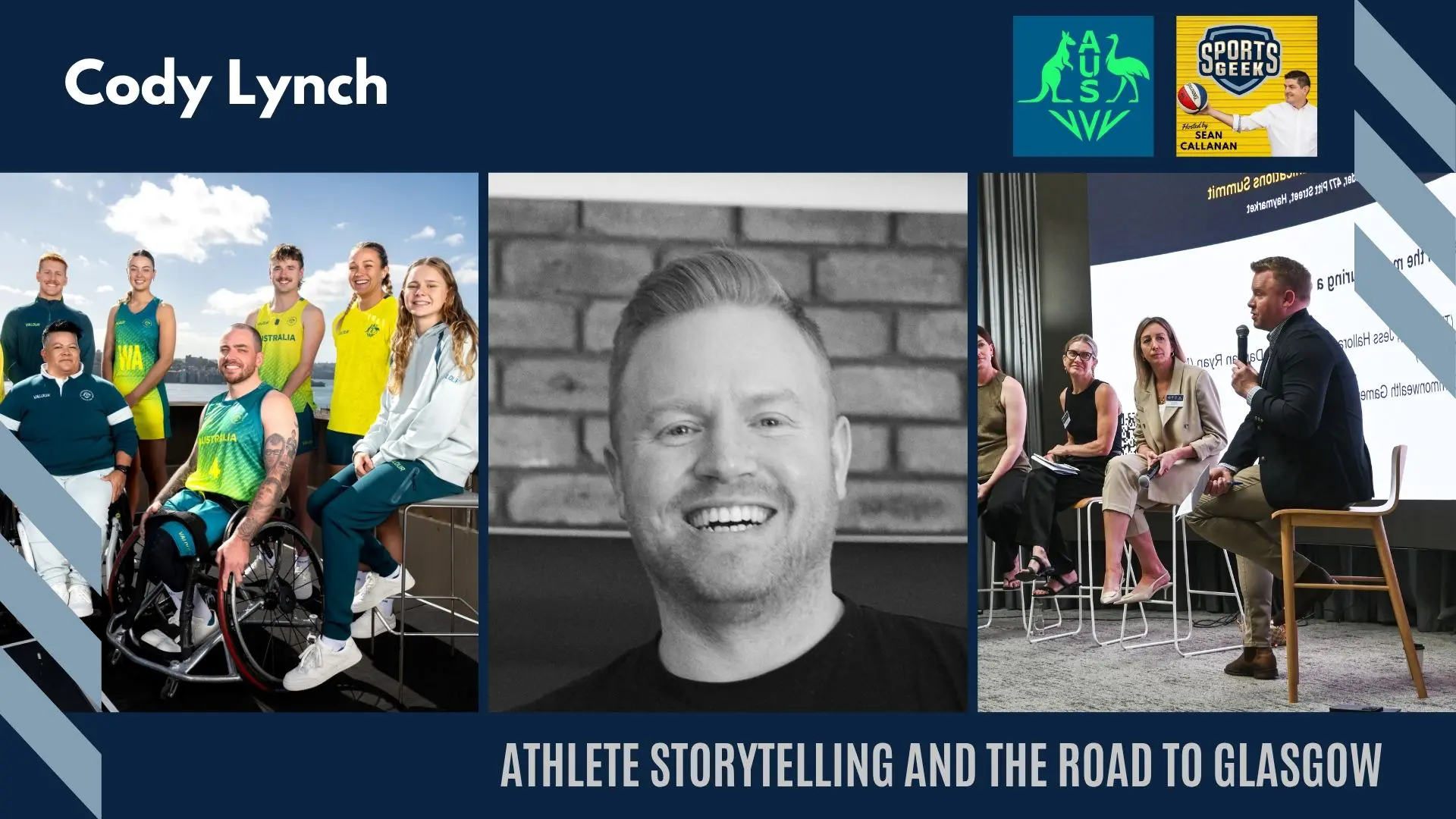
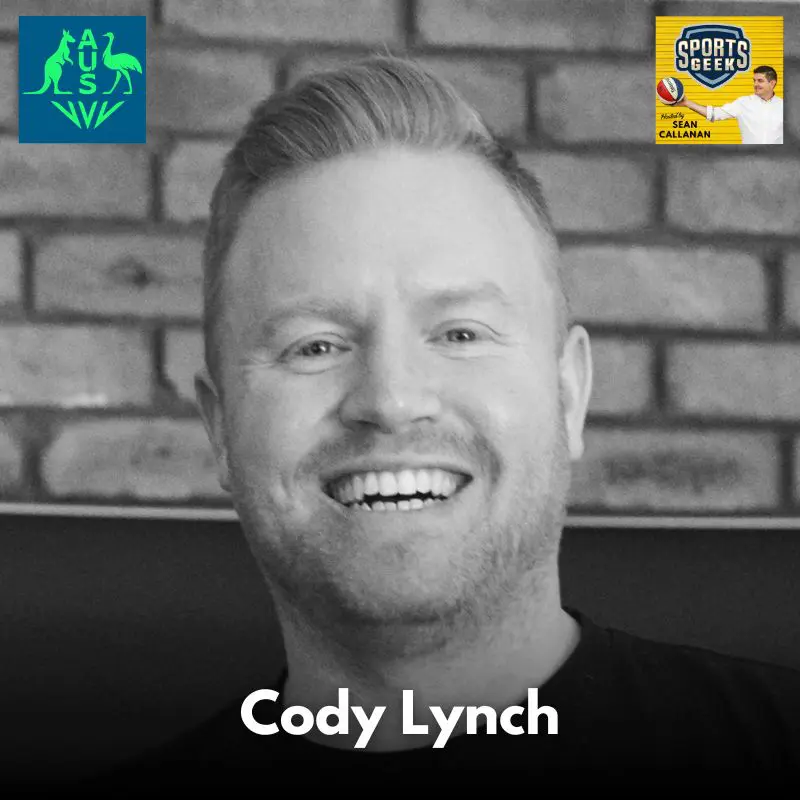
In episode 452 of Sports Geek, Cody Lynch brings a rare combination of Olympic media experience and national body marketing leadership to share insights into major-event communications and athlete storytelling.
In this conversation, you’ll discover:
- How Commonwealth Games Australia's “Unstoppable” campaign was timed and structured around a crowded sports calendar
- Why athlete storytelling has shifted from performance coverage to personal narrative, and how broadcasters and content teams are adapting
- How media liaison at the Olympics is both more demanding and more rewarding than most people imagine, and what it takes to do it well
- The critical role of the Commonwealth Games as a pathway event for athletes building towards Brisbane 2032
- How to balance structured content planning with the nimbleness needed to capture unscripted moments at a live event
- Why authentic, unpolished athlete moments outperform media-trained responses and what sports organisations can learn from Sally Pearson's most viral interview
- How Instagram's collaboration tools are levelling the playing field for sports with smaller marketing budgets
Listen to Cody Lynch on Sports Geek
Can't see podcast player? Click here to listen
Watch on YouTube
Interview Transcript
This transcript has been transcribed by Riverside.fm, no edits (please excuse any errors)
Sean Callanan (00:02.642)
very happy to welcome Cody Lynch. He's the general manager of marketing, communications and community at Commonwealth Games Australia. Cody, welcome to the podcast.
Cody Lynch (00:12.128)
Sean, thanks for having me. Good to be here.
Sean Callanan (00:14.692)
not a problem at all. I always try to get started to help to understand people's sports biz origin story and how they got started in the world of sports. What about yourself? How did you get started in the world of sports business?
Cody Lynch (00:27.712)
probably got started through luck to be honest, Sean. I was
Pulling beers behind the bar at Whitden Oval as a 20-something whilst at university, and landed in a sort of events and marketing role there as a sort of 19, 20-year-old. and that probably sort of started my passion for sports marketing. I actually switched my major to marketing on the back of that opportunity and have been in and around sports since and had the privilege to sort of work for a footy club that I'd barracked for my whole life, which certainly helped. and I'm sh
Sean Callanan (00:59.224)
So for those of you who don't know and listening and don't understand the Wick Novel, that is the home of the the Western Bulldogs in the in the AFL. So you effectively got a job in at the Western Bulldogs as one of your first gigs?
Cody Lynch (01:10.838)
Absolutely. Yeah, it was quite a surprise I think even even for myself. And with the benefit of hindsight, I wonder if I actually had the skill set necessary when I first started. I think
having leaving two and a half, three years later, I think I'd sort of built my skill set, but certainly it was a baptism of fire and if you've had people that have worked in Australian football before on the pod, I'm sure you have, you'll know that it it can be a baptism of fire. It's a very busy environment. The Bulldogs played in a couple of pre preliminary finals whilst I was there and I loved every second but that kind of sort of got me started in sport marketing and it's essentially been my passion ever since working in sort of various comms and marketing roles across the sector for
Yeah.
Sean Callanan (01:51.926)
And so yeah, so you sort of I said took the almost a i internship like learning on the fly, but then you sort of found some of those early roles are really good to find out like what you're good at and what you like. And were you just drawn to the to the media and the and the comms and the and the public relations? Is it something that you wanted to do or you sort of found while you were at the Bulldogs?
Cody Lynch (02:12.298)
Not necessarily while I was at the Bulldog, it's something I actually found sort of coming into my second role, which was I I spent eight years at Australian Athletics, sort of off the back of some time travelling.
Europe and whatnot as a twenty-something and my origins and sort of communications came through that interview process. If if I'm honest, I'd applied for a straight marketing coordinator role. and my line manager at the time, Nicole Roach, identified me for a secondary role that she was taking to market, which was a public relations role. you know, that's the role I stepped into, that's the role I sort of s progressed through to media manager and whatnot at Commonwealth Games Australia across sorry, at Australian Athletics across eight years. and that's kind of where I've sort of
Again, found my passion for communication. So I think you know much of my career has been in the sort of communications public relations space and now here at Commonwealth Games Australia I'm connecting that with essentially what I studied back at uni way way back in the the noughties, you know, a marketing degree and bringing them together with our work in the community into a broader general manager role today.
Sean Callanan (03:14.325)
Okay. And so at Athletics Athletics Australia being the national national sporting body for for all things athletics, was that sort of where you sort of got your I guess insight into, you know, big athletics meets, introductions to to the Olympic Games and the comp games because it's a big part of the athletics world?
Cody Lynch (03:34.123)
For sure. I mean Australian athletics for me was essentially what established the career that I have today. as I said, I was there for almost eight years, you know, starting there as a you know, twenty three, twenty four year old, leaving there in my early thirties essentially, and across that time experienced, you know, a Commonwealth Games in Glasgow. interestingly, I'm going back to Glasgow this year for the games, this side this time with the Australian Commonwealth Games team rather w than just with the athletics team. my first exposure to the Olympic Games in Rio, you know, Paralympic games in twenty
2012. so I think it was an amazing opportunity, particularly as someone in their 20s that got to you know travel the world with the Australian Athletics team and truly experience that global sporting event landscape that we so often welcome to Australia but don't often get to see. so very lucky, a real privilege and well supported. I think Nicole Roach tells me to this day that I owe her a beer for seeing something in me in the public relations space. It's certainly true, because it was a role I had and loved for eight years and it gave
gave me every opportunity to sort of be where I am now.
Sean Callanan (04:37.535)
And so then the other side of I guess your career has sort of been either in that in that sport space, in the NSO space, but then also getting an understanding of the government side of of of of of both populations, but also government's relationship with with sport in in working both with Visivic and the Department of Jobs. What's some of the differences and some of the I guess some of the understanding of like a lot of people listening are in sport but, you know, they work with government as stakeholders and that kind of thing. What were some of the things you were
Cody Lynch (04:56.778)
Yeah, absolutely. So
Sean Callanan (05:06.475)
That were similar and some of the things that were different in those in those two different spheres.
Cody Lynch (05:11.03)
I mean I think I I I would not be telling any anyone something they don't know when you learn the public service has a layer of bureaucracy that perhaps the sporting codes don't. That's something that I certainly had to learn when I made that pivot to Fifth Victoria in the first instance and then the Department of Jobs after that. in terms of similarities, I think that, you know, governments be they the Victorian government, the Australian government, you know, governments globally have a real passion for sport and they see the value of sport in driving participation and keeping people healthy and allowing people
Defined community. that was certainly something that you know the Victorian government leant into when I was working at the Department of Jobs.
And the ministers that I had the you know privilege of supporting through my role in the department and their offices both had real passion for sport. So, you know, Roz Spence was the minister for community sport during my time, Martin Pacula was the minister for tourism and major events. They both had a real passion for their portfolio and that came through. And I think that is essentially what we see in sporting environments too. People that work in sport have a passion for sport. it's something that people kind of find themselves in and they kind of s hang around for quite some time. I think that's n it's not unusual to see people working
in sport for the entirety of their career and you know the pivot to visit Victoria was one that saw me work on their major event portfolio in a communications role. and then similarly in the department it was working across the the sport minister you know the Sport Minister portfolio with Martin Pacula's office. So I think you know the sh the shared
Synergies is certainly passion and it and a real interest in driving participation and engagement with sport. the difference, but certainly the most obvious one, is just the layers of approval and the and the challenges around appro approval and the pol the political nature of the government side of sport. You know, realistically, for me, in decision making around our brand position or our creative campaigns, it's much more focused on what we want to say and how we want to say it. And there's no layer of politics, or there is a layer of politics, but not to the extent
Cody Lynch (07:08.456)
That you see in that political environment where they are considering much more than just what campaign works best.
Sean Callanan (07:16.413)
And through both your role of ath athletics and over the time you've been lucky enough, like you said, to to be at a couple of Olympics in a media liaison role. for those who, you know, aspire and say, Hey, I want to work an Olympics or I wanna be part of an Olympics one, what's the what's your advice on that? And then two, what is it actually like working in in that environment?
Cody Lynch (07:39.619)
well I think my experience of the Olympics is it's it's life changing. Like I've had the unbelievable privilege to work as media liaison at Rio in twenty sixteen and then, you know, was invited back by the Australian Olympic Committee having left Australian Athletics to work on both Tokyo twenty twenty slash twenty-one and Paris two years ago.
It's it's a really unique environment. I think for the sports involved, often the level of attention they receive at the games is not something they experience at any other point in the four years, potentially other than when they compete at Commonwealth Games. and that creates a pressure cooker environment for their staff and their athletes. And I think one thing that the AOC do amazingly is support their sports in managing that environment. The AOC, particularly during my time, have always had a very capable media and communications team that encourage and
Support their sports in storytelling about their athletes, obviously with the lens of the Australian Olympic team over the top. But broadly it's an environment where athletes come to the fore often for the first time and become household names. Like I think so many of our true Australian icons found their fame at an Olympic Games. you know, Catherine Freeman being the most obvious example for those of
our age or older, but in more recent times, people like Jessica Hull, like to be in the venue the night she won that silver medal was truly remarkable. To be there for Nina Kennedy's gold in the pole vault, for Matt Denny and the Discus. it's yeah, i it's an insane experience. But it's also a really unique in environment whereby they are long days and the glamour of the games are perhaps the experiences that you have in venue. But broadly it's
you know, buses to and from venues, managing media. We're not out, you know, club hopping in the host city or anything like that. It's quite a hard and strenuous environment and one that really runs for three weeks without respite. So you go in knowing that and then you fall in a heap on the charter flight home, essentially. but it's it's a a truly amazing experience.
Sean Callanan (09:32.534)
Yeah.
Sean Callanan (09:43.021)
Yeah.
I mean that that piece you were talking about about that support and the I guess the inundation of of requests and and it and attention, you know, we've done we've done some similar training and stuff with with teams, especially as the rise of social media, you know, they are a complete unknown, you know, before they hop in the pool or hop on the pitch and then s and then everyone in Australia and everyone around the world is w is watching them and it they're they're accessible. Has that media liaison role changed with, you know, the inundation of
social media and also the I guess the fr the the the way that the media has has changed from, you know, traditional here's the three ch T V channels that are tuning into all of these digital platforms and all of these different ways that that that can that are communicating and talking about the games.
Cody Lynch (10:28.224)
Yeah.
Cody Lynch (10:33.248)
Well there's certainly a broad consideration for digital media now. I think it sort of fan forms part of the media mix. The athletes and how they behave on social media is essentially how they set the tone for who they are in their media engagement.
But I think that digital media I don't think the role of media liaison has necessarily changed. Like in my mind, I approach the role as being both supportive of media but equally supportive of athlete. So the first person they essentially see coming off the field of play is their media liaison. They've done a broadcast interview before they get to you and then they move through, you know, the traditional media mix zone and go on to potentially press conferences and other media on the back of their performance. So I see myself as someone that
has to respond to how they are feeling and how they are sort of behaving in that environment. And I think good media liaisons support their athletes as much as they support media. It's a really delicate balance, but essentially you need a strong relationship with both. You're not there simply to service the media, you're there to support the athlete. In terms of how digital media has perhaps changed the approach, I would argue it's perhaps changed how traditional media and broadcasters come at covering the games. I think that they are much more focused
Focused on storytelling now than they are necessarily about performance in isolation. It's not a story about how the individual ran or swam or jumped. It's actually a story about who the person is and their background. And we see that today. Like to use our work with Channel 7 at the moment on the Commonwealth Games, they've got a brilliant team that's charged with building the story of the athletes that will compete in Glasgow. It's not necessarily about every athlete coming in expecting to win a medal. It's about people that have come through adversity or explained, you know, displayed it outside.
understanding grit or determination or have an interesting background. That's as much part of the story now as performance, and I reckon that's potentially the shift as a consequence of digital media and the way that it introduces athletes to, you know, populations outside of their regular sphere in the lead up to and at games.
Sean Callanan (12:28.373)
So in your role now leading comms and marketing for Com Games Australia, how how has I guess how has your focus changed knowing that, you know, the platforms are have have got different asks, you've got athletes with varying degrees of their own brand and their own their own media channels. How do you I guess shape what what you want to get out of the media platforms and and the opportunities that are there?
Cody Lynch (12:32.106)
Yeah.
Cody Lynch (12:46.836)
Yeah.
Cody Lynch (12:55.2)
So I think Glasgow 2026 in particular presents a really unique opportunity for the Australian Commonwealth Games team. You know, I probably don't need to introduce to your listeners that the challenge that the games movement has had since the cancellation of Victoria three years ago. I spoke glowingly about my time at the Department of Jobs. So I probably don't speak as glowingly about the cancellation and the impact that had on you know the Commonwealth sport movement. Broadly, I think the movement has recovered. We've got a host for 2026, we've got a host locked for 2030, which will double as
the centenary of the Commonwealth Games in India. There's a host for the youth games next year in 2027.
But one of the things that we don't underestimate is the sort of brand repair job we have to do, the the reintroduction of the games to Australian Australian audiences beyond the cancellation. So we're coming at it probably in a sport based approach, understanding what they're seeking for their athletes and how they want to manage media and environments for their athletes. But additionally we're working with athletes that have a keen interest to tell their story, to bring them to the fore, to make sure we can lean into their path
pathway as an athlete, particularly as we approach a home Olympic and Paralympic Games in twenty thirty two, our focus is on young athletes, people that'll be around for the next five, ten years. because they have the potential to be the next Catherine Freeman. and I think that realistically we would be doing ourselves a disservice if we didn't
showcase them as individuals in the way that we storytell. And I think one of the great things we're finding, particularly with the sports that we're working with on the road to Glasgow, is that they get that and they know that the athletes see this as a critical opportunity to s present themselves to an Australian audience. Seven understands that seven are looking for new narratives, seven are looking for new athletes that are going to be around for some time, while also showcasing those that have have the runs on the board essentially. People like Cam McAvoy, who gets the chance to compete in the 50-meter
Cody Lynch (14:50.624)
Freestyle in Glasgow, the first time it's been on the swimming program, but comes in as an as an Olympic medalist. So, you know, realistically, it's a balance, but broadly it's about you know storytelling and utilizing the opportunity to repair some of the perceptions that sort of came as a consequence of the cancellation in 2023.
Sean Callanan (15:10.569)
And so we're recording this and and it's fifty five days I think until the until the opening ceremony and obviously there'll be a lot of exposure and a lot of coverage when it's on. There's a lot of happening in that space. Is it there'll be a World Cup of football happening at the at the at the at the same time. So how do you how do you extend that period and and and start I guess raising the profile, start telling those stories so people know who to tune into or or know who to follow or you know, know which which sports when 'cause it
Cody Lynch (15:24.852)
Yeah.
Sean Callanan (15:40.321)
There's some unique sports also in the in the i i at the Commonwealth Games to to tune in. How how are you gonna start drip feeding that to the to both the Australian public but just anyone who's a fan of of Commonwealth Games?
Cody Lynch (15:51.605)
Yeah, very busy calendar this year. So shout out to Julian Linden in particular. He's actually headed to the World Cup for Newscorp in like a week. He's there for six weeks. He then comes to Glasgow and then he goes back to the US for Pam Packs with the Australian swim team. So he knows how busy the calendar is in the next couple of months, as someone that we work with quite a bit. I think for us, again, we've
Focused on what our market research is telling us. In 2024, we did an extensive market research piece on perceptions of the Commonwealth Games, perceptions of the Commonwealth Games team on the back of the cancellation to understand how Australian audiences engage with the games, the athletes, the sports. it didn't tell us anything that we didn't necessarily know, but it probably confirmed our thinking that realistically we have a short window to capitalise on the Commonwealth games, but during that window, Australian audiences do absolutely engage with
Success and absolutely engage with athletes that you know present Australian values, so to speak. So people that are determined, people that show sportsmanship, people that have come through adversity. So our campaign for Commonwealth Games this year is entitled Unstoppable. We've worked with TGI Wildcar to deliver that. I mentioned grit determination resilience. That's the theme of the campaign. It's about showing how athletes prepare and show up to be their best at games. And from a timing perspective, to your point, given how crazy.
Out at the market is we only bought that campaign through the line last Monday. So this first four week burst is really focused on digital media and working with Meta and TikTok to introduce the Commonwealth games to a younger audience, an audience that we don't often talk to through traditional media, making them aware that the games are coming, the athletes are coming, and the personalities behind those athletes, you know, are great and worth engaging with. We move to an out of home execution and some collaborations with Seven as we draw closer, and we know that those who have a
a long time affiliation, be it with Olympic, Paralympic or Commonwealth Games, they start tuning in two or three weeks out because you start to see it daily in the paper, you start to see it daily on your news bulletin. So we're really focused on capitalizing what I think is actually a 77 day campaign.
Cody Lynch (17:57.211)
Around Glasgow, and we know that we'd be, you know, wasting our resources to bring it to market any earlier than what we have because one, we wouldn't necessarily have budget capacity to do it justice, but two, people aren't paying attention for the reasons that you mentioned. There's things like the Australian Open, we then move into the football codes, we've got the World Cup this year, we had Winter Olympics and Winter Paralympics. We had to get our timing right, but we think we've struck the balance to introduce the sports, the athletes, the people they'll be watching to Australian audience.
At the right time so that we get the appropriate peak once the games do start on the twenty-third of July.
Sean Callanan (18:33.929)
you've had you obviously had experience at Athletics Australia and a lot of the sports in the comp games have a large participation base. And it's always that that piece of a sports market of should I go talk to a fan, someone that sits on the couch and doesn't do anything, or should I be talking to the people that are out there, you know, running laps, swimming laps, playing hockey on weekends? How much of yours is to of your, you know, plans and marketing are to talk to people who are playing those sports? Like someone who plays hockey on the weekend will want to watch
Cody Lynch (18:36.82)
Yeah.
Cody Lynch (18:42.347)
Yes.
Cody Lynch (18:54.667)
Yeah.
Sean Callanan (19:03.489)
You know, wanna watch hockey, the netballers and wanna see the netballers perform on the big stage. How much is it connecting to that grassroots and community sport that there's so many people in Australia that that that continue to play every weekend?
Cody Lynch (19:06.26)
Yeah.
Cody Lynch (19:14.986)
Well, we've probably come at it in two ways. We work with our sport members and those that are on the programme for Glasgow to talk to their existing audiences. We know they've got a captive audience. We provide them with assets. We collaborate with them on assets and other content to bring to life the build up to games and make sure they've got that what they need to inform their audiences of Glasgow Fast Approaching. From a campaign perspective, you know, our primary audience is sport fans. we know that we talk to those aged older than thirty nine through the broadcaster.
Through News Corp, through the nine newspapers, through the ABC, they they will learn about the Commonwealth games through those more traditional mediums more often than not.
We struggle to talk to a those aged eighteen to thirty-nine, which is why our campaign has a focus on digital executions in the first four weeks primarily, but that runs essentially for the seventy-seven days that we're in market, because they won't consume necessarily the evening news bulletin. They won't read the paper every day. So we need to talk to them in other ways. And we're doing that through some, you know, specifically identified talent that bring to life our campaign. So for context, we're working with Lachlan Kennedy in athletics, with Harney Watson in Para Powerlifting.
Jesse Moore in gymnastics. These are athletes that exhibit the
qualities the campaign obviously talks to and then we're targeting them through digital media. So I think in terms of how we we are talking to sports fans. They are our primary audience. If we get someone that's not a sports fan as a consequence of the games being everywhere, that's fantastic. But we know it's sports fans in the first instance that actually need to be introduced to the games again because even as a sports fan, it's a very crowded market and you can consume many, many sports over many, many weeks and months.
Cody Lynch (21:00.758)
But we want you to consume ours for about 12 days come July, and we want you to start being interested about a month before that.
Sean Callanan (21:09.823)
And you think like being able to use some of those athlete ambassadors that are, you know, you would say they are digital natives, that's they're the platforms they're on, that like that is one of the big opportunities to to, you know, people to be f following them, you know, via TikTok, via Instagram and then and then coming around to sort of d have have a deeper engagement with the with the com games?
Cody Lynch (21:32.663)
Absolutely. Like I mean, I if any of our athletes are listening to this podcast, I want you to collaborate with me on any piece of content you are publishing between now and the games. Of course you won't. You have your own brand partners and whatnot. That is completely understandable. But for us, collaborating with athletes, those digital natives that you spoke about
Are how we talk to audiences that we don't get through traditional media. We've done that with Lockie Kennedy. Our partners are doing that as well. You know, we've we're very lucky to have a you know comprehensive partner family in with you know brands like Amy, Harvey Norman. they're working with athletes that either have a large public profile or a building public profile to tell their brand story through the Commonwealth games and the athlete. Each of these touch points essentially introduces us more to the market. That's what we want, but we are absolutely working with.
where we can those that are capable and continuing to use digital media as a means of bringing themselves to life because that in turn brings our brand to life.
Sean Callanan (22:33.201)
absolutely. I mean and that's the thing I'd d is there when you're comparing the Com Games the Olympic Games, like we've I've discussed on the on this podcast with a few people on the Olympic Games, that there's a lot of rules with the Olympic Games. Is there a little bit is there things a little bit looser and a little bit is there a bit more freedom with the com Games?
Cody Lynch (22:49.887)
I don't think loose is the right word. I I I un I understand where you're coming from. I do appreciate the Olympic environment and the and, you know, the the commercial realities of that environment. I think
Sean Callanan (22:53.783)
Hmm. Yeah.
Cody Lynch (23:01.662)
I'm an I'm I suppose to be honest with you, I'm an advocate for that environment. I now working at Commonwealth Games Australia and having sort of been peripherally involved in the commercial program at the Australian Olympic team, just you know, being on that team. The commercial programs for both organizations are what fund teams to games. We're not government funded, we're independently funded through our commercial programs and our investment portfolios. we work hard on our commercial program. and I think athletes appreciate that we also
Sean Callanan (23:14.605)
Mm-hmm.
Sean Callanan (23:20.29)
Yeah.
Cody Lynch (23:31.559)
invest in them. So to use the Commonwealth Games Australia example, this quadrennium we're spending $13 million on performance investment, you know, initiatives that encourage or support the Australian Athletics relay teams, for example, classification for our power swimmers, you know, kit design and sort of technology for our cyclist. So we we do invest in athletes beyond that game's period and I think that they appreciate and understand sometimes through gritted teeth, but they do appreciate and understand the need for us to maintain that commercial boundary around
our games environment.
In terms of whether or not it's looser at Commonwealth Games, that's probably not the case. We certainly do still have a games period whereby athletes are bound by our partners. but I think what we aim to do is still work with them in a way to bring them to life as individuals so that when they exit the games environment, they've got a narrative, they've got a public profile to take to a potential partner. You know, we're not beholding athletes to our partners for an extended period. The games period is about three weeks. and for
For some, there's ambassador opportunities within our program, so to use Amy, they are working with Carl Chalmers and Jess Hall and Lockie Kennedy on an ambassador relationship as well as some para athletes including Hani Watson. So we're doing what we can to give athletes opportunity within the confines of our commercial programme, whilst also working with them to elevate their profile so that they've got you know a commercial opportunity to pursue on the back of the game's environment.
Sean Callanan (25:01.129)
Absolutely. And that is the that is the opportunity. One, they're there to perform and and win, but that that profile bump, you know, can be commercialised at a at a later date and and it like it like it can s you know, it can set them up. And you know, you've used Kathy Freeman a few times, so you know, and one of her first big, big ways was was at a Commonwealth Games. Like that was one of her first first wins that that did set up what was Sydney two thousand.
Cody Lynch (25:10.388)
Yeah, absolutely.
Cody Lynch (25:16.34)
Yeah, and I think another great example's yeah. Yeah, exactly.
Cody Lynch (25:25.642)
Yeah, I you know, so you've got Catherine Freeman, Victoria nineteen ninety four, she had that iconic moment with the indigenous flag, it was quite controversial. She essentially then became, you know, the face of Australian Athletics through Sydney two thousand. Ian Thorpe introduced through Kuala Lumpa nine in ninety-eight, again face of Sydney two thousand and again in Athens two thousand four. I think even more recently than that, you know, the performance of Ollie Hall, for example, in the men's fifteen hundred metres, four years ago in Birmingham was one that captured Australia's attention. I think that for Olli it has sort of set him up as a atr you
A track and field athlete with profile. He was already an established athlete, but it gave him that, you know, ability to use his profile for his benefit on the back of Birmingham. And I think for us at Commonwealth Games Australia, we don't position ourselves as a twin to the Olympic Games or the Paralympic Games. you know, we are both a pathway event for a number of sports, like I you know, at so many Olympic and paralympic medalists win medals first at the Commonwealth Games. I think
The statistic is, you know, 46% of Australia's Olympic athletes debut at the Commonwealth Games before going on to Olympic or Paralympic Games. So I think for us we see ourselves as a pathway event to build athletes' profile, to build athletes' public recognition so that they can become the Catherine Freeman, the Ian Thorpe, the Sally Pearson, whatever it might be at a future Games. but we're also a a critical pinnacle event for two sports in particular. You know, the Australian Diamonds at this stage, as they sort of pursue a Brisbane twenty thirty two bid, this is their
Olympic Games, for want of a better term. And same goes for our Bowls team. one of the most undervalued sort of teams. They are a brilliant cohort of people, fantastic stories. We announced their team last week, including a seventy-six-year-old great-grandmother who's debuting at the Commonwealth Games for the first time. She is a cracker. and for them this is their again, to use that quote, that they're Olympics. so we really support that for them too.
Sean Callanan (27:14.167)
Yeah.
Sean Callanan (27:21.505)
So you've sort of spoken about I guess the brand campaign and getting the messaging out and working with the partners, but the games, you know, when it is on, it is you're rolling, you know, there's no c set content plan, you know things are happening and you know p performances might happen. How do you how do you get your team ready to take advantage when those, you know, golden moments or even just awesome stories happen?
Cody Lynch (27:27.348)
Yeah.
Cody Lynch (27:35.732)
Yeah.
Cody Lynch (27:48.18)
Yeah.
Sean Callanan (27:49.25)
How how do you manage them both from your channels but then also, you know, with your partners, you know, like channel seven and with your media partners to I guess you know, push that as far and and as hard as you can?
Cody Lynch (28:01.076)
Yeah, so the campaign probably takes a back step once the opening ceremony starts. If we haven't got you by then, we're probably either not gonna get you or you're going to engage once you see something impressive. So we shift to a really content-led focus. to give context to the team we're taking to Glasgow. We're traveling with a team of sixteen digital media or media liaison staff to Glasgow to cover the ten sports we've got on the ground. our intention is to have a media liaison and a content officer in every venue at every point of the
games. They are charged with bringing the stories of the games to both the media in attendance and to people through our own digital media platforms and those of the athletes and those of the sports. So our focus really becomes to your point about capitalizing on the moment. We will go with a content plan. Like we know the men's hundred meters is the 24th of July. So we will have a plan for the men's 100 meters. We know that the first medal to be won is para powerlifting. We know we're a big chance in both the men's and
women's events for those for that sport. So we'll make sure that we're ready to respond to that when it happens. We're working with Seven on how we do that in their content planning. We're working with our media partners in our traveling media cohort on their planning. And we're working with our commercial partners. So again, they are considering their ambassadors when they're competing, how they leverage their competition. So we're coming in as planned as we possibly can, but the things we can never plan for are the moments that probably make the games excited.
So that's where we just have to be nimble and we need to just muck in where we can. And to go back to the conversation we had about the Olympics, that's probably where the games environment is truly unique, whether that be Olympics or Paralympics or Commonwealth Games, more often than not, the biggest story isn't one that you've got in your content plan. So you just need to be ready to respond to that as and when it happens.
Sean Callanan (29:56.97)
And so for all your whether it be your media liaison officers, your content offices, is it is it just a case of keep filming or you know, if you think there's an opportunity and or you should hand your phone to this person and they can talk directly to it? Like, do you sort of have that and then and then have sort of some processes in play to say, yes, we tick, tick, tick, yes, we can post that, but you can't post something you don't capture, you know, like whether it's a a tearful, tearful hug with a coach or
Cody Lynch (30:22.143)
Yeah.
Sean Callanan (30:25.461)
that's their mum. I didn't realise their mum was in and their mum's walked down and and like you would love the broadcaster to catch it, but the way the media works now, yeah. Hm.
Cody Lynch (30:28.394)
Yeah.
So we plan we plan for it as much as we can. Like we plan for it as much as we can. So like we will know, obviously who's competing and on which day and at what time. We will know if their mum or dad are there, if their mum and dad are in the stands or if their mum and dad are at home, or their family or whoever else might be watching them. Like we'll have an understanding of that. So we can plan for a lot of that stuff.
I I think what we can't plan for are the moments that you don't necessarily anticipate. So I think for example in Gold Coast twenty eighteen there was a brilliant moment where the three Australian ten thousand metre runners waited for the last athlete to cross the line. Your testing moment here it was, I know one was Jess Trengove and one was Eloise Wellings. I apologise to the third athlete, but they waited to meet the final finisher in the women's ten. It became a really iconic image of sportsmanship. It was obviously captured in venue by Seveners, the broadcaster and by photographers. But it
Gave a really moving moment to the Australian Commonwealth Games team that we hadn't planned for in the content plan, or they hadn't planned for in the content plan. And I think that's where we need to have the people in place to capture those moments. So Seven will be in every venue. Of course, they're working with the host broadcast to ensure they get essentially continuous streams of sports across all days. We'll know when Australians are on, we'll be there to respond to moments like that. And similarly, my team, the content officers, the media liaisons, our videographers.
of which we're traveling with two. We'll try to get them around as much as we can to cover those moments. If we miss them, well there probably aren't a moment, but th the ones that we capture we'll be able to make, you know make good opportunities out of, I suppose.
Sean Callanan (32:07.895)
But it is that I guess that permission to go and seek it out and then just having the right processes in place to go from it's been captured, where does this best go? That's something that is all fluid, but you just gotta make sure you have that process. so whatever is captured gets to the right place and like there is no there is no it must be our channel, their channel is like where's the best channel for it and what's the best outcome for the Commonwealth games?
Cody Lynch (32:22.965)
Yeah.
Cody Lynch (32:26.698)
Yeah.
Cody Lynch (32:32.596)
And that comes back.
And that comes back for the most part to our relationship. We have a brilliant working relationship with Seven. They've been so fantastic. I think, you know, for us at Commonwealth Games, the real shift in narrative around Glasgow 2026 and perceptions of the games in a lot of ways, they changed when Seven were announced as broadcaster just shy of one year to go. It made people realise that there was a continued interest in investing. It really invigorated our commercial program. and I think that was a really crucial moment. So our relationship with Seven is super important to doing exactly what you're doing.
saying bringing to life these stories we don't expect. And similarly the relationships that my team have, or you know, the traveling team that I have have with both athletes, the sports, the families of those athletes, building that rapport gives us the intel we need to find those moments, unless they are completely and utterly unscripted, and then it's working with the relevant individual to sort of capitalise on them should they happen. You know, another example I think was Ashmalone and his bronze medal in Tokyo and the decathlon was a phenomenal story.
but his relationship with Cedric Dubler and the way they worked together in that final event to get him to the point score he needed was equally a good story and then it became a matter of managing the two of them as athletes so showcasing the bronze medalist importantly but additionally showcasing the sportsmanship of Cedric and just having that rapport with the athletes is critical to bringing the story to life and that's the role of the team that'll travel for us from a digital media and content perspective but then additionally the relationships we have with both media and our broadcaster.
Sean Callanan (34:05.165)
So digital and and comms and marketing has a lot of ha a lot of KPIs, but sometimes it's hard to quantify success. What's a successful games look like for you?
Cody Lynch (34:10.08)
Yeah.
Cody Lynch (34:18.026)
A successful games. so I think hand on heart, we've not necessarily put any specific metrics like a 20% increase in social media followers, or you know, we we've not really done that. And you know, with the support of our team executive, my CEO, our board, they're not necessarily chasing that. I think for us a successful games will be bettering the metrics that we saw in Birmingham. Birmingham was a great success for Commonwealth Games Australia. 72% of Australians watch.
Sean Callanan (34:26.849)
Hm. Yeah. Yeah.
Cody Lynch (34:48.08)
Read or listened to coverage of the Commonwealth Games, 62% of those people felt proud about what they saw or wanted to then participate in sport. If we can match that as a metric on the back of Glasgow performances, that would be a win for us. 11.1 million Australians watched the 7 coverage of Birmingham. If we can match that or better that, that is success for us. And I say that because we can't quantify the reputational damage of the games through the cancellation.
So we want to make sure that we at least match what we've seen previously and do our absolute darndest to better it. And we're doing that through the campaign we've got, through the storytelling we're working on with athletes, through the relationship we have with Seven, and through the relationship we've got with the traveling media to Glasgow, just to bring what happens on the ground to Australian audiences here at home.
Sean Callanan (35:40.616)
absolutely. And that's the thing. Sometimes KPIs can send you in the wrong direction because if someone, you know, is doing a digital channel or a social channel and they're just focused on them, then you don't get that rising tides lift or boats of ever you know, th this b this bit of content will actually draw someone to the T V. Who might draw them to short clips over here, who might draw them to reading an article, who might draw them to a to an athlete if it's like you wanna be the you know, you wanna be the bigger person or you wanna make sure every bit of content is
Cody Lynch (35:54.016)
Correct.
Sean Callanan (36:09.581)
pushing that message, you know, it doesn't have to have a tune in now on seven on every single caption, but like it should be the emphasis that it's, hey, we're growing the whole game, we're growing the whole story. and it's it's it's an easier one to tackle as a
Cody Lynch (36:14.283)
No.
Cody Lynch (36:20.574)
And I think that's athletes
I think that's absolutely true for us. Like to your point, for the metric th in this instance is about bringing people on the journey and, you know, making sure people are aware and engaging with the Commonwealth games and seeing, you know, rising tides lift all boats. Like that's absolutely what we want. If you were talking to the head of media and public relations at the organizing company, her KPI is very different. They've got five hundred thousand tickets they need to move, they've got a commercial program that they need to extensively service. We do as well, of course, but you know, for them there is so much more ride.
Sean Callanan (36:44.161)
Yep. Yep.
Cody Lynch (36:53.108)
On the campaign that they deliver to market because it is much more based on conversion. Whereas ours is much more based on awareness. It's much more based on having people engaging with the games and learning more about the sports, the athletes, and how they can follow them, not just through Glasgow, but through through LA in 2028, be that the Olympics or Paralympics through the 2030 Commonwealth Games in India, and hopefully for some athletes, all the way through 2032, and the unrivalled opportunity that a home Olympics and Paralympics presents.
The whole Australian sports sector in 2032, whether you work for Commonwealth Games Australia, a national sports organization, Paralympics Australia, the Australian Sports Commission, for all of us, Brisbane 2032 is the ultimate end game, and our role at Glasgow is to sort of support beginning to tell the story of some athletes that will continue through that opportunity.
Sean Callanan (37:45.234)
absolutely. And that's the thing. It you don't you like, you know, you you've probably got in your plan, we'll have four or five viral moments. You can't plan them, right? You can't plan them. They will they will happen, and they'll only happen if you're you know, it'll only happen if you're posting. One of my favorite favorite stories is working with the hockey ruse and they were a terrific bunch and they're like, How should we do social? I said, Well just just do it as you would normally do it and have fun with it and you know, if you want to have fun, that you know,
Cody Lynch (37:51.286)
No, you can't plan them.
Sean Callanan (38:14.241)
That's what you want to do. And they took that approach and the Cookerborough went down to a more professional lockdown. We're not going to do any social. And they both went into the Commonwealth Games. And that was the Commonwealth Games where the girls took a selfie in and the Queen photobombed them. Right? Right. Exactly. And exactly. And and like if they weren't having fun and taking selfies at training, that never, never would happen. And they just created an environment where we're not going to take the pressure of social, we're going have fun with it.
Cody Lynch (38:26.817)
Glasgow. Glasgow twenty fourteen that was. We're going back. We're chasing King Charles this time around.
Sean Callanan (38:43.937)
And they got permission with their coach and that was sort of their loose plan. And yeah, because they were having fun with it, you know, the Queen photobombs their f photobombs her selfie. Yeah, you can't plan for it, but it doesn't happen if you don't set up that environment.
Cody Lynch (38:56.692)
That's right. I think that actually might have Gold Coast now that you say that. But broadly I get what you're saying. And this is I mean, funnily enough, you must be listening to the conversations we're having with sports and with athletes. Like we we want honest, truthful, engaging storytelling. you know, one thing I think that potentially r undermines any great campaign, any great approach to media is, you know, those almost generic, un over prepared media lines. look, I you know, as I say, I I worked at Australian.
Sean Callanan (39:00.628)
Mm. Yeah.
Sean Callanan (39:20.417)
Over prepared. Over over over sp over briefed. Yeah.
Cody Lynch (39:26.616)
Athletics for eight years. I started there in 2009 and had the great privilege of supporting Sally Pearson in her amazing career. but I think her most viral interview was the one in 2008 where it was genuine and it was raw and it was, my god, did you see that? Obviously she became a remarkably capable media professional, but that honest moment
is is what works best and I think that any athletes should look at that and take comfort in being themselves because I think Australians can additionally see through when an athlete isn't being themselves and it's probably not gonna work in their interests longer term.
Sean Callanan (40:05.777)
absolutely. It's and it's when Australia falls in love with an athlete 'cause they can see who they are. so Cody, I really do appreciate you taking the time. I want to get to the sports geek closing five. Do you remember the well, that's right, some people make notes. This is these are the questions that people rack their brains over. There's no wrong answers. You can't Google the answers 'cause they're yours. but do you re do you remember the first sports event you ever attended?
Cody Lynch (40:16.414)
I made some notes. I made some notes on these.
Cody Lynch (40:25.715)
Okay.
I don't remember the s first sports event I attended, but I remember again talking to Whit Novell, home of the Western Bulldogs. I do follow them, I did have the privilege of working for them. I vividly remember the final game there in 1997. It was a really wet day. the Bulldogs got over the line really late. and essentially it was as the club was moving from being Footsgrade to the Western Bulldogs in the new environment, they were going to start playing games at what's now Visi Stadium or whiche whatever Carlton is these days.
the Carlton Stadium is these days. So like I that's one of the first moments I remember as coming together as a family. I think I was like nine or ten. it was a historic game. And I think for me and for my family in particular, you know, we're from the Western suburbs of Melbourne. Many of our friends and family barrack for the Western Bulldogs. We, you know, barracked for them for thirty years, or for me, before I saw them win a flag in twenty sixteen. So I think it's always been part of my sporting story and seeing
Sean Callanan (41:06.605)
That's a pretty historic game.
Cody Lynch (41:29.14)
them at that game is it's certainly an afternoon I vividly remember back when I was like nine or ten. I also remember losing their preliminary final that same year, but I won't make that a highlight. He's right. It definitely went through.
Sean Callanan (41:35.241)
terrific answer. No. No, no. Yeah, yeah, Libba still thinks it went through the the big sticks. you would have been a lot of different sports events in your in your time. Do you have a favourite food or a favourite food memory at a sports event?
Cody Lynch (41:52.641)
Maybe a funny food memory. So there was this remarkable frozen asai at the Stadio Olimpica in Rio that we ate virtually every day. I've not eaten it since. I've not had an asai bowl since, but it was a great little treat to get through the hot afternoons of Rio. but more often than not, I'm I'm a pretty traditional sort of
Sean Callanan (41:54.86)
Yeah.
Cody Lynch (42:12.062)
pie and schooner kind of guy at sport, particularly here in Australia. but I do rem viv vividly remember the frozen asaies at the Stadio Olympica in Rio.
Sean Callanan (42:23.395)
terrific. sport can come at you, especially when you're working in a global sport, come at you at different times. What's the what's the first app you open in the morning?
Cody Lynch (42:33.406)
I shouldn't admit this and my wife gets really frustrated by it, but it's probably Outlook. I know that sounds really depressing. and and more often than not, there's not enough emails in there that warrant me opening Outlook, but I think it's a bad habit that I need to try I need to try and break. In terms of s in terms of sports apps
Sean Callanan (42:39.777)
No, they there's this
Sean Callanan (42:48.841)
It it it is. Yeah, you're not the you're not the first person you're not the first person who also admit that, so it's it's it's quite common.
Cody Lynch (42:53.91)
In terms of sports apps that I open, it's probably the Supercoach app. I'm in a league with 15 other blokes, and we my team is doing terribly this year, but it's still something that I pay probably an unnecessary amount of attention to each week.
Sean Callanan (43:12.034)
that's fine, that's fine. is there someone that that you follow? It might be someone you follow online, it might be a former former colleague, it might be an author that the podcast listeners should give a follow on why?
Cody Lynch (43:25.758)
Well the first.
The first account they should follow is at Com Games Oz, where across Instagram, Facebook, TikTok, we will be obviously running a very significant storytelling campaign of all of our athletes on the road to Glasgow. So first and foremost, follow us. We'll be the home of news on the road to Glasgow. I'm actually going to shout out to an athlete that I met last week, who I now follow on Instagram. His name is Daniel Boss. He is a para power lifter competing in Glasgow as a debutante. His Instagram handle is I'm gonna say it's Boss A, B O S A.
A Y E, quite a unique athlete, and again coming back to storytelling, he's a short statured athlete who benches in training and hopefully in competition lab this year 153 kilos. he is a bodybuilder, which you can see quite extensively on his Instagram account. But then also just for fun, he's currently starring in the latest series of Spartacus. So his account has a bit of everything. he's one to watch in Glasgow, so follow him. we met last week, he was involved in our
Sean Callanan (44:09.186)
Choice.
Cody Lynch (44:26.52)
President's dinner that we held in Sydney as part of a a series of events we had up there and I reckon he's one to watch come the games this July.
Sean Callanan (44:34.258)
absolutely. And the last one, and you can answer this personally and then professionally with your Com Games hat on. What social media platform is your MVP?
Cody Lynch (44:39.638)
Mm.
Yeah.
I'm gonna stick with Instagram, and I think this is because well, one, the for the primary reason for that is sport and all the emotion of sport, as well as all the movement of sport, either photographs or can be shot in an amazing way. And Instagram, I believe, remains the best platform for that to be celebrated. to put my Commonwealth Games Australia hat on, the extension that we now have around collaboration is critical, particularly for our sport members that don't necessarily have big marketing budgets, that capacity to collaborate.
and reach new audiences is key. so I'm gonna stick with Instagram as my MVP. That's certainly not very modern, perhaps I'm showing my age, but I think for the for the sector that we work in, it's the a great medium to bring to life what we see on the field of play.
Sean Callanan (45:22.657)
That's
Sean Callanan (45:30.997)
No, absolutely agree. it's not an outdated opinion. Insta is still is still often the VP nominated and it yeah, it's so multi it's versatile, it is multi generational for you know and it and it does offer some really good commercial outcomes for for teams. So I really appreciate you coming on. I always ask people who are listening to the episode if they want to reach out and say thank you, please do so. What's the best
Cody Lynch (45:34.08)
Ha ha.
Sean Callanan (45:58.554)
way or platform for people to reach out to you, Cody.
Cody Lynch (46:01.754)
best way to get me is probably on to use another platform. Cat you can get me on LinkedIn. obviously Cody Lynch, that's my name, you'll find me on there. happy to have a conversation with those that are interested in, you know, the space that I work. I I sort of started this conversation by saying it's an absolute privilege and it really is. I think
You know, I I I'd like to think I know a little bit about what I'm doing, but I've also been very lucky to land in the roles that I have. I think that many people would envy the opportunities I've had. So yeah, happy to support anyone trying to crack the market because it is a fun place to be. There's nothing surer.
Sean Callanan (46:34.273)
Well, really do appreciate it coming on. all the best for the com games. Hope you do get those viral moments, those great stories, and and you know, get and get the recognition for the performances, the athletes and and the stories around it across the entire games.
Cody Lynch (46:41.216)
Ha ha.
Cody Lynch (46:51.53)
That's the plan, fifty-five days to go and hopefully many, many, many Australian medals. So bring it on.
Sean Callanan (46:59.779)
And I hit stop and we're good.

Turn 15 minutes a day into sponsorable content your partners will pay for
Sports Geek AI is a done-with-you content system that creates daily newsletters, podcasts, and social posts—giving your commercial team new inventory to sell.
Resources from the podcast
- Please connect with Cody Lynch on LinkedIn. Let him know you listened to the episode. Please say thank you if you do connect.
- Learn more about Glasgow 2026 Commonwealth Games and its session schedule on their website. It starts July 23 2026.
- Give our new Daily podcast a listen – Sports Geek Rapid Rundown.
- Podcast episodes you should listen to:
- Throwback episodes you may have missed:
Podcast highlights
Highlights from episode 452 with Cody Lynch:
-
- 01:32 Cody's sports biz origin story — pulling beers at Whitten Oval
- 02:42 A Western Bulldogs baptism of fire
- 03:41 How his first PR role came from applying for something else
- 04:04 Eight years at Australian Athletics and the start of his Games career
- 05:07 Glasgow 2014, Rio 2016, Paralympic Games — what working multi-sport events is actually like
- 07:09 Government crossover: sport vs. public sector comms
- 08:41 Working a Games as media liaison — advice for aspiring professionals
- 10:01 The pressure cooker of the Olympics for minor sports
- 11:22 How digital media changed broadcaster storytelling
- 12:17 The Commonwealth Games brand repair challenge after Victoria cancellation
- 14:19 The “Unstoppable” campaign — timing, targeting, and TGI Wildcard
- 16:21 The 77-day campaign window
- 17:02 Targeting 18–39 through Meta and TikTok
- 18:04 Grassroots participants vs casual sports fans
- 19:43 Athlete ambassadors: Lachlan Kennedy, Harney Watson, Jessie Moore
- 21:00 Commercial rules — Commonwealth Games vs Olympics
- 22:31 $13 million performance investment
- 24:15 46% of Australian Olympic athletes debut at the Commonwealth Games
- 25:35 The Diamonds and bowls team: this IS their Olympics
- 26:43 Building a content plan for games day
- 29:26 16 digital media and media liaison staff heading to Glasgow
- 30:56 Building permission structures for content capture
- 31:57 The Queen's photobomb and creating the right environment
- 34:05 Why authentic athlete moments always win
- 35:07 Success metrics: matching Birmingham's 11.1 million viewers
- 37:14 Rising tides: avoiding siloed KPIs
- 38:15 Sports Geek Closing Five
SportNXT – Melbourne – 7-9 September 2026
Join Sean Callanan and sports executives from around the world to shape the future of sport.


Digital To Dollars is the five-pillar process pro teams and leagues have used for a decade to turn digital audiences into revenue, and it’s coming soon as a self-paced program. Those on the waitlist will get 20% off upon launch.
Listen To Sports Geek
Recent Sports Geek Reads
- NFL’s Australia Push, Cricket’s Private Investment & What Sports Get Wrong About Creators
- Football’s Global Battle, WNBA’s $3.1B Deal & Polymarket’s $21B Valuation
- Youth Sports Economics, Serie A Private Equity & LeBron’s Polymarket Bet
- Mark Stevens’ Seahawks Stake, Premier League Transfer Power & Kroenke’s $4bn Angels Deal
- Prime Video’s NHL Streaming Shift, Netflix’s F1 Playbook, and NVIDIA’s AI Play
- NBA Clippers Investigation, US Team Expansion & Yankees Tampon Partnership
Listen to Sports Geek Rapid Rundown daily