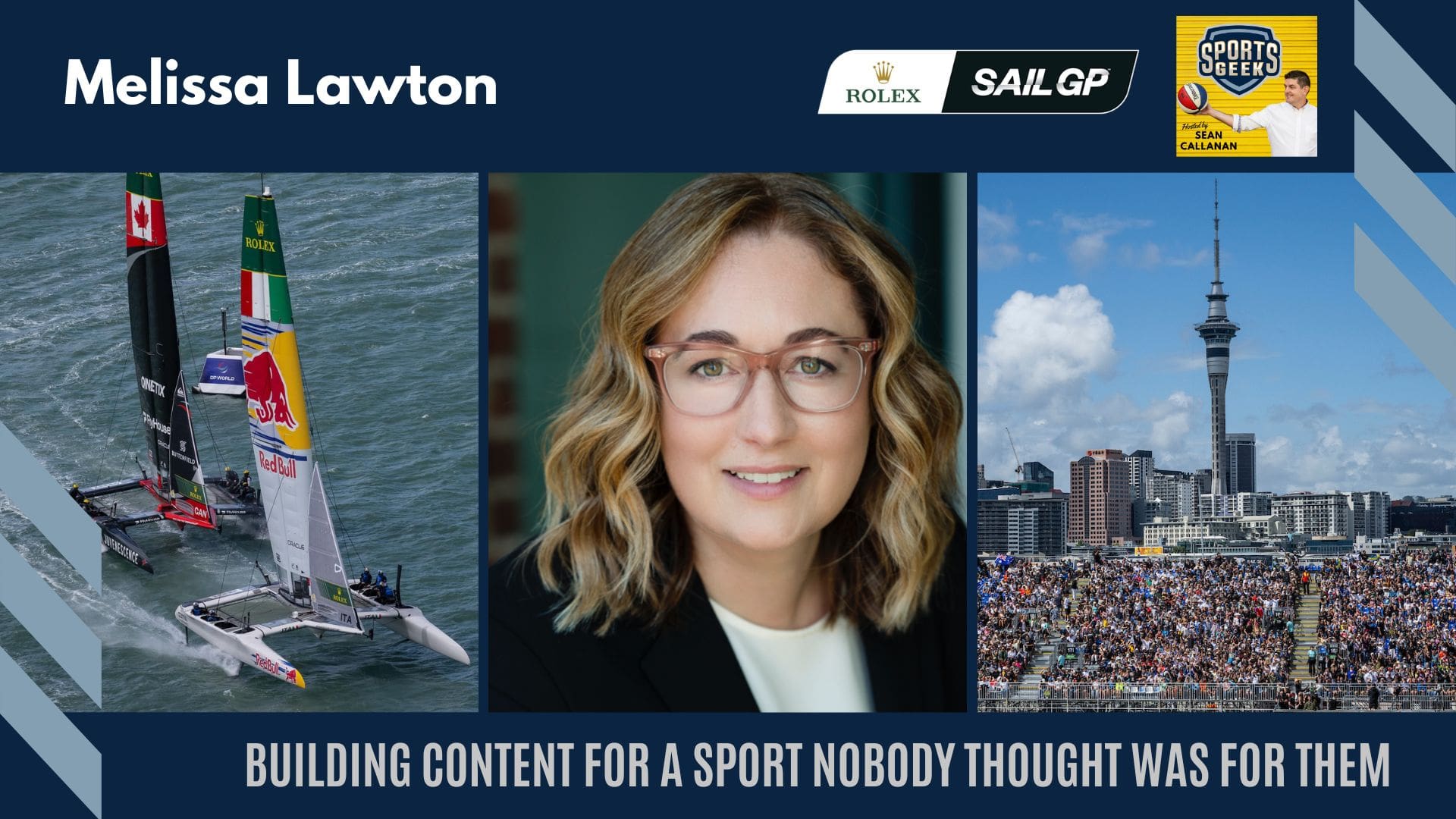
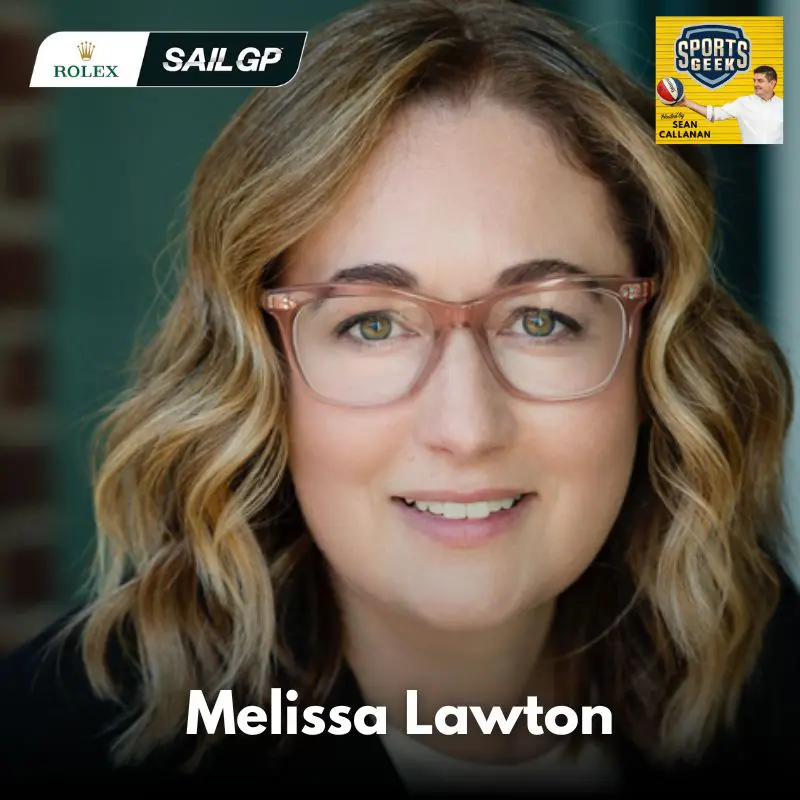
In episode 451 of Sports Geek, Melissa Lawton brings two decades of sports media experience, from Olympic broadcasts to Red Bull TV to Meta's live sports infrastructure, to share what content-led audience growth actually looks like in practice.
In this conversation, you’ll discover:
- What Melissa learned working in sports television.
- How Red Bull Media House built one of sport's earliest OTT platforms and why “not judging how fans want to consume content” was the key to massive audience growth
- Why SailGP deliberately pivoted away from targeting sailing enthusiasts and what that shift meant for broadcast, social, and event strategy
- How 125 sensors per boat power SailGP's augmented reality broadcast, and why self-explanatory graphics are central to growing a new audience
- What Melissa learned about change management at Meta, including convincing an organisation built on billions of individual streams to send one stream to millions of people simultaneously
- How SailGP measures content success beyond follower growth, using engagement data to shape platform-specific strategies across TikTok, YouTube, Instagram, and Reddit
- Why getting fans to an event is still the highest-value conversion, and how SailGP builds from social audiences to ticket buyers to travelling superfans
- Practical lessons from running a centralised global content operation from London and why that removes the event-by-event bias that kills consistent storytelling
Listen to Melissa Lawton on Sports Geek
Can't see podcast player? Click here to listen
Watch On YouTube
Interview Transcript
This transcript has been transcribed by Riverside.fm, no edits (please excuse any errors)
Sean Callanan (00:01.209)
Very happy to welcome Melissa Lawton. She's the Chief Content Officer at SailGP. Melissa, welcome to the podcast.
Melissa Lawton (00:07.768)
Thank you, thanks for having me, I'm excited.
Sean Callanan (00:10.533)
Not a problem at all. We will dive into SailGP. I was lucky enough to be at the race in Sydney just a couple of weeks ago. But I always start my podcast asking people what's their sports business origin story? What was your first gig in the world of sport?
Melissa Lawton (00:26.542)
The world of sport, my first gig was the Aged newspaper. I was a, of all things, was their rowing correspondent in the lead up to the Atlanta Olympics, which does age me somewhat, but I can say safely, I was at university at the time and there weren't a lot of rowing correspondents back in those days. So I was really, really lucky. It gave me a massive leg up when I went for my first full-time job, which was the Sydney Olympics.
So I moved from Melbourne to Sydney and started there as the manager of sports programming. Fantastic start.
Sean Callanan (01:03.545)
And your first couple of roles were all in that space around broadcast and around big games. Was it something that you were drawn to? I know I've spoken, a lot of people have been on games, whether it be Olympic games, World Cup, Commonwealth games, they sort of just get on that circuit of going from one eight year cycle or four year cycle and then jumping to another one. Did you sort of get caught up to that, but in the broadcast sense?
Melissa Lawton (01:25.878)
Yeah I mean it's a circus it is you just go around and around I felt yeah I did the Sydney Olympics and I was quite conscious that from there I was I was continually offered like do you want to go to the next one do you want to do I think I did the Goodwill Games I did a World Cup which were all just fantastic opportunities but I was very very aware that if I didn't learn real television domestic broadcasting I was I was going to
I guess hit the ceiling at some point in that area where you're just continually reliant on that loop. And I deliberately hopped off at one point and went and joined Network 10, which I think is called Paramount Plus now. I'm not sure what you're calling that Network 10 anymore, but it was such a great time to be there.
Sean Callanan (02:10.734)
It's
Yeah, it is still Network 10, but yes, like a lot of things in media owned by different conglomerates these days. And so that's where you still cut your teeth on the broadcast side, but would have been a time when also digital and social would have started to grow.
Melissa Lawton (02:29.481)
Not quite, no. The first we started to see the digital revolution was really with a company called Quokka.com which I keep coming back into or hitting people who worked in that Olympic period on Quokka.com but Network 10 back there was going from tape to DVD. So we were like clearing out the archive from tapes and starting to send out DVDs which is quite revolutionary at the time.
But 10 was a really, really important like lifestop for me on the career ladder. Cause I almost went backwards. I went back to, you know, like labeling tapes, sending out DVDs, receiving the letters from fans, like that people still mailed in letters.
But what you learned was the the the nubs of television like that very first rung on how how to create fandom, I guess. We were I worked on the V8 supercars tough series. It was during the Big Brother era like Channel 10 at that time just had so much energy and it was very young. It was full of really young, talented people. And you you were able to do a lot more from from the position where you started. So you had huge responsibilities. We were managing the home of motorsports. So you got to see F
You got to MotoGP, you got to see American series like NASCAR and IndyCar. was, I was just, I continually look back now and say how lucky I was to have that experience and work with some of the people that I worked with there. It was, like I said, full of very, very talented, ambitious young people who are still in the industry doing amazing things now.
Sean Callanan (04:10.274)
I mean, yeah, there's a lot of people who do discuss that one job that sort of gives them that wide, that breadth to be able to see all those things. And I guess coming from like that single event focus, you know, that 14 days or 18 days of mayhem that those big events to 52 weeks, different shows, supplying different sports, would have had to both wear a lot of hats, but also learn different TV production and broadcast skills along the way.
Melissa Lawton (04:38.253)
Yeah, and you're in decision making roles at that age as well. So, you you decided what went on air, you decided what athletes, you know, were driven to prominence, you decided how people viewed the sport. So it was, like I said, at the time, I don't know if I appreciate it as much as what I look back on now, because a lot of, you know, those jobs are getting smaller and smaller as the democratization of TV happens in the world. Anyone can make an editorial decision now.
Well, back then it was like there was this very narrow funnel and it was up to us to make motorsport in Australia as big as it is now.
Sean Callanan (05:19.076)
Absolutely. being in that TV space, when did you, I guess you did some freelance stuff, but when did you move, start moving out of, I guess, what we would call traditional TV and like working at a TV station, which is what you would call channel 10 at that time.
Melissa Lawton (05:34.668)
Yeah, I went from Network I was asked to go back to the Olympics. I had an opportunity to do a bigger role than the one I had at the Sydney Olympics and I felt like it was a career move. I also studied International Relations, my masters while I was at Network 10 and I did that in my evenings because my husband, now husband, then boyfriend was an athlete going for the Olympics and so our social life was pretty limited. So I got to do a masters while having that amazing role.
And my master's really focused on international politics and international relations and going to China and working on an Olympics in China just it was exactly the right move for me. I was getting amazing opportunities at 10 and I was really moving up. But I couldn't resist the idea that the cool factor of moving internationally and working in another Olympics and
From from those Olympics I then went to the other the other great brick power India so it's Commonwealth Games and it was you again you realize you're on this track of okay I've got to get off this circuit because I know I know what the next job is probably going to look like
Sean Callanan (06:49.028)
Yep.
Melissa Lawton (06:50.367)
I also had a baby during the Commonwealth Games. about, I don't know, about six weeks before the Commonwealth Games, I bought my first daughter into the world and my husband and I at that point were like, it's time to go back to Australia. Ironically, by the time we got back to Australia, we did a little world tour. We got back there and I was pregnant with my second child. So we only had a year in Australia and …
Sean Callanan (06:54.117)
Okay.
Sean Callanan (07:05.999)
Yep.
Melissa Lawton (07:20.013)
I think, you know, when you've got two kids and you're doing these cool jobs, I guess, and you're moving around the world, you start to think, okay, what does a full-time job in sport look like for a mum? And ironically, it was Red Bull that provided the solution. So I had a headhunter from Red Bull call me up.
they said you know would you be interested in moving to Austria and we did a very quick calculation of child care costs in Australia in Austria and it was like very clearly the place to for us to head with a like a one-year-old and a two and a half year old so we we made that move and again that move wasn't necessarily to head into the digital world it was Red Bull at the time were looking for someone to bring a lot more
I guess, robust structure to the broadcasts that they were doing to bring, I would say at the time, a little bit more professionalism into what they were trying to build with Red Bull TV. And after a year, it became clear that Mr. Madishitz, you know, he was wanting to change the nature of how Red Bull presented itself to the world. And he was creating this thing called Red Bull TV, which was massively digital, probably one of the first really, really big
OTTs that were seen at that time and again digital is really interesting space to be in and we got to build it from the ground up and that's I think a lot of really interesting lessons about like fandom and how people connect with content and how to attract people to content when there's so much available and it was also you know during this time where
Red Bull had completed this Strata project and they saw the power of things like YouTube and Facebook and those things that seem like such a part of our lives now back then was, they were growth platforms.
Sean Callanan (09:16.675)
Mm-hmm.
Sean Callanan (09:28.224)
Absolutely. mean, and you know, they're an example of, I guess, an early adopter of what we now call branded content. You know, the fact that Red Bull TV was covering all of the sports, all of their athletes, all of this, you know, everything cool that they do in that space. So yeah, it was early and then also being early on those platforms where that content was consumed. Was that sort of a bit of the
Melissa Lawton (09:34.348)
Yeah.
Sean Callanan (09:56.813)
like building the plane wallets in the air type of thing where you're bringing in that professionalism. Yeah.
Melissa Lawton (09:59.637)
Yeah, you're always building the plane while flying and TV I'd say like you it's a it went through this period of like never changing, know when TV again when I was at 10 there was this sense of like this is how you did things and and when sort of I think an influx of younger people came in and said well this is how I want to see things differently. What Red Bull really gave is people opportunity to choose what they wanted to view and I think
Some of the some of the things that we did back then are really resonating now. So like we did old casts, there were people who wanted to watch a really professional version with professional commentary of snowboarding or mountain biking. And then there are people who just wanted to hear the, you know, the OGs talk about, you know, the sport in the language that they really connected with. And I one of my biggest jobs at
Sean Callanan (10:34.414)
Mm-hmm.
Melissa Lawton (10:56.458)
One of my biggest jobs at Red Bull was not to judge what how people wanted to view content like not to apply my you know worldview onto everything that we did but allow fans to have their their viewpoint and ask for things and it was it was an important learning for me because
Sean Callanan (11:05.86)
Mm-hmm.
Melissa Lawton (11:18.508)
that we had a lot of producers who were in that OG world of like, you have to, you absolutely have to use this sort of language to connect with the fans. And I'm like, but how is the sport going to grow? Because you make it very exclusive to those fans. What we want is some of these, um, you know, mega fans to bring their girlfriends, wives, mothers, sisters into the sport. So we do need to provide another, another version that they can connect with without feeling stupid or feeling like there's a hurdle.
Sean Callanan (11:32.58)
Mm-hmm.
Melissa Lawton (11:48.495)
or a barrier of entry and even today we still have to take that view on sport is there are the OGs, there are the people who want to see it in the way that they want to see it they're very dedicated to how things are discussed and then you still have to do the you know I guess what the Olympics does really well is open the sport up so your grandmother can understand it and that's a lot of what we did at Red Bull at the time and we really grew audiences massively by connecting in those two different ways.
Sean Callanan (12:19.332)
Absolutely. And then after Red Bull, you ended up at Metta from a sports production point of view, which obviously a massive channel like something that we've worked with with teams and everyone's grown massive fan bases both on Facebook and then Instagram. And then there was that push-pull of pushing harder into video. Where do we fit in the sports production space? What was your role at Metta?
Melissa Lawton (12:25.835)
Yep.
Melissa Lawton (12:47.564)
It's an interesting role. So at, I would say it sort of grew out of this, this Red Bull experiments that we were doing. Red Bull were having a significant amount of success with live on, Facebook. And these, these lives were things that we could do a lot with. Again, they weren't recorded for longevity. They were recorded for the moment.
Sean Callanan (13:00.343)
Mm-hmm.
Melissa Lawton (13:10.86)
And we were able to really attract massive numbers of people into something they'd never seen before and we're able to use the rights that we had to do it in a way that was very Raw, I would say like we went all the way down there down the scale of like production quality to Just one camera focused don't explain what's happening Let people ask questions answer their questions and and connect with them on a sort of a one-to-one basis I worked with some amazing people in the Red Bull
Sean Callanan (13:24.494)
Mm-hmm.
Melissa Lawton (13:40.766)
Social side Many of them are still there And we use a lot of data at the time from the dot-com and from Red Bull to sort of go. Okay Well, this is like massive people really want to watch live content. They want to spend time with something they want to connect and they want to spend time and And then they want to be heard. So we were experimenting a lot
Red Bull with that sort of content and it just happened to be something that Facebook were really conscious That was a growing business for them and the sports department that the very small small sports department had convinced Mark that This was something to invest in so I was hired to do it almost exactly what I've done at Red Bull is is build up a internal infrastructure that would support the broadcasting of of big
games in a way that brought people to sport on their phones which again it wasn't that it doesn't feel like that long ago to me but it's like 10 years ago people didn't watch sports on their phones
Sean Callanan (14:48.322)
Yeah, I I think the advantageous point of being at Red Bull is you weren't tied up with big TV deals and rights deals that said, know, because their first foray was, no, you can't be on these platforms. We've, you know, we've paid lots of money, whether it's, you know, Network 10 with with rights or CBS has got locked up. you know, I remember
You know NFL teams doing claymation highlights because they didn't have any rights, but you had the rights obviously with Red Bull So obviously, you know live works But we've slowly been seeing that I guess that that piece being unpicked a little bit the technology is obviously faster than the lawyers That must have been a bit of a challenge from a from a meta point of view to say hey Come on out come come to our platforms come use our content Sort of unpicking some of those deals to be able to get get that reach and get that attention
Melissa Lawton (15:31.85)
Yeah.
Melissa Lawton (15:44.747)
I
Sean Callanan (15:50.22)
and we'll put it in there and go.
Melissa Lawton (15:53.812)
Look, Red Bull, yeah, did, did pave the way, what we learned to Facebook was we had to buy the rights ourselves. So we bought digital rights and we bought a lot. And I can remember it was, I was under a pretty strict NDA and people didn't want anything to get out about what we were doing. So I was hired sort of under the, in my, what I thought I was going to do is more of what I was doing at Red Bull. Go in, take extreme sports, take action sports, take sports that didn't have a big rights
Infrastructure around it and make them famous on on Facebook. That was only part of the job Day one I was producing I was producing the digital version on a mobile phone of Major League Baseball Never seen Major League Baseball before but the principles I didn't need to know enough about baseball what I needed to know was how to talk to the production crew to get them to film and Create content in a way that was meaningful to it to a group of people
on a digital platform, on a social platform. And Metta had some really key things that they wanted to bring to life. One of them was, you know, community. Let's bring the communities to the platforms. Let's use the live content as a hook. So we had Champions League, we had La Liga in South Asia. Some of our rights are really interesting and we got to experiment a lot with them. We had Champions League in South America, had Cobra Leap in South America.
We had La Liga in South Asia. had Major League Baseball in the US. We had just a smattering. had WSL, so World Surf League. We had global rights, Ironman global rights. So it was a huge period of experimentation, but also leading the way. We had to push through all these barriers. I can remember coming to the UK and sitting in one of these big sports conferences.
And there's a room full of sports execs and I'm, you know, doing a presentation of what is Facebook doing on rights? And I was, I was asked at the time, don't, don't be too explicit because we're freaking out the industry because they don't, you know, they're not quite,
Melissa Lawton (18:08.133)
sure about what we're doing here. So can you please just talk about like the how to get on Facebook? And I can remember this huge group of people and I'm like, it's you really need to look at your social team. need to bring a social team into the broadcast team. You need them to talk to each other.
And then when you're filming content, you probably just need to figure out what exactly the audience wants from you. It's no longer dictating to the audience because in the comments, they will tell you what you're doing right or wrong. It's about thinking about what sort of graphic aids that you need on a mobile phone, how you shoot things like there was a lot of opinion on like we need to do it this way or that way. It's like, the fans will eventually tell you the way they want to see the content.
That was like a really…
Sean Callanan (18:53.112)
I mean, and that was a time when we, you know, the verticalization of video, right? And people are, they don't turn their phone. They're happy to watch it vertical. So vertical is a different edit. And, and, know, how you cover a game on Instagram and Instagram stories and what reels are and how it gets shot is completely, you know, it is a new skill. it, and again, if you sort of go back to network 10 days, it's all these young people coming up and creating content in that way that's being consumed.
Melissa Lawton (19:04.019)
Yep.
Sean Callanan (19:22.872)
you know, there are sports you get to, no, this is how we should be broadcasting it, this is how it should be. But, you know, they really need to be listening to, one, their consumers, but also the people who are creating those killer videos and those killer edits and those kinds of things. Because it was a massive shift just for, you know, the regular sports executive, but to understand what the fans were consuming.
Melissa Lawton (19:46.803)
Yeah it really was and and even on on the inside at Metta we just the change management we were dealing with all the time and and encouraging people to take risks. On the Metta side it was really unusual also this whole concept of sending one stream to many people.
Sean Callanan (20:04.654)
Mm-hmm.
Melissa Lawton (20:04.81)
So there was a lot of change management internally as well. They're like, well, know, Facebook's built on the idea of like many streams to many people, billions and billions of streams, billions of billions of people. And that was the attitude at the time. So we had to build an entire infrastructure internally that would allow one stream to go to millions of people at the same time. And so you got to learn a lot about like last mile delivery and ambition and what should happen and what could happen and convincing people.
to follow the path that you want to take, you know, the fans down. It's really, it was really interesting but to work on that range of sports at both Red Bull, on the Red Bull side and then to work on the next level of range of sports on the meta side and dealing with…
you know, everything from alcohol advertising on online to betting to, know, all of these different things. And then having Mark at the end of the huge experiment go, okay, what we really want to do as a company is move into this metaverse and then moving a lot of what we'd learned already on, on these Facebook and Instagram experiments and platforms. We're moving then into the sort of into,
you know, into headset and, and, and, and really, really experimental ways of, getting fans involved in a more immersive environment. But at the end of the day, it just renting rights was not what Facebook meta wanted to do. They, and we saw during the period of COVID that anyone who was resisting any resistance, was, was really broken down at that point that the executives were realizing that they had to be somewhere digitally.
Sean Callanan (21:22.478)
Mm-hmm.
Melissa Lawton (21:50.389)
and whatever version of that was and whatever attracted fans and kept the the flywheel going during that covid period was on social media and that was that was the point at which if if meta is not in your i guess arsenal of tools to hit fans then you're probably not doing too well.
Sean Callanan (22:13.604)
Absolutely, absolutely. Well, I mean as I'm listening to you talking about the I guess that role of meta like I think I love your opinion It sounded a lot of there's a lot of similarities to that role at channel 10 where you got you got access to a whole bunch of different things But in that broadcast space you pretty much got that same Experience at meta across a completely new, you know tech set completely new sports a clear new experience But that we got a really wide range like a digital NBA effectively
in those two roles at Red Bull and Metta.
Melissa Lawton (22:44.042)
Yeah, it really was. And I think I'm most attracted to sort of companies or jobs or roles where you go, okay, we don't know quite what we're building here, but we know we need to move in this direction. It's like 100 % on there. Let me help you get there. it's about being really open minded to what a company wants to achieve.
Sean Callanan (23:06.628)
And so did that, was that, I guess, your impetus and reason for coming to SailGP?
Melissa Lawton (23:13.822)
Yeah, I mean, I'd seen a SailGP event in New York before COVID and the fact that SailGP still existed after COVID, I'm like, well, this company's got some really strong people at the helm and it's also, the helm, sorry, pardon the pun, but it's also a company that, you know,
Sean Callanan (23:31.94)
Ha!
Melissa Lawton (23:37.095)
It was small enough at the time that I thought you can really go in there and make an impact. And after being at Meta for four years, making an impact had become something really important to my ethos. So you just knew that in the third season of SailGP, you could make an impact, you could drive it forward in a way that you felt like it should go and you could apply all those lessons that you'd learnt. Because Chief Content Officer is broadcaster.
It's formal content creation. It's social content creation. I do distribution, my distribution team and we do all the production internally or you know the vast majority of it. So it was doing what you always said you could do and it was that opportunity to do it at a fast growing company. Swear, I just need to… sorry.
Sean Callanan (24:29.536)
speaking at the helm. did speak with Sir Russell Cootes in Sydney and he did speak about, that's fine, he did speak about the amazing growth that has been led by social and social growth and the amount of views. How much has that been, I guess, a key part of what you're trying to do but also that growth story and driving in new fans that you were talking about before of talking to the rusted on fans.
Melissa Lawton (24:34.516)
Sorry.
Sean Callanan (24:59.064)
the sailing fans that have been there, you know, potentially since the America's Cup days to be welcoming new fans. How's that as a challenge? Because you're getting that growth, but you've got to keep, I guess, engaging all those different types of fans.
Melissa Lawton (25:14.644)
Yeah, I think when I came to SellGP, what we needed to do is foundational growth first. We needed to get the broadcast in the right status, in the right way. So we spent a lot of time on just content and broadcast and philosophies and how we're going to speak to people and how we could move out of that world of only connecting with the OGs and their important part of the business. we like to keep them engaged, very engaged. But at the end of the
Sean Callanan (25:36.824)
Mm-hmm.
Melissa Lawton (25:44.54)
if you don't grow an audience, a new audience, you know, the sponsors aren't going to come. So the hyper growth phase we went through and it was meant to be very careful. You know, as young sport, you're only going to go up like up and to the right. It's the, it's the graph, but you need to do it in the right way. So we didn't just look at things like follower growth. We didn't just look at things like views.
Sean Callanan (26:03.29)
Mm-hmm.
Melissa Lawton (26:12.615)
it was engagements as well like are people connecting with the content are we explaining ourselves enough do we have enough content that allows people to come into our YouTube channel and understand what's going on what's our strategy there
how do we differentiate what a TikTok audience wants from us to what a Instagram audience wants from us? What are we saying on Reddit? Who are we as a company? You know all of those things go into to growth and being very specific and intentional about each one of those things. We are very very lucky to be I would say a fairly extreme sport. We're a racing sport but racing sport it's at close quarters we are close to shore so we have big fans
We have fans in stands, which is unheard of in sailing like that. I think it's it's hard to I think people underestimate how hard it is to get a stand of 10,000 people paying for tickets to come to a sailing event when traditionally sailing has happened offshore with a certain group of people who are on
big yachts with big sails and sailing into the sunsets and we're like no we're actually bringing the boats close to shore they're very very fast so you're 100 kilometers an hour they're quite extreme the racing is very close the courses are short so you can see everything in one in in in one sort of
Arena and it's fun. It's fun to be there. We put a lot of effort into making sure it's a really fun day out for people But everyone hears sailing and they're like that's not for me. So how do you get over that? It's it's it's not for me Was really through our approach to content and that was just really highlighting things that other sports might have shied away from we do have crashes We do we do have close calls. We do have angry athletes. We do have We do poke fun at ourselves. We do poke fun at the
Melissa Lawton (28:15.819)
You know, there are things that this sport had just never done before and and had quite like I would say a gentlemanly attitude to to content production and and I think when you Bring in a female who's who's quite used to risk and taking risks that gentlemanly attitude becomes like just let's have fun let's Show the best and the worst of what we've got to offer and let's bring in people who would have balked at the idea of like sailing
but we'll come in for some really extreme, really cool, really surprising content. And it's the surprise and delight that we're aiming for every day that we wake up. And again, whether that's on TikTok, which is like so unhinged sometimes, but we know the bosses aren't watching that. So we're really quite open to experimenting on every platform that we touch.
Sean Callanan (29:01.892)
Yes.
Sean Callanan (29:14.213)
And you did mention there in your role that as content, is everything. We're not just talking digital. is assisting broadcast and helping shape what that is, making that compact, easy to watch, easy to understand if you're watching the race and it's all there in an hour. Or, hey, what are the social stories you're doing? What are you doing on channels like TikTok? But then also how you're…
integrating with all the teams because the teams are telling their own stories and you know the NFL talks about helmet off like learning more about the athletes the sailors making characters out of out of those it's a it's a bit of a balancing act when you're driving so much of the content how do you I don't want to use another sun you know rising tires lift all boats but how do you get all the teams working together you know and and heading in the same direction
Melissa Lawton (30:02.409)
I love that one.
Melissa Lawton (30:08.805)
It's, so GP when it started was we owned all the teams and year by year we sell more teams. Now we've got like a, like a backlog of people that want to buy teams. We just can't build boats fast enough. it is, it has been.
a tougher sport to deal with. think when you work in in red ball sports, the athletes are used to filming themselves. They'll get their, you know, into three sixties or their GoPros or the Sonys and they'll spend a lot of time filming themselves, talking to camera and building an online audience. When it's something like NBL or NBA, it's like high school. If you've got talent in high school, you're already hustling for like space. It's a it's a crowded crowded place.
When you're a sailor, you get in a boat, you go out to sea. So I think one of the most, the toughest things that we've had to do is like educate athletes. What we're doing here is good for you. It's good for the sport and it will, it will lift everyone equally. we make racing on the edge, which is
You great series we're trying to get into the mind of the athletes and we're reframing how we do racing on the edge at the moment It's uh, it was it was sort very event-based. So here's the here's the event. Here's how it's unfolded. Here's the drama Here's what the athletes were thinking at the time now, uh, and what we saw we we look into data a lot again We do a lot of the analytics internally and we look at the data It's like yeah We would get some episodes where a million people would tune into that episode and watch it and then another episode where it was like 300 000 were like, okay, what's the difference?
between these episodes and sometimes it was really the strength of the athlete and the story they had to tell or the size of the country you know. So people were starting to watch these episodes based on national interest and that's that's one of the tough things about being a nation versus nation sports. So we're completely reframing how we do it and again that risk and experiments and you know bringing Rolex along for the ride is like we're now going to try and make episodes in groups of four where you follow one story the whole way through so it's not New Zealanders watching
Melissa Lawton (32:12.488)
a story about the New Zealand team. It's going to be the New Zealand watch it, New Zealand is watching four episodes of their athletes and how things unfolded. that's a big thing. Racing on the Edge has been big for us because it's also taught the athletes about, I think branding, things they say. You know, back in the early days, it was really clear that you say something in that black box room, we're going to use it.
you know athletes who aren't used to like a lot of media exposure like but you edited it like yeah we did you said it we edited it so that that was that's been an interesting process and i'd say it's you know they they really trust our racing on the edge crew they really trust the directors to make the right sort of content and and i think that's been a learning process over a period of time
Other long form content is like, think the broadcast is super important for us. We had a huge, huge results with CBS, 3.4, 6, 9 million viewers tuned in.
That that that just now is starting to show like we if we capture the right people at the right time We really do get a genuine viewership and every single broadcast we we now go back and say is this broadcast? Self-explanatory are people able to join this and understand what's going on. We really make an effort to get people to the start line Again, because it's that sailing idea. It's like I don't want to watch sailing could take hours They're go out to sea and I can see much if we get some to the start
line we really have a hook just from the product that we produce just from the sailboats themselves and the nature of our racing again it's so close you've got 13 boats heading to mark one.
Melissa Lawton (34:01.136)
and they're foiling and they're flying and it's really different. It's fast. if we get them to that, that point, and we don't muck around, we try and get to that point within 10 minutes. we find we get an audience to stick around. So our bigger job now is like, okay, so we have this broadcast that's watchable. It's very, very high quality. I'm hoping most people can understand that we do get it. The occasional sort of email or you know, Reddit thread was like, I don't know what's going on, but
Sean Callanan (34:27.525)
Mm-hmm.
Melissa Lawton (34:28.144)
We really, really try not to use sailing terms. We try and use terms that you use in your everyday or you find in a motor sport. But yeah, it's on us now to get people to the start of that broadcast. And we work very, very closely with the broadcasters to do that.
Sean Callanan (34:45.551)
Yeah, one of things that I noticed when I was in Sydney and watching the broadcast was how much data is around the sport, both for the broadcast, for the boats, you know, your operations team that's supporting it, and then how that gets filtered to broadcast in many different ways. Like, is that something that you're constantly evolving to sort of, you know, bring in, you know, F1 fans know different…
different measures and what they've done. And as another storytelling device, the amount of data that you collect is available during a race.
Melissa Lawton (35:22.94)
Swear, sorry. I'm on the edge.
Sean Callanan (35:24.462)
It's
Melissa Lawton (35:32.508)
The broadcast is highly, highly reliant and I'd say critically aligned to the idea of having augmented reality graphics and they come from the data from the boats. There's 125 sensors per boat. It measures absolutely everything. Those sensors go to a mesh. The mesh captures the data. The data then goes through a fiber. The fiber goes to a remote production where we sit with the Live Line graphics team who create that augmented reality.
field of play and all of that information comes to our commentary team that's that's based with us in in London in Ealing. It's really unusual, very very complicated, technically difficult broadcast but it's hugely reliant on the data that we receive. It's it's massively reliant on being self-explanatory like the ladder lines are there to help you understand intrinsically that this boat is in front of the
boat. We have the the speedo you know how fast is each boat going how fast they're going how fast do they need to go to capture the the boat in front of them where the wind direction is. We don't do a lot of biometrics we can but we don't at the at the moment we've still got lots to think about in that area.
but the boat data is critically important to us and we'll look at any sport and we do spend a lot of time looking at other sports. So how are they using data? We have access to so much. We could probably do it ourselves. There are things we've tried in the past like mini maps works great on formula one where cars spread out or there's, a little overtaking because cell GP has so many overtaking opportunities. that those sorts of things didn't work for us as well as
Sean Callanan (37:08.771)
Mm-hmm.
Melissa Lawton (37:22.79)
We'd hoped it's too confusing, but we're constantly thinking about like, how could we bring more people into the sport with more knowledge about what's going on? So our graphics team worked very hard to sort of introduce something maybe every six months. We're not a traditional sport in that we have a big off season. Our off season was about seven weeks. So we introduce things as we…
when we feel like they're ready to go, rather than just wait for the start of the season, they introduce a whole lot of new things, we're constantly evolving. The broadcast you see in Rio and New York will be different to the broadcast that you see in Abu Dhabi and Dubai at the end of the year. So it's a constantly moving fleet.
Sean Callanan (38:13.301)
And that does give you, I guess, options for other fans. The geekier fan can be watching the broadcasts and have, know, Sgt. Jp Insights up to be watching the tracking or watching the onboards of their favorite team or, I can see Team USA is coming up on, you know, the flying ruse. I want to have both of their onboards on. Like you can have that experience. so, you know.
Melissa Lawton (38:22.151)
Yep.
Melissa Lawton (38:34.257)
So our GP insights is fantastic. If you want to really geek out on it, you can listen to the athletes, whichever athletes you like on the broadcast. sort of, we're in this constant battle of how much do we listen into the boats? You know, there's a lot of noise for new viewers who don't understand what the sailors are saying because they're still speaking in sales speak. So, but if you're a mega fan, you go to sell GP insights with a super low latency. So you can literally hear the sailor you want to hear.
watch the data or telemetry for the boat that you want to see and still watch the broadcast at the same time and this has been since day one obviously we have a really really strong partnership with oracle and this sense of giving everyone everything and being really open about data and sharing as much as we possibly can is important to the league it's it's important to our founder who is is obviously you know larry ellison and and i think that's
that open data source makes it really interesting for things like betting as well because that's like huge, huge growth for us.
Sean Callanan (39:44.998)
Absolutely. We've spoken a lot about fans in different stages and producing content. A lot of times when we're working in broadcast and social, it gets to a point where you've got to convert them. What does conversion look like for you? Is it getting their email and you're now emailing them? Is it getting them to an event? What is it specifically for you that you're trying to target?
Melissa Lawton (40:10.563)
multifaceted really it's conversion for us we did a lot of work last year in in bringing in sort of DJ Khaled was our chief hype officer well you know he was huge in converting a I don't know casual or somebody may have may be interested into okay I'm gonna watch this I'm gonna spend time with this I want to find out more about this we did Uncharted a documentary series where we wanted to convert people through I think a really
Sean Callanan (40:18.775)
Mm-hmm. Yep.
Melissa Lawton (40:40.317)
really cool technique was used by a production company in that case where we used Jimmy Spithill legend of the sport, Red Bull athlete, gritty, known for being hardcore, sort of drive this narrative of like what is sail GP. So we're taking people who might've been America's cup fans or might've been sort of Olympic sailing fans and really giving them an entry point and an anchor and someone to follow and, that followed sort of the successes and I guess not even
It's just the journey of someone who was an athlete who was going into this CEO position and and and it it It allowed us to explain what the hell is going on here and that's that's really important for conversion as well So you get a deeper level of fan and we really felt that that helped our YouTube channel growth so we hit a million subscribers on on YouTube but it's because we just put a lot of content YouTube now that is
athlete based, going deeper, it's allowing that two track thing of like if if everything we're doing on on TikTok is sort of like really fun, what are we doing on on YouTube? We're telling the story of the league, we produce a documentary called Speed which talks about the technology, we have a huge number of engineering and technology geeks who just admire the way these boats operate and how they're built and the speeds they hit. Then we have we've just had a week of really celebrating our female athletes, we've got female
driver so converting just fans of women's sports again we use YouTube to do that so it's really like the central hub but conversion is yeah it's it's really really important as you go down this these different fan journeys is get them to an event because when you see a boat up close it is stunning it is like oh my god these things go 100 K's an hour there's no like
roll cage. These athletes are pretty much sitting exposed to the elements and going super fast on machines, they're huge and they're completely powered by the wind. So getting a fan to an event or to see a boat is super, super important for us and you know selling that ticket because what we find is if you buy a ticket you're going to buy a ticket next year you might even… we actually have a group of fans who just travel from event to event now it's like we follow the sun so it's quite
Sean Callanan (42:33.827)
No.
Melissa Lawton (43:01.668)
a cool series to be to be involved in and yet database like we're seeing now ticket sales are really evenly spread between like what we're doing on social and what we're doing through targeted campaigns on on email and through our newsletters so you've always got to have that.
that next level of going down and deeper and deeper into the fan. then, and then once you have the database information on the fans, you can start really curating experiences that they want to be a part of. And if they want to be a part of their family and friends will, and you know, if their family and friends get involved with it, then it's that, that reverse social, social engineering, you know, you're, you're hitting one person and creating that, fandom out of that. And that's, it's really what we saw at Red Bull with, with, with the OTTs. Like we had
Sean Callanan (43:41.708)
Absolutely.
Melissa Lawton (43:50.841)
a very small number of fans of downhill mountain biking and as they were able to bring more and more people into it it grew exponentially so that is definitely a key for us.
Sean Callanan (44:02.117)
Absolutely. Well, I can attest to that. Going to the Sydney one and seeing the boats up close, seeing the athletes, chatted with Mike Buckley from the US sail GP. Like it is something to see, you know, you've got to see it. Yes, you can watch your broadcast and learn it, but then once you see it up live, it becomes something, something different. I do want to sort of touch on that, you know, the global nature of the sport, know, multiple races, multiple.
multiple ports around the world, is it very much a case of, you just, you turn your attention to where that next race is. There's lots of local marketing around that, but you're also trying to make sure that, you know, someone that watched Sydney starts tuning in and that's a conversion piece to say, well, I want them to now follow the rest of the races, but it's really, I guess, following the races as they go around the globe.
Melissa Lawton (44:54.982)
Yeah, it is. We have to…
Be really careful that we don't become an event to event based business and and having a remote production is really, really interesting because we're not going to the event so we don't get caught up in that like local moments. We have all of our crews go there. Obviously our marketing team hits hard. Our events team hit hard in the locale, but sitting where we're sitting in London for every single event. Yes, we're 100 % focused on how the Italians are receiving our content, how
their broadcast looks, how…
how in tune they are to that Italian story. Same with the French, same with the German. So for us, we're able to take a far more global outlook because we're sitting in a centralized place and doing everything from one position and able to sort of clock what's going on and what the different storylines are. The teams that go, and it's really interesting, like it's a phenomenon, I say. There are our teams that go on site and depending on whether the wind was blowing.
or not blowing is whether or not they thought it was a good race or not good race. Whereas sitting in London and being just watching the flow of the broadcast and seeing the content being pushed out from because all our social is done is done from London as well we have people on site capturing content but largely the strategy and the publishing everything is done centrally and
Sean Callanan (46:20.047)
Yeah.
Melissa Lawton (46:25.814)
you know we can have like just the best event ever because we made great content the broadcast was fantastic you know it doesn't the wind or the the mood on site doesn't really affect us we're able to be really even killed and we can have like a fabulous that was a fantastic broadcast and great flow it was like really informative really exciting we're able to tell the story of this event and on site they're like but there wasn't enough wind it was really boring i'm like it and you have those two different perspectives so what what we need to be careful is
We've always got on-site flavor and we've got enough people there capturing the right sort of content to deliver that that mood across in the broadcast But our focus is very much on like what is everyone doing around the globe to continually support their narrative on this event and and look I will say that's a lesson that we learned at Network 10 when F1 came to Australia to Melbourne we were huge numbers the second that left Melbourne it was
you know the numbers just took a dive I don't know if that's still the same data that we saw like a hundred years ago but it became like this really important factor in how you do a production to make sure that the storyline is relevant to the broadcaster who's taking it all the time.
Sean Callanan (47:43.577)
Well, before we wrap up, make your pitch. Why should people start following SailGP?
Melissa Lawton (47:50.779)
you'll never see a more exciting race. think like at the end of the day, we have four races. They're fast, they're close quarters. Even if the wind is not blowing, the strategy that's unfolding, the chess game that happens in those circumstances, it's just compelling viewing. But when the wind is blowing and those boats are going as fast as, know, as fast as any boats on earth,
it's it's just compelling like the the jeopardy the decisions those athletes have to make you almost can't tear your eyes away so i'd say if you're into short bursts of high energy action that's that's the reason to watch us.
Sean Callanan (48:33.508)
Absolutely. Melissa, I do appreciate you taking the time. I want to get to the Sports Geek Closing Five. Do you remember the first sports event you ever attended?
Melissa Lawton (48:44.644)
Yes I do and it's the the shirt is behind you it's Collingwood. Collingwood with my dad my dad was like is still I should say is 80 like the biggest Collingwood supporter and I think I was christened and given Collingwood as a team and dragged along to a Collingwood football match the the soonest he could get a member of the family there.
Sean Callanan (48:50.436)
Well that's fine by me…
Sean Callanan (49:10.072)
Well, that's the best answer as someone my great-grandfather played for Collingwood, so I didn't have a choice either, but I'm okay with it.
Melissa Lawton (49:15.718)
Okay, we've got the same family traditions. My brother went and followed North Melbourne because they had a winning year and my dad's never really forgiven him.
Sean Callanan (49:25.549)
Exactly, What's your favourite food or food memory at a sports event?
Melissa Lawton (49:30.95)
has to be the meat pie if I said Collingwood. I do sort of I've traveled and lived all over the world and I do find it weird that the meat pie hasn't you know translated into any other country because it's a perfect meal for like a football match here in the UK or a baseball match in the US but you know someone's got to do it one day.
Sean Callanan (49:33.668)
It probably does.
Sean Callanan (49:55.11)
potentially potentially running running content for a global sport makes your hours completely weird but what's the first app you open in the morning
Melissa Lawton (50:05.982)
this is really boring, but it's the New York Times.
Sean Callanan (50:08.747)
That's alright. Everyone's got their own morning routine. There's no wrong answer there at all.
Melissa Lawton (50:14.373)
It's New York Times they pretend to read all their really intelligent articles and then I get to games and do the crossword so it's If I'm late to work the crossword was hard Yeah, yeah, well I actually do three of them
Sean Callanan (50:19.653)
Yeah, well, that's it. Other people have said, other people have said WURTLE. That's, know, so that's also a valid answer.
Sean Callanan (50:29.349)
Is there someone that you follow and it might be an author, might be a colleague that you've worked with previously that the podcast listeners should follow and why?
Melissa Lawton (50:39.085)
Look, I'm just gonna say I'm gonna do a shout out for the sale GP mega fans here if there are if there are sailing fans If you really want to know what's going on at sale GP sometimes if you really want to have something leaked follow sir Russell Cootes the founder of sale GP I he's he's he's the blessing and bane of our social team He will he will release things that no one else has seen before so he has got quite a A special following of people who then see stuff he's posted and we're like, my god
post please don't reveal that now and then it goes viral but he's if you're a sailing fan he's he's the guy but for sports fans in general I follow tomorrow sports they've always got a you know interesting take or perspective
Sean Callanan (51:12.325)
Very good.
Sean Callanan (51:26.499)
Yep. And the last one you can answer with your SailGP hat on and then you can answer it personally, but what social media platform is your MVP?
Melissa Lawton (51:36.973)
Look, I'm a big Instagrammer. I'm a lurker, not a poster. Although I probably comment or like every single sale GPO post ever. But I've started to really spend a lot of time on Reddit. It's…
Sean Callanan (51:51.717)
Mm-hmm.
Melissa Lawton (51:54.329)
It's what Facebook communities was setting out to do and, and, but it's just so much more in depth and easier to navigate and, and, participate in. So Reddit for me is, it's become a bigger platform just in general life, gardening, questions about, you know, kid stuff. what does this mean?
Sean Callanan (52:14.085)
It is definitely, I guess it's the one that hasn't lost its community feel. Like Twitter had community back in the day. Facebook, maybe it's probably still lurking in Facebook groups potentially is probably where community lives now, but Reddit just is just there.
Melissa Lawton (52:19.405)
Yeah, yeah, it's.
Melissa Lawton (52:31.555)
Yeah and and and everything like there's nothing that's not covered in Reddit so you can always find someone who's asked the same question and wants the same answer as you so yeah I love I do love Reddit I I go to it more often than ever actually.
Sean Callanan (52:45.989)
Well, Melissa, thank you very much for your time. Hopefully, if I'm next to the Sale GP race, I see you. But if you're always in London, I probably won't. But that's fine. But maybe come down for a Collingwood game and we'll have a enjoy a meat pie together. I always ask people, is there a platform? I always ask people who listen to say thank you to the guests. Is there a platform that you prefer them to do that on?
Melissa Lawton (52:54.706)
Come to Portsmouth.
Melissa Lawton (53:12.585)
I'm a big LinkedIner for if people want to connect and ask questions or you know I just had a conversation last week with someone who connected with me on LinkedIn and just wanted some advice for the industry so yeah please come and find me on LinkedIn it's good to see people interested.
Sean Callanan (53:32.185)
Well, appreciate it and all the best for the rest of this LGP season.
Melissa Lawton (53:36.889)
Thank you very much, thanks for having me on.
Sean Callanan (53:41.189)
And I-

Turn 15 minutes a day into sponsorable content your partners will pay for
Sports Geek AI is a done-with-you content system that creates daily newsletters, podcasts, and social posts—giving your commercial team new inventory to sell.
Resources from the podcast
- Please connect with Melissa Lawton on LinkedIn. Let her know you listened to the episode. Please say thank you if you do connect.
- Learn more about SailGP's Rio Sail Grand Prix and for its long-awaited Brazil debut on their website.
- Give our new Daily podcast a listen – Sports Geek Rapid Rundown.
- Podcast episodes you should listen to:
- Throwback episodes you may have missed:
Podcast highlights
Highlights from episode 451 with Melissa Lawton:
-
- 01:30 First gig: rowing correspondent for The Age, lead-up to Atlanta Olympics
- 02:30 Sydney Olympics — Manager of Sports Programming
- 05:30 Going from tape to DVD — and learning the fundamentals of creating fandom
- 08:30 Red Bull comes calling — moving to Austria to build Red Bull TV
- 12:00 The dual-audience approach: OG fans vs newcomers — and why you need both
- 14:30 Day one at Meta: producing mobile-first MLB — without ever watching baseball
- 18:30 Standing at a sports conference: “You really need your social team talking to your broadcast team”
- 20:30 Internal change management at Meta — one stream to millions of people
- 22:00 Why SailGP: small enough to make a real impact
- 24:00 Sir Russell Coutts on social growth — the conversation in Sydney
- 25:30 Foundational growth at SailGP: getting broadcast right before chasing audience
- 28:00 How SailGP overcomes the “sailing's not for me” barrier through content
- 30:00 Working with teams and athletes on Racing on the Edge
- 32:00 What the data showed about episode performance — and the nation vs. nation challenge
- 36:30 SailGP Insights — the ultra-deep experience for mega fans
- 37:30 Oracle partnership and open data philosophy, including betting
- 42:00 The athlete education challenge: sailors vs Red Bull athletes
- 43:00 Why getting fans to an event is still the highest-value conversion
- 52:00 Social media MVP: Instagram lurker, but Reddit is her growing obsession

Digital To Dollars is the five-pillar process pro teams and leagues have used for a decade to turn digital audiences into revenue, and it’s coming soon as a self-paced program. Those on the waitlist will get 20% off upon launch.
Check out our podcasts with SEAT
We’ve launched two monthly podcasts in collaboration with SEAT.
Sean hosts The SEAT Report with Josh Barney. Check it out
Each month, Sean will profile a SEAT partner on SEAT Solves.

Listen To Sports Geek
Recent Sports Geek Reads
- Women’s Sport Boom, Wall Street’s MLB Comeback & Apple’s F1 Ad Model
- Amazon Prime’s $3.8B Sports Play, Brewers vs. Rays Business Models & FIFA’s World Cup Rights Tender
- Private Equity in College Football, NFL Global Expansion & AI in Sports Strategy
- PlayOn Sports, 2030 World Cup Rights & Hawks Go Prime-Only
- NFL Stadium Economics, Private Equity Expansion, and USL’s Promotion and Relegation Branding
- Euroleague’s €13B Forecast, Toto Wolff’s Mercedes Blueprint & NFL’s Private Equity Pivot
Listen to Sports Geek Rapid Rundown daily