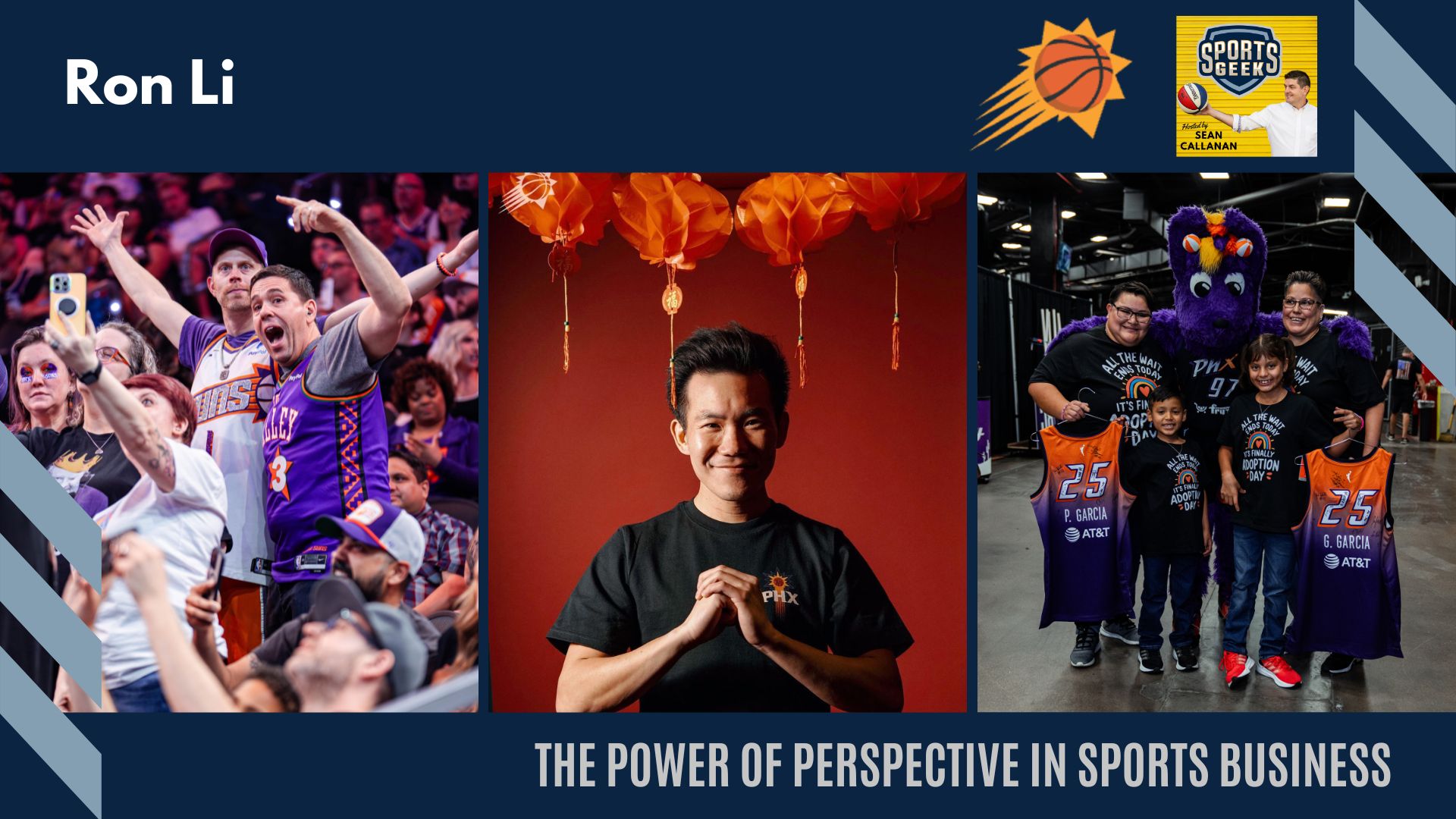
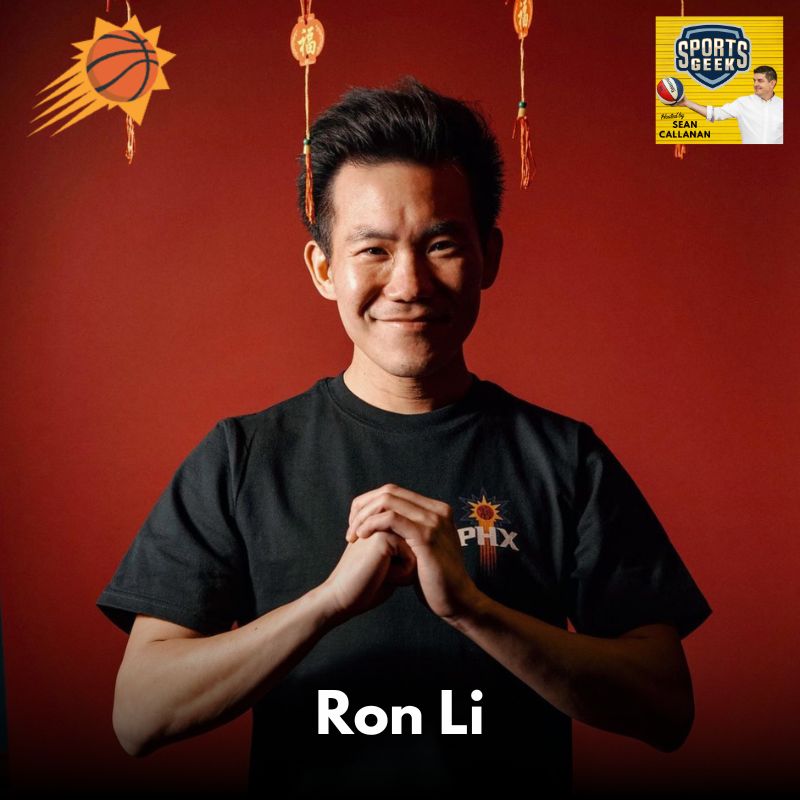
In episode 449 of Sports Geek, Ron Li brings a truly cross-industry perspective — from PGA Tour international expansion to EA Sports esports commercialisation to NBA partnership strategy — to share insights on how data, communication, and perspective drive growth in modern sports business.
In this conversation, you’ll discover:
- Why communication is the most underrated skill for analytics professionals — and how Ron developed his by learning from a Premier League veteran
- How Ron transitioned from “the numbers guy” to a commercial leader by tying data insights directly to revenue generation
- What gaming and esports taught him about fandom creation that traditional sports organisations still underestimate
- How the Player 15 Group is centralising data and intelligence across the Suns, Mercury, Valley Suns, and Mortgage Matchup Center
- Why process-driven dashboards — not just results dashboards — are the next frontier for sports business analytics
- How to think about commercialising fan data beyond ticket sales, particularly for partnerships businesses
- Why globalisation is a long-term growth lever, most teams don't invest enough thought into
Listen to Ron Li on Sports Geek
Can't see podcast player? Click here to listen
Watch on YouTube
Interview Transcript
This transcript has been transcribed by Riverside.fm, no edits (please excuse any errors)
Sean Callanan (00:03)
Very happy to welcome Ron Li. He's the VP of Fan Intelligence and Partnership Strategy at the Player 15 group, also known as the Phoenix Suns. Ron, welcome to the podcast.
Ron Li (00:17)
Thanks for having me, mate. Good morning.
Sean Callanan (00:20)
Good morning or good afternoon or good evening. It's a bit like Jim Carrey and Truman show You don't know when people are listed one when recording and when people are listening so I always get started trying to figure out people's sports business origin story. What about yourself? How did you find yourself? Into the in the world of sports
Ron Li (00:37)
Yeah, I think I just decided to work in sports at one point in time because when I was choosing to go to business school, I had sort of a bit of a identity crisis in which I wanted what I wanted to do. Overly simplistically, it was probably something in finance versus pursuing something that I loved in the sports growing up. Of course, like most that work in the industry, I'm a sports fan. But what sports really mean the most to me is actually friendships in new communities. was born in Hong Kong, grew up a bit in Singapore, Germany.
I've been living in the States now for about 14 years. But it sounds cool to move a lot, but actually when I was a kid I hated it. Because I just interpreted it as my friendships getting torn apart constantly. And so the only thing that made things better was sports. know, going to the local pitch and playing footy or in Singapore learning how to play badminton or learning how to play hockey in Canada. So sports just meant a lot, I think to me in that sense. I was always captivated by its impact on the human experience.
culture and so I decided to pick it when I had a chance to go to business school.
Sean Callanan (01:36)
Absolutely, I it does. I remember, I think it was my end of my first year in an IT degree saying I'm gonna throw this in and go into sports and I didn't but I did 15 years later. it is something that is definitely a draw. So what was some of your first gigs? What were some of your first steps on your sports business career?
Ron Li (01:43)
Hmm
I think it actually probably got started before my academic career finished. So I made it a point when I was in business school at the University of Oregon to endeavor to get as much real life experience as possible. That's really just a very fancy way of saying I offered myself up as free labor as much as I could as a grad, as just like a keen hardworking graduate student. So that led me to a lot of interesting opportunities from, you know, doing interesting projects with Nike you kind of do when you live in Oregon and you go to school there.
I spent a little bit of time ended up with the FIFA World Cup organizing committee in Qatar a little bit of consulting and work in what was formerly known as glide slope and eventually an internship as well at sports Singapore while I was there so I felt like You know between all that basically consulting work as a student and also my internship I had built up a pretty good taste for figuring out what I wanted to do when it came out and which eventually translated into a career really in data analytics laddering into
revenue generation and then just kind of slowly grown there into a bit more of a leadership level at it.
Sean Callanan (02:54)
I mean, it is a common thing of students either going into a degree and wanting just saying sports and it's a really big bubble and not knowing what it is. And yeah, I give the same advice. know, volunteer, off yourself as free labour, intern, work on game day stuff because you start seeing the machinations around sport, whether it's, you know, game day, what events look like, all the stuff that happens to, you know, put the cheeks on the seats to fill a stadium and you start figuring out.
like where your skill set and where your passion sort of lies. And for you to, at the start, to sort of go back to that fan piece and that data piece and understanding that. And that was one of your first key roles at the PGA.
Ron Li (03:36)
Mm-hmm. Yeah, it was, you know, to your point, think business is one of those disciplines where real life experience is like really valued as much as it is in the classroom. And so, yeah, it's really a point to reinforce that I think it definitely falls into one of those disciplines where the more you kind of can figure out how to apply what you're learning in the real life, the better off you'll be to set up your career is something I would probably tell most students out there. And then you'll hear me talk about zooming out a lot away from sports, even though I deploy my skills in sports to your point of analytics, right? At the end of the
I've over simplistically I've basically made a career out of helping organizations make data-driven decisions. I started out at a junior level.
Sean Callanan (04:09)
Mm-hmm.
Ron Li (04:10)
and a little bit more intermediate, then I started influencing revenue. just, I can constantly do it, I just do it at different levels now, but at the PGA tour, the mandate was basic, not basic, but like very straightforward. At this point in time, the PGA tour wanted to expand its operation globally, and it needed to approach that mandate in an, as informed of way as it could. And so I spent a lot of time doing things like creating models and figuring out, you know, and ranking what kinds of
countries we should be choosing to expand in and really then just informing stakeholders that were involved in the decision-making process and challenging them, telling them how they might be wrong and in what ways they needed to think about things. that was really how I first got things started was just being the loudmouth analyst in the office essentially and thankfully people listened.
Sean Callanan (04:52)
But that's super important, that bit of challenging. Like it's one to just prepare the data or data as you might say, prepare it and send it out and say, here's my report. But if you're not challenging beliefs and moving the needle and making people see what the data is or, know, storytelling, help them understand what you're seeing, then all of those reports and all that research and all of that work is gonna fall flat if you cannot.
Ron Li (04:59)
Hmm
Sean Callanan (05:17)
effectively, I guess, sell the data and sell the story. How important has that been for you to be able to concisely say, oh, well, this is all the work I've done, but here's why it's important in here is why it's important to you. And when was it the when did the light bulb go off for you to go, oh, hang on, if we you tie this to revenue, people will start listening to me.
Ron Li (05:21)
Yeah.
That's a good question. think to answer your first point.
I say this all the time to my mentees when they ask about what kinds of skills they need to learn, especially those who are analytics focused. Sometimes it surprises them, but often my first answer is actually communication. Communication in this can encompass verbal, written, or even visual. It doesn't matter. It's just how you present your ideas, how you present yourself to folks. I think this is the plight of the intelligent or especially people who are intelligent but also have very technical skills. So this could apply to creative.
This could apply to data analytics. This could apply to engineers, right? Like you could create a great product. You could create a great something. But if you can't communicate it to those that are not as disciplined as you, your ideas and then unfortunately, consequently your career will probably be negatively impacted as a result of it. I was actually really lucky when I started the PGA tour and that I used to work for. I started out my career by working for a Premier League veteran.
And I really still do believe today that when it comes to thinking about how you articulate a commercial narrative today, I don't think there's many people that are better than it, people who have done it at a Premier League level or at least at a global proper football level.
Sean Callanan (06:39)
Mm-hmm.
Ron Li (06:43)
And so it kind of just struck me as I got to spend a lot of time with him and listening to him. I don't know, when I was young, I always just thought, man, he is so polished. How is he doing this? And I ended up just spending a lot of time really focusing on finding my communication style and figuring out how to better communicate. so a lot of that involved working on public speaking. A lot of that focused on like thinking about how did the complicated people or sorry, how do people disseminate and explain and summarize complicated ideas to the masses?
was
really a skill I massively worked on. So I think that helped me out on the data analytics side. But then what the breakthrough was, or at least a bit of an epiphany that I had in realizing I needed to move towards influencing or impacting revenue, and eventually I decided I liked sales, was at some point in my career I realized, man, if I want to have outsized influence in an organization, I need to figure a way to impact revenue instead of just being the numbers guy. And so I just asked, candidly,
asked what are ways in which I could help out revenue and because at that time at the PGA tour, the international business was very, very immature. I was one of single digit employees in that department and so there was a lot of opportunity. I found myself being quote unquote the international guy for a lot of revenue related departments. So whether that would be new sales, like client management, even marketing, media, licensing.
I just found myself being sort of like the guy who would provide the analytics and the data around global expansion in those areas. And so naturally I just, I don't know, maybe it was because of my natural nosiness, just found my way in and in in more and before I knew it I was leading pitches and that's how I think the identity of the data guy who can also sell and articulate a narrative really nicely kind of became born and I still kind of carry that with me today.
Sean Callanan (08:17)
Mm-hmm.
And that, I mean, I guess that international growth piece, one, you get to lean on, you know, again, I'm someone that moved around. didn't do it internationally, but I had that same experience of moving around a lot of places. But that adaptability and resiliency you would have got from moving from place to place, learning about different places in the world would have, again, been something that was in your kit bag that wasn't, you know, it wasn't in a course, but you could start, it definitely would have helped you in that.
early international expansions phase because now like a lot of sports, you know, we've been working with the NFL and international expansion, lot of NBA teams and golf, they're all looking at what the global look looks like. But like you said earlier, the Premier League were the ones that were doing it first. They were the first ones sort of that left their own shores and sort of led the way. How much were those, I guess, life skills and your international experience help you in that that that in that foray?
Ron Li (09:15)
A lot, but I think really if I think about it, it's just perspective, right? When we often think about things and not even just in our vocations, but you think about just how little perspective unfortunately seems to exist in all too many regards in today's world. Often people lack perspective and in some ways that's also just a different way of saying empathy. If you can't really understand how someone else lives and how they might think, you don't have to do it perfectly. It's very difficult to grow. And so from a business perspective, I just found myself really lucky in that
I often because of my experiences was not didn't only literally have experiences and perspectives that others didn't But also was more willing to take on perspectives that I didn't know And I don't really take that much credit for it I mean I was just a really lucky kid that traveled with my dad's that basically gravy trained on my dad's very successful career around the world and that that's what gave me the perspective But I don't know. I mean, I I still think about that a lot today. I love travel personally, but
Also, you nailed it. Globalization, I think, is one of the main topics right now in the sports. The Premier League was first there partially because I think the economics and their league structure allowed for it. But you look here right now, all the leagues in North America are to some degree globalizing. You've got…
leagues from Europe, primarily coming over playing now even the Premiership has come over and played, even rugby's coming over, it's probably a matter of time before cricket does. So I think it's just all perspective and I've been really lucky just through my own means in life been given I think a disproportionate advantage in having more perspective.
Sean Callanan (10:40)
And then the other part of your career sort of going from the PGA to your your next stop at EA Sports is sort of playing in that space of, you know, that growth, growth piece and commercialization sort of putting those two because everyone goes, hey, we want more fans. We want more customers. It's always going to be a space that, you know, has capacity to grow both from a from a role position point of view, but also, you know, what you're what you're tackling, what was your, you know, jumping from sports to, you know, virtual sports or eSports and
and gaming, was there much of a shift or was there a lot of similarities?
Ron Li (11:15)
For me, personally, no. This is going to sound really cheesy, but I think we've talked about this before probably. I used to be, know, Teen Run was competed in esports. I don't, you know, I think I was technically a pro, but I'm not sure. I think my career earnings are embarrassing compared to the kinds of like checks that I wrote to streamers and real esports pros. But in many ways, because I had experience when I was much younger, I used to play a game called Day of Defeat.
I think, cheesily, it was like a way for 30-year-old Ron to finish off the dream that 14-year-old Ron never had, because he was born like a smidge too early. So for me, like, the segue was very natural. But there's still a lot of new things about it, right? Like, I think it gave me even more perspective, one, in understanding what it was not like operating at the center of the world or the product that I was working on. You know, eSports as a marketing vehicle for the game itself, I think is a concept that
Sean Callanan (12:01)
Mm-hmm.
Ron Li (12:07)
that a lot of traditional sports executives or professionals have trouble wrapping their mind around. Personally, I also worked in a Goliath of a company at EA. It taught me how to be a proper business professional. You know, to our point on communication around explaining data analytics, I kind of forged my, I forged that skill extremely well there because I had to figure out how to help engineers translate their ideas to business stakeholders.
And I think to be honest, that was far more difficult than working in data analytics and deploying that to business. ⁓
Sean Callanan (12:43)
Yeah, definitely. As someone that's talks
to a lot of geeks, and you know, back to that communication piece, like, if you can talk to geeks and get them to understand you and help business understand the geeks, you're in a really good spot.
Ron Li (12:55)
Completely. It's crazy how far that'll get you in just… And I don't think that's my coincidence because we live in a world that focuses on specialization a lot. Like the notion of the master class, right? And I don't think that's a bad thing whatsoever. But if you accept that that is happening, which I think is fair, then the people who can help translate really is, I think, becomes a pretty necessary skill when it comes to being a leader in this world full of specialists.
Sean Callanan (13:20)
And so in the gaming space, as someone that was in the e-sports space and owned a League of Legends team and sort of was one of the people coming from sports, trying to sort of bring e-sports into the professional realm and this is how sports are doing and it's still rather disjointed, like publishers, team owners, players, as an ecosystem. What did you learn, I guess, from that experience, sort of being inside the…
Ron Li (13:26)
Mm-hmm
minutes.
Sean Callanan (13:47)
being on the publisher side and seeing how they were trying to, I guess, activate both, because it's two parts. It's the gaming world, which is a massive world and lots of people in it. And then there's that e-sports world, which is an add-on to that space. How was it for you in that space at EA?
Ron Li (14:03)
The oversimplistic way I would probably separate it is thinking about esports in a traditional sense, but then esports that are sports titles. ⁓ Traditional esports, think there's depending on the title itself, there's probably a real argument to be made that, you know, they could become a commercially viable spectator product that akin to traditional sports. But ironically, think traditional sports professionals have a tougher time wrapping their mind around that just simply because they don't understand the product. And that's fine. But I think from a commercial perspective, is much, the ceiling is much more higher on there because that's what we
Sean Callanan (14:10)
Mm-hmm.
Ron Li (14:32)
endemically associate right with gaming. I mean I'm preaching to the choir here with you Sean right but but I think the know-how and the savvy of traditional sports can be very welcome there so long as traditional sports professionals are willing to open up their mind a bit and that's where I think enjoying games probably helps out a little bit more because man once you start thinking about the opportunities like in that realm it's fascinating. I think closer to probably the audience for for Sports Geek
It was interesting for me to think about sports titles.
as a marketing arm or vehicle, not only for the publisher, but for the game itself. Right. Like I would wager that EA probably has the single most powerful fan database on football fans around the world. At worst, top three are one of the strongest and at best potentially the strongest one. And so it was really interesting. We think about like streaming products. We think about like daily fantasy.
Sean Callanan (15:04)
Mm-hmm.
Ron Li (15:23)
We think about all kinds of different products and their impact on cultivating fandom for traditional sports.
It was just really interesting to be able to work on the video game side and see that come up in real life, right? Like not, not how much revenue can we generate out of, you know, what was then known as FIFA or the Madden competitive series, but what does this mean to football? And what does this mean to American football? guess. Um, so it was great. I don't know. I think of everything. Like you think about times when people pivot their products, like successful businesses, even though tech was eventually not for me, at least in that
I know it's one role, so I don't want to overgeneralize. I think I grew more than I ever could have by doing that.
Sean Callanan (16:08)
Absolutely, I do think we could spend 45 minutes just talking about the esports and the gaming space because there's so many nuances to it. But for mine, like I was in the League of Legends space, is Riot Games, and the piece that was missing as a participant and as a team owner was the data piece because so much of it was anonymous and they didn't have a lot of that player data to be able to say, hey,
I'm gonna go talk to these fans. And it was a bolt on to their overall thing. I think that was the mind shift or the tough piece that traditional sports came to it. Say, hey, but you've got millions and millions of players, what's the data look like? And they haven't been in data capture mode as much as sports has, which is people buy the tickets, they're tuning in, they're watching streams. So yeah, it was a…
Yeah, that data piece for me was one of the things that was missing in making those connections, which is something that sports done really well.
Ron Li (17:06)
Yeah, it's, it's also interesting that, you know, I, think maybe this was because of the size of business at EA, but it also taught me a lot. also noticed a lot about, you know, I don't want to say people are selfish, but it helped me really understand people's motivations based on their mandates in the organization they represent. So like, for example, from the rights holder side, right? Like say with the NFL or FIFA at the time, or the NHL or any of the rights that EA has acquired or even
take two in this case. If you're speaking to somebody in marketing about their partnership in gaming, you would very often get a very different train of thought or perspective than somebody who worked in legal, than somebody who had real commercial revenues like as part of their incentives. Same thing over on the publisher side. Depending on who you talk to, you can have all kinds of different conversations and drastically different perspectives.
I don't really know how it all comes together. Certainly it definitely happened successfully. Could it be better? Probably. But you know, what is probably irrefutable in this is that they will have to continue figuring things out. Like, I mean, that's such a general basic way of putting it. But when we think about the way that sports fandom is created, right, it's created more through athletes. It's created more through influencers because of the creator economy. But one of the ways it's also now created is in gaming, right? Like we see it so much in football where more often than not people establish
Sean Callanan (18:19)
Mm-hmm.
Ron Li (18:22)
their favorite clubs before they actually even watch a real game of footy, especially over here in the US.
Sean Callanan (18:27)
Yeah, absolutely. And, you know, to the point of FIFA, you know, I've discussed with football guests where they've coordinated a jersey release, you know, with the game, because, you know, that impression or they've taken the celebrations that are in the game and put them on the big screen. And that, you know, that's where I think that connectedness of, you know, online and gaming to the event, because, yeah, you've got a 12-year-old that is now a fan of your team because
Ron Li (18:38)
Mm-hmm.
Sean Callanan (18:54)
that's who they keep picking or they're picking that team because that player has transferred to that team and that's why they're also buying the jersey. Like it is, it has been the case study that does show, you know, where does, you know, where does the fan come from? And, and, know, FIFA is a terrific example of, you know, there are, there are fans that go, I started watching football because I was playing FIFA with my mates.
Ron Li (19:18)
And in many ways, it's just a very, it's a little bit more of a complex way of how traditional sports rights holders think about using social media or collaborations or other ways to try to reach a younger and or different audience. Essentially, I mean, it's oversimplifying it a little bit, but at the end of the day, I do see it as such.
Sean Callanan (19:31)
And like.
But when you
are a communicator, sometimes you have to oversimplify things to boil it down, as we sort of said. So you went from being in the tech space, and then you went into sort of more of a consultant role to navigate with AJ Masters, who's been on this podcast before. What was that kind of role like? It's always different and challenging going from, here's my one project, here's my one role, I'm servicing multiple people internally, to going to that consultant.
Ron Li (19:42)
You do.
Mm-hmm.
Sean Callanan (20:03)
working with multiple projects, working with multiple fandoms, multiple fan bases, data sets. What was that experience like for you?
Ron Li (20:11)
It was great. I was pretty well fit to be a consultant. And I think it's because I have like a savagely bad case of business ADHD.
And so, you know, AJ and at Navigate gave us a lot of freedom to go pursue all kinds of things. would say anything from traditional sports rights holders in leagues and teams, all the way to brands making investments in sports, to parts of our industry undergoing drastic transformation, like college athletics. Even as far as to like working with entities like Space Center to go help them figure out a sponsorship strategy would be like things that came up and that doesn't
even begin to scratch the surface of some of the wackadoodle stuff that we did, but it was just so good to be so exposed to so many different parts of our industry and even outsiders who were trying to use our industry in ways to grow their business. So for me very personally, it was great. But one of the things that I realized I was going through it that I didn't really ever, you know, I hadn't ever really faced, at least at a leadership level, execution and implementation. And that's something that only certain types of consultants
and agencies are really tasked with. I don't think that's a pro or a con as something I'm learning in my career. It's only a pro or con as it relates to me and my preferences and the things that I want to do. But again, going back to, you know, what we keep talking about with perspective, we could probably name this podcast title perspective at this point. It's it filled in like a really nice gap in the experiences I've accrued so far, looking at different rights holders from a league and a team.
Sean Callanan (21:19)
Mm-hmm.
Mm.
Ron Li (21:42)
level,
working at a brand that's creating rights in the form of competitions, and then acting as a consultant and facilitating commerce in between. So the one thing that I want to go back and look now is, yeah, that was actually pretty important to me for that reason, even though on the surface, getting to do all kinds of different things was selfishly also very fun. But I really, really enjoyed it.
Sean Callanan (22:02)
Yeah, I mean, it is good. Like, you know, I use the phrase steal with pride, but like, you know, when you get to work with different people and see what different things they're doing, and it might be a completely different industry, completely different sports fan base, but you can the takeaways you can be like, Oh, how does that apply for a team? Or how does that? How does that get tweaked for this type of market or this type of demographic? And just getting that wider experience of different things, again, just goes into your toolbox, you don't know when
or when it will be applied, that's with those kind of roles and that's when you are a consultant and you might have that multifocus can pay off down the line.
Ron Li (22:41)
And we see that everywhere not just strictly consultants. I'm not sure that's healthy either
But the notion of needing to bring people who have looked at things in a different way, right? You look at sports teams evolution into being an asset class more than anything. So then that requires people who understand how to build revenue streams that are non-traditional to sports. That would be one way explaining it. Or you think about the sort of influx of traditional sports professionals into the e-sports space would be another piece of evidence. It's only likely as, let's look at media for an example, right?
was IP commercialized that this will probably continue to happen, the notion of bringing people in that have different perspectives.
Sean Callanan (23:18)
Absolutely, absolutely. So now you're at player 15 group. One, tell us what the player 15 group is and sort of what your current remit is there.
Ron Li (23:29)
Yeah, so the player 15 group is the holdings company of the Phoenix Suns, the Phoenix Mercury, the G-Leaks Valley Suns, and also the Mortgage Matchup Center. Essentially will represent the collection of properties held under our owner, Matt Ishbia. And so in many ways, I believe that the North Star is not so different from some of the multi-sport property groups that we've seen today. Your Cronkies, your Believe Sports and Entertainments, your Fenway Sports Groups, your City Football
groups of the world. My mandate within this is I actually started here first as the head of business analytics. I spent about a year doing that, but I had I learned a lot about myself in terms of what I wanted to do and decided to shift out of that into more of a role that focused on our partnerships and media business. So today my title is vice president of fan intelligence and partnership strategy. But in plain English, I lead planning data research for our partnerships, media and new ventures business.
And because of my background in selling quite, I would say, large assets for pretty large properties, I also get to dabble a lot in sales and also activation strategy as well.
Sean Callanan (24:32)
So that's a lot. ⁓ First of all, how do you fit that on a business card? It's probably the first thing. So how do you corral what that is? Because it is a lot, but it is also, it is more common these days.
Ron Li (24:34)
It is.
Sean Callanan (24:47)
Like gone are the days or hopefully going are the days of the silos of different people where you're trying to be the person that's pulling it all together or you're getting pulled apart, which depends on what the analogy is. But like, how is it to make sure all of those pieces are aligned? Like the commercial folks, what you're trying to deliver from a media point of view. And then also, because it's now also a physical, how are you implementing that from a footprint?
Ron Li (25:07)
Yeah.
Sean Callanan (25:11)
you know, and around the stadium and the precinct and all of that kind of stuff. How do you, yeah, how do you pull that together?
Ron Li (25:18)
It's hard. And it's more of a people in process related question than more than anything, but to zoom out even out of sports a little bit, right? If you think about any given company or organization that wants to use data more effectively to make decisions, I think the question then really is, do you want to centralize this or do you want to put this within departments? I don't think there's a right or wrong, but I'm of the opinion that centralized is probably in the long run more efficient for an
organization. However, I would also submit that centralizing all data and insights is also probably a bigger challenge because while it's easy, for example, in a team environment to say, well, the ticketing team can just have its own analytics team or the sponsorship team or the partnership team can also do that. That would be easy, but then you don't reap like sort of collectively larger benefits from it. However, if you centralize it like we're endeavoring to do here at the player 15 group, that requires that central body.
to have good perspective and understanding what data and analytics means to the marketing team, the arena team, the partnerships team, a media capacity and ticket and ticket sales. And that's actually like a pretty tall order. And I think it requires like a pretty good setup in order to make that happen. But we remain committed to that here. And I do think ultimately that will benefit folks in the longer run. And by the way, we talk about data and analytics, analytics, in the most traditional
sense or the most quintessential sense of thinking about gobs and gobs of data sets, right? But we also have to remember there is qualitative data in here. There's first party data. There's third party. And so really being able to find folks who can really understand and harness the power of that for very different business disciplines is really hard. But we're working towards it. I don't think it's all of sudden you snap your fingers and you get there. For us, our business analytics, our business intelligence team is very much focused on building the data infrastructure to enable that.
for everybody. At this moment, the role that I serve is I'm basically I went from the person that was building the data infrastructure. So if let's just say, I don't know, let's even simplify more. Let's just say, I don't know, plates of food were the data or the food ingredients were the data and we just trying to create dishes. I went from being the executive chef in the back to being the maitre d in the front, making the orders and asking for the right thing. And in this case, I represent partnerships, media, new ventures, and sometimes brand marketing. So we're kind of hodgepodging our way there and slowly.
getting there. There is a method to this but right now it's it's sort of building up to that as we kind of sophisticated or as we build ourselves up to be a proper organization that has sophisticated processes.
Sean Callanan (27:42)
Absolutely. mean, any time I am talking to people about data and what it means, you know, I have to drop in the word journey because everyone's on the journey somewhere to get to where they are. Right. And so you have sort of milestones or base camps where you say, hey, you know, we've got to hear, you know, whether it's we've got all the data in the one place or we've got a significant dashboard that's telling us significant data. there a dashboard or a metric?
Ron Li (27:51)
Yeah.
Yeah.
Sean Callanan (28:09)
that you've been striving for that you would you wish every team except so trusted more or or started following that
Ron Li (28:15)
No, there's not any single one. think if I were to maybe broaden my answer a little bit, we have got a lot of good dashboards here that are performance and results oriented, which I think is very normal. Right? Like when you think about dashboards, you know, your quintessential example would be how are folks pacing in ticket sales? How are we reporting our results as it relates to various types of tickets? How, what are we reporting as it relates to what kinds of revenue we're generating from different kinds of partnership inventory? What about our television viewership? Everything that is sort of.
Sean Callanan (28:26)
Mm-hmm.
Ron Li (28:43)
backwards looking, I think we've got in a really, really great place here. The things that we want to do better at here are the process driven dashboards, right? Like this is where I think being a wannabe athlete really comes in where, you you want to measure the things that you're doing that you want to do right. Because if you do those more often than not, you will generate the positive results that you want to get. And those are tougher because I think the results or backwards oriented measurement and dashboarding
Sean Callanan (28:44)
Mm-hmm.
Ron Li (29:09)
Ideologically, there's rarely too much debate into them. Maybe sometimes there's formatting, then maybe there's design. But as it relates to the ones that measure process, man, what you want to measure is more an ideological question than it is anything. For a ticket sales perspective, is it calls? Is it how many times you meet someone in person? Or from a partnerships perspective, Like, what are the things you want to measure as predictors of success? I think that's sort of the next level that we're trying to get to.
Sean Callanan (29:14)
Mm-hmm.
Absolutely, because yeah, it is very much a case that if you're dashboarding or tracking all the outcomes, but not realizing, hey, what are the things, what are the steps that we're taking, whether it's, like you said, calls, number of content pieces that have been developed or what's been delivered and those kinds of things to see, connect those two. I think that's the stuff that can sort of quantify, hey,
These are all the things that we delivered and the end result was yeah, customer satisfaction goes up, renewals go up, those kind of things. I think there's a little bit of that secret sauce to prove hey, the hard work does pay off.
Ron Li (30:07)
We can tell you what happened, but we like many others are figuring out how do we measure the things that produced what happened, if that makes sense.
Sean Callanan (30:14)
And so now in your role and you're starting to get that bigger picture and you're zooming out and getting that 30,000 foot view, but then you can zoom in operationally. And if a lot of your career, you've looked at the word growth and how you can tackle it, and it's always different levers that you can pull, what's one growth lever that teams potentially overlook because it's not shiny and new?
Ron Li (30:28)
you
That's a really good question. I think I have two answers to that. That's such a cheating way of answering this, but… ⁓
Sean Callanan (30:41)
Mm-hmm. That's fine.
Ron Li (30:45)
I think the first one and I might be, you know, maybe biased towards my own experiences, but it might be what can you, in what ways can you actually commercialize against your data? One example here in your average team example would be most are excellent, at least in a North American capacity, at commercializing their data for ticket sales purposes. Most are phenomenal at this to be quite honest. But all the efforts that an average team spends on using to empower their ticket sales business
Sean Callanan (31:03)
Mm-hmm.
Ron Li (31:11)
I would wager a partnerships business could get a crazy amount of value out of it as well. When I look outside the United States and I think about some of my peers across the pond, I think in some weird ways it's almost the opposite. I'm not saying I don't think ticket sales all of a sudden needs to be a major point of focus because I just don't think the economics work that way. But even investing a little bit more in data would help them materially understand what they can do with data as an asset.
and not even just empowering the revenue streams that currently keep the lights on, but what others, right? We see it everywhere, and I think real estate is probably the most natural place we see this in, as ways to diversify your revenue streams. But data as a commodity, I still think in many ways, is still a little underestimated. Then my second one would really be globalization, and I think the underestimation of it as really a long-term game.
Depending on which sport you're talking about and which market you're talking about, most of the big players in their own markets are entering, if not well into diminishing returns. But what does it really take to actually cultivate a fan base elsewhere? How do you work within the confines that have been drawn out for you, depending on the league or whatever system that you work in? I think it's some that most don't put enough thought to. But at the same time, I also understand the plight of the game day is very real.
Sean Callanan (32:09)
Mm-hmm.
Ron Li (32:25)
to keep the lights on even if you want to go build a shiny new building next to the one you're in already.
Sean Callanan (32:29)
Absolutely. mean, it is sort of like there is that shift starting to go away from like the 2%, the 2 % of the people who turn up to your stadium and the 98 % that are there. And some of them may be local and, you know, a big chunk of them are global and a big chunk of them you've never even interacted with. And I think that's the shift that I think is definitely happening in North America. It's probably happened earlier, you know, with the bigger…
Ron Li (32:39)
Yeah
Sean Callanan (32:56)
European football clubs, know, like the Barcelona is the Man City's Manchester United, but like, what does that, you know, 98 % look like? And then how can you, you know, like you said, commercialize that data? What does it look like? You know, what can you what are the returns you can get for that? But it's not just a matter of saying, cool, we will, you know, we'll market to this thing like that needs strategy that needs boots on the ground that needs, and definitely a path to commercialization, not just if we do stuff here.
Ron Li (33:14)
You make.
Sean Callanan (33:26)
know, Kevin Kostasar, they will come. Like, what does that look like?
Ron Li (33:31)
And you make a really good point by the way there on you know for any given successful property how many of its fans will physically attend ever
should be very low for a successful property. so, you know, that's a very fancy way and backwards way of saying, or speaking to how a lot of properties and teams, I think have the toughest part challenge or have the toughest time of accepting this or figuring this out is thinking of themselves as a media business where content is king. And then the value of your IP is also really important. And I think that is also like a major one. And we're seeing, I think, very different paces of development at the team level on this front.
Sean Callanan (33:38)
Mmm.
And that is a tough one because you go into work, you go into the arena, you're there for 41 games and playoffs. It's the thing that's in your face. They're the fans that are talking to customer service. There is that touch point. So it is that hard piece of what is the longer term piece, the convincing an executive that's never been in that part of the world that this is important because…
you know, we've got so many fans in China or this is what the data says about our fans in Mexico and my goodness, I've just looked at the data, look at how many fans we've got in Australia, trying to understand what that opportunity is, because it's not, you know, it's not in your face, it's happening, you know, while you're sleeping, like it's a bit of a, it's a real mind shift for, you know, sports execs that have always been, that's our stadium, we have to have it full.
how do we win championships like that? It sort of goes against a lot of those traditional sports pieces.
Ron Li (35:06)
does and my take on it is that this development like many others, AI is probably also another place is where you'll see a lot of like four step forward, four steps forward, three steps back, sometimes more than four steps back kind of pace but eventually we'll all get to a better place. I think I just find myself very fortunate right now to work at the player 15 group where
we think very differently, right? Like to use China as an example, you know, we were part of the NBA's return to Macau last fall. And while it was, don't get me wrong, was amazing. I had so much fun on the trip and it was so cool to look at all, but really that was the product of multiple years of travel there. We brought many of our partners with us and I say all that to illustrate, you know, or as evidence that I'm thankful to be part of an organization that thinks bigger. We still have to keep the lights on, but at the same time, we're very open to new ideas here.
Sean Callanan (35:55)
And so going into your role, and I've spoken to a few people and you're very entrepreneurial in your thinking and there's that idea of being an entrepreneur, like being that internal entrepreneur for the business. How do you balance one, being an org that embraces those big ideas, but then also being someone of service to different parts of the business and helping them succeed and bring fresh ideas. How do you sort of manage that?
in your role to try to, I guess, develop growth and have Player 15 have success.
Ron Li (36:27)
And think part of it is really just you have to first understand how the business operates. And I know that just seems like almost like a facetiously basic thing to say. But no, like I mean it really like actually look at how the business operates. What is important to the business right now and is any of it tied to your department? It probably is, but what is important to the business right now in and out of your department?
And if you can get a sense of what that looks like, how does the revenue move around, what's important right now to the business? And some of them might be revenue generating, but there's also bits and pieces that might not be. But I have always believed if you want to have greater impact in an organization, doing that is paramount. Because once you do, that helps set how aggressively you should pursue new ideas. And if so, in what areas of the business. That, unfortunately, not unfortunately, but I just think consequentially it is as equal parts a political
strategy as it is actually a business strategy. And I would have never been able to sort of have that worldview had I not actually spent a lot of time consulting to be honest. That's really how I approach it. You know, there's probably a criminal amount of stupid ideas in my head, but which ones I pull out of the holster when and in what respect I typically decide through that dynamic.
Sean Callanan (37:35)
Terrific. And then I think just, I guess one to wrap up, because you're always in that commercialization, how do we activate with our fans? mean, if you're a time in the business, like consumption habits and fan behaviors have changed a lot.
We sort of talked about, we're doing a commercial partnership. What does the stadium activation and the LEDs and the banner boards, what do they look like and what's it look like on the concourse? But as consumption is changing, when people aren't going or they're only consuming via streaming or they're only consuming via social and digital, how has that changed what a commercial opportunity looks like with both MBA and WNBA teams right now?
Ron Li (38:18)
I ground my answer in this in the classic marketers dilemma or the marketers challenge in delivering the right message at the right place at the right time to the right audience. How does sports knowing that it controls very bright and shiny platforms that captivate people and really take their attention quite effectively as sort of like stewards of that. How do you use that for the marketers purpose? And I think today we have better tools than ever at our disposal.
in better data and now AI helping us sort out the root and it's still improving to be able to do that. That's not to say that brand building assets like the LED boards in the signage of the world don't offer up a purpose, but I think it's really important to recognize what purpose they serve based on what kind of partner we are talking about. Because if I flip everything I just said and I take the perspective of a brand marketer, I think it's also important to think about their world.
And they're living in a world right now where I think there's a lot of questions around the economy and its impact on discretionary spending. So their dollars are being squeezed, so they need to make sure that their dollars are being spent effectively. So I always program myself to think about it this way. And I spend a lot of time, thankfully, having the opportunity to coach a lot of the folks on our partnerships team. And more often than not, I always find my prompts to them in like, they're always revolved around understanding someone's business. Like, how do they make money? Maybe we should start there.
Sean Callanan (39:35)
Yeah.
Ron Li (39:37)
And once you do that, then you'll understand how we fit in rather than fitting our solution on top of them. I think the economy kind of sets the bar for that higher than it's ever been, but we also have really, really great tools at our disposal and incredible IP to deliver. So we just have to be better at it, would be how I think about it.
Sean Callanan (39:54)
Absolutely, mean, putting yourself in the brand market is shoes that is coming to you. Like you said, not only you've got the economy, but like they've got so many more choices than they had 15 years ago.
they can plug into programmatic, they can be buying, buy out socials, they can be working with influencers. And it's like, well, hang on, they're not just coming to you going, we like you because we watch you on TV and we like the team. You've got to be sophisticated in what you deliver, but also show how you can infer their brand trust and infer your brand equity over to them. So it's like, and that attention piece, it's like,
Ron Li (40:07)
They do.
Sean Callanan (40:32)
You can advertise on TV on a Tuesday night, is anyone watching that? But they know that the eyeballs are there for live sports. So it's like, you've got something that's really powerful, but you've also got to remember what are they trying to get? And like you said, understanding their business. I call it the Spice Girls Strategy. You ask the sponsor what they want, what they really, really want, and then you actually know what they want. You're not just…
Ron Li (40:53)
Hahaha
Sean Callanan (40:56)
you're not just selling them a jersey patch and some courtside seats and some signage, you're actually figuring out, what do they actually want? Because you've got the option, you've got all the options to sell them or to partner with them.
Ron Li (41:09)
Yeah, couldn't agree more. And it's really interesting because if you accept that right hypothesis, then really the challenge as a business professional, assuming you want to enter the partnership space anyways, isn't to be a great sports business professional. It's a great is to be a great business professional who knows how to deploy their skills in sports and actually even more broadly entertainment or even more broadly in the content and experience economy.
Sean Callanan (41:32)
Absolutely, absolutely. Ron, I really do appreciate you taking the time. I'm glad we finally got a spot in the calendar. I want to get to the Sports Geek Closing Five. Do you remember the first sports event you ever attended?
Ron Li (41:42)
Sure.
Oof, I think it was a race at the Hong Kong Jockey Club. I might have been too young to be there, but yeah, that place was fun.
Sean Callanan (41:49)
Okay.
Yeah, I can imagine. And you would have been to a lot of different sports events in your time. Do you have a favourite food memory or a go-to food at a sports event?
Ron Li (42:02)
This is recent C-Bias, but I am actually kind of a sap for the $2 value hot dog at the mortgage matchup center. It's very funny, my fiance and I will go to games and I will demand to have hot dogs. There's something about it, I don't know. But if I really go back into my own sports fan experience, after I immigrated to Canada, my dad and I spent a lot of time at Seahawks games and garlic fries at what was then CenturyLink Field held a very special and dear place in my heart.
Sean Callanan (42:24)
Yep,
yep. Always good to have that one, that food memory or the, I'm at a sports event, I have to have a hot dog. Like, again, it's a case of, you can program fans and you can influence behavior. That's definitely one of them. What's the first app you open in the morning?
Ron Li (42:32)
Yeah.
Totally.
Aura.
I'm always, I'm a, yeah, I don't know why. Like I, I, I, I'm obsessed with numbers. I mean, I'm sure that comes as no surprise to anyone who knows me, but tracking where I'm at seems to be a thing I do these days. That, and to be honest, it's like disproportionately healthier than opening up Reddit in the morning.
Sean Callanan (42:42)
Just checking.
This is true, but I do joke occasionally because I do it and so does my partner. like if your smart device tells you you didn't have a good sleep, you think you had a good sleep or not had a good sleep or you're just taking it's, know, did you have a good sleep? Hang on, I just got to check the app. We've forgotten how to know whether we had a good sleep or not.
Ron Li (43:19)
no, that's so true.
Sean Callanan (43:22)
Is there someone that you follow where it might be a former colleague, might be an author, it might be someone you follow on social media that the podcast listeners should give a follow on why?
Ron Li (43:32)
Yeah, I mean, I do a lot of reading. will sometimes listen to podcasts, but I still read and I can't believe this, but like my friends sometimes don't believe this, but I still read hard books. I don't know why it's just my favorite thing to do. So most of the things that I read and then eventually listen to about typically revolves around three topics these days. The first is behavioral economics. So like Daniel Kahneman, Richard Thaler, the Freakonomics guys I think are really, really good. I've also like, as I've kind of ascended into
Sean Callanan (43:42)
Mm-hmm.
Ron Li (43:57)
to more management and coaching and leadership related responsibilities. Also started reading a lot more on negotiation. So Roger Fisher, Robert Cialdini, Chris Voss, I really like reading on their styles of negotiation, especially like things like understanding how to be empathetic, because I think negotiation teaches that. And then I also really love like quantitative books that contextualize the world in different ways. So like Vaclav Smil is like one of my favorite authors, Steven Pinker is also very good.
Sean Callanan (44:04)
Mm-hmm.
Ron Li (44:23)
But at the end of the day, think I really like all of these kinds of topics because they help me think about sports in a different way. Like, how can I take these things and apply them to sports? I want to spend more time in like advertising and psychology because I think that's what sports means or how sports can have a lot of impact. But for now, it's behavioral economics negotiation and data around the world. That's not sports.
Sean Callanan (44:29)
Yeah.
Absolutely, and I completely agree. Like the more that you can study other industries where there are potentially it's far harder to market to and far harder, like you don't have clips of slam dunks and engaging athletes to help from a marketing point of view.
they have to work every single piece of data to get it. And then it's like, well, how can we apply that to sports? It's definitely great advice to be able to figure out what other industries and what are other trends or what are other ways to do things. Because you can always apply it back to the business. Like forget sports, just the business that we're in. Lastly, and you can answer this two ways. You can answer it from a…
know, data perspective from a Play 15 group and then you can answer it personally, but what social media platform is your MVP?
Ron Li (45:28)
I probably find myself on LinkedIn and Instagram most these days. From our organization's perspective, Instagram holds a lot of value at the moment. But I think from like a business intellectual curiosity standpoint, I still find YouTube by far to be the most interesting. ⁓ I don't know if it's my favorite. I don't use it enough for it. Actually, I still use it a lot. That's a lie. But you know, I was working at EA at a time where I think I watched the way that YouTube could scale a part of its business specifically into
Sean Callanan (45:44)
Absolutely.
Ron Li (45:55)
sports so well, in the same way back in like the late 2000s when they chose to take things very seriously, it is an absolute behemoth and its infiltration into our daily routines and what it means for the next generation has, I believe, the kind of impact and influence that really no other platform has had.
Sean Callanan (45:57)
Yep.
Absolutely. mean, again, it's sort of, one, it doesn't get counted in the, is this a social media platform space and it's accelerating like crazy. And then it also doesn't get counted in, what about all the streamers where it's like far away the leader? And, know, in the last few years I've I've seen Neil Mohan speak at the NBA tech summit and then last, then a couple of weeks ago at the Super Bowl brand innovation summit.
Ron Li (46:26)
Totally.
Sean Callanan (46:37)
And yeah, YouTube is one taking sports seriously, but now sports is taking it, taking it seriously. And I think there's going to be far more advances. mean, part of it was like tied up in rights and what rights could be done. And as they've sort of been loosened a little bit and highlights could be there and those kinds of things. But yeah, the ability to, the fact in the last 12 months we've had YouTube.
broadcast an NFL game with streamers calling the game, like boom, this whole conversation has been about perspective, but that global market, the global eyeballs that got via YouTube, it's gonna be more and more. And then the fact that most, you know.
Ron Li (47:04)
Hmm.
Hmm?
Sean Callanan (47:16)
Nearly more people now are watching YouTube on their big screen TVs. They're just hitting the button and letting the algo's share them, share them what they want to watch or what they're gonna start watching. I think it's still one that's, it's amazing that it's still underrated or underused in the world of sport, considering it's a gigantic.
Ron Li (47:34)
No, I know it's so crazy to use that word to describe
it. I know it's unbelievable to use that
describe it, but I really do agree. Like, it's the as we talk about globalization, and for many rights holders, it's a very easy vehicle to get into new countries, especially those where they don't have a mature, like distribution strategy. But then yet here, we still have a lot of grandfathering out to do to figure out what it means. And we're just now starting to see those inflection points that you've said, Sunday ticket going on to it, I think is an interesting one. It's one we'll look back and say, remember when this happened? It's like a different version of when like, I don't know, Netflix went from DVDs to streaming, people will look back on those things like that.
you
Sean Callanan (48:08)
Yeah, then the internationalization, whether it be multiple commentary, recording, and all of that type of stuff, and whether that becomes people doing it, or whether it becomes an AI translation thing, and it's like you're just starting to watch the replay, and it's automatically doing it in your country's native language, like that type of stuff, I think.
Ron Li (48:15)
Mm-hmm.
Sean Callanan (48:31)
is something that completely will blow up that global internalization piece. Ron, I really do appreciate catching up. I really enjoy chatting with you and when we do catch up, so I hope we catch up again in real life. I do want to ask, I always ask people to reach out, say thank you for the podcast. What is the best way for people to reach out and say, hey Ron, I listened to the podcast, I really enjoyed it.
Ron Li (48:55)
Find me on LinkedIn.
Sean Callanan (48:57)
There we go. Easy to do. Ron Li, thank you very much. I will put your LinkedIn link in the show notes. Thanks for coming on the podcast.
Ron Li (49:07)
Thanks mate, I enjoyed it.
Sean Callanan (49:08)
and I hit stop.

Turn 15 minutes a day into sponsorable content your partners will pay for
Sports Geek AI is a done-with-you content system that creates daily newsletters, podcasts, and social posts—giving your commercial team new inventory to sell.
Resources from the podcast
- Please connect with Ron Li on LinkedIn. Let him know you listened to the episode. Please say thank you if you do connect.
- Learn more about the teams in Player 15 Group: Phoenix Suns and Phoenix Mercury
- Join me at SEAT in Charlotte in 2026.
- Give our new Daily podcast a listen – Sports Geek Rapid Rundown.
- Podcast episodes you should listen to:
- Throwback episodes you may have missed:
Podcast highlights
Highlights from episode 449 with Ron Li:
- 02:07 Ron's origin story — how growing up across Hong Kong, Singapore, Germany and Canada shaped his career
- 03:13 Getting started at the PGA Tour and the value of real-life experience over classroom learning
- 05:19 Why communication is the number one skill for analytics professionals
- 08:27 How Ron became “the data guy who can also sell” through international expansion work
- 11:45 Moving from sports to EA Sports — esports, gaming, and translating ideas between engineers and business stakeholders
- 14:33 Traditional esports vs sports title esports — understanding the commercial difference
- 16:38 Why EA may have the most powerful football fan database in the world
- 18:57 How FIFA/EA FC creates new fans before they ever watch a live match
- 20:41 Consulting at Navigate — the value of multi-industry exposure
- 24:59 What the Player 15 Group is and Ron's current mandate
- 26:48 Centralised vs decentralised data strategy — the chef-to-maître d' analogy
- 29:27 Why process-driven dashboards are the next frontier beyond results dashboards
- 31:45 Two overlooked growth levers: data commercialisation for partnerships and globalisation as a long game
- 34:36 The 2% vs 98% — why teams must think of themselves as media businesses
- 36:57 Balancing entrepreneurial thinking with organisational reality
- 38:48 How consumption shifts are changing commercial partnership opportunities
- 41:39 Being a great business professional who deploys skills in sports, not just a great sports professional
- 42:54 Sports Geek Closing Five
- 45:58 YouTube as the most underrated platform in sports — and why that's changing
Listen To Sports Geek
Recent Sports Geek Reads
- NFL Venture Capital, LeBron’s Philly TV Impact & Sports AI’s US Move
- Las Vegas Sports Boom, LeBron’s 76ers Move & World Cup’s MLS Lift
- Emirates’ Global Playbook, TikTok’s NBA Deal & Wimbledon’s Data Experience
- From FIFA’s Record World Cup to a $3.4B Agency Sale and Bundesliga’s US Expansion
- FIFA World Cup Revenue Records, ESPN’s Strategic Pivot & YouTube’s Live Streaming Breakthrough
- World Cup Ad Boom, NFL Revenue Records & AI Voice Agents for Fans
Listen to Sports Geek Rapid Rundown daily