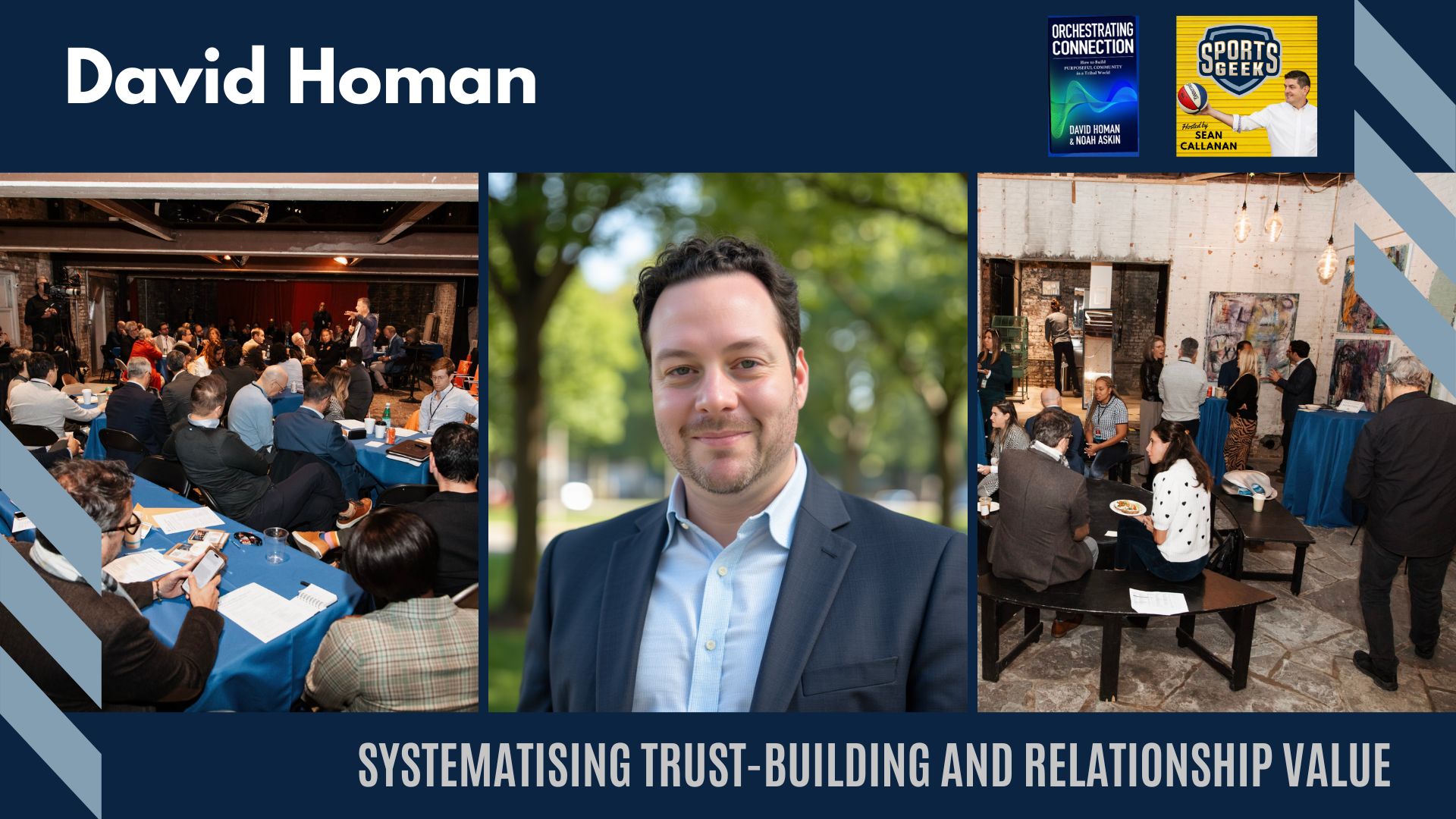
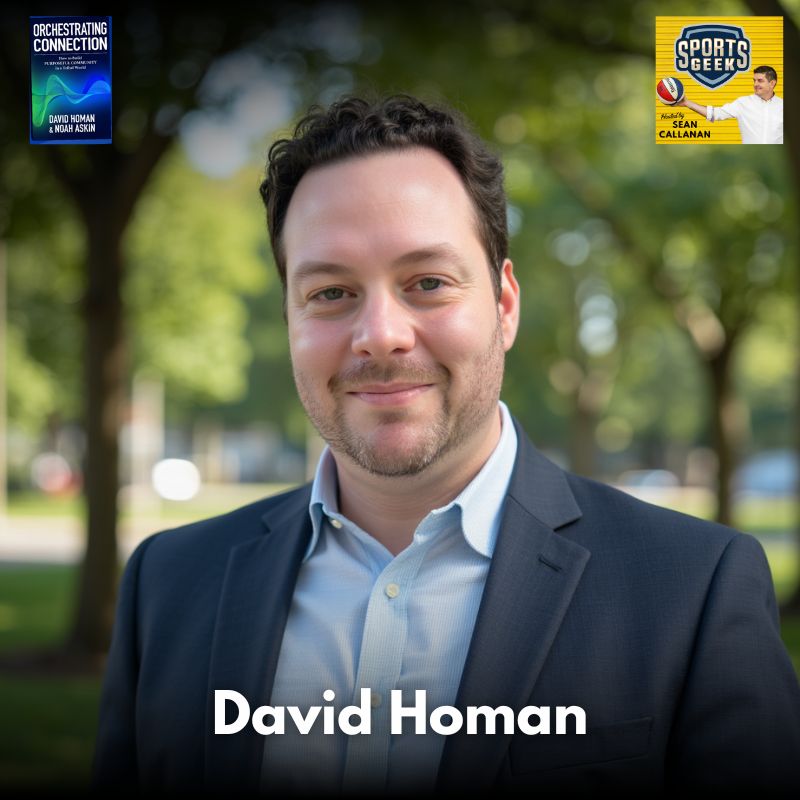
In episode 446 of Sports Geek, David Homan shares his experience building a 2,200-member community of founders and investors and offers insights on transforming transactional networking into trust-driven relationship-building.
In this conversation, you’ll discover:
- How childhood experiences rebuilding health and relationships after a near-death incident shaped a systematic approach to building trusted networks
- Why curiosity and vulnerability are the founding principles of meaningful connection – and why 70% of people fail to reciprocate curiosity in conversations
- Essential frameworks for moving beyond superficial networking conversations (weather, game scores) to building genuine relational value with partners and fans
- How to make yourself “ready for the moment” like an athlete preparing for game day – applying sports resilience principles to relationship building
- Practical strategies for creating what David calls “reputational value” through consistent, intentional support of your network
- The power of looking people in the eye and being present – illustrated through David’s eight-year-old son’s basketball passing lesson that applies directly to business relationship-building
This episode explores the transformation of networking into purposeful relationship-building, featuring insights on systematising trust-driven connections at scale, moving beyond superficial conversations to create genuine relational value, applying sports resilience principles to business relationship preparation, and building communities of 2,200+ members through curiosity and vulnerability rather than transactional networking approaches.
Listen to David Homan on Sports Geek
Can't see podcast player? Click here to listen
Watch on YouTube
Interview Transcript
This transcript has been transcribed by Riverside.fm, no edits (please excuse any errors)
Sean Callanan (00:01.24)
Very happy to welcome David Homan. He's the author of Orchestrating Connection, How to Build Purposeful Community in a Tribal World. David, welcome to the podcast.
David Homan (00:12.056)
Thank you, Sean. Such a pleasure to be here.
Sean Callanan (00:14.572)
Not a problem at all. I always start the podcast trying to understand people's journey, how they got to here and normally say, did you break into the world of sports? And you've probably got, you've got some crossover in the world of sports, but you know, what's your origin story?
David Homan (00:28.526)
So I grew up in what we'd called Jock, Florida. So this was the Florida Gators. So this was Emmett Smith and now Tim Tebow and half the US women's national soccer team. So that was where I grew up. I was a fourth tier athlete there. But when I got to college in upstate New York, I was like a god amongst men in comparison. so, Ryan Lochte trained at the school. so much of the world of sports that we know, a lot of them are.
proud Florida Gators. I thought I was going to be an all-star pitcher. And until fifth grade, like my team was ranked, like I was an all-star pitcher. And then I pitched my last game. I blacked out. I woke up a day later. I had been in the hospital and we called this the year that I died. Nearly did. And so what I thought was an athlete's career growing up. Now that I know I was only going to be five eight on this planet, it was a dream of an elementary school kid.
Sean Callanan (01:18.221)
Okay.
Sean Callanan (01:26.99)
Yep.
David Homan (01:27.138)
But I grew up with all those values, all those teams playing multiple sports. can play basically everything because in Florida you play everything. And then my dreams were shattered because my entire social network failed, my health failed, and I had to rebuild it. And in that rebuilding of this, I lost my sense of self and where I fit in. By eighth grade, I could run a seven minute mile, yet I thought I was slow. I thought I was out of shape.
By the time I got through college, where I was obviously a god amongst men for intramural sports at a liberal arts college, I realized that a lot of the resilience and the way that I had rebuilt my health was the same way that friends of mine who are very well-known, athletes in particular, and huge parts of active parts of my network, they had taken that same resilience mindset, they'd applied it to excel in sports.
Sean Callanan (02:22.052)
Mm-hmm.
David Homan (02:25.972)
I applied it to solve the other thing that had fallen apart, which was how I look and view relationships.
Sean Callanan (02:33.016)
So that, so a lot of your relationship, I guess, theory and your thinking comes from that sports background of teamwork and looking out for your teammate. And that thing, is there some of the formation from that world of sport?
David Homan (02:47.182)
100%. So way to think about it, right? Everyone needs to be ready for that moment. Every athlete trains for the one moment that they get to win the race, they get to score the goal, or they make the pass. And you have to have both ready. You cannot be an all-star without a team, unless it's a solo sport. But honestly, everyone I've known who's ever won a sport like being fastest man alive, I was on a panel with Justin Gatlin, who finally beat out
bolt in the Tokyo Olympics. And he's like, listen, I lost three times, but I won the last time because I didn't give up. And when we actually drew a parallel to my world, I never gave up on this pursuit to connect in a different way. And now my network is absolutely insane. The people that I know, the people who trust me, that other people would dream of access. I had to be ready for every moment to meet them.
but I also had to do enough work to be able to deliver value to those people whom everything wants something from and instead I can help and support.
Sean Callanan (03:53.305)
So sometimes there's people that don't even like the word networking. They think it's a dirty word and they think it's very transactional and you're going into a room trying to barter your services or get a favor from someone. How do you look at the word networking and how do you tackle it?
David Homan (04:15.82)
I hate the word networking. I hate it because people have so many connotations of the person who walks up and puts their card in your face before they know your name. I think that people even have a hard time with connecting, which is just a different way to say it when you don't want to say networking. When I say I run a purposeful community, I build and maintain trusted relationships. Who doesn't get that? It's the exact same thing you want as an outcome from an interaction, but you have to name it differently.
Sean Callanan (04:24.387)
Mm-hmm.
David Homan (04:44.386)
Some of the other terminology, like I spend my day building relational value and increasing my reputational value amongst people by supporting them. There's a whole currency that comes from relationships, but it has to be earned. It's not granted because you've interacted with some.
Sean Callanan (05:03.606)
And so how do you start that relationship, whether it be someone you've never met or someone you do know and you want to start building up some of that, like you said, relational value.
David Homan (05:17.784)
We had five founding principles for my methodology, which my co-author Noah Askin and I put into the book. None of them are going to be rocket science, Sean. When you meet somebody, be curious and be vulnerable. Seems simple. It's incredibly hard. 70 % of people you meet on average, if you're curious to them, will not ask you or express a single bit of curiosity back to you. If you sit there and you talk about the weather,
Sean Callanan (05:33.71)
Mm-hmm.
David Homan (05:45.795)
What happened with the Giants? happened with Real Madrid played the last game? Or what's gonna happen with FIFA in the US? Will enough Americans come or is the rest of the world just gonna spend a lot of money to see soccer here? There's no value in that. It's just superficial. When you talk about things in a way that has substance about what's bothering you, what's scaring you, what's challenging you, what you're excited about, it gives people an opportunity to be curious and then an opportunity to share their own vulnerability.
Those are the founding principles of what engaging in conversation should be most people fail at. And that's because most people want to network. They want to network through to who's more important. Maybe you're not important. If I feel judged and somebody doesn't think I'm valuable, I write them off forever. They had an opportunity to spend five minutes with me. If they found value in it, a lot comes from it. If they make me feel devalued, nothing comes from it.
Sean Callanan (06:21.635)
Absolutely.
Sean Callanan (06:35.459)
Mm-hmm.
Sean Callanan (06:42.547)
Absolutely. I do like I was at a conference the other day and there was a I think it's Sam Ward, he runs a restaurant group in London. And he asked the group, he said, I just want to turn to someone next to you, and just look into their eyes. And that was the only instruction he gave the whole room. And literally 15 seconds later, everyone started talking.
And he goes, I didn't ask anyone to do that, but like everyone made a connection and it got a little bit awkward for like five seconds. And he's like, hi, I'm Sean. good day, I'm Carlos. And like then the room was buzzing and he to pull it up. But it was that, like having that intention, like once you start looking at someone deeply, he's like, just look in their eyes. And it's like, well, yeah, you start to have a conversation and it gets around that.
perfunctory, you know, handshake, hand over the card, what's your name, what's the weather like, everyone's been busy. I found it to be, yeah, it was amazing to get the room light up straight away.
David Homan (07:35.791)
And I take this back to sports, my eight year old who thinks he's going to be a basketball star, but since my genetics made me five eight, I feel bad for him. But Max was doing this basketball class, which is every Tuesday, and he's new to this group. Some of these kids have been playing together for the last year and he kept getting frustrated he wasn't getting passed to. And afterwards, after the coach had tried to call it out, I was like, Max, you never made eye contact.
Sean Callanan (07:49.047)
Mm-hmm.
David Homan (08:01.922)
You never showed them you were ready to be passed to. So every time they did glance, you weren't looking. Why would they throw the ball to somebody who's not looking at them? And he I mean, he's eight and he was upset and he looked at me. He's like, right. Like, it seems common sense when I connect with somebody, engage with them, stare into their eyes like, you know, the eyes of the portrait, the soul, all of that. But in the end, if people feel like you're looking through them or looking around. They're.
Sean Callanan (08:02.103)
Mm-hmm.
David Homan (08:30.411)
You're looking for opportunity, you're not looking for relationship. And the world is built entirely on relationship.
Sean Callanan (08:35.509)
absolutely. And so how do you, like I view it as a, it's a muscle. It's something like, and it's something that atrophied like in COVID when we couldn't meet with people. And yes, we've translated some of it to an forum like this in online where you can connect with someone. We sort of got past the phobia that you can't learn, meet someone online and not know them. Like we've got past that, but like.
I really miss that for that, you know, being in Melbourne, we were locked down for a while of not being able to see people and have that in person connection and develop that, you know, keep that muscle well tuned. How do you go about keeping that social muscle well tuned?
David Homan (09:16.354)
My network felt really bad during COVID, Sean, because they were all thriving. They were meeting people, they were engaged, video was just a different way to do it that was honestly less exhaustion than what we mostly feel, going all around the world and meeting people and traveling and conference, conference, conference, event, gala, whatever it might be. And it's because there's just a very specific reason that you end up getting the right interests. It's hard.
Sean Callanan (09:20.361)
Mm-hmm. Mm-hmm.
David Homan (09:45.081)
but it's because you ask for it. It's that simple, right? So like, I have a friend, he's a pretty amazing guy, he rebuilt Pakistan's cricket league and is really credited with elevating that sport throughout the entire country. And he fell in love with this incredible human being, the world knows her as Malala.
And they came to me, they told me what they were gonna do. They spent about a year and a half getting ready for their fund, which is called Recess. And I said to them, well, what are you guys doing? And they said, well, we're working on a sports fund. wanna invest in the entire spectrum of women's sports to elevate women so that when we see women is equal to men, there's equal pay, there's equal rights, there's what should be on this planet. And there's a pathway for this for girls who can learn the same skills that we know men gain easily.
in playing sports in a prominent way. And if more than half the world is women, why wouldn't we have this focus? And I said, great, well, who are you looking to meet? And they paused and they said, well, who do you think? If we don't know how to ask, and they became incredible at this as they build out their fund now currently, it makes it so much easier when you build a relationship. It's not about who they are, it's about what they're doing. And a lot of people I know are leaning in to try to help them.
Sean Callanan (10:57.208)
Mm-hmm.
David Homan (11:08.354)
because the asks match each other, the whys match each other. And this is what happened in my network. We had people who were comfortable asking for what they needed. Not easy to do, but then when you can match one ask to the other, the amount of potential that comes from that is profound. And this is where I focus on the connectors in this world who are the most adept and best at this. But most connectors are really good at asking what somebody else needs.
Sean Callanan (11:20.311)
Mm-hmm.
David Homan (11:38.105)
They're really great at trying to understand what should happen for them, but they don't understand how to build real trust in a relationship for themselves because they want to be of service to others. And everything in this book, a lot of what I talked about is, what those founding principles are strategically to transform your life and figure out who you trust, not based on emotion, but based on action.
Sean Callanan (12:05.857)
And that action piece, because like I've even been guilty of it before. Like I'll be at a conference, I'll be traveling, you know, I'll be at the Super Bowl, which is a really hectic week with lots of people around. You make some of these fleeting meetings or fleeting conversations. But then if you don't, like if you don't have some sort of system or make sure that you do follow up and do engage post that.
it just floats away. Do you have a system or a process that you do to ensure that it doesn't just be left with that fleeting meaning?
David Homan (12:44.332)
So the current process is Google Sheets, my memory, and an admin. The startup that will come to market this year that I've raised over a million one for in a building is called SOAR Connect. SOAR stands for Strength of Authentic Relationships. As opposed to building a tech company where you give us all your data and we try to come up with great suggestions for you.
Sean Callanan (12:59.949)
Mm-hmm.
Sean Callanan (13:09.41)
Mm-hmm.
David Homan (13:09.676)
I thought that premise sucked because I've never gotten a great intro from technology. The algorithms don't work and I don't want to enter more data. So we built something that's private for each individual that maximizes and augments how you see your data, who you know, who you trust. It's not going to solve the problem. You meet somebody at the Super Bowl. Do you follow up or not? But if you emailed or you WhatsApp that person and then you have an ask like, who do I know who is a former Philadelphia Eagle?
If that person can be Googled and you have their information, our system will help rise that back up for you to know maybe you should connect around that if that was the need for meeting somebody at a Super Bowl. But the goal of this wasn't just for that to be an example for you. If you were to ask that of me, my tech, but I would instantly say, well, you, have to talk to my buddy, Naji. He's incredible dad. He's an unbelievable guy. He also won Super Bowl with the Eagles.
Sean Callanan (14:09.347)
Mm-hmm.
David Homan (14:09.39)
And then he went to play for the Jaguars. But he's my friend. Like we have respect for each other. He also has the ring. But here's what he's doing in sports tech. Here's how he wants to help players have better control over who follows them as fans and the data behind that. So that the third party isn't monetizing your world. Then when you retire, you don't know how to make your world work anymore. That's what his company, OVPO, does. You know?
Sean Callanan (14:34.787)
Mm-hmm.
David Homan (14:35.608)
Forget me being interviewed by you as a sports geek and whatever you do, you want that guy. And after this podcast, I can text him and be like, hey, I just got interviewed by an amazing guy named Sean Callahan. You gotta do it. He'll probably write back, cool, when? Access is trust. Knowing what somebody is after makes you memorable. If you have that minute with that person and you can resonate for what you need with them, you're trusting them to remember. If you can pull out from them in that short time what they need,
Sean Callanan (14:40.322)
Yep.
David Homan (15:06.338)
You're memorable. It's why you should be curious first as opposed to think your opportunity is to pitch.
Sean Callanan (15:14.027)
And absolutely, I do appreciate that. We'll follow up with that contact to see if we can catch up when I'm in San Francisco. But I did want to follow up, like we've got a lot of people listening that are sponsorship executives and very much in a transactional role, trying to help a brand access fans, whether it be in a sport or like you said, the Pakistani Cricket League. so that's it. Most of that is on relationships. Yes, you're handing over deliverables. We'll have signage here and we'll do an activation. How do you…
like bring that relational value and that relationship, but then also, you know, bring in business and have transactions and I guess try not to muddy the waters.
David Homan (15:54.711)
So if you constantly want something from somebody else and you keep asking them for it, if they keep giving it to you, that's not a relationship. That's a transaction where you know the person. It's much different. And I'm talking about just getting to know them, how old their kids, sending them a car to their birthday. Like some people that think that stuff matters, a lot of people don't. What is the thing that no one asks you, Sean, that you actually need for your podcast?
Sean Callanan (16:05.772)
Mm-hmm.
Sean Callanan (16:15.139)
Mm-hmm.
David Homan (16:23.01)
What is the thing? Who is the person on it? What is the world you're trying to dig into that would actually add value to what you need? If that question is asked first and then after you help the person or at least they feel heard, transaction, transaction, transaction, things stay relational. And especially in a lot of the world, like a lot of the people that I'm fortunate to know in my network who are former sports stars or own sports teams,
Sean Callanan (16:41.473)
Mm-hmm.
Sean Callanan (16:51.373)
Yep.
David Homan (16:51.692)
I didn't build my relationship with them because they owned the Miami Heat or the Miami Dolphins. I didn't build it because they were part of the men's league for soccer played in the World Cup or they won an Olympic medal with women's basketball. I figured out that I liked them, figured out what they needed, and I helped them. And then if I asked something that is transactional, okay, they'd hear my ask, I give them the permission to say no. And by giving that
permission, I have more access than that person who's actually offering money for something they don't have access to.
Sean Callanan (17:30.234)
Absolutely. One of the things is I'm always asked whether it be young graduates trying to break into an industry like sport, which is a very high competitive industry. And it is a lot about the relationships. It is a lot about who you know. There's a lot of advertised jobs that aren't advertised. But you've sort of got that high status, low status sort of play where, you know, you're a
you're a grad and you've done this, but you wanna reach out to a CMO of a team or somebody who runs the digital department or somebody who runs the venue tech. Is there a particular, I don't wanna say tricks, is there particular strategies in doing that reach out to someone that might be, you might be thinking, oh, this person is beyond my realm, I really can't reach out to this person. How do you get over that fear and is there good ways to do it?
David Homan (18:19.95)
First question is, do you have something of value to add? Is this something that you need and they need, or is this something you desire or you want? I really wanna work with this rugby team, because I love this rugby team. Then you get there, you're like, I love this rugby team. They're like, go to the work. And you're like, well, why do I wanna do work? I like the team. So when you're trying to outreach to somebody whose job is to do their job, did you do the research to understand it? Did you look at where they came from?
Sean Callanan (18:23.971)
Mm-hmm.
Sean Callanan (18:34.307)
Mm-hmm.
Sean Callanan (18:39.202)
Mm-hmm.
David Homan (18:48.984)
Did you look at the challenges that they're facing? Right? If you take one of the best weird sports shows ever, which is Ted Lasso, like what does he do that's interesting that makes it such a compelling show? He studies the people in it and what they need. And even though he's weird and off-putting and it's a comedy, like the team starts to do better because he breaks the system that made them just think, well, I'm going to do good, but my team's not.
Sean Callanan (18:56.737)
Mm-hmm.
David Homan (19:16.598)
And so in every example that I've seen that has worked positively with this, meaning you weren't born with connections. There was no spoon you're trying to hide because your dad owns this or your mom did that. If you take the time and you show up and you offer something of value because you figured out what you could offer, you may get that chance. If you figure out the people around you, not as people that are of the moment, and then
Sean Callanan (19:29.251)
Mm-hmm.
David Homan (19:44.301)
You're going to be the one that makes it. You're not dismissive of the network that can become a community. What I've seen over and over again, I grew up in a small town in Northern Florida. Now people think I know everyone in New York, but my network is so big. I know seven people in Perth as an American. So for anyone who's in Aussie listening, what American have you met who knows where Perth is on this planet?
Sean Callanan (20:02.68)
Mm-hmm.
Sean Callanan (20:10.028)
It is one of the most isolated places on the planet. it's even three hours from me.
David Homan (20:13.038)
And I know seven. I mean, know tons in Melbourne and Sydney and a decent amount of Adelaide. like, are you kidding me? But like one of the guys from birth is my buddy Mick, who just built, he built Global Citizen. It's one of the best exports to come out of Australia is that incredible focused music philanthropy. And I didn't build these with an agenda for it. I built this step after step.
of meeting somebody being curious, then as I grew and they grew, at some point, they do something substantial. I do something substantial. You don't get it when you're 20, but the relationships you build will flourish. But not if you thought, all right, well, Sean's this guy, he's gonna do this thing. You played for a little bit, now he has a podcast, but I can't wait to do this other thing. I'm not here for you at this moment. The minute we feel that,
We dismiss other people from it, but we never think it's happened. We're doing it to others. We only smell it when it happens to us. And the people who fail seem opportunistic. They seem shallow. They seem like they're trying to work through you. The people who engage and respect you, they get the respect back. And then when somebody goes, Sean, who's that one person who should go work with this team? There's only one person you think of because they built respect without an agenda.
Sean Callanan (21:35.492)
Mm-hmm.
Sean Callanan (21:42.402)
And is that some of the, I guess, some of the key traits of the key people that you would call a connector in your community? Is it something that they've honed over time? do you think it is something that can be learned?
David Homan (21:51.243)
All of
David Homan (21:57.295)
I think it can all be learned. think children are like this and that it's unlearned when we try to take from this world. And when we realize like COVID, like we realized we were alone, but my network wasn't. My network grew from 400 to 900 people in 18 months. Cause somebody would jump on the call with me and be like, Hey, I'm Alan. I'm a connector. Let's talk. And I'd learn what Alan's doing. And then I'd be like, wait, you built spy game and Warcraft.
and Starcraft and like most of my childhood of video games. He's like, yeah, those were all super fun. You played them. What are you doing now? And so there is a way to thrive with it. It can all be learned. It's really as simple as thinking maybe you're not the most important person in this world. Maybe if you'd be curious to other people, maybe there's something out of it there. What if you could be helpful without an expectation of return? What's that worth? And the answer is it's worth its weight in gold.
once you deliver value without that value being something that you prescribe. And if you give me a moment, I'm gonna give you an example of one of the greatest gifts of value that stems back to my friend, Najee, who was the one who won Super Bowl with the Eagles. So here's an example, a living example of why this matters. One of my best friends whose daughter has known my daughter since my daughter was born and his daughter was three months old.
Philadelphia Eagles fans. For anyone who knows the Eagles in the United States, they never won. They never.
And then Sunita calls me on Super Bowl Sunday when the Eagles are playing for their first time. And he says, Eagles are playing tonight. I'm headed to India. I was like, he's like, can you just make help for you? Like, and watch my kids and my wife and I at the time were like, of course. And I go, but what happened? And he says, my dad died. He was visiting family in India and he died. And I'm going to go see him.
David Homan (24:05.614)
And so Sunique gets on this flight. He's a wreck. He starts telling people about it. They find a way to put on the game. Everyone on the plane is rooting for the Eagles to win because his dad was there in spirit. And two weeks later, I told my buddy, Jonathan, this story. Jonathan and I know each other a few years and he goes, I got you, bro. I don't even know what that means. I'm just like, he's like, I'm gonna help you out. A couple of weeks later, Jonathan comes to my door in New York.
Sean Callanan (24:16.281)
Mm-hmm.
David Homan (24:35.5)
And he says, I need you to give this to Sunit. I shared a little bit about Sunit. Sunit is somebody who's always grateful, always thankful. And it's a football signed by the entire team. And it's a poster signed by the entire team with notes of admiration for one of their super fans who was there in spirit. And I thought at the time, okay.
Sean Callanan (24:47.705)
Wow.
David Homan (24:57.902)
This matters, this is meaningful. If my network delivered value, then I was at another event a few years ago and I met one of the other people who had been captain of that team. And everyone else wanted to his autograph and I come up and I was like, I have to thank you. And he goes, for what? I was like, you signed the thing Najee did for Kieran. He pauses and he goes, oh my God, I didn't think about how important it was that my dad was alive to see me win the Super Bowl.
And now it made it meaningful, not because I won, but my dad was there and I realized three of the other players' dads weren't. It made it more meaningful to me. You gave value and meaning to me. And this is a true story. This has happened. I put it in my book. And with it, if somebody's wondering why do this, anyone in the Eagles who played that day has instant access
Sean Callanan (25:26.36)
Yeah.
Sean Callanan (25:40.75)
Mm-hmm.
David Homan (25:53.327)
to a friend who's launched four major companies in the tech world, who's a professor, who has an insane network. We have access to everyone who played and I will help any player on that team who asks anything of me because they helped my friend remember his dad. We built relationship that then becomes, hey, this friend is raising for his startup, will this investor take the call? Of course he'll take the call when I tell them that story.
Who's not gonna take the call with Najee who did that for my friend? He did not know at the time.
Sean Callanan (26:20.899)
Yeah.
David Homan (26:28.556)
He did it because he was glad his dad was alive. So this emotional thing, this soft thing that everyone thinks doesn't matter has direct, tangible, profound results that make everything relational and then every transaction can happen under it. And people don't think this is what you should learn in business school. They don't think you should learn when you're trying to be real. Then all of my friends who are players who have maintained their wealth post-career.
Sean Callanan (26:31.927)
Absolutely.
David Homan (26:57.73)
They stopped trusting the people they grew up around. They started trusting the people who acted in accordance with respect to them that they never saw as being opportunistic because they made millions. And therefore you have to invest in my real estate deal. You have to put money into my startup. Like one of the investors in my startup that I mentioned briefly is the current long snapper for the Cowboys. And when he called me up and said he wanted to invest, but he's not sure because he's trying to invest long term.
Sean Callanan (27:13.912)
Mm-hmm.
Sean Callanan (27:20.334)
Okay.
David Homan (27:25.938)
especially because he has two young kids, I said, I'm not sure you should invest. Talked to my friend who's a very savvy sports investor, an ex-major league soccer player. And my friend took the call and he came back to invest with me because I thought it was more important he considered what was right for his kids than what was right for me. And what person raising for a startup says, don't invest, let me connect you to somebody to convince you not. But therefore I built trust. He saw it as something powerful.
And when I go to him, my friend Candice, as in Candice Parker, who's the WNBA star, and I go to this incredible guy, Sean, who's currently a quarterback for the Bengals, and I go to friends who are Olympic gymnasts, and I go to Asir, who's Malala's husband, who relaunched cricket and built a lot, and I go to my entire sports network about what I'm doing. It's not about sports, it's about what they need, what they want, my network can help them with, and I have all that access.
And I know I'll stop at this to give you a chance to ask me another question, but it's just a reframing of how to position it that ends up with a much better ROI and much better results and more purpose all in the same.
Sean Callanan (28:28.9)
Mm-hmm.
Sean Callanan (28:40.228)
Absolutely, like I totally agree with a lot of your sentiment and thank you for sharing that story. I mean, I owe a lot of what sports gig is and has become because of my network, whether it be connecting with people through conferences like Seat and meeting people and they become guests and they become friends. And it's like, you know, that that that energy comes backwards and forwards around the world. The question I did have
You know, we're both business owners and entrepreneurs and looking to build things. This all still applies to someone who's in a job, who's working their way up on a career, and they might be at the same, you know, they might be at the same team or the same league for many, many years. All of this still works. It's not just something for entrepreneurs and business owners, is it?
David Homan (29:32.267)
It's a way of life the way I see it. To quote the Mandalorian, because my brother writes for Star Wars video games, like, this is the way. I don't know another way to do this. I don't know why you wouldn't. Why would you not want to have a stronger purposeful community around you? Why do we think that the world of relationships is only how do I get to Steven Spielberg or Ray Dalio or the Pope or the Dalai Lama? Why isn't the person who helps you with the sale into your kid's school for a bake sale valuable?
Sean Callanan (29:40.835)
Yep.
Sean Callanan (29:45.028)
Mm-hmm.
David Homan (30:02.798)
Why isn't the person who you travel with for 10 years when your son or the same premier soccer league valuable? There's all value in that. It is not just about a high achieving entrepreneur with a billion dollar exit. If you are working at a bookstore, you were doing sales for a med tech company, it is all the same in terms of relationship because in the end what we all want and need is community. This is why I want, you know, my.
Sean Callanan (30:08.367)
Mm-hmm.
David Homan (30:29.582)
colleague Noah and I who wrote this book together, we wanted to be really clear of many things, but that this isn't a way of doing it to get access to the glitterati of the world. I have met a lot of those people. I don't like a lot of those people. They've been horrible to me. They've been dismisses of me. They made me feel like I don't matter. And there people in this world that have no value, that have more value to me than any others, how they showed up when I lost my dad last year.
Sean Callanan (30:47.545)
Mm-hmm.
David Homan (30:58.19)
how they're showing up now, months later, as I'm also launching a startup. Who was there when I needed it, not when I had to ask for it, because I was desperate. All those are ways to build community. When we have a strong community, everything is easier. When we are lonely and isolated and feel judged, everything gets harder. We die faster. We end up with mental health challenges that we can't overcome because we have no one to talk to.
Sean Callanan (31:11.449)
Mm-hmm.
Sean Callanan (31:26.597)
Absolutely. You've been lucky enough, like myself, to travel the world, meet people from different parts of the world. Do you adjust things for different parts of the world, whether it be for culture? is that connection and that building that relationship a little bit different in different parts of the world, or is there some commonalities there?
David Homan (31:47.609)
So some things are the same and some are not. When you run events as a huge part of your living, you learn what after work means. In Chicago, when the day finishes, an event has to start because everyone leaves and goes to the suburbs. In New York, when you do an event, you need a one to two hour buffer for everyone to go home, change into mostly black clothes, and then come back out. It's all different. But the universal thing, in London, in Tel Aviv, in Berlin,
Sean Callanan (31:56.367)
Mm-hmm.
David Homan (32:17.888)
In Miami, in Los Angeles, I make everyone show up on time for meetings with me or my events, no exception, because I say one thing that is a universal term understood. I want you to honor the people who are here. I want you to honor the relationships and honor and dishonor and every language have no in-between. And that's where I focus on the vernacular, the language that is the same. You translate this into any language on the planet.
your relationship value. Everyone gets it. Networking and connecting, there's many things people misconstrue, but it's really fascinating. know, American bravado, it's okay to fail. It's okay to just ask for what you need if you're not ready. Tell me a single entrepreneur in Australia who doesn't live with the feel of failure sitting with them for their entire lives.
Sean Callanan (33:05.231)
Mm-hmm.
Sean Callanan (33:13.305)
Mm-hmm.
David Homan (33:14.104)
Tell me a single VC who ever talks about something that failed in their portfolio. They just don't talk about it. Whereas in America in particular, which is makes us a unique country that I live in, they're literally like, here's my worst company and what I learned from it. Want to invest another hundred million with me? And everyone's like, well, sure. So there's a difference because this country is, although it has its challenges, it's incredibly diverse in a way that most others are not because of how it was built after a lot of the rest of the world.
Sean Callanan (33:19.759)
Yeah.
David Homan (33:44.482)
became and stayed more tribal. So I find that people who need more in most cultures, there's a cultural norm that it's not okay to ask.
But it's okay to say, this is my passion. Here's how I believe it could be amplified to help you and everyone else. And that's what I call my impact ask. That works in every culture. I get stodgy Brits who wear three piece suits and come up in an event and you know, they show up on time. On time is eight to 15 minutes early. And I get them within 20 minutes to be saying, this is what I'm passionate about. This is what I care about. Do you care about this? Who cares about this?
Sean Callanan (34:15.461)
Mm-hmm.
David Homan (34:26.082)
because there is something universal in talking about passions and doing something greater than oneself that transcends all cultures. And that's what I focused on as I built a global network, how to make something universal but also personal.
Sean Callanan (34:40.805)
Absolutely. And is it for you, you know, being around connectors so often, you know, there's that philosophy of you become or you start being like the, you know, the rooms you're in. So if you're hanging around with people who are connectors, who are givers, that's how you are. Are you really intentional in, you know, the rooms you want to be in or that you want to find yourself in?
David Homan (35:06.03)
A little bit over 10 years ago, when I realized I needed to my first event to correct the wrong I had started, which is I had all this trust and respect of so many people and they knew me, but they didn't have that trust with each other. And all I was doing, and at least it would be like person one, talk to person three, you were both at my birthday party, why don't you trust each other? I failed at that. So, since everything I do is based on psychology, even though I've not fully studied it,
If you're going to be in my community, anywhere around the world, you have to be an action oriented, natural giver that I would leave my children.
That's the bar to make a recommendation. That's the bar I have to uphold when I bring people in. And if you're not that, there's plenty of other communities. I set a very high standard thinking it would be limiting. I'm so exhausted because my network has grown and grown and grown and people come up to me like my buddy Mick from Perth, who just he and his wife found value. We are friends. We're helpful to each other.
Sean Callanan (36:09.582)
Mm.
David Homan (36:14.702)
And I was like, hey, you're in London, but I'm in London. Why don't you speak at my event? And he speaks so nonchalantly about what he's doing to build new jobs in Africa, asks for relationships to a couple of different countries they're expanding in, and then says, yeah, well, we're doing this through this little vehicle that I built. We did this conference at Central Park. It's kept going. It's called Global Citizen. And everyone's enamored. But it was all about humility.
And that's because he's an action-oriented natural giver I leave my kids with, not a global superstar philanthropist bringing billions of dollars to help alleviate poverty, which is also what he is.
Sean Callanan (36:55.909)
So before I wrap up, thank you very much for the conversation. Do you have an ask of me or the sports geek audience?
David Homan (37:06.542)
You know, I was thinking about this because a lot of the podcasts I do in a lot of the world I'm in is all around impact and connection. And when I think about sports, right, like when I grew up in the deep south in northern Florida, like you were a Gator or you were a Seminole, eventually they became not the best team. So then you were many of the other teams in what's known as the SEC. And everyone cared about it as if it was such a rivalry until I got to New York where no one cared.
and there was this bar restaurant called Brother Jimmy's and you'd go there and you'd meet somebody who was a Seminole and meet somebody who was a bulldog and you'd be like, wait, you also know about this? We have more in common with what we thought was our hate than what we have in actual what a rivalry would be. So my ask always is, especially with people in this world where a lot of their identity, their world is sports, is to try to figure out even if you're against another team,
most other people don't care and you do, is there a way to make it about the game and not about the venting of the hate that comes out as a way to honestly deal with a lot of mental health and a lot of other things? Because I think that sports is one of the most important community building groups on the planet. I can't think of a single thing where somebody's identity or their youth wasn't shaped either by it or the absence of it. And the number of people who make it are like the number of people who make it into Hollywood.
Sean Callanan (38:30.191)
Yep. Yep.
David Homan (38:36.086)
make it into anything. But the number of people who maintain their love of sports stays, whereas a lot of people who were former musicians, former that, they stopped loving it. It beat them down. But I had dreams of being a soccer player. I was a really great right fullback. It's just I never got above 5'8″. And everyone thought I should played rugby, but as a musician, you can't play rugby. I was a great wingman. I could kick the ball. It could bounce out right before.
Sean Callanan (38:54.277)
Mm-hmm.
David Homan (39:03.444)
And then we could run in, but once we are in a scrum, there went my Chopin the next week. And so what I'd ask everyone to think about is not just what the sports mean to you in your life, but how you could build a deeper community by the fact you share something that is also beyond the love of the game or whatever game it might be.
Sean Callanan (39:30.402)
Absolutely, I mean that's what a lot of the listeners are doing in building out what is the precinct and what is the game day experience and what it is like and that tribal nature like it's in your book. For me, going to a Collingwood match, my great-grandfather played for Collingwood, I go there with my brother and my nephew and my son.
and I cherish it. And that's what it is. Yes, I'll get excited when we kick a goal and I'll be devastated when we lose, but that's that piece. what think draws a lot of people into sport as a fan, but it'll drive a lot of people into the business. If you can help foster that when you're working in sports, that's it. You're unlocking the secret sauce for me.
David Homan (40:14.786)
But here's what I'd say. It needs to be sports and. Because sports can build community. Sports can give you identity. That can give you a multi-generational perspective that's emotional and sharing that with your son. I'm just thinking like that's just incredible. But do need to be anonymous in the crowd as a community watching a game? What happens when the teams do it right and they come together with it to help kids with cancer? What happens when they do a local cleanup?
What happens when they take the identity and just take what, you know, welcome to Wrexham did. Like, look at what happened to the town, which is really the most meaningful part of it. It's great that the team got better and better and better, but people who came there also came because they felt they could do more than just be part of a winning team. That's what a community can do as they follow their team. If we take that little step more with what we're doing, that little more collectively.
Sean Callanan (40:48.067)
Mm-hmm.
David Homan (41:12.17)
is greater than most to help people get in their lifetime.
Sean Callanan (41:16.075)
Absolutely, absolutely. David, I really want to thank you coming on the podcast. I want to get to the Sportsgeek Closing Five. Do you remember the first sports event you ever attended?
David Homan (41:26.318)
I remember watching Emmett Smith play as a Florida Gator. That was phenomenal even before he became what everyone else knew was Emmett Smith. That is my first really profound memory.
Sean Callanan (41:38.55)
That would have been it would be trivial You would have been a few sports events in your time whether in Florida or New York Do you have a favorite food memory at a sports event?
David Homan (41:48.345)
My friend Steve took me to the final opening game for when the Dodgers were playing the A's. And with the craze of world's most famous Japanese player watching him play, the fact that a stadium had a bunch of crap American food, that authentic Japanese food, my God, it was good. It was not third rate. This was like LA high quality.
Sean Callanan (41:56.857)
Okay.
David Homan (42:18.798)
at a stadium, at Dodger Stadium.
Sean Callanan (42:20.197)
That is amazing and it is good that that bar is being set high. What's the first app you open in the morning?
David Homan (42:32.75)
You know, I really try not to open anything for a little bit, but when I do, it's just my email. I need to see when it's got over 200 or 300 how much stress I'm gonna have till I bring it back down.
Sean Callanan (42:37.498)
Mm-hmm.
Sean Callanan (42:47.769)
No, that's fair enough. Is there someone that the listeners should, you've shared out a few names the podcast, I really do appreciate it. Is there someone that the podcast listeners should follow? It might be an author, it might be someone that you work with, it's obviously be someone in your network that they should follow and why?
David Homan (43:04.162)
I would tell everyone, and everyone, read my friend Candice's book, The Candy Mindset, two-time Olympian gold medalist, WNBA star, now covers sports with Amazon. When my father died last December, Candice was the only person who asked what I was doing to commemorate his life and when. And then she texted me,
Sean Callanan (43:12.229)
Mm-hmm.
David Homan (43:31.855)
please send me your address. And she sent me flowers that day. She's a friend. She's also somebody everyone wants to meet. It was one of the most noble things that's ever happened. It just hit me at the right moment. And I had finished her book a few weeks before, when you're dealing with an ailing parent in hospice, you have a lot of time to read. And her book struck me as something that was just so practical and useful. It wasn't some player.
building their brand, it was really heartfelt because she's heartfelt. So that would be the book. Candice Parker, The Can Do Mindset. It's like how to build resilience. There's a final part. I should remember since I'm plugging her, but it's easy to find.
Sean Callanan (44:06.862)
Alright.
Sean Callanan (44:13.957)
It will be easy to find. It sounds along the same lines as one of my favourite books that I gift often is Angela Duckworth's Grit. I don't know if you've read that book or seen her speak. Yeah, again, something that I hold true of. You've just got to keep on keeping on and it's something that you do. So I'll definitely check it out with travel coming up. Lastly, I asked people what social media platform is your MVP? Is there a platform that…
David Homan (44:23.02)
Mm-hmm. I love that book.
Sean Callanan (44:42.947)
that works for you and helps you in what you do and helps you connect with people?
David Homan (44:48.632)
The only one that I found of substantial value for me, which will also date me, is LinkedIn. Now as a platform,
Sean Callanan (44:55.141)
I don't think it dates you. think it is a very powerful networked tool.
David Homan (45:03.192)
for all of its flaws, for all of its issues, for the bias I know that's in it, for all of it. You know, my old friend world was on Facebook years ago. I did that thing called Instagram as it promoted my book. I got 20,000 people to watch, but it did nothing happen from it. When I posted on LinkedIn about losing my father, 800 people wrote me. That's power, whatever it worked out, that people wrote me individually to share their own story.
Sean Callanan (45:18.949)
Mm-hmm.
David Homan (45:32.046)
because I was courageous enough to share mine and a medium like that for whatever its issues also delivered a lot of value.
Sean Callanan (45:39.621)
Absolutely. Well, I want to say thank you for delivering value today. And I want prompt people listening to check out your book, Orchestrating Connection, How to Build Perps for Community in a Tribal World. David, I really do appreciate you coming on the podcast. I always ask people to reach out and say thank you. What is the best way for people to do that? Is it to reach out via LinkedIn?
David Homan (46:00.792)
You know, honestly, no, I don't check my LinkedIn messages as much as I should. I'm actually pretty bad at it. I made my world public. If you want to reach out to me to say thank you and you go to my orchestrated connecting site or you Google me and the variations of that, my email's there. If you look hard enough, my phone number's there. But in the end, right, and it's David at orchestratedconnecting.com, like go figure, it's a pretty easy one. Do it with intentionality, with a why, with a reason.
Sean Callanan (46:16.045)
Okay, we will put it…
David Homan (46:30.318)
Everyone in my world is crazy busy, when somebody's intentional, seem to always have time.
Sean Callanan (46:37.381)
Well, thank you very much, David. Hopefully, I will be in your part of the world sometime in the next 12 months. If I go to New York, I'd love to catch up. other than that, thank you very much for taking the time.
David Homan (46:48.962)
It's been a pleasure, Sean. Thank you and thank you everyone for listening.

Turn 15 minutes a day into sponsorable content your partners will pay for
Sports Geek AI is a done-with-you content system that creates daily newsletters, podcasts, and social posts—giving your commercial team new inventory to sell.
Resources from the podcast
- Please connect with David Homan on LinkedIn. While he admits he’s not the best at checking LinkedIn messages, you can reach him directly via email (listen to the podcast to get David's email). Let him know you listened to the episode. Please say thank you if you do connect.
- Learn more about Orchestrated Connecting community and platform.
- Check out his Book – “Orchestrating Connection: How to Build Purposeful Community in a Tribal World”
- Join me at SEAT in Charlotte in 2026.
- Give our new Daily podcast a listen – Sports Geek Rapid Rundown.
- Podcast episodes you should listen to:
- Throwback episodes you may have missed:
Podcast highlights
Highlights from episode 446 with David Homan:
- 03:15 Origin story: Florida Gators childhood and near-death experience that changed everything
- 06:35 Why networking is a dirty word and how to think about building relationships differently
- 08:30 The founding principles: curiosity and vulnerability in building connections
- 11:42 The eight-year-old basketball lesson – making eye contact to be “ready for the pass”
- 14:25 Why 70% of people fail to reciprocate curiosity in conversations
- 18:50 Building relational value and reputational currency through support
- 23:15 How sports teams and athletes demonstrate the power of preparation meeting opportunity
- 27:40 The death of six-degrees of separation in a hyper-connected world
- 31:20 Moving beyond transactional “what do you do?” conversations to meaningful connection
- 35:45 Why being a connector requires thinking like a team captain, not a solo athlete
- 38:10 The Welcome to Wrexham example – community impact beyond winning
- 42:20 Sports Geek Closing Five
- 43:40 Book recommendation: Candice Parker’s “The Can Do Mindset”
- 45:40 Why LinkedIn works for building authentic professional relationships
Listen To Sports Geek
Recent Sports Geek Reads
- Saudi Arabia Reshapes Tennis, NFL Eyes Thanksgiving & the World’s Richest Sports Owners Revealed
- March Madness TV Trends, PGA Tour’s $150M Real Estate Play & NIL’s $30M Problem
- Ticketing Battles, Netflix on Sports & AI Code reviews
- NFL Ad Costs Soar, TKO’s Rise & AI Turbocharging F1
- NFL’s Rams Genius Strategy, DAZN’s Global Push & Netflix Bets on Ben Affleck’s AI
- Media Sports Strategies, Wrexham vs Chelsea & Ticketmaster on Trial
Listen to Sports Geek Rapid Rundown daily