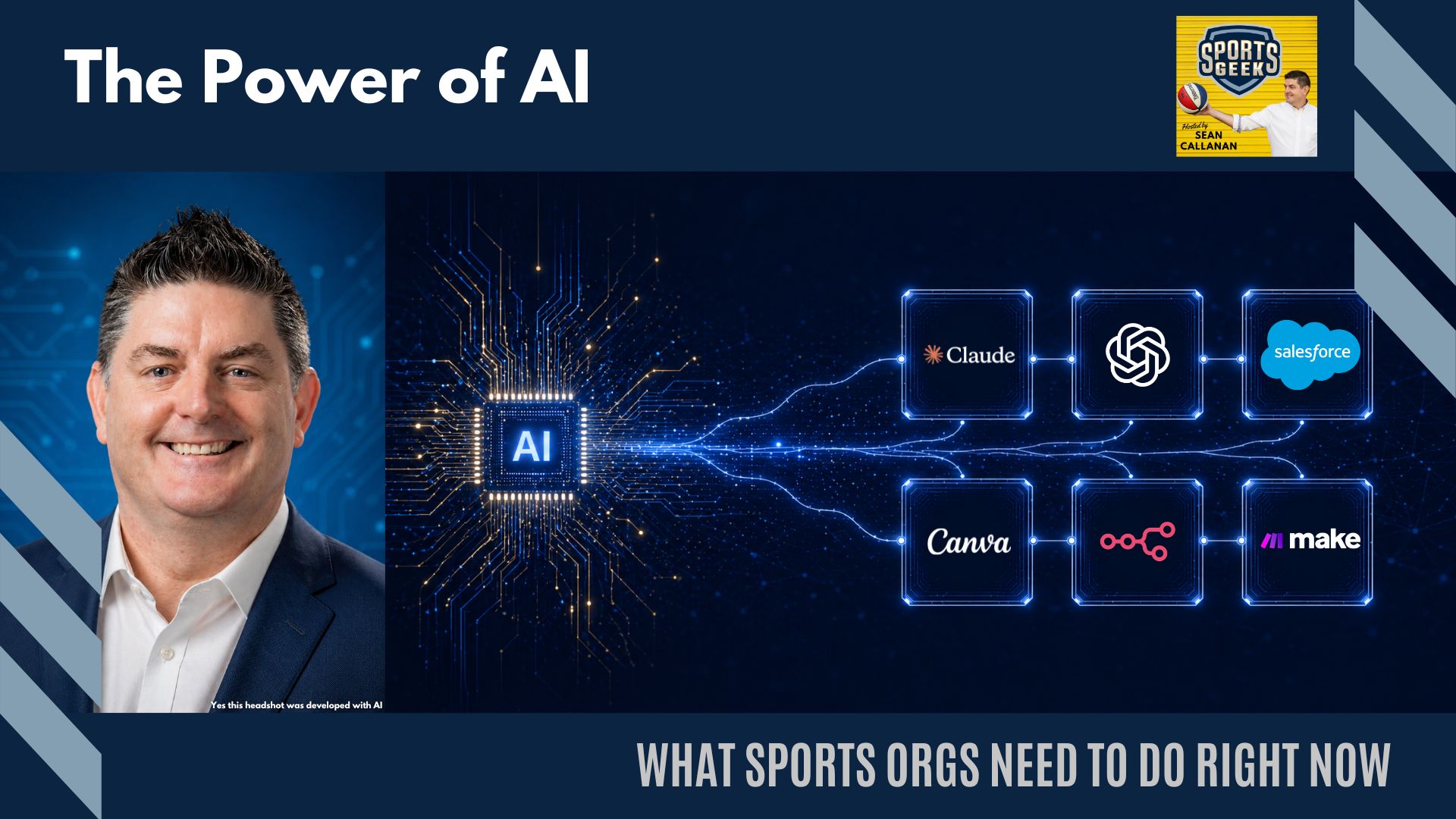
In episode 450 of Sports Geek, Sean Callanan reflects on the state of AI in sports, not from the sidelines, but from inside the machine. As someone who's been building live AI workflows for Sports Geek and clients over the past 18 months, Sean brings a practitioner's perspective to what's actually working.
In this conversation, you’ll discover:
- Why the arrival of Claude Managed Agents in public beta means the cost of waiting just went up, and what that means for your organisation right now
- How Canva AI 2.0 and Claude Design are shifting sports marketing from “AI tools inside design software” to “design inside an AI platform”
- What Sean has been building, from a LinkedIn data analysis tool and a sports creative CRM to a fully automated daily podcast pipeline, and what each one costs in time and money
- The SportsGeek.AI case study: how the Never Enough Pies Collingwood newsletter went from 90 minutes of daily curation to under 20 minutes using AI
- A practical triple-threat filter for evaluating any AI project: Does it save time? Does it generate or save money? What does the pilot actually require?
- Why the organisations winning with AI aren't the ones with the biggest budgets and what a permission culture looks like in practice
Listen to Sean Callanan on Sports Geek
Can't see podcast player? Click here to listen
Watch on YouTube
Interview Transcript
This transcript has been transcribed by Riverside.fm, no edits (please excuse any errors)
Sean Callanan (00:01.428)
I'm Sean Callanan and welcome to episode 450 of Sports Geek. In this week's episode, I'm going to discuss what a big week it has been in the world of AI, but really, what a big year it has been in the world of AI and what we're doing about it, what the opportunities are. I look back at last year at SEAT Nashville.
I spoke about the power of AI and I talked about things like agentic AI. I had slides. They were future concepts. They were still in their initial form. But in the last couple of weeks, Anthropic has shipped Claude managed agents into public beta. You can now deploy in a day. That's how fast it's moving. So what I wanted to do is to use episode 450
to sort of check in, find out how you're using AI and let you know how we're using it and where we think the opportunity lies for the sports industry, how it can be embraced, why it shouldn't be something that you fear. So I really do appreciate you listening. If you're doing so via the SportsGeek website, sportsgeekhq.com or via the multiple channels that SportsGeek is available.
on our SportsGeek YouTube, SportsGeek on Spotify, SportsGeek on Apple Podcasts, and also my favorite podcast app, Pocket Casts. Thank you very much for listening. If you're listening to this for the first time, thank you if you've been listening since episode one. I really do appreciate it. And so really what I want to use this episode is to really talk about how AI can use
how sports can use AI and what are the things you need to be doing because I believe the cost of waiting is going up day by day. So for those who were in Nashville for SEAT last year and I did a bit of a read and you can find that keynote on the Sportsgeek YouTube. There'll be a link in this show notes. Go to Sportsgeek HQ.
Sean Callanan (02:25.55)
dot com slash 450. I really just went into the terms and all the different buzzwords that are around the world of AI, machine learning and deep learning, generative AI, low code, vi coding, agentic AI. They were the things that I was explaining. Now machine learning and deep learning is embedded. It's part of the furniture. But what we have seen is
Generative AI, low code, continue to be exposed, continue to grow. Vibe coding becoming more of a, not a new term, it's a thing people are doing. They're one-shotting code, whether it's using tools like Claude Code or something of that nature. And now, Angentic AI, so building agents that are sitting there, they're autonomous, they do what they do.
as programmed, as developed, are now becoming more attainable, easier to deploy. And as I said earlier, Cloud Managed Agents are now in public beta. And so that, again, it gives you a harness to say, hey, this is a task that I want done. It can be built as an agent and then run. So that was shipped this in the past two weeks. The other big announcement in the space from a
AI point of view, but also a design and a framework point of view was the Canva AI 2.0 announcement. It's their biggest product launch in Canva history. I've long been a Canva advocate and a long-time user of Canva. I think it's a really good tool to produce a lot of fast content, fits with the pace that the world of sport needs, and it's continually…
kept leveling up its toolset and what it can offer. And so what the AI 2.0 is, is trying to pull in more of the AI tools that everyone's using into one architecture. It's not something that I'll be using in that method, but I can definitely see the path where people will just expand what they do in the world of Canva.
Sean Callanan (04:49.151)
and bring in more generative AI and more models into that ecosystem. The other thing that was launched recently was Claude Design. And this is very much a hand-in-hand collaboration between Canva and Anthropic, really looking at applying design, pretty much saying design is code. If you can code it, it can be designed. So I think…
Again, the advances that Claude, Canva, we've also seen OpenAI launch its latest model and see what its latest image generation can do. It's going to keep iterating. It's going to keep improving. And as I said, it's going to be how do you use it? How do you leverage it? How do you provide improvements for your team?
but then also how does it fit into your workflow? So there are a couple of the, I guess the big pieces from a news point of view. One of the other things that I really did see that was a really important announcement is again, the growth of MCPs, Model Context Protocol. So they're the plumbing, they're the plumbing of AI agents, how they can plug into different tools, different tool sets, get access to data.
over 97 million installs across MCPs across the world. So the ways that agents can talk to different tools, whether they be Slack, whether they be Notion, whether they be Airtable, whether they be Excel, whether they be Google Docs. So it's those kind of things are what your agents are going to look for. And if you want, I guess, a market to say, this is where we're headed, Salesforce released
Headless 360 effectively removing the UI, allowing agents to plug into the system. I think we'll see more and more of that with more tools, more users will expect it, more agents will request it. So I think it is the way that the industry will move forward. We'll move to what
Sean Callanan (07:11.967)
what Canva is offering, what Claw Design is offering. We'll move to more natural language interfaces. We'll expect people to talk and ask for what they want and have it be interpreted and then come back and be designed, be code, be implementation. So for me, it's an exciting time. It's a hard time to keep up.
271 major AI model releases in Q1 of 2026. That's just velocity. It's going to keep coming. It's really hard to keep up, but you don't have to be across all those 271. You need to keep focusing on what you can build and what works for you. So that's what I wanted to share here. This is part of the reason
I haven't had some podcasts coming out. I do need more podcast nominations. So if you know someone that is doing an amazing job in the world of sport, they might be doing stuff across digital sponsorship, ticketing, technology, or implementing AI. Please reach out. I'd love to talk to people who are doing it, who are on the bleeding edge, who are working in the trenches in sport. You can email me.
Sean at SportsGeekHQ.com. I'd love to fill that guest pipeline, but the real reason I've had a bit of a break from podcasting is that I have been in the AI cave. I'll use the Marvel metaphor. I'm like Iron Man in the cave, building things, figuring out which tools should be used, which tools shouldn't be used, which ones work, which ones don't.
And so I want to sort of take you through some of the things that we've been doing. One of them has been pushing harder and harder into using Claude. I think Claude has sort of pushed harder and been more accessible for bigger teams and for doing things you want. I think there was definitely a shift away from OpenAI.
Sean Callanan (09:30.795)
I think OpenAI has punched back with its latest model, but at the moment, I believe Claude is in front for a lot of different use cases. I still use different models for different purposes. But one thing we have done is made the move to Claude teams, primarily to get my entire team access and seats. The other thing is the privacy. I wanna make sure that the data that I'm working on
that I'm sharing with Claude is protected, doesn't leak out. So it's a really important point when you're working with LLMs to understand that piece. it's again, it's a difference. And so what we've been doing is building out skills for the team and really trying to treat Claude as a colleague in some instances.
having some schedule tasks and those kind of things. So we've done a lot of work with Claude in understanding how to improve some of the process that we do with our own things, podcast production, content development, writing proposals and the like. But then also trying to see how those projects or those use cases can be used with clients or in a client setting. Then the other
Then the other part of the equation is testing, I guess, these standalone agents. There was a lot of hype around Claude code, then it was called OpenClau, and it's effectively, that's the other side of the equation. Claude and Chatch EPT are the enterprise solutions. They're the paid models. They're the two that fighting out, that are the main two that are fighting out.
You've also got Google and you've got others, but they're the ones that are paid and trying to build a bit of a walled garden around AI. But there is a big community of open source and models and sharing and implementations. so OpenClaw was one of the first ones of those where you could set up your own agent, effectively set up as your own assistant or as your own staff member.
Sean Callanan (11:52.285)
I did a lot of testing on that. I was able to get my agent to transcribe the whole back catalogue of SportsGeek. 450 episodes, which has been on my to-do list. I've got to find a tool. How do I do it? What should I do? What's the cost? I buy a transcribing tool? Should I ask a staff member to load them up and transcribe them and save them? I got my open claw agent to do all 450
in about three or four hours, transcribe them all, put them back in the Google Drive, and it cost me, I think, about $80 in total, just by using the OpenAI Whisper translation API. And that's been something that's been sitting on my list for many, many years to say, hey, I want to get a full picture of every word spoken on the podcast. I've now got that. Now that will now form something.
for another project and this idea of second brain and those kind of things but that was just me testing OpenClaw. I had found it a little bit buggy, a little bit too techy, a little bit cumbersome at different points and now I've been testing the the open source Hermes agent by
Now it's research, that's how I'm gonna say it. But I'll put a link into that. And I've been playing with that and that seems far more stable. It's self-learning capacity is really, really good. It's been able to pick up all the open-claw skills and what I was doing. So again, testing that as a, effectively, an agent as a staff member. And I literally message it via telegram and say, hey, can you save this to my to-do list? Can you read these emails?
It is something that I'm continuing to test. I think there's some real validity in every staff member having an agent, like a Hermes agent, to delegate task two to take some of that workload off. But it does take some testing and refinement. And what does that look like? And what does data protection look like? And how do you make sure it doesn't make mistakes? So that's the sort of stuff we've been testing in that space. We continue to do work in
Sean Callanan (14:17.673)
both make and in that low code automation piece, it's starting to become more powerful as you can, it could be having more agentic workflow. So you're not being prescriptive of here's the 10 steps, you're putting agents in there and they're figuring out what needs to be done. But it's definitely something that we're gonna continue to do. It's gonna be part of the…
part of the equation, some of the other things of like things that I've built to test one, my ability to be able to send a spec. I built a tool that analyzed all my LinkedIn data. I literally wanted to find out who in my LinkedIn network should be podcast guests, who should I reach out to, who haven't I reached out to for a while. And I built a tool that pretty much extracted and reviewed all of my LinkedIn data.
gave it back to me in a format that I wanted. All pretty much off a couple of verbal prompts with Claude code, which is always a mouthful. I also used it in a case where I was asking people and sort of refreshing my connections with the sports creative community. Now I put that out on LinkedIn and I said, I really should have done a landing page and got people to fill out the form and the like. But instead I had a whole bunch of emails coming in.
And so again, all I did was I went to Claude and said, I've got all these emails coming in. Can you build me a database that keeps track of them all? And so now that's a Claude skill that checks my email. If someone replies, it updates that sports creative CRM. And so I'm one, I'm replying, I'm talking to these people, but now I've got a fully fledged CRM just by realizing it was an issue, getting it built, and then building a skill that keeps that up to date.
So there's really a lot of options there We're building a lead re-engagement tool so taking an old list of leads for for a client and And giving them the brief of what the project is what you're trying to sell And starting an SMS outreach and again all all Angentic so it knows everything about the project. It's not I'm not scripting
Sean Callanan (16:42.636)
answer to question, it's doing it live. It's looking at the information, it's able to look up certain things. So for me, I'm really excited in what it offers. There is a bit of overwhelm as far as my point of view is the overwhelm of the opportunities. And that's a good problem to have. So it's really starting to narrow down on what
can be done, what I should do, and what provides the most value to both me and my business, but also the industry. And so.
One of the things that I'm really thankful for and grateful for is my background. Like I've always joked that before sports geek, I was a geek. And my ability to clearly articulate what I want or what the end result I want or what outcome I want. And then also being able to push back, understand what the edge cases are, what the user flow is.
So even though you're not writing code, the skill is understanding what you want delivered. So it's the same as talking to a developer or talking to someone who is building. And the same for the design point of view. Hey, this is what I've got in mind. The ability to articulate that brief and understand what you're doing is paramount if you want to be diving into this.
AI led coding, it's a revolution. You really need to be able to say, hey, here's what I want, can it be built? And so part of the efforts has been improving the workflow around what we've built so far. So SportsGeek AI, because that's the only thing I haven't done, has got more names. But the first thing is that we've built is the…
Sean Callanan (18:54.055)
is the curation platform. And so it's currently working on everything that we do. It sources a whole bunch of content articles and links from the world of sports business and everything that we, that everything I want to read. And again, that's why I built it. That was the selfish reason for it. It ingests all those sources. We've built our own rubric and our own scoring system on
What's a good article? What's a bad article? What's an article of interest to our audience? And then it will surface those in. So once we've got that engine of that data, then we look at, what do we want to build from that? And so we build a daily email, SportsGeekReads, which you can subscribe to. You can go to sportsgeekhq.com slash reads and get that email every day with a mix of here's what's happening in the sports world around the US, Europe, Australia.
Here's what's happening in media marketing. Here's what's happening in the tech world, in AI. That's what's in that email every day. And then the other output is the SportsGeek Rapid Rundown, which is a cloned, which uses my cloned voice. Claude writes the script. Eleven Labs records the podcast with my voice and it gets shipped every day. And that takes me now two to three minutes a day to check that it's all good.
and hit publish, so that's the human in the middle element. And so that's working really well. And what is working really well is I've engaged Collingwood content creator, Swoop Luke, who's doing an amazing job engaging with Collingwood fans. And now he is the editor, if you will, of Never Enough Pies. So he is effectively doing the job of
of curating or at least putting the finishing touches, he's the human in the loop for a Collingwood version of this. And this is the whole idea of SportsGeek AI. I think curation is making a comeback. I think the overwhelm is real. There's lots of content everywhere. I think sports teams specifically have built out their own media departments and they are competing with every sports outlet for attention.
Sean Callanan (21:15.371)
And so there is an opportunity for the teams to pull back and become the curator once again. What's the best content that should be shared? What do the fans want to know? How do we mix our content, the earned content inside? How do we mix the best of social into that email? And in the same way that Swoop is doing it, five to 10 minutes a day, review what has been surfaced for that daily email and hit publish.
and you could have a daily email that's going out to a wide group. It could be a completely opted in group. It definitely could be sponsored. And the thing is you can build multiple assets from that. And so in this case, we're showing the use case of a daily email that I think fits for the older demographic over 45, don't want to check everything on social, want to be able to check their inbox and get everything about your team.
I think that's the email for them. Get them to opt into it, have someone be the champion for it and be the editor. And it's really a five minutes a job day. You will get high open rates, engage fans, and it's a very sponsorable opportunity right out of the box. It definitely proves to me the fans want more. And I think curation is definitely a space that sports content should be. And that's why we're seeing content creators
clipping the best from news and putting it on Instagram, they're doing that already. And so it's a little bit of how can sports teams provide that space. You get to decide your voice, you get to decide what deliverables, just the same way that I've got a daily email and I've got SportsGeek Rapid Rundown. We're signing up sports teams now. I'd love to have more listeners involved. Yeah, please get in touch. You can go to sportsgeek.ai to find out more.
Well, you can reach out to me, Sean at Sportsgeek HQ. I think the thing now from a point of view of AI, it is across every department. And this is a common thing that I'm now seeing. Yes, I'm talking to digital folk and saying, how can AI improve digital workflows and produce more content? That's always been something that we've always done, pre-AI, what tools, how can we maximize what we do?
Sean Callanan (23:39.532)
But now AI is hitting every department and there is some confused conversations like what does the overall strategy look like? CTOs trying to, I guess, set the scene. A bit of partner shuffling to try to figure out which model or which vendor should we go with. I think that's gonna be what the next 12 to 18 months look like. Every tool you're going to, every tool you currently use will start.
embedding AI in it. But then what is the overall approach for your organization? How do your staff access generative models? How do they access image generation? How do they access collaboration? Again, this is what Canva 2.0 is trying to provide, that full enterprise workflow.
entire suite. are chasing after Google workspace in effect. But yeah, so across all departments, if I look at marketing, how can they get personalized content out quicker? How can more content get pushed out to fans? How can captions be optimized and those kind of things?
From a sponsorship point of view, I think this is where it's, I guess, its peak and it potentially also, you know, the opportunity for the sponsor recap decks that take forever. What would it be like if those three, that three hours work was 15 minutes work? I mean, you're still gonna be using tools like CrowdHQ, CrowdIQ and Zoom for social management measurement. But I think integrating those tools with
Sponsorship recap decks and and how you reply to your sponsors in a more Timely manner will be something that will will be expected. It will be expected from from sponsors. I think ticketing is one that is absolutely right for disruption whether it be a single ticket ticket sales group sales membership
Sean Callanan (26:04.029)
engagement and getting members to turn up. So I think that's something that is going to be ripe for disruption from an ancient point of view. You know, I believe like almost every customer should have an agent assigned to them, making sure they turn up to the game, asking if everything is okay, and then escalating it as needed. So that, I think that's going to be
One that's gonna continue to be disrupted. And then it's just some of the boring stuff. Operations, admin, meeting summaries, reviewing contracts, reviewing proofreading articles, making sure graphics are correct, making sure a QR code on a poster actually goes to where you think it is going to go. So these things that at the moment require
human intervention or someone to look at and sometime it gets lost, that's the start. Like that's AI backstop, that's the start. So like every department has a version of what they need from AI and I think a big part is going to be who are the people in your organization that aren't gonna be the champions or
or the orchestrators that help pull these things together, both in a single department, but then getting multiple departments to work together. I think it will be a lot similar to my joke of being a digital divorce counselor working between multiple departments. I think that's gonna happen again, you know, with the advent of more more AI being implemented. And then I haven't even, you know, spoken about.
What does AI look like on the high performance side? Like analyzing stats and assisting the coaches and developing theories and being a sounding board, like there's so many opportunities. So what I am really enjoying is having those discussions with clients, running workshops to helping them understand what they should be doing. Not laying out, here's the whole plan for the organization.
Sean Callanan (28:29.535)
I'm happy to help facilitate that and be that, but just that starting point, what should we be doing? What tools should we be testing? How can we start using this in a safe and productive manner? So you don't sort of fall through, fall down the rabbit hole. So if you're interested in something like that as a workshop, please reach out. I can do those workshops in real life because I like.
meeting people in real life, but I also can do them online because guess what? We can now do that online. So looking forward to doing some locally, traveling to some and then also doing some internationally or online as needed. So for mine, if I sort of wrap up this episode of sort of where AI is now and I sort of look back at my Seat 2025 keynote.
some things are still applicable. From a data point of view, you need to figure out what data you have. Is it useful? Is it clean? And how that data can or will interact with whatever processes or tools you want to use. And then I will use one another phrase, the triple threat question that we use when we're looking at
I guess more tool-based solutions. something that someone says, hey Sean, you validate this tool? I asked three questions and I believe it's the same for AI projects. The first one is does this save you time? Everyone in the sports world and to be honest, the world is searching for more meaningful hours in the week. They need more time. So does the tool save time? To me, that's the first one.
The second one, because we love our digital to dollars, we love driving revenue, I still have the goal of helping digital be the number one driver for sports, does it bring in the money? Does it enable revenue or does it cut costs even better? Does it do both? Like if I look at SportsGeek AI and saying, well, here you go, we will deliver a daily email. It only takes five minutes to develop.
Sean Callanan (30:55.402)
So we've only added five minutes to the day, but we should be able to add sponsorship options and advertising inside that email to cover the cost of the tool and the five minutes the person is doing. That's not to mention, we can also put ad spots in a daily podcast that also gets produced with no or more resources. So that's the key thing. Can you do something that will save you money or
generate money. And then the last one is resources. What does a pilot, what does this AI project require? You need to know, oh, it's going to require someone to be diving in and understanding the workflows to understand that we need to build something and understand that piece. Or, oh, it's a tool that we're adding and it doesn't require us to do anything. Or it's a tool that we're adding and we've got to build out a whole bunch of infrastructure or understand the tool or use the tool a lot.
to get results. That's really important to understand because too often I've seen in my time sports by tool think it's a silver bullet and then realize, we need someone to roll out the implementation of this or we need someone to babysit this tool or we need to be annoying to everyone in the department to constantly run this tool.
If that's what you, you know, to me, that's a big no. That's why I would stop. And then from an AI point of view, I think it's more about building and less about strategy. Like I don't believe AI, I don't believe in there's an AI strategy because AI will be everywhere. It should be, how can we use it?
And that's why building will matter. Build something, get one thing working, show your boss, prove that it works, and then that should give you the permission and the runway to add to and deploy. And the thing is, they don't all have to be hyper-connected. It doesn't have to be, here's one big project. You can build simple, discrete.
Sean Callanan (33:19.548)
AI projects or AI workflows that do the job and you just never worry about them again. I have some that have now been running for 18 months. I get an email, it always comes in, it always attaches a PDF. I just have a workflow now that always reads that email, always grabs a PDF, always puts in the folder and I always know that that PDF will always be in the folder. That's an example of something that's small. It's like, I always had to do that and that was a tiny job.
but it's tiny job that I never do anymore. And what you do need in this, I guess you do need now, is you need a permission culture. You need a culture and a team that says yes. You need people that'd be curious, but you also want them to be understanding of what they're doing. I don't think, I know, you don't want,
to go down the path that initial versions of social media were, it's like we gave the social media to the intern.
You don't want that. That will result in, like the story that went where an AI agent deleted a whole code base because they didn't have the right guardrails and the right checks and balances to understand what they were doing. So you want to be, have permission and be curious, but you want to be able to…
I guess, point it to people to say, hey, what are you solving? What problem are you solving? And get into that frame of, I'm going to build this. This is the problem that's going to solve. This is what I built. See it working. And that culture shift will start exposing some of those wins. And I think you'll get a lot of wins out of allowing your staff to find a better way
Sean Callanan (35:23.274)
To do something that they do every day because they know those processes and those flows Better than anyone so that's where you start you start with with Workflows and processes and pain points that you're currently facing It's much better to start there then Hey, we want to build something shiny and new that shouldn't be your starting point So to close
Thank you very much for listening. This has been episode 450. I will put some links in the show notes for this episode. You can go to sportsgeekhq.com slash four five zero. If you want to see what an AI content pipeline looks for your organization, please reach out, go to Sportsgeek AI, hit the button.
to get some more details or send me an email. I'd love to set it up for your team, show you what it can produce on a daily basis and see what can be sponsored relatively quickly. Like I don't need to go to your team and say, you need to build this. It will be built relatively quickly to be able to show what you could be delivering to your fans within a week.
The second one is a workshop. If you're still unsure of how you can tackle AI and want to know more and start identifying some of those projects, some of those quick wins, some of those time savers, it's a bit boring, but it does make a difference. It frees up your staff. If you can say, hey, we've got a really big tournament coming up and our staff do 12-hour days during that tournament.
What does it look like if I can get two hours a day back for all of those staff members? That's a pretty big win. That's what I'd be focusing on for a workshop. So again, go to sportsgeekhq.com slash phone call. Book in, book in for a chat. Happy to have a chat. Figure out how we can help you or I might end up just pointing to you to a tool like Claude Code and say, hey, here's what you need to do. You need to look at this skill.
Sean Callanan (37:51.115)
It really is about getting that getting started. If you want more info and you've only just got here, go back to episode 402. So was 48 episodes ago, a little under a year ago, when I first pulled back the curtain on what I was doing in AI and automation and what I thought could be done and what can be done like.
The speed and the changes that have happened in the last 18 months are amazing and I think there's a massive opportunity there. So please, yeah, check that out. That'll be at sportsgeekhq.com slash 402. Like I said, I hope to see you at SEAT in Charlotte. You can go to seaconference.com to register. That'll be June 28 to 30. I'll be in Charlotte. I'm looking forward to it. Still refining.
exactly what I'll be doing, but I think there is obviously extended discussion to be had around how sports can leverage AI. So that's it from me for this episode at least. I'm looking forward, I don't know if I'm going to say the next 450, but let's get the next 50. Let's get to the next, let's get to the 500 milestone. I've got a couple of really great episodes. Interview is already ready.
So look out for those coming up. But until next episode Thank you very much for listening to sports geek. I think the world Will continue to change. think AI will be leading that change. I think it'll be I think the sports industry will be very different So let's build build with me. Cheers

Turn 15 minutes a day into sponsorable content your partners will pay for
Sports Geek AI is a done-with-you content system that creates daily newsletters, podcasts, and social posts—giving your commercial team new inventory to sell.
Resources from the podcast
- Please connect with Sean Callanan on LinkedIn. Let him know you listened to the episode.
- Watch Sean's keynote on the Sports Geek YouTube channel – SEAT Nashville Keynote — The Power of AI
- Work with Sean to identify AI quick wins for your team. Book a workshop or strategy call here.
- Give our new Daily podcast a listen – Sports Geek Rapid Rundown.
- Podcast episodes you should listen to:
- Throwback episodes you may have missed:
Podcast highlights
Highlights from episode 450 with Sean Callanan:
- 01:30 Welcome to episode 450
- 03:55 Six AI concepts from SEAT Nashville. Where are they now?
- 04:15 Claude Managed Agents: what shipping into public beta actually means
- 05:45 Canva AI 2.0 – the biggest product launch in Canva history
- 06:20 Claude Design: Canva + Anthropic partnership explained
- 07:15 MCP at 97 million installs, the plumbing your AI stack needs
- 08:00 Salesforce Headless 360, where enterprise software is headed
- 08:45 271 AI model releases in Q1 2026. The velocity is the message
- 09:30 Why we moved to Claude Teams
- 11:00 OpenClaw testing: transcribing 450 episodes for $80
- 13:00 Hermes agent, messaging an AI via Telegram to delegate tasks
- 15:50 LinkedIn data analysis tool: who in your network should be a podcast guest?
- 16:15 Sports Creative CRM built from a LinkedIn post and inbound emails
- 17:00 Lead re-engagement tool: agentic SMS outreach for a client
- 18:30 Why articulating what you want is the key AI skill
- 19:00 SportsGeek.AI: how the curation platform was built
- 20:30 The Sports Geek Rapid Rundown pipeline with only 15 minutes human review per episode
- 21:00 Never Enough Pies: Swoop Luke and the Collingwood case study
- 22:30 Why curation is making a comeback for sports teams
- 25:10 AI across every department: marketing, sponsorship, ticketing
- 26:00 Ticketing disruption — every customer deserves an agent
- 27:00 Operations and admin: the boring stuff that AI does well
- 28:30 The “digital divorce counsellor” problem returning with AI
- 30:00 Data audit: know what you have before you buy any tool
- 30:55 The triple-threat filter: time, money, resources
- 33:20 Build a pilot, not a strategy
- 34:00 Permission culture: what it looks like and why it matters
- 35:25 Start with pain points, not shiny projects
- 37:50 Episode 402 callback and looking ahead to SEAT Charlotte
- 38:30 Closing thoughts and sign-off

Digital To Dollars is the five-pillar process pro teams and leagues have used for a decade to turn digital audiences into revenue, and it’s coming soon as a self-paced program. Those on the waitlist will get 20% off upon launch.
Listen To Sports Geek
Recent Sports Geek Reads
- ESPN’s DTC Strategy, Netflix Eyes FIFA Rights & OpenAI Data Breach
- Disney’s Global Sports Strategy, End of Exclusive Rights & AI’s Coming Democratization
- Lakers’ $30B Blueprint, Barcelona’s Stadium Crisis & Disney+’s Live Sports Bet
- Carlyle’s $485bn Sports Push, Oura’s $14B IPO & Yankees Stake Sale
- Mbappé’s Nike Exit, NBA Expansion Economics & ESPN’s Cloud-First US Open
- Gaming Subscriptions, Kayo’s Streaming Playbook & On’s Football Disruption
Listen to Sports Geek Rapid Rundown daily