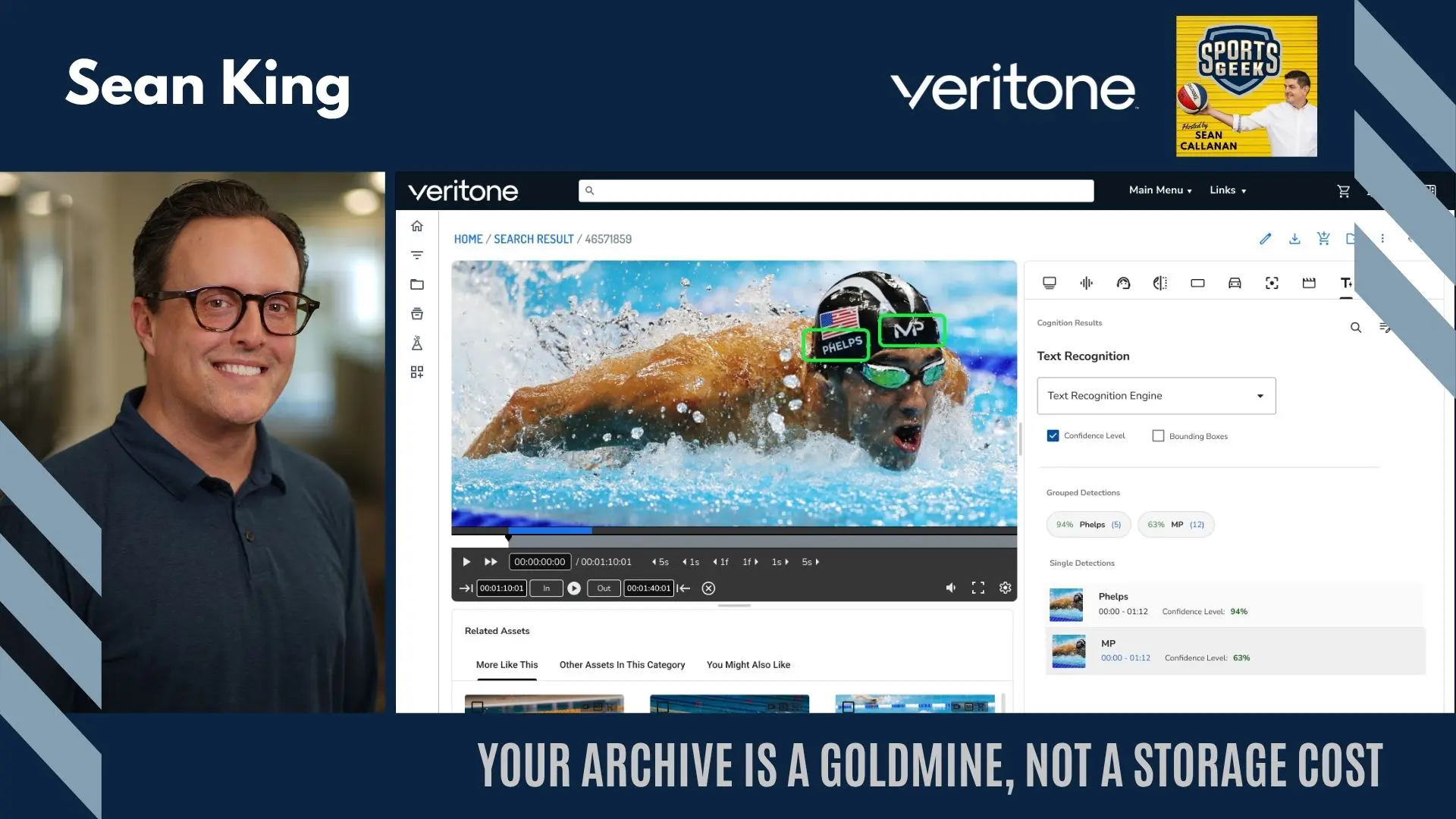
In episode 459 of Sports Geek, Sean King from Veritone brings two decades in media, advertising and AI to explain how sports organisations can turn their video libraries into active, revenue-generating assets.
In this conversation, you’ll discover:
- Why your archive is a core asset, not a storage cost, and how to start unlocking it
- How to turn a passive video library into a licensable revenue stream using a commerce storefront
- Why metadata and frame-by-frame data are becoming the backbone of live sports broadcasting
- How to think about rights and governance so you know what is yours to license versus the league or the broadcaster
- Why a model-agnostic approach beats model lock when you need accuracy across different sports
- Where the real return on AI shows up, and why the boring AI of workflows matters more than the hype
- How to move first on landmark archive moments before the ability to digitise old formats disappears
Listen to Sean King on Sports Geek
Can't see podcast player? Click here to listen
Watch on YouTube
Interview Transcript
This transcript has been transcribed by Riverside.fm, no edits (please excuse any errors)
seancallanan (00:01.242)
Very happy to welcome Sean King. He is the Chief Revenue Officer at Veritone. Sean, welcome to the podcast.
Sean King (00:08.674)
Thank you for having me, Sean. It's a pleasure to be here.
seancallanan (00:11.954)
and it's a first. you're the first correctly na named Sean to be on the podcast as a guest, so
Sean King (00:17.996)
Yeah, correctly named and correctly spelled.
seancallanan (00:21.21)
Exac exactly. So apologies to my other Sean's that have been on that spell it with the AW but we know this is the correct way. Sean, I always want to find out people's origin story, how they got into the world of sports and business and in media. what about yourself? How did you find yourself in the in the world of sports, digital and media?
Sean King (00:41.968)
geez, I mean it's been, well, sports is a passion, I think, of mine, just in general. You know, grow up playing sports, love sports, love enjoying sports, playing sports, watching sports. so even when I wasn't working in sports, sports has always been a part of my life. so for you know, for myself, you know, I I I cut my teeth for the better part of two decades in the agency world. So working with brands, working with networks, you know, frankly monetizing the area on air.
You know, on television, in podcasts, on YouTube, all around sports. It's just, you know, it's a different ad capacity.
seancallanan (01:17.444)
And so and so that's around so in that on that agency side it was very much you went through that transition as well from T V and radio being the ma and print being the main to the explosion of digital and you sort of started talking about those new channels, YouTube, streamers and how that you know, that whole space has been fragmented.
Sean King (01:37.642)
Exactly. I mean, you're seeing just an explosion of content that's coming out everywhere. And, you know, it's interesting is because the viewing patterns on all the other devices aren't going down anymore. They're just being they're just emerging with this all this different media in more unique ways. But I think what's also one of the most fun and interesting thing about sports now is these athletes and these teams and and individuals around it are becoming brands themselves.
you know, they're becoming, you know, in their own mind a content creator themselves and and are and are garnishing their own audiences that are tuning in and watching what they're doing day in and day out. So which is, you know, just it it's it's fun to just be able to engage and and and and work and experience this. It's a it's a fun time to be alive and be a sports fan.
seancallanan (02:24.255)
absolutely. I mean, if you'd spoken yourself twenty years ago, you wouldn't be talking about just to time date this episode. a week ago LeBron James launches a YouTube channel. Like again, that would have been unheard of, you know, way back in his rookie year, which is, you know, over twenty one years ago. But like the fact that he's launched his own YouTube channel is proof that athletes and all of these media properties are becoming brands and broadcasters in their own right.
Sean King (02:50.103)
without a doubt, and garnishing hundreds of thousands of of subscribers within hours.
seancallanan (02:56.944)
absolutely. So, firstly I wanna ask what how do you go about explaining what Veritone do? And you can answer it first what you tell your parents and then what you also tell the rest of the industry, because my parents still don't know what I do.
Sean King (03:09.005)
that's fantastic. well though I tell my parents exactly what I do. it's it's easier that way. but you know, at Veritone, at the end of the day, we're a video intelligence company.
And across our different portfolio of customers, whether they're media and entertainments like Sony Pictures or the NCAA or Pac-12, or they're in the public safety side and it's a local municipality or a three-letter bureau of the government, we're ingesting hundreds of thousands of hours of content every single day. And we're appending kind of frame-by-frame data to these. And that you know, orchestration of that is through our underlying software called AIWare.
And that's kind of what we do day in and day out is we create video intelligence.
From that video intelligence, we build and monetize different applications that sit on top of our core software stack, whether it's a digital media hub or an investigate, which is just allowing the end user very purpose-built applications that allow them to interact with their video and the underlying data from that. And so whether if it's a you know a rights holder that wants to, you know, find and and store its its content, they want to monetize it or share it in in different capacities with, you know, it could be.
A commercial sponsor or a new brand or a documentary, or if it's someone that's trying to solve an investigation, you know, it's all using the same kind of software and its core set of applications. And sports is even kind of interesting in this case is because that's really where those two worlds of Veritone come together. Because you have you have action that's taking place on the field or on the court, you know, you have the sports, you have the fan engagement from those ones, but then there's a whole ecosystem of.
Sean King (04:54.393)
Of commerce and security and and and and event that is live event that is taking place all around it. and that's kind of where Veritone sits kind of at the center of being able to provide the intelligence, whether if it's the camera watching the field or if it's a CCT camera, you know, monitoring the hallways or the concession stands. You know, that's where Veritone can help, you know, the the the the license and the rights holders and the content creators as well as the people putting on the the event themselves.
seancallanan (05:24.446)
I mean and that was again if you sort of go back ten years, a lot of that was manual. That was people looking at video, looking at photos, tagging them, categorizing them, putting them in different folders, and a lot of that knowledge was, you know, in a in a video archivist or someone that was looking after the library, someone had to know that's right, we did interview so and so on that time at that point, and that system was always
That's always fraught with danger when there's lots of people entering and keying you know, keying in the wrong things. Has the has that sort of just ex absolutely accelerated in the past five to six years where that ingesting, categorizing, understanding what's there, using using technology like computer vision and the like to understand what's in the pictures and that's sort of what this you know, where all these opportunities have come about from.
Sean King (06:18.477)
Absolutely. I mean it's it it's the the the speed in which the technology has advanced and continues to advance. I mean it's gone beyond what are just taking place with what's taking place in the game and what's the score and what was this a three-point shot, but you know, going to the name, image, and likeness of the people on the like the the players themselves.
and even a step further where it's actually becoming like the behavioral side of it. You know, what is the the the the movements of a particular athlete, their center of gravity, how is that different than the next person?
you know, what is LeBron Ja what are the different mechanics and behaviorals of how LeBron James comes up for a shot? How does that different than, you know, a Victor Wembenyama? And so you're actually starting to see and there's just so much more intelligence that's you're able to garnish from the and the speed that you're able to do it.
seancallanan (07:11.728)
So there's I guess two parts of it. You sort of talked about that that archive. Like there's this just mountain of of of of content and you know, you've got you've got organizations like NFL Films that, you know, as the NFL season comes along everyone dives into the history and has that nostalgia hit. But there's so many archives that are yet un untapped. Like how important is that, I guess as an asset for sports rights holders to say, Hey, we've got we've got this content, how can we leverage it?
Sean King (07:39.778)
I mean I i i i i they gotta realize that that is like one of their core assets of what they have. They almost have to rethink and reimagine their entire media strategy in some capacity, 'cause I think you said it best with the with the word nostalgia.
You know, sports is it has so much fandom and feeling and passion towards it. I mean, and and and people will go back and reminisce. I mean, I could count the times that I'm talking to a friend and like, man, do you remember when this happened? and so being able to keep that, because it's it you're you need to charge your ecosystem of of of your fans. And so much of that is going to be things that take place today, man, that's gonna be really special.
In in tomorrow. It's gonna be really special a month from now. It's gonna be really special five years from now. It's gonna be even more special 25 years from now, where people can look back and remember these moments and be able to experience it. But like also herein lies the challenge for some of these, you know, rights holders in it in in sports, because you know, it's easier right now to look at all the technology and look forward.
And be able to say, okay, well, going forward, I have all this stuff being adjusted correctly and I have all the data and I have that. But to your point, like in in in that mountain that I have behind me. You know, I always kind of say it's like, you know, when you're getting in a car, the first thing you're doing is you're looking out the the the windshield and you're seeing what's ahead of you, but you're also looking back and seeing all the things that are behind you. And that's where you kind of go look back and then you gotta, okay, geez, well, how am I gonna start tackling this problem? How am I gonna start bringing some of these things so I can get the same.
utilization and the same you know efficiencies and ROI that is available today for my content. But again, it's it's it's a tall task to go back because there's there there's so much that's there. And and and everyone's going to be different. And I always kind of tell them it's like, well, when you're driving that car, you know the big landmarks that that that you passed.
Sean King (09:39.82)
So let's start there. Let's go get that, you know, that Reggie Bush, Matt Leiner tush push in the Rose Bowl. that came. Let's go grab that one. Let's grab, you know, these different scenarios that came back. Let's bring those in. Okay, and then let's just start to see, you know, what what type of demand we're seeing, what type of other things come about, what other things, what it's going to be the anniversary of something every single year. You know, okay, let's how do we want to do that? How do I want to engage my fans? How do I want to engage
My sponsors? How do I want to create more opportunities by leverage? And it's just a it's a one again, yeah, like a to say those assets and and the technology available today, those ultimately become incredible tools in their tool belt to be able to just engage keep and staying engaged with their fans and creating just better experiences for everyone that interacts with it.
seancallanan (10:35.253)
Absolutely. I think the key thing for me and like as as someone who's worked with, you know, sports digital teams and and content teams that are under constant demand, like the ideas are there to definitely tap on that nostalgia audience and hey, how can we tap back to our glory days, especially if you're if you're having a tough season, there's nothing better than celebrating a a past career. But it's always been the the effort that is required to go and get it. And I think that piece around efficiency, like as the tools develop, and as if you've got a tool that says
you know, I want to get this footage of this player because that player's turning sixty this year. We want to show their highlights instead of just having a gr you know, a photo of them because we'll we know it'll tap in better. Normally the thing that's been stopping it is how do we how do we get that footage again? Is it is it still on VHS in the back room? Like having that efficiency. Yeah. Hm.
Sean King (11:25.057)
Yeah. Who do I need to call? They need to walk down the yard white. You gotta find the tape. You gotta put the tape into a machine to digitize the tape so you can get the tape and put it into a format that you can use today. And I think, you know, y you bring up something about like the tape because I that's a really I love that you brought that up, Sean, because that's an important thing. Like here and it's and it's scary to think this and and I mean and and and it and it and it dates me and dates many others, which is like, wow, like
The actual engineers that are able to work on the technology that these tapes were in aren't going to be around much longer. And I know it's a real morbid thought around that, but like you that that's a reality that that's here. It's like, you know, you're there there's gonna be not saying that's gonna happen, but there's just gonna be a lot less. And and and and that's a crucial part of it, which is like, how do I extract it, let alone get it into a tool that I can start to utilize it?
seancallanan (12:19.934)
Absolutely. We'll put a picture of a VHS tape for those who don't know what it is and what Sean and I both discussing. I mean it it it you know, I am seeing now teams do v do video clips and hand players, cassette tapes and VHS and they don't know what they are, but that this is how people used to watch content. So that is both the challenge but also the opportunity, 'cause you're right, once it is digitized, you've one, you've got access to it. and then, you know, what I'm really excited about is to see to see what
the how the technology can upscale some of that some of that some of that technology. The technology that's being used with film making, documentary makers to restore to restore some of that some of that vision because, you know, it's not in ten ADP and all of that kind of stuff. Like I think that's also going to be exciting down the path. That's the that's the historical piece, right? That's the, you know, the mountain behind us and the and the opportunity. But as you see, you know, a lot of sports are looking forward and live is
is such a big thing and there's this demand for first and fast and and and getting the content in your fans on your channels because you're now competing with media outlets and that kind of thing. What w how important is that space, that that space of live and and and getting getting vision to fans in an efficient manner?
Sean King (13:39.638)
I mean it is in it is crucial. And look, we live in unfortunately a right now economy where everyone is expected on demand. So you want your sports, you want your updates, you want it delivered to you, you want it delivered to you in the y i it's it's instant and infinite almost personalization for this. And so you know
That's where a lot of our partners leverage Veritone and some of what we do to be able to help with that. Because again, as you're ingesting all this content, you know, having kind of custom bespoke workflows, while geez, this is, you know, Rafael Nadal playing, okay, great. We we know that we need to have sky broadcasting and these other outlets that are instantly covering it. You know, his core sponsors of, you know, this, you know, Nike and whoever else are gonna want this different footage. here's a wonderful shot. The Nike logo is seen, there's a Rolex image behind.
We can part pulling these things. And you can start to programmatically clip the men and make these highlights and make these things accessible and build the workflow. So as these things are happening, you're providing access, frankly, to those clips, to that content in a close enough time to be able to peak that engagement.
You know, I love the personalization aspect. You know, I I I am a sports geek and I look, I'll say I am a diehard San Antonio Spurs fan. I have been since, you know, the late 70s, early 80s. I and you know, I love the fact that I, you know, my devices know that when I wake up in the morning, like what I'm going to check. And it's gonna serve me the s the the the latest stories from last night's game, it's gonna be able to have that.
seancallanan (15:07.133)
Mm-hmm.
Sean King (15:24.299)
But you know, it you know, we're not too far away and you s you're seeing it more and more today where I'm gonna be able to define the highlights that I want to see and be able to have that because the tools are accessible and when they're more leveraged in a in and I'd say in a more kind of ubiquitous way across all of sports, we're gonna be able to create that personalization layer for everyone and every fan. So you're getting the information, the highlights of what you want, when you want, how you want it. but you know.
Behind and underneath all of that, in order to power it, has to be the video intelligence. It has to be the data associated with that video to power all of it.
seancallanan (16:00.103)
Yeah, yeah.
seancallanan (16:04.463)
And absolutely I mean the other thing, I mean and we're seeing it in the in the podcast and the YouTube space, this this idea of clippers and clipping and and licensing of your content to make it have more people see it so they so they tune in or they watch more. That's definitely been a strategy that different sports have either loosened the rein on or held the rein on, you know, where they're either playing whack a mole with don't use our rights or they've said, Hey everyone use our rights because if more people are seeing those bite sides, which is sort of
Adam Silver sort of tactic. How can how can teams understand and leagues I guess from a right side of understand how to license and how to get their how to get their content in the right hands? Whether they're official partners like, you know, broadcasters and regional broadcasters, but I guess new media, you know, these content creators and YouTubers, but giving it to them in a you know, in a in a in a licensed manner, not just saying, Hey, you gr you guys grab it and it's all the Wild Wests.
It's a bit of getting the technology and the legal team together, which is always a bit of a mess, but how do you go about how do you go about solving that problem?
Sean King (17:08.573)
Well, it it it doesn't have to be a mess. I mean, if you have the right structure and the right governance over your rights versus w what aren't your rights, and like and that's a challenging thing in sports because okay, if you're a team, what rights do you have as the team from your practices, your promotional things that you do, your local events, your charitable work versus what rights do the league own?
versus what rights do the broadcasters that are paying billions for the ability to be able to have the rights and license it. So it is so you first you gotta be able to start with, okay, f what is mine?
And when I'm ingesting the content and when I'm doing that, identifying what rights are mine and how I could do it and what are the use cases that I have. And kind of first off, being able to establish what your own rules are. What do I want to use this for? Do I want to use this for fan engagement? To your point, do I want to use it to license? Do I want to make this documentary available? Great. We need to be able to do that. How do I make this accessible? You know, and like, I mean, a lot of our Veritone customers leverage our licensing services that we have, you know, and we also offer them their own storefront.
seancallanan (17:45.413)
Mm-hmm.
Sean King (18:15.023)
Where, you know, on sitting on top of our applications and sitting on top of our technology, they can have a commerce storefront where they can manage and they can say, hey, look, fan, you want to be able to have this clip and download, be able to have great. You could buy it yourself. Maybe we give a promo or we give away a great clip to everyone, to our fans or those. Or maybe look, I have all of my local partners in town that support my team, that show up, that do different activations, do on-field. Like, how do I want to make sure that I give these local these
seancallanan (18:16.227)
Okay.
Sean King (18:45.033)
assets that I own the rights for or the league the team owns the rights for accessible to them so it's part of their package. So I can keep showing value to them as a partner so they buy that sponsorship again next year. and there's it but really just you you just have to start with like, I mean like all things, let's get your house in order first.
seancallanan (19:03.265)
Yeah. But that is a like that that piece is a massive opportunity rather than you know, 'cause you know, you the creators, that new media, is bringing in that newer audience, bringing in that younger audience and that's what a sport or a league wants. But again, having that mechanism to say, either one, we will give you this these rights or these these highlights or this this vision and you have right to use it and potentially right to commercialise it because if you're getting the you know, the audience bumped from it that
That's great, but also they just it should end up in a spot where the creators go, I can commercialise this in my manner with my audience. I'm hap actually happy to pay for the pay for the rights a as they do it. And it like you said, having something like a storefront allows that to allows that to happen. It's not, you know, someone in the in the digital department sending a DM and sending a sending a clip to someone and saying, These are the clips you can use and and and that kind of stuff, sort of formalising and getting some infrastructure in that space.
Sean King (20:03.371)
Yep. Absolutely.
seancallanan (20:05.206)
And then from an from an and then from an AI point of view, how hard or how has it changed or how is it changing to again do that re recognition, you know, 'cause every sport is is is different and and trying to understand is that a is that a good play, is that a bad play? Like that that piece of I guess training on on the content 'cause you know, like every sport is different. Some might be easier than others.
Sean King (20:23.821)
Mm.
Sean King (20:31.851)
Yeah, you that that's an important piece that you're you're you I'm and I'm glad you brought this up, Sean, is you have to be prepared and and be in a place where you cannot be you know, we call it at at Veritone like model lock, where look, there are models that are amazing and do incredible things, but sometimes putting the right model on a wrong piece of content, you know, or
seancallanan (20:45.259)
Mm-hmm.
Sean King (20:58.623)
aren't ultimately aren't going to give you the outcomes that you're hoping for. So like for how we solve it at Veritone is we have kind of almost a a model agnostic approach. You know, what is again the use cases, what are you to be able to have? You know, for football, you know, and I'll say football for American football or for global football, you know, using the same recognition may not have the exact same accuracy.
seancallanan (21:09.088)
Mm-hmm.
seancallanan (21:17.216)
Mm-hmm.
Sean King (21:25.451)
Because it's a different sport. It's a different use case. You know, there are different sponsors. There are different other things on there. There are different lows. So, you know, you need to be able to make sure that you have the accessibility. And that's what, you know, we really focus on for our partners, is having the ecosystem of engines and we call them AI engines, like our different models or engines. engines is how we refer to models that we have. We have ones that we own and we built, and we have hundreds of third-party models.
seancallanan (21:27.669)
Mm-hmm.
seancallanan (21:44.883)
Okay.
Sean King (21:55.348)
That are all onboarded. We want to solve for the accuracy and the use cases. So we're agnostic. I I could care less if it's our own model or if it's a third-party model. As long as it solves for that. But that's an important piece because like you can, if you if I'm gonna go to one part, this partner, and I've got a really great pitch, but I am locked in using one specific model to be able to get my video intelligence.
You know, i if if my score is 65% accurate or 70% accurate, like my searchability, my accuracy, those moments are gonna be able to have. I mean, there's gonna be a degradation of performance by nature. So that's where, you know, we we we feel we're in a great wonderful spot to be able to provide to the different groups because ultimately we're agnostic.
seancallanan (22:28.425)
Mm-hmm.
seancallanan (22:36.37)
Yeah.
Sean King (22:45.333)
You know, i if if we can deliver you the the r the right moments, the right search criteria, the right outcomes, you know, irrespective of what's being used in it, that's all that matters. That's all that matters to the fan. They're not gonna care how the sausage was made. They just wanna know that it was the right w the the the right one.
seancallanan (23:03.877)
And that tuning, like you said, that tuning has to happen also like by sport because, you know, a a soccer field, an NFL field, a basketball court, an ice hockey rink, they're all shot differently. They have different, you know, different angles, different, you know, peak plays, those kind of things. So that that training and that and that knowledge stack around the sport and the way it's covered will depend on what the output is. You can't go and say, yeah, we've just finished our hockey season and
Sean King (23:17.453)
Correct.
seancallanan (23:33.659)
and run that same template over a basketball b game because, you know, the logos are in the different spots, there's, you know, less players, they're doing different things.
Sean King (23:39.485)
Exactly. Exactly.
seancallanan (23:44.058)
And then that provides that that metadata and that and that information that then that's where the I I guess the goal is to say, Hey, what are the opportunities?
Sean King (23:55.404)
Yeah, I mean it it's i no matter what you do or what business you're coming from, success ultimately comes from how you're able to make great decisions from your data. And sports and video are no different. You know, you know, sports analytics is can continues to be on the rise in different ways that people are looking at biometrics and and load management and everything else, you know.
Where do where are they getting a lot of this intelligence out of? They're harvesting the video, they're harvesting watching it, they're being able to leverage, you know, the data that's being able to be derived from the video to be able to write to make better decisions.
seancallanan (24:33.381)
So there's two two parts of how there's so many opportunities. Like it's it the the opportunity scope is so wide. How do you as Veritone go, well this is this is the space that we want to really make sure that we're a hundred percent covering? ‘Cause you could be, we could do high performance space over here, we could be doing this over here. So how do you keep a hyper focus on the things that are important to you?
Sean King (24:58.007)
That's a great question. It it it it really boils down to at the end of the day, we excel in video workflows and orchestrations.
So we're talking about processing tens of thousands of hundreds of thousands of hours a day at singular events, whether, like, you know, our team is out at the US Open right now prepping to start ingesting and building workflows for the entire US Open event. you know, we do that for Augusta nationals. You know, for us it's like we understand how that ecosystem works, how those workflows need to take place. You know, things that matter, like you know, bitrate and transcoding and things of that.
that nature and how you're be able to pull together to your point, there's a lot of disparate data that's taking place in all these events. You've got, you know, you've got the actual studio cameras that are on these different areas. You've got folks that are also filming on their, you know, cellular devices or mobile devices. You have to still be able to harvest those things. You still need to be able to get a consistent layer of you have to be able to get a consistent data layer
To all of that content that's coming through. And that's where really we we strive. So for us, you know, we look at it as like, you know, sports is obviously one of those things that is always going to be creating content. You know, news always gonna be creating content, surveillance, security, always going to be creating content. And they're gonna be creating content at such rates.
And but there are so many important elements that come to that, like the sovereignty of the data. How is that data going to be secured? How is that data going to be protected? How, you know, what are going to be the outcomes? What am I going to allow to happen with my data, with my video that comes from? And that's where we aim to provide that complete package. You know, how do I wanna, how do I wanna first manage it? How do I wanna orchestrate it? How do I wanna, you know, capture it, but also like more importantly, how do I want to protect it?
seancallanan (26:48.354)
Mm-hmm.
Sean King (26:55.489)
And all of these things is really where we aim to provide, you know, an unmatched service and and technology for our customers.
seancallanan (27:04.822)
And so is that when you were you were sort of talking about the PGA and Augusta there, is that is that how you would start? You would come in and say, What are all your inputs? Like what's capturing, where's it being captured, and what are your outputs as of now? it's got to end up on broadcasts and it's got to end up with your social team and and so you'd know those two pieces and you say, Well, we want to help map all of those so it's less of a of a bird's nest and understand all the things and so it's tagged. And then after you've at least done that initial run, you can start looking back and going
hang on, this could be more efficient and did you realise you've got this content that's been captured that's not hitting anywhere?
Sean King (27:41.966)
Ig exactly. You get this opportunity to be able to it it it comes down if you knew ten percent more of what was going on in a match or ten percent more that was going on in a game, how much more interesting could it be? And what would you do with it? And and it's just it's it's it's it's
First being able to surface it so that you're putting it into a position where whether you're a producer, you're a social strategist, you're, you know, you're so you're on the sponsorship side, you're just trying to surface more data so that way everyone can make better business decisions, to provide better experiences, better monetization, whatever it may be. You know, that's where really it comes down to, which I keep coming back to at the end of the day, we're video intelligence because that's what, you know, we're surfacing through our applications and through our people to be able to provide that to
seancallanan (28:23.701)
Yeah.
Sean King (28:29.711)
Different organizations.
seancallanan (28:32.104)
And that piece that monetization, I mean we've got a process called digital to dollars, which is get your digital platforms and and help commercialize them. Once you've got that infrastructure in place, you can 'cause you can go, you want that highlight that comes out at the third quarter or whenever there's a hole in one, we're automatically in a badge and put it through and it's gonna go out straight away. Like your commercial team can pitch that with confidence, but your digital team is not left with,
That shit moment of how are we going to deliver it because you've got a system in place to be able to do so.
Sean King (29:03.871)
It a a exactly. You know, we're we're enabling through technology their ability to be able to meet that demand.
seancallanan (29:11.924)
And then the next two or three years it's a bit hard to predict the future with the absolute rapid change that AI is putting on every business right now. but what excites you over the next couple of years in the world of sports content discovery and monetization and delivery?
Sean King (29:21.698)
Mm-hmm.
Sean King (29:30.521)
I mean so much of look, I mean, with AI, as well with any new technology, there's always that hype cycle.
seancallanan (29:40.819)
Mm-hmm.
Sean King (29:40.926)
And and and and like and look, and then that always runs its course. But now what we're really gonna start to be able to see is like the ROI of it. And I'll say, you know, not what's not gonna be the glitz and the glamour AI that's gonna come around, but like it's I was gonna say it's more the boring AI, you know, where's gonna be those workflows that ever start those things are gonna happen. But that's gonna be key, it cause it's like AI is gonna be AI is already everywhere and it's continuing to be in more and more places.
seancallanan (29:57.352)
Yeah, yeah.
Sean King (30:08.609)
There's going to be the natural assumption within people that this is part of it. But creating such a uniformed viewing experience and fan experience, leveraged off that, you're going to start to see the promise of the ROI that, you know, AI has, you know, promised for years. but I think ultimately, and I and I still feel strongly about that, the level of personalization is only going to continue to get better.
seancallanan (30:33.253)
Absolutely, and the fact that it and there's that that that time from idea to execution is so much shorter now. can we build out a a digital museum where someone can just click through and and walk their way through all the decades? It's always been yes, but it's always been, that that's we've got to get web developers and we've got to archive it some way and and like now it that that is far shorter and th I guess that's that's a bit excites for me and and yes, AI will be part of it, but it's really just accelerating that
Sean King (30:39.565)
Mm-hmm. Yep.
seancallanan (31:03.206)
that development time that that that presents itself.
Sean King (31:04.929)
Well, the accelerating yeah, accelerating the development timeline, but also the adoption curve of those things that come up. You know, you know, we're seeing a point where as that's coming, we're actually the adoption curve is happening just as fast, if not faster. And, you know, again, sports is one of those areas that, you know, there's such a passion and around. There's always going to be people there engaging and doing it, as long as you keep it a good, authentic, you know, safe experience for them.
seancallanan (31:32.975)
Absolutely and and the and the interfaces that fans expect is is gonna change. Like people went from I'm just gonna Google it and they would get it to I'm just gonna click a button and a car will turn up and that's the expectation and and now the expectation using all these all these models is I just wanna talk to it, either typing or voice, and I get an answer. And so that's gonna be the expectation. And so to your example, like, what did Wemby do last night?
And you're gonna expect your own personalised video of here's every Wemby Dunk and and he you know, he just poured in sixty against you know, against the Kings last night. You'll you'll watch every second.
Sean King (32:12.907)
Yeah, and and and by the way, the the talk track is coming in Wimby's voice. Yeah. Yeah.
seancallanan (32:17.881)
Yep. Yeah, no, exactly. As some as someone has a daily podcast with my AI voice, I totally agree. that will definitely definitely be on the on the radar. Sean, I really do appreciate you coming on the podcast. I want to get to the sports g geek closing five. Do you remember the first do you remember that do you remember the first sports event you ever attended?
Sean King (32:24.695)
Yeah, exactly.
Sean King (32:34.07)
Okay, let's do it.
Sean King (32:38.957)
it was a Texas A and football game at Kyle Stadium.
seancallanan (32:45.755)
tr terrific, absolute a terrific atmosphere it would have been there. You would have been a lot of you would have been a lot of sports events over your time. Do you have a favourite food or a go to food at a sports event?
Sean King (32:57.541)
well that that that's easy. For me it's the good old fashioned hot dog. You know, i it it's I I I frankly I won't eat them any other place except really at a sports game where I've had those ones. It's just for me it's the nostalgia of of sitting there and having a hot dog.
seancallanan (33:14.957)
Yeah. All all the fixings or or or or or pretty play. All the fixings? absolutely.
Sean King (33:17.835)
all the fixings. all the fixings, all the fixings. And it went I mean, I should put a caveat on that. You know, there is a great hot dog at Costco that, you know, if I am there on a Saturday afternoon I may dip from there. But like for an event, it's always the hot dog.
seancallanan (33:31.021)
No. absolutely. what's the first app you open in the morning?
Sean King (33:38.916)
first app I open in the morning would e likely be my email andor Slack.
seancallanan (33:45.495)
Yeah, that's fair enough. A lot of us a lot of us are guilty of that as well. is there someone is there someone that you that you follow that the podcast listeners follow? It might be a work colleague, it might be an author, it might be someone on social media that you follow?
Sean King (33:47.487)
Yep. Yep. I'm very guilty.
Sean King (34:00.206)
no, I mean from a podcast one, I always like how I built this is a i is a great one because, you know, people I always like the similarities of, you know, the athletes showing up and putting in their ten thousand hours and mastering it and putting it in there. They'll love the story and just seeing the same grind from a founder.
seancallanan (34:06.158)
Yeah.
Sean King (34:22.305)
You know, of showing up in the morning and starting at ground zero and finding his way to grind through the ten thousand hours to master whatever he's we're trying to achieve. And and and and here are the pains and the traumas and the ups and the downs. I mean, the parallels with sports for me are just they're they're they're they're they're they're right in line.
seancallanan (34:40.813)
absolutely. I mean one thing along those lines is Michael Keaton in the founder where he plays Ray Croc and McDonald's is a is another one that's similar like founders founders journey. lastly I ask people what social media platform is your VP?
Sean King (34:47.873)
Yep. Yep.
Sean King (35:00.289)
social media platform that's my MVP. well I have to say, like I the the algorithm I'm most impressed with right now is Instagram. They know how to they know how to keep me engaged and keep me going from those. so I'd I'd I'd have to go with Instagram right
seancallanan (35:12.396)
Yeah.
seancallanan (35:21.433)
absolutely. lastly, thank you very much for coming on the podcast. I always ask listeners if they want to reach out to say thank you. what is the best platform or the best way for someone to reach out to you?
Sean King (35:35.213)
I mean for myself, you know, you can reach out to myself on LinkedIn, you know, Sean Patrick King, or you know, S. King at Veritone.com. I look would l love to explore and geek out with with someone on the same topic.
seancallanan (35:50.911)
Well, thank you very much, Sean. as someone who's both a consumer of of the advancement in video products in sports and also someone working in the space and and seeing the improvements both when we're working on them and with teams, it's it's absolutely amazing I guess the tools that are now being put in digital folks' hands and also on the on the broadcast side. So I'm very thankful that these advances continue to be made.
Sean King (36:16.301)
Awesome. Well thank you thank you so much for having me here, Sean. It was great. Great chatting with you.
seancallanan (36:23.453)
And I hit stop and it fishes

Turn 15 minutes a day into sponsorable content your partners will pay for
Sports Geek AI is a done-with-you content system that creates daily newsletters, podcasts, and social posts—giving your commercial team new inventory to sell.
Resources from the podcast
- Please connect with Sean King on LinkedIn. Let him know you listened to the episode. If you connect, please say thank you.
- Learn more about Veritone's approach to enterprise AI — plus updates on aiWARE, its flagship AI operating system — on their website.
- See how Veritone Sport is reshaping AI in sports media
- How Veritone Digital Media Hub Turns Sports Archives into Instant Fan Engagement
- Give our new Daily podcast a listen – Sports Geek Rapid Rundown.
- Check out Digital To Dollars – our self-serve program to help you drive more revenue from your digital fan base.
- Podcast episodes you should listen to:
- Throwback episodes you may have missed:
Podcast highlights
Highlights from episode 459 with Sean King:
-
- 02:11 From two decades in media and advertising to leading commercial at Veritone
- 03:07 The explosion of content and athletes becoming brands and broadcasters
- 04:26 How Sean explains what Veritone actually does
- 04:39 Video intelligence, AIWare, and where sport brings Veritone's two worlds together
- 06:54 From manual tagging and video archivists to computer vision
- 07:48 Name, image and likeness, and the behavioural data of how athletes move
- 09:09 Your archive is a core asset, not a storage cost
- 11:09 Start with the landmark moments fans already reminisce about
- 12:55 The tape problem and the engineers who won't be around forever
- 15:09 The on-demand economy and building custom clipping workflows in near real time
- 16:54 Personalisation, and why video intelligence has to sit underneath it
- 17:34 Clipping, licensing and getting your content into the right hands
- 19:45 The commerce storefront and keeping sponsors coming back
- 21:35 Training AI by sport, and avoiding model lock
- 22:01 Why Veritone takes a model-agnostic approach
- 25:25 Making better decisions from your data and video
- 30:02 Turning live moments into content and commercial value
- 31:00 The hype cycle, ROI and the case for boring AI
- 33:02 How fan expectations and interfaces are about to change
- 33:47 Sports Geek Closing Five

Digital To Dollars is the five-pillar process pro teams and leagues have used for a decade to turn digital audiences into revenue, and it’s coming soon as a self-paced program. Those on the waitlist will get 20% off upon launch.
Listen To Sports Geek
Recent Sports Geek Reads
- Netflix NFL Ratings, Amazon Sports Spend & Wall Street Ticket Scalpers
- Red Bull’s Madrid Metro Stunt, OpenAI’s Sports Push & NFL Media Shake-Up
- Oura’s Sports Strategy, FloSports’ $200M Niche Play & LIV Golf’s Revenue Model
- NFL’s Flag Football Strategy, MotoGP’s DTC Shift & Memphis Grizzlies Turn to Streaming
- NFL Revenue Secrets, LIV Golf’s Bankruptcy & AI Commentary Debuts
- From LIV Golf’s $5B Loss to NFL’s Australia Play & TikTok-ified Sports
Listen to Sports Geek Rapid Rundown daily