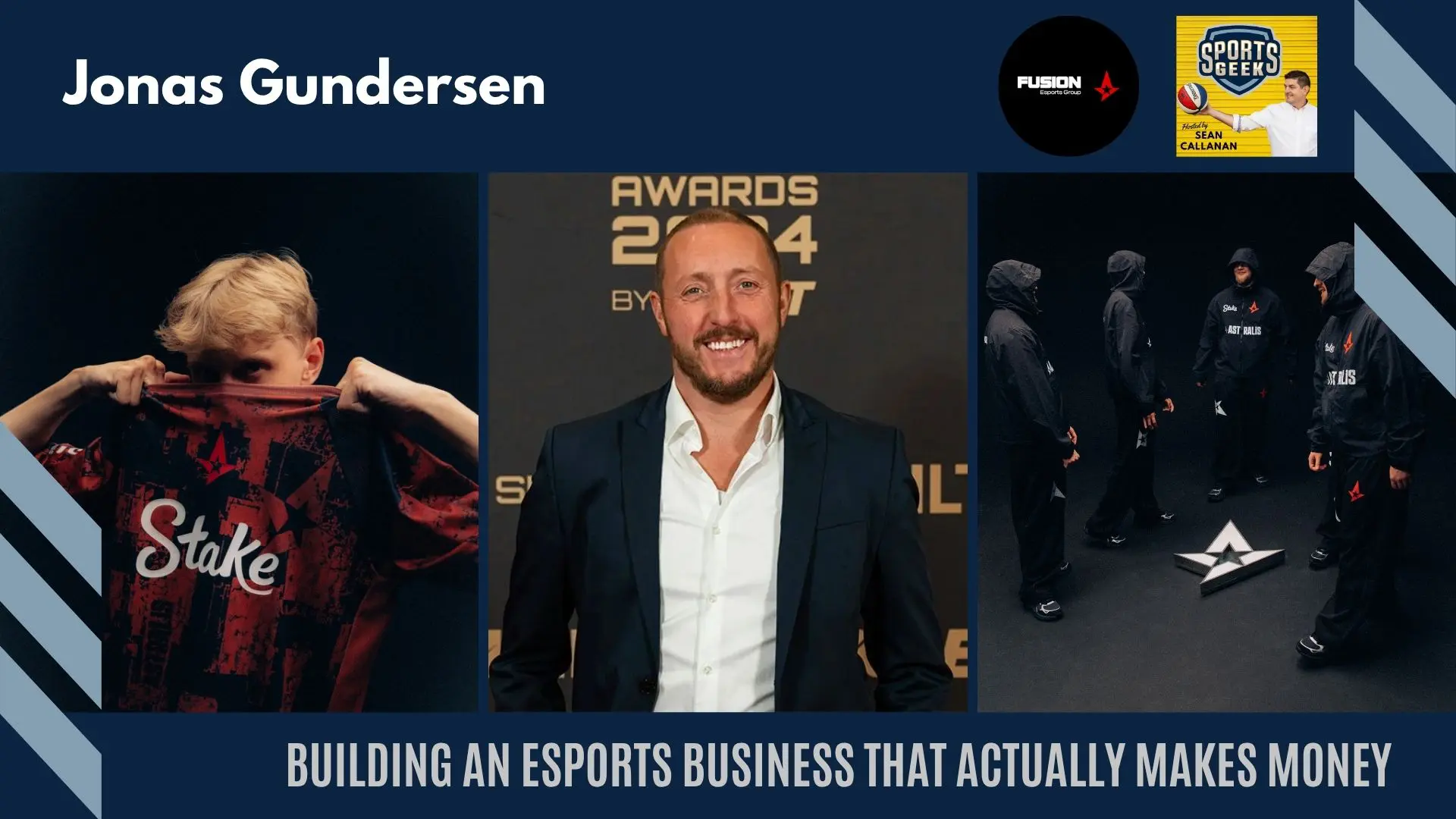
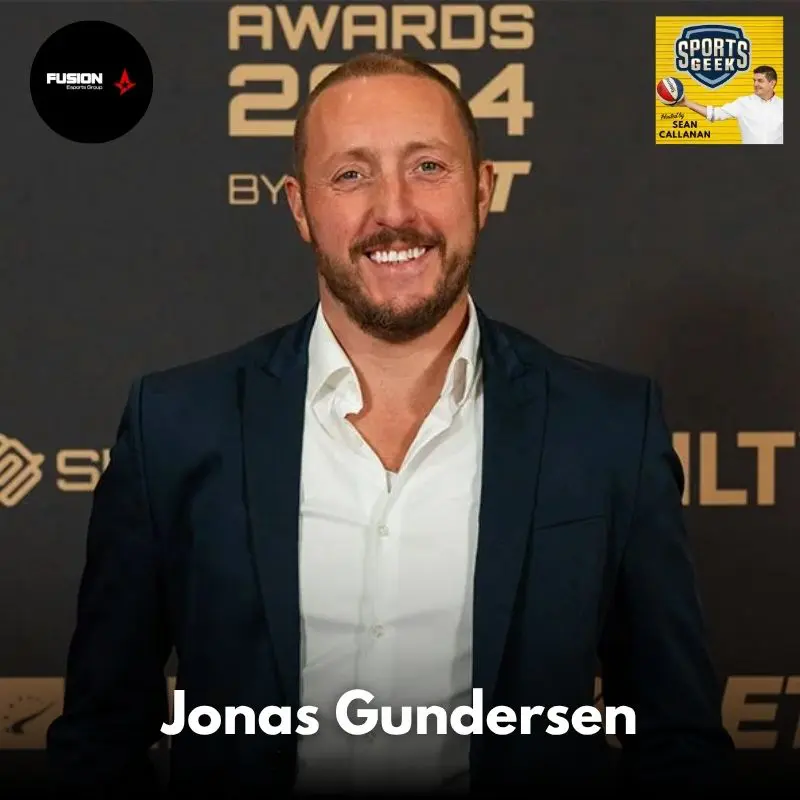
In episode 458 of Sports Geek, Jonas Gundersen brings a rare full-circle perspective, from professional Counter-Strike player to founding Fusion Esports Group and taking over Astralis, to share what actually works when you commercialise an esports organisation.
In this conversation, you’ll discover:
- Why the tempo and sequencing of investment matters more than the size of the market
- How the same mistake repeats in every esports winter, and how to avoid overpaying against revenue you cannot yet earn
- Why Jonas thinks of esports as “an armada of fifty million dollar businesses” rather than a hunt for unicorns
- How to apply venture-studio discipline (business case, headcount, funding need) to a passion-driven space
- Why an esports team has to be profitable on its own before “gaming is culture” becomes a strategy
- What mainstream sports operators can borrow from how gaming builds subculture and emotional IP
- Why the “boring” five-year plan of robustness, stickiness and legacy beats chasing esports hype
Listen to Jonas Gundersen on Sports Geek
Can't see podcast player? Click here to listen
Watch on YouTube
Interview Transcript
This transcript has been transcribed by Riverside.fm, no edits (please excuse any errors)
Sean (00:00)
Very happy to welcome Jonas Gundersen. He is the founder of the Fusion Esports Group and owner of Australis. Jonas, welcome to the podcast.
Jonas (00:10)
Thank you. The nice to be here and a nice backdrop with all the jerseys and all. Looks cool.
Sean (00:16)
thank you thank you very much. I always start the podcast asking people how they got their start in the world of sports and business and that applies to esports being a being in that same in that same sphere. What about what about yourself? How did you find yourself in the world of esports?
Jonas (00:32)
yeah, good question. I guess all the way back, I used to be a professional Counter Strike player in one point six ages ago, right? so I guess I found my way through some detours on not going to school, etcetera, not finding my tribe, I think. So I dropped out of school at sixteen and then ended up becoming a professional one point six player in Counter Strike. So this is in two thousand and I don't know, two, something like that. And then into
Sean (00:56)
In the early two in the early two thousands. So so that was that was really early in the esports in the esports space was did that take did it take you on travels or was it local lands or was a bit of a bit of both?
Jonas (01:09)
No, I I traveled the world playing Counter Strike from like two thousand two to two thousand and five, which is insane to think about today. But I saw like forty countries back then. We did not get paid as much as they do now though. But it was I think we're we're the pioneers that did it for the love of just video games, I suppose, right? So it was a very different time back then. But still we still did manage to play a couple of arenas for like three to five thousand people. So the fans were there back then also.
Sean (01:35)
absolutely. And and so I've had a lot of people on the podcast who have been an athlete and then found that second career in coming into in coming into business. So you were a counter strike player, you sort of knew the industry, but you didn't just go straight into esports, you went into, you know what, a lot of gamers and the real world and and and and cut your teeth and and
Jonas (01:56)
Yeah.
Sean (01:57)
in other jobs, but were you always sort of looking back fondly at the esports space and trying to figure out how to get back in, how did you find your way back into the industry proper?
Jonas (02:08)
Mm. I think it wasn't until a lot later actually, esports was a thing, right? I think you're very right in like you ended a career back then in two thousand six where the money was something very different. You needed it to go into real life. I think a lot of us went into poker. So I was a professional poker player after 'cause it was like natural, let's say, game theory and you know, analysis and performance mindset that went into that and then you could make make money, which was unique back then.
and then that sort of died out after five years after I did some coaching on that and had to find I g I guess my way. I distinctively remember now that you mentioned sports also one of the first books I read when I was sort of interested in entrepreneurship and stuff was Mark Cuban's Business of Sport, which resonated quite a lot with me because it is essentially some of the same philosophies that goes into that. so I think
translating that that skill set into business sort of just happened in the entrepreneurial and startup environment. And then I spent a good fifteen years, I wanna say, in various types of startups and entrepreneurial environments w which fit well. And I was actually doing pretty well in B2B, SaaS predominantly lived in Silicon Valley for a while, was part of quite a few journeys there, scaling a couple of companies. and then esports came knocking again. So it was I wasn't actually trying to get back into esports. I was
I was quite content and wasn't actually following esports for ten years. But then, you know, full circle and you know you've you've got romanticizing about it and you love it. So it's I don't know. I ended up coming back into it through North Esports, which was FC Copenhagen and Nordisfilm, one of Denmark's biggest entertainment companies. So I got lured back in.
Sean (03:41)
Okay, yeah, I think
yeah, and so so I know the guys at F C Copenhagen, that's that jersey there.
Jonas (03:48)
Yeah.
Sean (03:50)
and so again, like that was sort of when a lot of professional sports were getting into esports and that that crossover was definitely definitely happening and there was that, you know, rise, a lot of more money coming into
into into esports, what was it like coming back into esports, you know, fifteen fifteen years later after knowing what you knew, but coming into into that world?
Jonas (04:14)
Yeah, it's it was an exciting time, I would say. I waited a bit, like I said, in the period 'cause it was right around the venture boom, right? The venture money started rolling in. And when I got Lurr back in, my first idea was to say no. Because it was like, I don't know, is there enough money in it yet? has it matured enough? And then this started happening. It's like, that's that's quite an ambitious concept, right? We FC Copenhagen coming in, they got Nordic film, that's a cool J V. so I thought it was exciting because it was also quite obvious that
What was happening at the moment was there's an influx of money like any emerging market. let's say quite a lot of actors that did not necessarily know what gaming was.
Sean (04:50)
Yeah.
Jonas (04:50)
and then a lot of actors that knew a lot about what gaming was, but had no idea how to run like business operations. So I think that was a super exciting time. but it was also a transformative time because it came in I'd say I came in the on the end sort of what of the VC boom.
Sean (05:05)
Yep.
Jonas (05:06)
so it was already
You know, everyone was like pushing, pushing, pushing. This is gonna be the new Super Bowl. I was like, I'm not sure it's gonna go that fast, but you know, it will it will become something. So I think it was it was a good time to be in, but but I will also say that it's a tricky time, complex time.
Sean (05:22)
absolutely. So in your time at North Esports did you come par did you cross paths with Kaspar Heisenberg?
Jonas (05:27)
I did, yeah, Casper. He's the he he runs the Manchester United side, does he not? Like the
Sean (05:32)
Yes,
yep. And he was at he was FC Copenhagen and and had some crossover there. So that's yeah, that's what I was like we must have we must have been very close to crossing over 'cause that's when I caught up with with Casper and and spoke to him about what they were doing on the on the football
Jonas (05:46)
cool.
Sean (05:47)
side and some of the stuff they were crossing over into the esports side. So very interesting.
Jonas (05:51)
He he was in marketing
at FC Copenhagen at the time and definitely I'd say one of our advocates that he was definitely seeing this whole digital space and stuff. Yeah, great guy.
Sean (05:59)
Yeah, yeah. So so you're sort of in that space around that around that time, you know, that there was a lot of money coming in, a lot of new players, you know, a lot of people coming from the sports industry, there was the old school esports, and there was a lot of, you know, figuring it figuring it out. How did you how did you figure it in that space, both with North and then your and then your next and then your next steps?
Jonas (06:22)
how did I figure it out? I I think one of the things I did and lucky luckily I'd say because I was from you know from the old school. So I had a lot of access,
Sean (06:31)
Mm-hmm.
Jonas (06:31)
I'd say, to the top of esports because of my I guess my legacy and my my my contact from before. So I was trying to bridge both worlds essentially. I think that's the role I took pretty fast in saying, Hey, listen, we have to understand each other. I think what we tried to do was
modernized a bit in the operation at the time. At that time no one were data driven in any shape or form. It was just writing on hype essentially. There's no processes, no nothing, right? So I tried to do that and a lot of education on what it was going to be, what it needed to be. But at the same time, I also I wouldn't call myself a a skeptic at the time, but I I I also spent a lot of time telling types of investors
what it was because at the end of the day, I I'd say I'd say sports in general, right? It doesn't matter what what kind actually esports is the same also, right? The type of investor you have dramatically determines what sort of trajectory and what kind of unit economics and what kind of strategy you could use, right? and we were sort of misaligned in a lot of the ventures that we had at the time. So a lot of it went into education on saying, hey, listen
This is not gonna be a venture model, right? You're gonna you're gonna want me to do, I don't know, we were doing four million dollars in revenue at the time or something like that. They're like, how about a hundred? I'm like, I I don't think I can deliver that at the end of the day. I I think this is not the model, right? And some of the strategies I remember at the time is like, why don't we buy, you know, NIP, we buy Navi, we buy G2, we buy Liquid, and we merge them all into one super brand. And you're like, I I don't think
That's how it works. I think that you know, you need you need Real Madrid and Bayern Munich and Manchester City to play against each other, right? Or it doesn't work the whole space. So there's a lot of crazy strategies at the time, I'd say that that that that was that. And then my next move was then I moved from north pretty fast actually because they were sort of winding down, understanding also that the amount of investment they had put in already was not gonna cut it at the end of the day, even though they did great and the ambition was great.
And like, hey, listen, the market exploded around you, so you're gonna have to force like quadruple your investment. And they they weren't gonna do that, which I completely understand at the time. and then I ended up joining NIP, Nindus and Pajamas, which was one of the I'd say one of the most iconic teams of all time, which was more backed by high net worth individuals at that time, which also just gave a much longer perspective on sort of how to how to go about it, right? So so you could more more like family office style. so let's say
Yeah, I spent a lot of time aligning product, trajectory, tempo, to the investment profiles and and sort of the the amount of revenue you can actually do from the market, right? Which I guess I still do today, but but it's I th I always found that that was one of the most important factors on esports because the the growth is inevitable, the
Sean (09:13)
Mm-hmm.
Jonas (09:13)
market is inevitable, but the tempo, the sequencing is wildly important.
Sean (09:20)
Well, I I'll yeah, I completely agree with that. I mean, just for for for context, Miran that same time we had a League of Legends team here in Australia in the OPL Gravitas, I'm still repping the jersey, but it was in that same
Jonas (09:32)
Yeah.
Sean (09:33)
sort of same sort of space. I was coming at it from a from a sports lens and a s traditional sports marketing, but the the audience and the and the sponsorship wasn't matching the you know, wasn't matching the hype and that mismatch
was, you know, unfortunately, R O P, the OPL and Wright pulled out, you know, pulled out funding and the and the league dissolved. Like, getting that matching right, you know, was really tough. Like, and we were in the same space of playing playing regularly against professional sports that invested and similar to, you know, North, it would have been, hang on, we're gonna concentrate on on the pitch and so they they withdrew from Esports and so that sort of space sort of you you hear the term
esports winter and people being doomsayers on it,
Jonas (10:18)
Yeah.
Sean (10:18)
you're obviously still really you're obviously really still positive for it. I I'm positive for it, it just wasn't a it wasn't a right now for this market. W why do you see why do you see the upside and you know, talking about a market being inevitable? why do where do you see the upside and why do you see the upside in what is esports?
Jonas (10:36)
I I th it's a great question, right? But and I think the most important thing is to understand sort of the situation we've put ourselves in quite a few times in the esports winters. Essentially, we put ourselves in a way where a company like REPL comes and say, I love what you're doing. Take my money, please, right? They'll say two hundred and fifty K. I sit on the other side and say, like, I need one point five million. And then they're like,
I I can't, like literally, because you're you're operating in a media market, like a sports media market. What you're asking is a five X premium. and is that Red Bull's fault? Is that the market's fault? Or is that a systemic sort of like way of putting it together is mistake, right? That that's what it is. So I think that's what happens all the time, that we sort of overdo it somehow so that we simply outpace the revenues. And you can.
Like of course it in most markets, but when it's not a venture backed market, then this becomes a different exercise altogether, right? And I think in every crypto winter not crypto winter, which is the same, but in every esport
Sean (11:37)
Which is the same thing, yeah?
Jonas (11:39)
yeah in every esports winter, it's the same mistake that sort of happens every time, right? It's just that the hype is still real, you know, risk willing investment comes in.
We sort of jack up the prices just a bit too much. The revenues you can take from the market don't quite follow up. You get an i inevitable downturn because it's an emerging market. We consolidate, we find our way, and then we try again. But every time it's a new cycle, it's a new floor, and we keep going up, right? But that that's one of the main reasons I'm just so bullish about it, that I find it I would be much more worried if the Red Bulls of the world told me this is terrible. No one watches it. But that is simply not the case.
Sean (12:20)
So now you've you've obviously gone chips in with the Australis acquisition. So what were some of the things that were you know were really important for one f for that acquisition and then what were some of your first moves to like, you know, to correct those foundations? So sort of, yes, the hype is great, but we need the data, we need the sub you know, we need the support where you know, you're competing against, you know, football clubs and basketball clubs as much as you are
You know, YouTube and and and other entertainers. Ha what was your what were some of your first moves with Astralis?
Jonas (12:52)
I I'd say the the first step was after leaving NIP, right? Or Ninja Sim Pajamas. we went public on Nasdaq in the in New York, right? I was sort of hovering around what I wanted to do. And my main belief that I come back to was just that okay, esports and gaming in general is massive. And I love it, first of all, right? But also it's just it's gonna keep growing. And for me
It's way more than just a competitive esports or something like that. It's a cultural cohort of people that are there. People like us that grew up on gaming,
Sean (13:23)
Mm-hmm.
Jonas (13:24)
right? We grew up in a different way than the old generation. So we understand, hey, we have different ways of thinking, different ways of building businesses, different ways of leading, different way of living our lives. You know, I think the popular word for from the boo for the boomers out there now is neurodivergence, right? Everything is neurodivergent.
For us, I don't think neurodivergence is a thing. It's just a matter of fact that we are just very different people and we're completely fine with that. We're gonna build structures in that. And that to me is the future of where we're heading. you could call it gamification or whatever you want in business, but for me,
Sean (13:53)
Mm-hmm.
Jonas (13:54)
it's way bigger than that. So it's like I'm staying in this space for sure. Wanna build something in that sort of trajectory, right? So the side the second part was that one of the hugest components of the this esports winter was that.
Everyone sort of realized it's not a VC market. The investors, et cetera,
Sean (14:12)
Mm-hmm.
Jonas (14:13)
understood this is not venture capital proven. That means that you know risk-willing investment went like this. And what that also means is that distressed assets are gonna happen inevitably, right? Which doesn't have to be a bad thing, per se, of course, in emerging markets, someone will fold and and consolidate. But it's an opportunity in many ways. Say, like, that means you can bundle up maybe potential assets, buy it on the cheap.
Turn it around, right-size it, figure out the organization, and we can write the next wave. So that's what guided my my next move, right? And that led me to found the Fusion Esports Group, which is essentially based on the fact that I want to build in gaming culture. And I want to do two ways. I want to do audience, right? Where you you get as much attention and audience, but gaming specific and relevant audience. And then you work across products, right? Whether that's you know commercializing to partnerships or
potential joint ventures you could do with companies you can sell or you can you can sell consumer products into them or you know other avenues of of stuff, right? So that that's the whole premise of fusion, which I think is an important component. So we then got the opportunity to acquire quite a lot of teams honestly and looked at across like YouTube channels and whatnot and then got a really good opportunity to take on Astralis, which is obviously a great brand, a bit of legacy of where we're from and stuff like that, but is a great brand.
that is I think one of the ones in the more modern times that have cracked the mainstream so that literally everyone knows. because they did this amazing Counter Strike run, right? And I think they did it at a time where the mainstream was looking. So they're like, Astralis, I've heard about that. Even though there's sports franchise or esports franchise that have done better than Astralis over
Sean (15:52)
Yep.
Jonas (15:53)
way more games, you have team liquids of the world, right? And all that. But Astralis just has a different connotation with that. So yeah so we did that.
And end up saying, okay, we'll buy Astralis, raise some money from a great group of investors and the Nordics, like again, similar gaming people, entrepreneurs, exited entrepreneurs, they're like, hey, this is a cool vision, let's try and do it. And then off to the races with the turnaround of you know, backing backing myself on the fact that hey, this is just wrong sized unit economics, hold my beer, we're gonna we're gonna fix this. and we did, but it's
It was it's hard. It's hard to do.
Sean (16:26)
I
it I it is actually I I'll c totally agree with that. It's it's definitely hard and I think the piece I think you know if I look back if I Monday morning quarterback our time with Gravitas it was that everything was all in just on the esports. Like we were a team playing each week and it was very much just that side and we didn't have the wider sphere of gaming. How like how important is that is part of your you know, your ecosystem to go, Hey, we want to be in
gaming and 'cause gaming is a lot of things to a lot of people. When you say gaming, what how do you define it? It whether you're talking to someone in gaming or or a or a new partner that's trying to figure out what gaming is?
Jonas (17:08)
Yeah, great question. I'm not even sure I have the answer, but but it's like for for us, gaming right now is is about that everybody is a gamer, right? Five years ago, or even yeah, ten years ago, but even five years ago, not everybody was okay saying, Yeah, I play video games. Now everybody does, right? We have a few celebrities coming into our next funding round. We've seen a lot of them, like in in esports overall, and we know like they play.
They they play video games. They grew up on it, whether or not it's FIFA, Call of Duty, Counter-Strike, whatever. They just play. And I think that's much more of what the gaming culture is. So I think we're leaning into gaming being something similar to Supreme, you know, like a skateboard company, like snowboarding. Is it punk rock? Is it X games? I don't know. A bit in that direction. I'm I'm thinking about gaming. And then of course you could do the whole iceberg where esports is at the top. That's flashy, that that's all that. And then there's, you know.
Down below, huge gaming, mobile games, casual gamers, all that stuff. So I think that that's definitely there in terms of the revenue pile. But I think for starters, we go and say gaming is culture. Gaming is is a type of person that does gaming and you know, think think of themselves as a gamer and having learned stuff through gaming. And what can we use that for? So I think that's a wildly important part for us to look at it like there's core.
Which is like the the core like gaming esports attention that we do in a way. And then there's culture where we can do a lot of that stuff also. so I think that that's how we look at it. With the caveat though, that's very important to say that astral is isolated, esports team isolated is profitable, has to be profitable, right? Because we've we've had these conversations before where people
Sean (18:49)
Yeah.
Jonas (18:49)
were like, let's go gaming and then astralists can just lose as much money as they want. No, no, no.
Australia makes makes money, we right size the opportunity, the unit economics and all that, and then we use that as a springboard to do more culture.
Sean (19:02)
And and is that like is that a sort of a key plank that you're trying to do around these verticals? Because when you say gaming is everything, which it is, it's mobile, it's it's console, it's it's it it's culture, it's influencing fashion, you can get distracted with all of the different things. Are you putting that sort of constraint on all of these opportunities to say, if we want to do activations or we want to do stuff in the grassroots, or we wanna do you are you trying to put that same constraint to say
What's the business case? Where's the revenue? How do we how do we build it out?
Jonas (19:32)
Absolutely. And I think that's where the strength of my background comes in that I was away for a long time in gaming. I I think at the end of the day, esports and gaming for me, esports predominantly, is not like this huge towering unicorn space, which is the VC model, but much more like an amata of like $50 million businesses. And that's completely fine, you know? That that's cool. We just need to adjust to that reality of saying.
Let's not chase the unicorns, but you can do great businesses at $50 million that are profitable, that employs people, that services the community and stuff like that. So that's the thesis. With that, I think we apply some of the let's call venture building, venture studio mechanics into it, where you try to build it in a way where you yeah, yeah, exactly like you said before.
Like you go about it, what's the business case, how much people is actually needed, how much funding is actually needed for it, et cetera. that's sort of just how you that that's how you have to go about it. And if you were building in any other space, that's what you would do, in any other startup space, right? Rather than saying, this is cool, this is awesome, let's just go do something, right? You have to get these things in here. So we're trying to pair w venture studio mechanics and, you know, solid company building with I guess like the craziness of saying, but we got a huge audience engine at the same time.
So so yeah, that that that's definitely a a way of looking at it. I I simply don't think you can succeed if you don't look at it that way.
Sean (20:59)
absolutely. I mean and then how do you one of the things that I guess like we f I found frustrating was being in a team and and a cohort of a team and and try, you know, the fight against the league, which happens happens in esports, happens in pro sports, you know, the club saying the league's not doing the right thing, they're not promoting. How do you look after your patch and make sure your patch is right without trying to fix the problems of
you know, of the league or other tournament promoters or or the way how do you how do you stay focused on the stuff you can control?
Jonas (21:31)
I think it's twofold. building an esports and being a responsible part of esports means you have to do both of them at the same time. Yes, you have to water your own patch, right? You have to make sure that you're doing your duty, of not crazy selling sponsorships that can't deliver anything all the time. And you know, you need a stable operation that can keep, you know, telling the stories and building legacies. Sure, you have to do that. That's a tough exercise. But I think there is a responsibility and
in a space also obviously if you've been around for a long time like I have also to then collaborate with the wider ecosystem because we are more people that have to make this work, right? So you you have to divide and conquer a bit, but still I think it's equally important that we find common ground as teams, if it's associations or not associations, right? As players, right? The contracts, what kind of deliverables on them? What kind of salary levels can we actually sustain as as a as a business, right? The TOs, how do we have healthy competition?
But not destructive competition. How do publishers engage, right? Some of them engage one way, some of them do another, right? I think it's a it's just a it's a part of the game that we have to partake in the same way. But I c I think again, responsible. You come and say, Hey, I'm running an operation that I believe in myself fundamentally. I'm not coming to market to say, somebody save me, right? We have to we have to water our own patch, let like you say, and make sure
The house is in order. Let's go collaborate and build sort of the next layers that can make the esports scene grow, right?
Sean (23:01)
And and is that do you think that that if you sort of say organisational maturity is coming more and more into esports in that you've had the wave of, you know, the the V C money and people chasing it and thinking there's riches and then people who just go, I'm out, like I can't I don't have the I don't have the capacity to keep tr chasing this. So you've got you've got some stayers, but then you're also getting some some structure and some maturity 'cause people have made the mistakes, whether it's paying players too much and it's not sustainable or
take you know, taking big cash for sponsorships and not delivering like 'cause those mistakes can't keep happening and that's, you know, the the webs flows. But do you think there is maturity in the industry overall that it is l there's less of those mistakes and the and the highs and lows aren't as much as they maybe once were like seven or eight years ago?
Jonas (23:48)
I think this time in esports is the most exciting post esports winter that's coming altogether. It's
Sean (23:55)
Mm-hmm.
Jonas (23:55)
never been closer, I think, to a position where you can actually build sustainably because we are big enough. We are big enough. However, it it's gonna get worse before it gets better. because it's it's also the end of the VC market, meaning.
crashes are gonna happen. And unfortunately you still see some of these news, right? More and more companies and organizations and just not being able to sustain themselves because there is no more revenue lines to pull from. There is just not and there's
Sean (24:24)
Mm-hmm.
Jonas (24:24)
no more funding lines to pull from. But again, you can look at that as a very negative thing and say that that's sad. But also like I said earlier, it's an opportunity at the end of the day. And it's how every emerging market works. And I think the foundation we stand upon now, having learned from COVID
which was tough and in many ways, but also gave so much influx of viables, which made us realize we're not ready apparently for all this attention, right? and then straight into like really complicated geopolitical financial landscapes which we still find ourselves in now, right? So that means it's been rough, the the whole thing. So the foundation is a lot better. And obviously Saudi having poured a lot of investment and time into trying to show this to the mainstream means maybe maybe it's now.
But s but but it doesn't come without work on it. But but full stop, this is the best time for it ever. I think there's more smart people than there's ever been. I think we've learned more than we have from before and yeah, I I th I think we can make it. But again, at what scale we'll we'll see, but we'll we'll we'll definitely make it into profitability in this next cycle.
Sean (25:27)
It is a sort of a case of esports Darwinism. Like the strongest will survive and and the landscape will level out and and and the and the right players will be in the right space. You know, the data like I which I have always thought has been the unlock, like the you know, and it's always been some of the the tough thing, either getting the data from the publishers, saying who's the gamers, who's playing, and then, you know, getting the data off the streamers and the Twitch to be able to get that important data, the more the more data you can get at any org.
the better you'll be. But I do think there is a there is a that case of that esports Darwinism where everyone gets to dust themselves off and say, you're still here, you're still here, we know what we're doing. you can go forward from there.
Jonas (26:07)
For for sure. and I think obviously in esports we we we think we're the most important in the world 'cause you know, we work with it and all that. But honestly, again having spent so much time away from esports, right? I've I've been in plenty of different industries and markets and you know, this is the nature of any emerging market. It just is. And I think we have to remember this is not negative. It's just who's willing to go through the wall first? Someone's gonna get bloody and
Someone's gonna get exhausted, right? And I know many, many friends that have, you know, have done the esports thing and they're like, you know what, I'm out. And then they give it five years, yeah, I'm maybe ready to build again. Because it is like that when you when you do an emerging market. You have to keep keep showing up, keep keep hammering at it, knowing that some of it is gonna break. and we've only been going at it for I'd say twenty years or so, is real esports.
Sean (26:52)
Yeah.
Jonas (26:53)
And even in those twenty years.
Could we credibly say that where we are now is the same as five years ago, ten years ago, fifteen? Hell no. Like it's so different from from from every cycle we've been through. Even when I played, which is too long ago now, because I'm getting old, right? But so yeah, we had a lot of the same core mechanisms, but come on. This is like in 2003, the world was a different place. Technology was in a different place, right? And now, especially I forgot that with the the era of AI, right?
Everything is just so different. Everything can be built much more lean, you know, faster, all that, right? So it's I think we we're too hard on ourselves in many ways, and we are definitely not too hard on ourselves in how we have to reach profitability faster. So it's it's both at the same time.
Sean (27:40)
Abs absolutely. When you look at, you know, at a professional sports sense, there's lots of professional sports that aren't making money. there's a lot of professional sports that weren't making money in their first fifty years, you know, and there's that historical, you know, the historical piece is still it's still relatively new, right? And, you know, we've we've even got, you know, sports that have only been invented in the last couple of years. So like you've got esports does have heritage, but there is, you know, so
so much further ahead. So I wanted to ask you from the position you're in and and and you've you've got to take that long lens of here's where I think we can go and it's always hard to predict the future. But what d what do you think where do you think like esports and Australis will be in like five years? Which is like it's a long time in esports, like 'cause five years ago I owned a team and I don't anymore. Like, you know, where do you think
Where do you think esports will be in five years' time?
Jonas (28:35)
Esports will obviously be in a better place in five years, or this investment idea is very stupid. So obviously I have to believe that, right? but I I honestly think the answer is boring. I think we will be exactly where we are, just with more, more robustness, more audience that sticks around, more general stickiness to the product, right? More understanding of the fact that running profitably.
year after year, telling legacies, good stories, you know, making making moments that we can all, you know, enjoy and and bringing in new fans in a non-volatile fashion where a new fan will not understand six months from now, there's only four teams left I remember. Like that's not gonna get us anywhere. So I think it it's just gonna keep evolving into that. More more more solid robustness. So you'll know the teams and the
You know, the player legacy, some will retire, you know, now the fallen thing, I think, is the most amazing thing for me now, because he was always the my time. but you know, some of the the greats will retire, new ones will come up, new records will be broken. And the more we do that, the foundation is gonna be unbreakable because that's how
Sean (29:45)
Mm-hmm.
Jonas (29:45)
you make real emotional IP. That's why a market exists. It's because of stories and legacy, right? And back to only being there for twenty years. We just need to do more of that.
And I I think that's where we will be.
Sean (29:59)
So is that I mean, to sort of 'cause it is a very boring answer and sometimes boring answers are the most successful ones. So is that s simply like, you know, your recent Australis jersey launch, you know, that you you know, that you did a collab and got someone else to design. Like in five years' time, that sells out like that. And people are wearing the one that they bought this year as a retro jersey because they were the ones that got it. ‘Cause that that's what boring success looks like, right? Where you just go, Hey, we're gonna bring out our next
next jersey and we've got people queuing up for it, whether that's on a physical store or on a digital queue, like they're the kind of successes you want. It's not like that hype hype, here's how many Twitch followers and, you know, millions and millions of watching us. It's executing that year on year so people keep lining up and, you know, become you know fans for life.
Jonas (30:47)
I I a hundred percent think that's what we're gonna be. Like the it's like these small battles relatively scene, right? That it's like it's it's about putting yourselves in a position if you already know that jersey sales are complicated in esports, as most do by now. why are we benchmarking against Barcelona? Right? We probably shouldn't do that because Barcelona, as you have hanging on your wall, is a cultural powerhouse in the world. Like you can wear it Barcelona Jose jersey.
For a variety of reasons, right? It's just like it's just a fashion statement. But they've always also been around for I don't know, 150 years. I don't know how old Barcelona
Sean (31:21)
Yeah.
Jonas (31:21)
is. I'm a Chelsea fan. So so it's just been around forever. So I think let's be okay with the fact. we did this one. that sold this. here's the new one that sold that. Let's service the market we have and just keep grinding at and saying, here's our audience, here's who likes us, esports fans.
Are not necessarily the same as like die-hard Barcelona fans. They will also buy a G2 jersey or an Avi jersey because they think it's cool. Okay, fine. That's not a problem. Let's just work with that instead, right? And then slowly I think that's gonna come. And I think the overarching thing to understand is I can't at the end of the day influence the greater growth of esports to the mainstream audience of eyeballs alone. Right? And I also can't rush it. That happens
you know, systemically, organically, as it sort of goes. And we can see the numbers going up, right? It will keep coming. And ultimately that's where more of the revenue is gonna come from. More people watching gives more money from the sponsors and from other revenues, right? But we can't just make up that in two years we're gonna need it to 3X because it doesn't work like that. But does that mean it doesn't grow? No, of course not. But we just have to follow the tempo of that and in that do these small things, like you say, the small cultural things of saying, now we did this event. Now it's this player.
Now we collaborated with this team. Now there was this tournament. Do you remember this tournament run? Now we had vitality. That was almost as good as Astralis, right? Then it was Astralis.
Sean (32:44)
Yeah.
Jonas (32:45)
Then it's T one, right? This this is what we need to keep keep just going at it.
Sean (32:49)
absolutely. I mean I'd I'd like you said, like the numbers are there from an audience point of view, like it is a matter of like just focus on your audience first. Like main if that's going to keep growing, that's where mainstream will come. Like b servicing your community, which is a you know, we've it's a tough thing when you're starting out, but like with a a brand like Australis, you can get more people locked in and that's where your success can come.
Jonas (33:14)
Yeah, exactly. And I think going back to Fusion of why the thesis is building on gaming culture, it's because of the it is this subculture at the end of the day, because that's where we came from. Right. And I think you have to remember that any cool thing, whether it's the you know, creative art, like it it's fashion, it's music, it's skateboarding, punk rock, even sports where or football when that came out, or esports now, right? It comes from very few people in a very small room.
And then it grows, right? Then that vibe grows. But without the the small room and the real you and I looking each other in the eye saying, Yeah, that's cool. I I like that vibe. It doesn't grow. It's not gonna expand. You can't just synthetically sort of expand something, right? Why is Supreme all of a sudden one of the most, you know, profitable companies in terms of skating and culture ever? It's because it came from that couple of guys in a skate park thinking, Hey, that's awesome, when nobody was looking. So I think that's the
basis of fusion. Obviously what we want to infuse into Astralis and and all the other potential assets we're gonna buy if it's YouTube creators or, you know, whatever we can figure out of audience, right? It has to come from that. The real emotion and DNA of, you know, just a couple of guys or girls thinking this is awesome. Let's just do it because why not? And that's gonna grow. That's exactly what's gonna grow us into the mainstream because then people want to come to the party in the end.
Sean (34:39)
ab absolutely. I really do appreciate you coming on the podcast, educating me about esports. I know I learnt a lot, but I know I didn't get it right, and there's always more more to learn and so I love hearing 'cause I'm still passionate and bullish about the market. Like I said, I just just not in this space.
Jonas (34:56)
Sure.
Sean (34:57)
And again, like COVID affected a lot of businesses. Esports a l i was only one of them, but it it definitely put the
put the death knell into the OPL here in this in this market. So that was definitely tough tough going so I can completely understand. I wanna get to the I wanna get to the sports geek closing five. and you can you can do you remember the first sports event you ever attended and y sports is valid is a valid answer.
Jonas (35:22)
that is a good question.
It was probably my first memory, I wanna say it's probably some sort of Danish football match, either one boo or something like that, that I can vividly remember. It's probably Copenhagen of One Boo where it like something like that. But I will say then the second answer is probably again, what is an event? Like, but that would that would have been one of the ones I played myself, like in in Counter Strike b back then, right?
Sean (35:45)
Terrific.
Jonas (35:45)
all the way from four thousand people in South Korea.
watching it to I don't know, eight people sitting behind us at a land somewhere in Denmark in a gym hall. That's my first memories.
Sean (35:55)
Yep. Yep.
And what's your favourite food or a go to food if you're at a sports event?
Jonas (36:01)
Our favorite food. I I I love a burger in any shape or form in general, but nowadays I I guess I try to do some sort of chicken salad to not get too many burgers going. So it's one of those two.
Sean (36:15)
That's
fair enough. That's fair enough. what's the first app you open in the morning?
Jonas (36:19)
the first app I open in the morning probably WhatsApp. That's where most of my my influx of messaging comes.
Sean (36:27)
Wha yep, that's that's fair enough. and then is there someone that either you follow? It might be someone on social media, it might be an author that the or or or an entrepreneur that you follow that the podc that the podcast listener should follow and why?
Jonas (36:41)
cool answer. question. That's yeah, that's a lot. I'd plug Mark Cuban and Richard Branson as the biggest heroes I have in entrepreneurship whatsoever. Like everything they put out, even though they're at a different level now. I think there's many good ones. this podcast is good. I'd say the high performance podcast I listen to a lot, I think is a great one. they've they've had a lot of them. Business of Sports, I think is a great one, also I follow.
in terms of esports, I guess follow me, you know. That's
Sean (37:07)
Terrific. Well we'll do. Well now you're part of the Sports Geek alumni 'cause Mark Cuban has also been on this podcast. So there you go. You've had a you've had a connection. If you want me to I can send you an intro, I'm more than happy to to tear it up. But yeah, he
Jonas (37:19)
I'd love to.
Sean (37:20)
was on way way back on episode sixty two. lastly, and you
Jonas (37:23)
really? Nice.
Sean (37:25)
and you can answer this you can answer this professionally and then you can put a like an esports lens on it, but what social media platform is your VP?
Jonas (37:34)
that is a good question nowadays, right? if I
Sean (37:37)
It it's def it's definitely shifted over the years, that's for sure.
Jonas (37:40)
Yeah. I think it goes through trends at the end of the day, like saying from an audience perspective of who we are as astralists, let's say you're growing something, I think that's hard to answer now also. And I think it's moved into more micro influencing in general. Like even you know, even the people behind it now, like like listening to the business side of it, like people enjoy as much as watching some of the players at the moment. So so that's changed. But
Twitter is big still, no matter what. I I think in sort of how the engagement works. I I I find myself
Sean (38:12)
Are they are they one of the last
in l is is gaming one of the last industries still holding onto Twitter? ‘Cause I 'cause like I can r you know, there's a lot of lot of people in in the world of sport and the professional teams that are questioning its worth from from where it is, but yeah. Gaming Twitter is still strong.
Jonas (38:29)
Yeah, but
I I think it's a it's a good question. Like I said, like I I find myself being a YouTuber in general because I I guess I just grew up in the YouTube age. So I definitely consume YouTube the most. I also think YouTube
Sean (38:41)
Yeah.
Jonas (38:41)
is one of the hardest channels, however, to do content like we do, because it's very short form based at the end of the day, it's very creator focused, right? So so I think that's different. I don't know, and maybe maybe there's a new thing coming. I don't know. I th I think the the
There's there's a new age with AI and all that stuff, new new ways to consume media and all that stuff and you know, micro influencing. I don't know, I think it's a tough answer, but that's probab we're probably not done with social media platforms.
Sean (39:05)
I mean the days of big follow like
you had to secure big following and big following was what got the numbers 'cause 'cause you're right, you don't need a big following to have success on TikTok as an example. Like the the the models flipped a little bit, but it's still it's it's and you know, people are f following less. Like, you know, I'm an old school Twitter person as well, like yourself, I'm not calling it X. But like I I always ask someone who says they're on Twitch, Cool, when was the last time you followed someone? And people go
Ooh. Yeah, haven't haven't done that for a while.
Jonas (39:34)
Yeah. Yeah, there's
defin No, there's definitely that. yeah, I don't know. It's a it's a funny funny combo. It's yeah, it's like there's this micro influencer thing that you want to follow but still you wanna have reach at the same time. It's it's cyclical, is it not, right? That's like then we go we go very narrow, then we probably go really wide again, then we go very,
Sean (39:55)
Yeah.
Jonas (39:56)
you know, bespoke, I'm assuming it's coming very soon, bespoke and then, you know, something new is coming.
Sean (39:59)
Yep. I mean we've gone through this whole
conversation and we actually haven't mentioned two of the platforms that are that you know, dominate gaming, which is Twitch and Discord.
Jonas (40:08)
Yeah.
Sean (40:10)
‘Cause th that's one of the
Discord's one of the ones that non gamers have real hard time getting their getting their head around. But it is but it is the the social network of gaming, isn't it?
Jonas (40:22)
Yeah, for sure. but it also is just it just works in a different way. It's like a community, for sure, like like often. But I think it's it's hard to say, like 'cause communities are so different, right? the other face
Sean (40:33)
Yeah.
Jonas (40:33)
some some communities work really heavy on Discord, some of them really don't. But Discord for sure has I'd say great potential still in many, many ways, because it is still the way. If I want to play
with my friends or something like that after a long time, it will be Discord that we're sort of hanging out on on the cash level of it, right? So I think it's it's a massive platform that I'm not sure we've solved enough yet, right? But it's and also what kind of purpose does it serve? I think that's also the beauty of Discord sometimes that it serves a purpose. And the second you start saying, this is the new social platform, I know gamers well enough to say like, okay, then we're out. Then it's too much, right?
Sean (41:10)
They don't yeah, they're not a fan
of being told what what they're meant to do. If they if I can remember
Jonas (41:14)
No.
Sean (41:15)
that's that's one definitely one thing that I remember a lot of gamers. It's like, don't tell us what we're meant to do. We're gonna do what we're gonna do, which is
Jonas (41:20)
Yeah.
Sean (41:21)
which is that's where it is very very different from I guess yeah, from the from the sports industry and and and that kind of thing. Just that that
Jonas (41:29)
Yeah. And then
Sean (41:30)
culture piece and the way that they're that the way that they c form communities themselves.
Jonas (41:36)
Yeah, and then I guess the last comment on Twitch, hot take on Twitch, is that just because it's the incumbent that's always been there, what does Twitch offer any except just being a VOD destination? who knows? There's other ones. Kicks coming pretty fast and there's other opp opportunities.
Sean (41:52)
It is
it is, it is. Well Yannis, thank you very much for coming on the podcast. When people do come on the podcast so and I s tell listeners to to reach out and say thank you. what's the best platform for people to do that? Would that be LinkedIn?
Jonas (42:07)
Probably LinkedIn yeah, that's where I'm the most active. LinkedIn or X, let's say.
Sean (42:10)
Well
well I appreciate you coming on the podcast, and hopefully we can connect in real life sometime soon if we get in the same same part of the world.
Jonas (42:22)
Yeah, I'd love that, man. It's great to be on and love the work you do, man. Keep it up.
Sean (42:26)
Cheers. And it stopped.

Turn 15 minutes a day into sponsorable content your partners will pay for
Sports Geek AI is a done-with-you content system that creates daily newsletters, podcasts, and social posts—giving your commercial team new inventory to sell.
Resources from the podcast
- Please connect with Jonas Gundersen on LinkedIn. Let him know you listened to the episode. If you connect, please say thank you.
- Learn more about Fusion's approach to esports ownership — plus updates on Astralis, its first and flagship team investment — on their website.
- Give our new Daily podcast a listen – Sports Geek Rapid Rundown.
- Check out Digital To Dollars – our self-serve program to help you drive more revenue from your digital fan base.
- Podcast episodes you should listen to:
- Throwback episodes you may have missed:
Podcast highlights
Highlights from episode 458 with Jonas Gundersen:
-
- 02:05 From Counter-Strike pro to esports owner: how Jonas got his start
- 02:47 Travelling 40 countries playing Counter-Strike in the early 2000s
- 06:08 Coming back at the tail end of the venture-capital boom
- 08:27 Bridging old-school esports and new money, and bringing in data and process
- 13:04 Why he's bullish: the systemic “five times premium” problem
- 14:57 The Astralis acquisition and Jonas's first moves
- 15:32 From the Ninja in Pyjamas Nasdaq listing to a belief in gaming as a cultural cohort
- 16:54 Distressed assets as opportunity
- 17:22 Founding Fusion Esports Group: audience plus products
- 18:50 Why the Astralis brand cracked the mainstream
- 20:05 Defining “gaming”: everyone is a gamer now
- 21:56 Astralis must be profitable before it becomes a culture play
- 22:37 Esports as “an armada of fifty million dollar businesses”
- 24:49 The responsibility to grow the wider ecosystem
- 27:13 The best time for esports yet, but worse before better
- 29:04 Esports Darwinism
- 32:29 The five-year view, and the “boring answer”
- 37:25 The Fusion thesis: subculture and the Supreme analogy
- 39:42 Sports Geek Closing Five
SportNXT – Melbourne – 7-9 September 2026
Join Sean Callanan and sports executives from around the world to shape the future of sport.


Digital To Dollars is the five-pillar process pro teams and leagues have used for a decade to turn digital audiences into revenue, and it’s coming soon as a self-paced program. Those on the waitlist will get 20% off upon launch.
Listen To Sports Geek
Recent Sports Geek Reads
- Cavaliers Go Streaming-First, Soccer Transfer Economics & Joe Tsai’s Sports Empire
- FIFA’s World Cup Discount, NBA’s Fan Disconnect & DAZN’s EverPass Play
- FIFA’s World Cup Discount, Netflix Chases NFL & MLS’s Calendar CRM Play
- DAZN Buys EverPass, Seahawks Sell for $9.6B, and Jamie Vardy’s Bundesliga YouTube Party
- Brands as Fan Experiences, DAZN’s US Expansion & Baseball’s Betting Toll
- Unrivaled’s $650M Valuation, Man City’s AI Kit & 49ers in Melbourne
Listen to Sports Geek Rapid Rundown daily