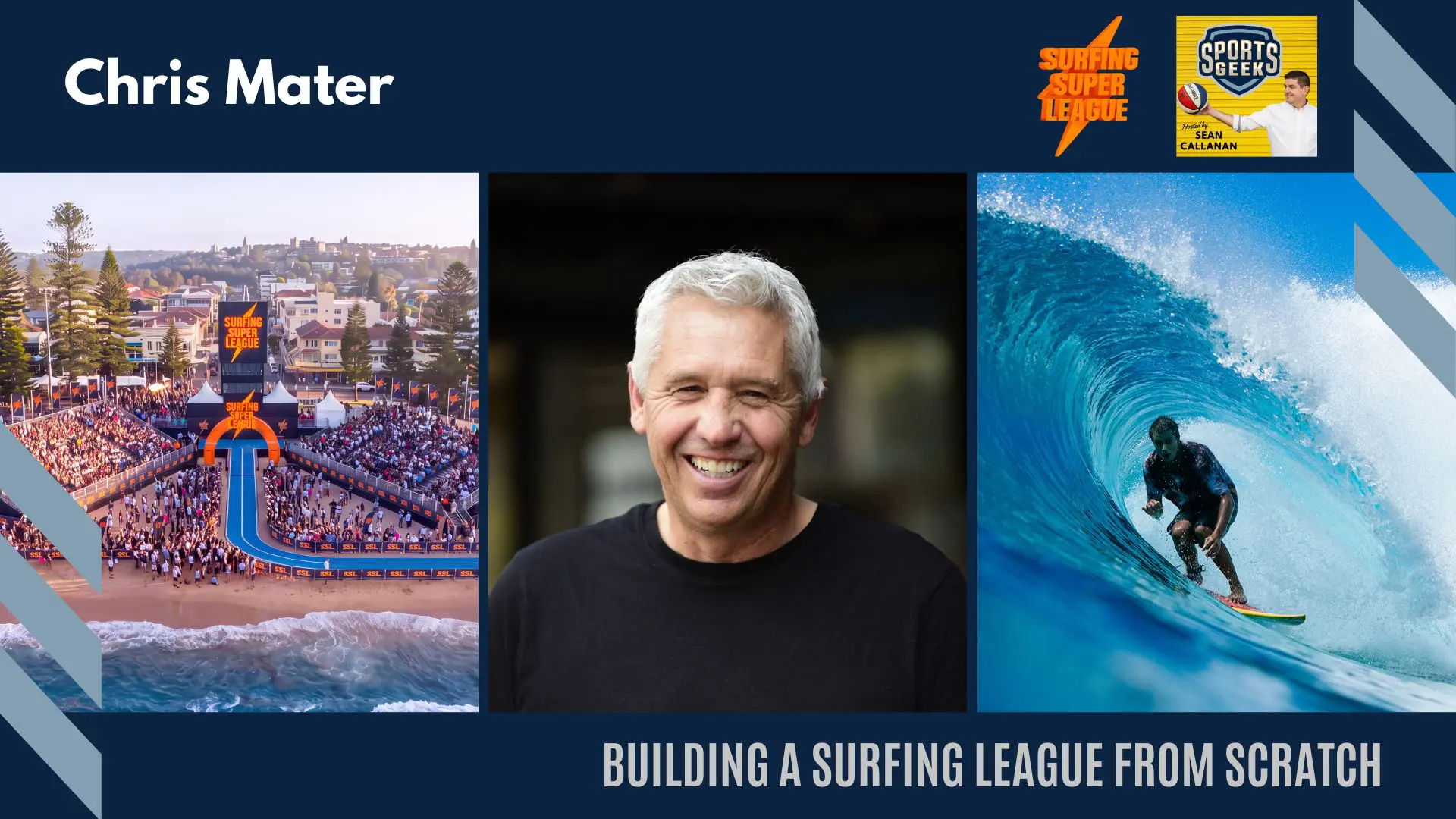
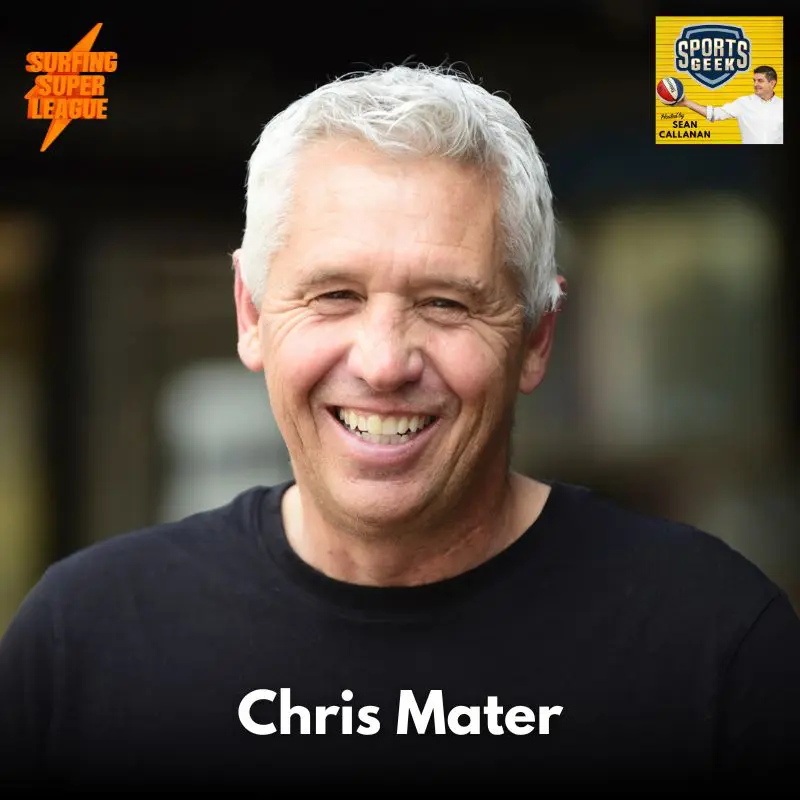
In episode 461 of Sports Geek, Chris Mater brings a rare mix of Red Bull marketing instinct, national federation experience and founder ambition to share how he is building Surfing Super League from a blank piece of paper.
In this conversation, you’ll discover:
- Why Chris designed the entire competition backwards from the broadcast window, and how that solved surfing's multi-day holding-period problem for live television
- How to turn an individual sport into a team-based league, and where the format actually came from
- Why a 90-minute, made-for-TV product built on familiar sporting rhythms matters more than novelty
- How nearly two decades at Red Bull shaped the way he packages sport for fans and sponsors
- The four commercial pillars behind SSL: league partners, team partners, host cities and a minority investor
- Why he believes a domestic league, not the world tour, will become the most important thing in Australian surfing
Listen to Chris Mater on Sports Geek
Can't see podcast player? Click here to listen
Watch on YouTube
Interview Transcript
This transcript has been transcribed by Riverside.fm, no edits (please excuse any errors)
seancallanan (00:03)
Very happy to welcome Chris Mater. He is the CEO of the Surfing Super League that we'll be launching soon. Chris, welcome to the podcast.
Christopher Mater (00:13)
Thanks, Sean, great to be here.
seancallanan (00:15)
Well, I always get I always start my interviews trying to find out people's sports business origin story and how they got into the world of sports. What about yourself? How did you find yourself in the world of sports?
Christopher Mater (00:29)
How did I form myself in the world of sports? Well, I always loved sport. Like growing up as a kid, I played a lot of water polo, a lot of rugby union and was obsessed with both. But I also was a skier, which I used to do passionately. so when I finished high school, I deferred university, as many of us do, and told my mum and dad I'm going to take a year off. And I went skiing, which was my sort of big love.
And I got quite good at it. And I finished up doing, never went back to uni and finished up doing, you know, years as a competitive mogul skier. And I was, you know, finished up skiing Europa Cup on the Australian ski team and had a fantastic time as an athlete. You know, you certainly weren't winning any world cups, but you were sort of world-class level, but certainly not.
not winning, but also during that time you had to hustle. So as a skier you got to, you know, I had to represent myself, my own deals. And so I did that and a friend of mine worked at a magazine, skiing snowboard magazine. So I went and worked for him. So I had this sort of, this taste of…
of selling advertising and running around sports. That was my sort of first foray into into sport was as an athlete doing my own sponsorship deals and then hustling at the Skien Snowboard magazine selling ads.
seancallanan (01:54)
absolutely, and especially as an athlete, even in those days, but even now, you do have to support yourself, find your own your own forms of income, while while you're an athlete. But then coming out of that, so when you s stopped living the dream and and being an athlete and and skiing around the world, th you know, athletes always have to go to that that second career after after that athletic career is stopped. You'd already done a bit of stuff in the advertising space. Is that where you
sort of found yourself being up because you're able to sell yourself and and getting into sales. Sales always moves the needle. Is that why you're sort of moved into sales and marketing?
Christopher Mater (02:33)
Yeah, that's right. I could always sell and I just sell myself as an athlete for sponsors. And then when I got into the magazine sales, I learned how to sell advertising and learned what advertising is and started to dip my tone understanding what marketing was and started reading some books and whatnot to sort of bring my skill level up. yeah, essentially that was my…
and to make money, to make money, to have enough money to go overseas and compete on Europa Cup or do the Australian ski season. And the more money you had, the more time you had to put your craft to compete and train. So that's what I did. And did that all way up till I was 27. I actually remember really clearly I'd broken my hand skiing. I'd fallen, you in the spring I'd fallen down, I'd smashed my hand and I was sitting back in my office, back at the magazine. And that was when I was, I'd just turned 25.
and I realised that I was going to have to finish skiing and go and get a real job. And I got really, really lucky. A friend of mine, Glen Condie, rang me up and said, hey, there's this drink company that's going to launch. This is October of 1999. And they said, this is a drink company that's going to launch in Australia. Would you come and do a presentation on?
on sport and they said the drink company was Red Bull and because I'd been in Red Bull I knew what it was but they hadn't gone global at that point. So I went into this meeting and I remember, I don't get nervous public speaking anymore but I remember getting so nervous because I walked in this boardroom and I'd never been in a boardroom before and anyway I finished up getting through this presentation, bumbling through it on Explaining Australia and after the meeting the guy came to me and said who had
the license at the time said, listen, we're looking for a sports marketing manager. Would you, would you be interested? Do you have a resume? And I said, sure, sure. You know, I'd love to. Anyway, went home.
called my friend up and said, I don't have a resume. I'm not a professional resume. I don't have resume
seancallanan (04:38)
Yeah.
Christopher Mater (04:38)
to be a script. And I said, listen, I also can't turn this computer on. I have no idea how to work a computer. And so this is, you know, obviously 1999. And he came over and put our resume together and presented it to Red Bull. And then a month later, I was the sports marketing manager of Red Bull Australia. We launched our first product on January 1st, 2000.
seancallanan (05:01)
that's this is why I asked people their origin stories, 'cause they get trivic ones like that. But again it's a it's the case of your all your history, being an athlete, being in sales, being exposed to Red Bull internationally to know what it is, but then also having the the knowledge of Australia as a sports market, but especially early on, Red Bull was really about the action sports and the extreme sports and and that's where they would have been really prevalent. So even though you didn't have the traditional
you know, nutritional skill set, you know, that world experience, especially from an athlete, becomes really valuable.
Christopher Mater (05:37)
Yeah, that's right, Sean. was, like, I wouldn't get that job today, but back then they were on the rise. And I had…
Like I had just enough to get the job, you know, and because I knew athlete. So at the time Red Bull was really just two parts of their sports business was one was athlete management, which I would say I was probably a six out of 10 or seven out of 10. And then the other side was event management and marketing. This is even before they get into content, but at that time it was more basic and I was probably a zero out of 10. But fortunately for Red Bull is just, there's one of these companies where they just throw, and this is my whole career.
I've been like this and I was just like, put your hand up, get in there and learn by doing. And that was the opportunity. So I got the job at Red Bull Australia, started sports marketing major, expanded to New Zealand at some point as well. that was really the first four years was building an athlete team, which I was really proud of. had 20, know, Mick Fanning and Robbie Madison and Josh Sanders, like great athletes and then doing events. So we did Red Bull only events and that was an incredible
four years of learning like crazy, doing some great work in event management and athlete management. And then I also learned at that time how to start my journey into content development. So we would make television shows around the event. I learned that, you know, on the go. And then at the end of four years, I've always sort of wanted to go on and do other stuff. And so that's when I put my hand up and said, listen, and Red Bull moved people around quite a bit.
So that's when I moved to America for a job in Rebel USA.
seancallanan (07:21)
And so on that in in that journey across to the States where you're at athlete marketing and and working in the North American market and that was really a a massive period of growth for Red Bull where they were just pushing harder and harder both in the action sports but then in other in other sports. And
Christopher Mater (07:39)
Yeah.
seancallanan (07:39)
and again you've sort of that put my hand up, tac tackle the job and run like crazy. But was it really just the I guess the internal ethos and the and the culture of Red Bull that just really
was, you know, if you see an opportunity, seize it and really go after it.
Christopher Mater (07:55)
Yeah, that's right. It's an ideas company. So it's about what creative ideas could you come up with? And that was always a strength of mine, like really imagining doing things different. And then…
and then actually then doing it, then having the ability to go execute it. So it was that two dimensions. And then you have the growth of Red Bull. So they had the money to do it. So a lot of places you have great ideas, but they don't have the capital to go execute it. So it was a perfect place to go. And if you had great ideas and you had the ability to do it, you would do it. then, so it was growing like crazy. I I just reflecting on it. I had seven jobs while I was there in North America.
two year visa. So I went for, you know, with the intent. I remember releasing a car for two, for two years at the time, because I just thought I was going to go back. We finished up staying there 15 years. ran the content development because when I first got there, I realised no one was making the TV shows and the movies. So I did that for two years. I had no, you other than my Australia experience, I didn't, hadn't really done that. So I did that for two years. Then I went into athlete, back into athlete marketing and management. So I was the director of athlete.
So I did that for a few years and then I got the job as sports marketing manager looking after events, athletes and high performance. And then eventually I got the top job doing events, athletes, high performance, the toys that we have, the vehicles and planes and helicopters and motorsport and ran that for six years, which was incredible. I mean, we did some amazing work during that time.
Obviously,
huge amount of experience and learning, but that's again, that's all learning, doing as well. And then at the end of, so I did that for six years, which I loved.
You know, and then, I sure remember I wanted to be the CEO of Red Bull. That was my desire. And Red
seancallanan (09:55)
Yeah.
Christopher Mater (09:56)
Bull is at this place where there's sales and there's marketing and you may as well be on, someone might be on Mars and someone's on the moon because they're, they were just two different sides of the building. And so I wanted to be CEO and to do that, you have to go and learn sales and distribution. So what they did is they created these regional general manager roles looking after certain territories. So at that point I said, listen,
mean, people thought I was crazy because you had the best job in sports, but that was what I wanted to do. So I left there. I remember ringing my dad and saying, hey, I'm going to go and do this general manager job. It's running distribution centers and sales and key accounts and whatnot. And he's like, well, congratulations, son. You're now 40 years old and you finally have a job. Cause he
seancallanan (10:39)
Ha ha.
Christopher Mater (10:40)
always, he just never quite understood. just, he's just, cause I was always running around at great events and doing building stuff. He just couldn't quite understand that as a job.
and then did that and then did that for five years as general manager and learned all about, which was a great, I said it was like getting an MBA, like I had the CFO there who I mentored with for a year, he taught me how to read a P &L and understand finance and then as I learned about distribution and sales and key accounts, was a tremendous, another tremendous, know, knowing nothing about that and then doing that for five years was great as well.
seancallanan (11:16)
absolutely there's probably every chance you you cross paths with a another former guest, Melissa Lawton, who worked in the who worked in the Red Bull content content house and the content team and dr and drove that. But knowing that it is a big beast you y you you you may not have.
Christopher Mater (11:34)
No, when was Melissa there? like that church and state I mentioned, so when I left sports in 2013 and you go into general management, you don't really, you know, somewhat with marketing, but you may as well, again, you're off doing something else in the company, so there's not much interaction.
seancallanan (11:48)
Yeah, yeah, yeah. Yeah, she w yeah, she
was it she was running the the media house at that at that point, so
v very
Christopher Mater (11:54)
Yeah, I got you.
seancallanan (11:55)
different. I wan I wanna ask you, how has that that that go getter culture, you know, that that ideas to execution piece shaped you shaped you as a leader? Because like like speaking to Melissa, she said working at Red Bull was transformative in her thinking and the way she you know, tackled brig problems and took on big big projects. How has that shaped you as a leader?
Christopher Mater (12:19)
I mean, there's certain values there that you so you value execution, right? know, well done is better than well explained. That was a so it helped me like really value execution as a leader. You certainly value big ideas. you vision.
What you certainly value decisiveness, think being, so that really helped me because you have to make decisions with not all the information. So that definitely shaped me and particularly both on the, particularly on the sports marketing side, because you're doing things that no one's ever done before. You're doing with not all the information. So you've got to learn to be decisive and you learn there that, and so that, that really helped me become a decisive leader as well. So yeah, there was several things I think that shaped me for sure.
seancallanan (13:10)
So you're at ten so you're at Red Bull for for a fair while and you made the move back to to to surfing Australia. What in the in the CEO role, what what was the draw to to to move to a to a national sporting org as like that surfing Australia is?
Christopher Mater (13:29)
Yeah, so a friend rang me, a lady called Carly Loda was on the board of Surfing Australia at the time. I didn't know Carly, but she was good friends with a really good friend of mine. And they said, hey, there's this job in Australia. And I said, no chance. There's no, I'm not working for.
national sports organisations. don't like national sports organisations as a lived experience as a skier. And more importantly, my goal is to run Red Bull as the global CEO or some other fast moving consumer goods. So that was really where I was. And then they convinced me to say, have a look at it. So then I had a look at it and it was quite interesting. It was a sport that I loved. So I love surfing. I love skiing.
We worked in so many other sports, know, basketball.
seancallanan (14:19)
Mm-hmm.
Christopher Mater (14:19)
all the mainstream American sports, all the motor sports, all the action sports. So I'd worked in all of them and knew I wouldn't work in most of them full time, but I knew, but I liked surfing. I looked at the, it was going to the first Olympics and I loved the Olympics. I'd been to, my brother-in-law had been to two Olympic Winter Olympics. I'd been to some Olympics with Red Bull. So I loved the Olympics. I liked that. Then I looked at the business and I was like, wow, it's a small business, but I think I can really, I think this really suits my skillset.
needed to understand high performance and needed to understand content and needed to understand partnerships, leadership. And then, so I was looking at this, I was getting more and more interested and then…
I had a big role as a general manager with a lot of scope as a general manager or head of sports, but at the end of the day, you're not the CEO and where the buck stops with you. So I like the idea of going, okay, I can go and run a run on an organisation and at the end of the day, be 100 % like, as I said, the last, the last
call will be mine or the teams, but I have to be all the teams call, but I'm held accountable for it. I'm to be responsible. So I like that to go test myself to see how I do that. And then the ability to build my own team and my own culture with the people. then, then lastly, have that board experience. I've never worked with a board. So I liked the idea of, okay. So there were those things that I'm like, you know what, let's, let's go and, and sorry. And then lastly, Sean,
And this is.
I love to learn, I love to grow and that's and all the jobs that that I did, it was it was time where I where that learning curve was coming, you know, it goes like a huge, steep learning curve and you're really good at it. But it comes off quite fast as well. And that's where I was coming from. As a general manager, I'd learn everything that I need to learn in the five years and I was I'd learn everything I needed to know. So it wasn't wouldn't be good for me to stay there another two years because I wouldn't learn.
else so was time to move on.
seancallanan (16:28)
And at surfing, you obviously got to go deep on one sport. Like at Red Bull, you were obviously jumping and and activating in multiple sports with multiple athletes and multiple events. Did that I mean almost allow you to take a breath and really go deep on surfing as a as a as a sport, what participation looks like, but then also start looking at what are the commercial products and like you said before the
The the important pieces like getting content right, getting getting the right exposure. Was that sort of the the genesis for what we're talking about here, the the surfing super league?
Christopher Mater (17:07)
yeah. So, yeah, to comment on that, the at Red Bull, that experience was two things. One is coming as an Australian, you're going to America and Australians think they know about America, but they don't. So when you when you go there, you realize here's New York City, here's New Orleans, here's San Francisco, here's Sacramento, here's Fresno. So you learn about markets and in a way that you.
Cause when you grow up in one, you don't even know what, sorry, you're so part of the culture. When you go over there, you're not. So you're observing it in totally different way. So you're learning curve about how markets behave and what makes them important and how you study them. That was, that was incredible for me to, to, learn. And then with the sports side of things, the same thing. I'm not on the, I don't know the MBA, but then I go and learn how it works. I don't know, you know, drag racing, or I don't know
you
flying sports. And so the exposure to all the different communities with the same philosophy of like being authentic and understanding how they work, but really learning the nuances. And you really see where sports are true. Like I always used to laugh at not laugh, but snowboarding, for example, like they all think they're original. And then if you, but if you go, you go look at them, they all look the same. You know, if they're all wearing a pink beanie, then they all have a pink beanie on all. So it's funny when you get to understand.
And same with golf, you look at golf and you look at these tribes of, or even cowboys, and there's sort of this originality in it, but not in itself. And then you start to understand what's true and not true. so you're taking those two really deep experiences of experiencing new markets and new sports and the culture. When I brought that surfing, I could understand where the opportunities are, what was true, what wasn't true. What are some of the, I call the myths.
things they believe that you can charge through and make untrue, but also at the same time, deeply understanding what is true. Like this is the thing with seeds and cultures that you can't change as much as you might want. So yeah, taking all those experiences and which I took to surfing, but most importantly, surfing, it was about looking at the business of surfing Australia, looking at the communities of surfing Australia and making a really clear strategic plan of what will give us the most value with the
least effort and the most and the things that are most important and creating a plan and getting after it and making big changes. So we doubled, I doubled the business there in seven years and two of those were COVID. So really proud of what we did.
And, but then the motivation from there is, okay, if you see my career, like, okay, now what's the next thing? You know, seven years at Surfing Australia was probably two years longer than I needed to be from that learning curve, as well as providing value to them. And so
seancallanan (19:59)
Mm-hmm.
Christopher Mater (19:59)
I was like, what do I, what do do next? And I could just see this huge, huge opportunity sitting right there in front of me that I had to go and take on, which is now the Surfing Super League.
seancallanan (20:11)
And so and so that it's I mean it's a it's still it's a very much a new model for s for surfing, but we've seen that model built out in a in in other sports. You know, early on it was T twenty cricket, like I was saying before, Melissa Lawton is now at Sale GP and they're they've got that and they've built that out to provide a better better product, I'd say, for fans and and content. Where did you start I guess putting the pieces of the puzzle together for the surfing super league?
Christopher Mater (20:42)
So there's a friend of mine sent me a quiet podcast. Got a quiet and…
seancallanan (20:50)
Yep. It's a great a great listen.
Yep.
Christopher Mater (20:54)
It's a great listen. You know, listen to all of them now. Most of them are four hours and really, and they, someone sent me the IPL, the Indian Premier League. And I was listening
seancallanan (21:01)
Yeah.
Christopher Mater (21:01)
to the Indian Premier League going, wow, there are so many parallels here of the mark of IPL versus surfing. So that, that was sort of a real light bulb moment of like, wow, it got me churning like, okay. And so then I was like, okay, the market is really strong. It's Australia, there's surfing everywhere. I know from the data it's growing.
the people have money, it's got all sorts of really, really strong market indicators that there's a strong market. Then the second thing is there's a product here. So surfing is a person on person format, but there's a thing served at the club level. This is, that is the best format. So it's almost like, we're not going to do boxing anymore, we're going to do UFC because there's a cage and we're going to kick each other, we're going to get much, much. So the teams format is a much, much better television format.
that I didn't invent that was just sitting there at the club. So was that. There was the media market. So Australian media rights is strong and healthy and competitive. And also the Australian mainstream market will cover surfing. So there was that. And then I was looking at the surfers, like these amazing surfers who are just sitting there on the sidelines who aren't, who are available. And I'm like, there's a surfing group of people that people are desperate to see. And then lastly, you know, what I do, I'm like,
the experience to do it. Like I've been literally built for this moment to go and you know because of all my experience and all these other sports understanding business doing it in Australia with surfing I'm like I got this is this I was born to go and try and make this happen so that was that were all the conditions.
seancallanan (22:43)
So for to explain it for the listeners, there's there's eight teams are gonna be across eight beaches across Australia. a a ninety minute Mayford T V format again with different segments and and clocks and high stakes and very much team team team team format, so not not, you know, surfer versus surfer and and one surfer one surfer wins. how how do
And
then the other part is actual attendance and and and and grandstands and having having fans attend these these events. So you're gonna be balancing that piece of designing the event the live event for the fans and also making sure it it it pops on pops on T V. What are the what are the main priorities for you?
Christopher Mater (23:34)
You know, let's if we just do it sport side of things that there's there's like I said mentioned before that surfing has a team's format. So it has a format that I've watched dozens and dozens of times and works great. So it's very authentically a team. So then I took all my experience of looking at sports and started applying them to surfing and they and they
They got, they ticked the box. Like, let's build a franchise. Let's have players. Let's have a contract. How does fandom work? How does, how do you build fans? How does content work? What's playing for a premiership? Who cares about that? How do people care? So it was all these like really, really smooth ways of like developing and growing it. So that was, that was the,
the what we've created that we've taken to market, I think people get straight away. Like I can talk to a surfer or non surfer and explain it to them and get it. To your question around entertainment, it's gotta be entertaining. Part of it is the format change. So normally surfing runs seven, nine hours. It's so long. It's it's untenable. So making a short product, which is 90 minutes, we think is gonna be really key. And I didn't just make 90 minutes up. 90 minutes is what an NRL game is, which is what millions of people
already do and then from a broadcaster and an advertiser and a fan experience not only just the 90 minutes it's the 40 minute first half the half time and what happens in the the second half so that that is familiarity so I really feel like people be able to sit in it in their seats and experience that it is non-stop action so when you watch teams which is what you want in sport
You want people, you want things happening the whole time. You want tension. it has that. There's always something going on, which is very different than the core serve product where people just sit there and wait. We're always moving. And it has this really natural end of a first half and end of a game that always creates drama. So we're highly confident that it's going to be really entertaining for fans. people will care quickly about, know, do you win a premiership or not? Like people in New Zealand, no one,
I shouldn't say no one, but look at what they did with Warriors. know, there's no, you know, the game, you know, over however many years has really evolved because they play in it, people fall in love with it, they like the players. And I think that's a good parallel of a sport that, you know, was certainly not the number one, but over time people really fall in love with it as well.
seancallanan (26:05)
And
the and the event side of it with the with the eight eight locations is the goal that they become eight mini events, everyone who wants to go to their their their r their race, their you know, their meet, if that's what you're calling them, because either they're local or next to it or or you might even have some super fans that that travel up and down the travel up and down the coast to catch catch a couple of catch a couple of weekends.
Christopher Mater (26:32)
Yeah, there'll definitely be super fancy travel. But so again, we're creating an original playbook for surfing, but not for sport. So the NRL have the Magic Round, AFL the…
gather around, that's what we are every weekend. So for parity of competition, everyone has to have a home game. So everyone has a home game. Everyone has a gather around, which means we all go to that home thing, and we know the power of that when all the teams come to one market. So we do that eight times. Then there's ability for all the fans in that market to come and watch the game and watch all the teams all at once. yeah, we really, and then that travels along the coast. So people will start going to fans will be traveling with their teams.
So we know that works in AFL and NRL and they just do it as a one-off. That's how our whole season's built. So yeah, we're really confident that we will build fast fandom.
we'll have the media coverage and we'll have people care about who's winning the premiership. The other important thing with surfing, and so, you know, I follow the NBL, what they've done in the last 10 years is amazing from what the sport was and what it is today. But they play in arenas that, you know, most people, if you walk around the city, wouldn't even know exist and or know that it's on that weekend. When we build an event site, like if you build an event site at Manly or Northern Beaches, the whole town knows it's getting built because it's getting built
seancallanan (27:53)
Yeah.
Christopher Mater (27:53)
over a water.
So
that plus it happening plus the media week in week out, we think we will have really high household penetration and awareness at the end of the first season where people know that the season existed and then quickly over time that will become important that you won the premiership or didn't.
seancallanan (28:15)
And
you did say before the the the market the market rights, the T V rights, you you're already done a deal with Fox Sports or or Kayo Sports as they'll be known af after saying that the they'll be the rebrand, but that you'll be you'll be across
Christopher Mater (28:27)
Yes.
seancallanan (28:27)
the screens of Kayo. how important is that to to to get that exposure? I mean, obviously Kayo, like all streamers these days, searching for high quality content. So how do you make that partnership work?
Christopher Mater (28:43)
Yeah, I mean, that's the most… So how important is it? It is the most important thing.
And probably the second most important thing and third most important thing is that you have a really good platform where people can watch the sport. But more importantly, sorry, as importantly as is it on design or Kayo sports, whatever you want to call it. So we're on binge Kayo and Fox and how they get rebranded in the future. So we're on those platforms, but more importantly, or as importantly, we're on it four to 6 p.m. So we've got a two hour window Saturday and Sunday, and you've never seen that in surfing.
completely new. We're in January and February. that's it's summer holidays, people are at home. That's when people watch sport. So the time and time part was really important to us. we and we love that, you know, KSports got that and they gave us the time and they believe that we'll get an audience and then having the weekend week out and then the grand final. So we're just ecstatic that we have that. And the Australian media landscapes.
You know, it's hard to find that sort of premium time. So we're ecstatic that someone believed that we could bring an audience and then we have that time for sure.
seancallanan (29:57)
And I think the important piece, I mean, it does sort of go back to the eighties and nineties when when sport was always on at the same time and you can sort of set appointment viewing. But for a new league it is quite important for people to know, this is when it's on and for to tune in live. Obviously they could always watch the replay and that's the beauty beauty of streaming, but to be able to have, hey, you know, this is on now. Like I I sort of talk about Big Bash being the almost the screensaver of summer, it just ends up being on in the background.
because that's what you what you can watch and you sort of can sort of be in that space of Saturday and Sunday, if you're not if you're not if you're not heading down to beach to watch it, you'll know where you'll be able to catch it.
Christopher Mater (30:37)
Yeah, that's right. That's right. So it's really important.
The live event experience is important. So most surfers haven't been to a surf event. They haven't been because they're all in remote locations. we also believe having those big market moments. So when we're on the Gold Coast, it's going to have out of home advertising, buses. Obviously the digital content's incredible for surfing. It's followed and watched. And then tens of thousands of people can come and experience that. And our prediction is then those people or some of those people then start watching it week in, week out.
So, yeah, we're highly confident that we can build an audience. Well, there is an audience there, so… we can get them watching the surfing super league, you know, pretty robustly and quickly as well.
seancallanan (31:22)
So you've got the the
the media in place and the plan and the plan in place, but some of the other parts of the commercial
Christopher Mater (31:26)
Yep.
seancallanan (31:27)
model are you know getting franchises in franchises in place and and and and and partners partners in place. Obviously there's a lot of private equity in in in sports at the minute, and in and in team and team ownership. We see a lot of team ownership in this market, you know, in the MBL
Christopher Mater (31:45)
Yep.
seancallanan (31:46)
and and that that that is growing. What's what are the steps
that you've got in fr in front of you and how can potentially how can people get involved with the surfing super league?
Christopher Mater (31:55)
Okay, bye.
So there's four things. The first is league partners. So we're selling league partners. So just like there's the NRL Telstra Cup, we're selling a principal partner for the league and founding partners. So that's really important to us. And we've got listeners out there that are interested. And that's league level partners. And so we're in the market right now trying to find the right brands for us. The second is team partners. So that is just like the Brisbane Broncos.
have Kia on the Jersey. We're selling each of those teams in each of the franchise markets. So we're really excited getting a great response to those local teams and a lot of opportunity for both the national and regional outcomes in those cities. The third is we're meeting with the cities, so meeting with each of the cities on…
what we need their support on in each of the markets, like Gold Coast, Sunshade Coast, so on and so forth. And then lastly, we are looking for a minority league investor. So the league owns all the franchises and the business is a franchise factory. It's a fantastic business. So right now we're also looking for the right minority league owner.
seancallanan (33:18)
terrific and like we're talking about this, it was only last week that the Big Bash and Cricket Australia d discussed about taking on investors in in all the Big Bash franchises. So I'm sure that's one that you'll be watching with interest.
Christopher Mater (33:35)
Yeah, we're watching that. mean, it's a friend of mine and I've been, I have been watching that.
And the discussion around is it good, is it bad and the varying opinions of that. But I won't comment on that. But I think it's indicative of, you know, even for the Big Bash, we were looking at the Premier League. We're looking at the valuations of that. And that was how our model was built much on that. In America, you're looking at we're more similar to the Premier Lacoste League, if you're familiar with that. they own the teams and the league. You obviously you mentioned Sale GP, obviously the major sport.
codes, know, the NFL teams have gone, the NBA teams, the Lakers that just sold. So lots of lots of great examples. And then to your point, yeah, we're watching obviously the big bash, which is going to privatize as well. So and our business is, you know, that's probably a good proxy for us, right? Because, you know, the season, the time of the season, the players, the fandom, a long game, it becomes a short game. So we have a lot of parallels there. We've got a really good, you know, we're playing our players really
well but our our costs we've got a great business in terms of controlling costs you know we have six players on a what's happening on a big bash team 18 15 so we've got a really good business we don't need arenas so you know they play so there's from a cost perspective it's a really nice business to own and operate as well so but yeah in short those we think it's favorable that those they're privatizing even though it would be competitive because there's more capital
getting invested in different areas. We're excited because we're keen to see what those valuations are.
seancallanan (35:16)
And
sort of taking the story full circle, you started as an athlete. What what's the surfing super league gonna mean for for athletes that are gonna participate?
Christopher Mater (35:27)
Yeah, it's gonna like we've got had over 100 athletes sign up. It's the big one of my big motivators, non-commercial motivators of why I'm doing this is I was really frustrated at Surfing Australia when because less and less Australians get on the world tour because it's harder and harder, which is is okay. We want people to win world titles. But if you're not on the world tour, you're really, really struggling. So we wanted to create a really new, meaningful pathway. And it's I'm really
passionate about our Australian surfers having this opportunity. And I use the proxy of, you know, the example of the NRL. Like, I truly believe this, this will be the most important thing to Australian surfing is the league. Do you play in the league and then do you win a Premiership? In three years, it'll without doubt be the most important thing for Australian surfing, Australian surf communities. And to your point, the surfers, it'll be the most important thing to them.
seancallanan (36:27)
And and and you said as a complementary piece of the surfing ecosystem and definitely a pathway thing to to be able to have someone play and surf in the in the surfing super league and then potentially go on the world tour and produce fur future champions?
Christopher Mater (36:44)
Yeah, I think they're complimentary. It's not it's not like as an example, you don't see that in V8 supercars. You don't see V8 supercar drivers then you know.
ripping into Formula One or vice versa to somebody, you have seen somebody do NASCAR. So how much that goes, maybe more so than that example that I'm giving. But what it does do is if you're a young driver, you're in your go-karts, you got two really good pathways. I can go drive V8s or can go drive Formula One or I can go drive NASCAR. So we're similar like that. think there's just more opportunity. Will it create better surface for Australia? Probably as well, because there'll be more young people doing it and a higher
rate. And what happens in surfing is when you get to 18, 19, 20, 22, and you're not making it on the World Tour, people retire very quickly or stop their sport. So we've got a whole group of players, you know, we're talking 40 odd people who will, who can continue for longer. So yeah, you know, if you said make a prediction, would say, yeah, it'll, it'll produce better Australian surfers for us and the World Tour. But I just think it creates a whole new pathway that will be just super valuable for
for a strand shaving.
seancallanan (37:57)
Well, absolutely. Chris, I really do appreciate you coming on the podcast. I'm looking forward to to attending a surfing super league event, but I want to get to the Sports Geek Closing Five. Do you remember the first sports event you ever attended?
Christopher Mater (38:11)
I do. And very, very clearly, I grew up on the northern beaches of Sydney. And I'd mentioned before, I loved rugby. So was a rugby union game and it was Manly. I can't remember who they were playing, but I distinctly remember, and they play in blue with red, Manly down at Manly Park or Manly Beach. Just, they were huge, like huge, hairy men. That's what I remember thinking. And that was, geez, that would have been in that would have been in early 80s.
seancallanan (38:40)
Early eighties, terrific. you would have been to lot of different sports events in your in your travels. Do you have a favorite
Christopher Mater (38:46)
Mmm.
seancallanan (38:47)
food at a sports event or a go to food at a sports event?
Christopher Mater (38:51)
Is beer a food?
seancallanan (38:53)
It it is when I go to sports events, so yes, I count
it as a as a food group. that's
Christopher Mater (38:58)
Look.
seancallanan (38:59)
that's a perfectly fine answer according to me.
Christopher Mater (39:02)
Yeah, I'd say beer first and then I can eat anything. So I love the nachos or hot dogs or whatever's going.
seancallanan (39:12)
trivic. what's the what's the first app you open in the morning?
Christopher Mater (39:18)
It changes. I do AFR, Australian Financial Review. I do Instagram, doing a lot of LinkedIn at the moment, because I'm getting lots of people reaching out through LinkedIn. I love checking the bomb and I'm a surfer, so I check surf line. So I check all
seancallanan (39:31)
No that's
Christopher Mater (39:33)
of them.
seancallanan (39:34)
That's all right, it's a pretty good morning routine. you've already nominated
Christopher Mater (39:37)
It is.
seancallanan (39:38)
the Acquired Podcast, which I recommend as well, but is there is there someone or something that you follow that the podcast listeners should follow and why?
Christopher Mater (39:48)
Yeah, so I've been, not to get too deep here, but I've been following Stoic beliefs, which is a Stoicism, which is all, and the reason we should do it is it's…
It gives me really nice, because I'm building this business and you're running into challenges and all this stuff every day. And obviously some people doubt you and I really like it because it brings up just quick quotes from great philosophers on a daily basis that inspire me, also give me… So people should subscribe as well, because it just gives you a moment of reflection not to take…
yourself too seriously as well.
seancallanan (40:31)
Absolutely. Absolutely. I was lucky enough to hear Ben Crow speak at Sport Next. If you haven't checked out his book, he's he was Ash Ash Bardi's mindset coach. And I'm trying to remember the book name. I think it's Where That Let
Christopher Mater (40:46)
Bye, ciao.
seancallanan (40:47)
the Light In or something along the lines of it. I will put the link in the show notes but I'll send you a I'll I'll send you a link. But very much along the same things, and you know, keeps you grounded and focused on on
on what you can control and when you're running your own business or starting a new league.
Christopher Mater (41:03)
Yes.
seancallanan (41:03)
it's it's absolutely terrific advice. lastly, and you can answer this you know, personally or or look at it from a surfing point of view, but what what social media platform is your MVP?
Christopher Mater (41:18)
Instagram for sure. You know, and if those people want to follow surfing super good Instagram, yeah, I just think it's I find it very entertaining. know you got to watch how much you get on it and scroll and go down the rabbit hole. I just think it's a great it's a great platform.
seancallanan (41:33)
I mean the algorithm does does continue to serve the stuff you're interested in. So as you like you would be diving further into the into the monoculture that is surfing, it'll keep sho serving up new stuff all the time. So it is a it is a popular answer. Chris if there are I always ask listeners if they listen to the podcast to reach out and say thank you. what is the best way for people to do that? you're
You're active every morning on LinkedIn. Is LinkedIn the platform to say hey hey Chris to listen to the podcast? Look forward to super surfing super league?
Christopher Mater (42:05)
Yeah, LinkedIn is a great, great way to get me. It's Christopher Mater, M-A-T-E-R. yeah, and if you're particularly, if you're a brand out there looking for something new and exciting, like we are, we're a blank piece of paper. We can create whatever you want. We love innovation. We love content creation. We love brands that will promote, you know, what we're doing as well through their channels. So yeah, we'd really invite anyone out there that wants to get involved to come and come to the party and let's have a good time.
seancallanan (42:36)
Thank you very much. We will send people to serving superleague dot com. really do appreciate you coming on the podcast. Let me know when you're next in Melbourne and we might have some of that food you discussed at a pub somewhere.
Christopher Mater (42:51)
Great, thanks Sean. Thanks for having me. Thanks for the time.

Turn 15 minutes a day into sponsorable content your partners will pay for
Sports Geek AI is a done-with-you content system that creates daily newsletters, podcasts, and social posts—giving your commercial team new inventory to sell.
Resources from the podcast
- Please connect with Chris Mater on LinkedIn. He is on there most mornings and told us it is the best way to reach him. Let him know you listened to the episode. Please say thank you if you do connect.
- Learn more about the Surfing Super League‘s approach to team-based surfing plus updates on the inaugural Season 1, its flagship eight-team competition launching Summer 2028 on their website.
- Give our new Daily podcast a listen – Sports Geek Rapid Rundown.
- Check out Digital To Dollars – our self-serve program to help you drive more revenue from your digital fan base.
- Podcast episodes you should listen to:
- Throwback episodes you may have missed:
Podcast highlights
Highlights from episode 461 with Chris Mater:
-
- 01:57 From mogul skier to magazine ad sales, the sports business origin story
- 04:01 Breaking his hand at 27 and the Red Bull phone call that changed everything
- 06:00 Launching Red Bull in Australia on January 1, 2000
- 09:23 Fifteen years and seven jobs across Red Bull North America
- 11:17 Chasing the CEO seat and stepping into a regional general manager role
- 12:17 The GM years as a self-described MBA in finance, sales and distribution
- 13:47 The Red Bull leadership lesson: well done is better than well explained
- 14:38 Why he took the Surfing Australia CEO job after saying no
- 18:35 Going deep on one sport and doubling the business in seven years
- 22:10 The Acquired IPL episode that sparked Surfing Super League
- 24:11 Eight teams, eight beaches, and a made-for-TV team format
- 25:30 Why the product is 90 minutes, the length of an NRL game
- 28:00 Borrowing Magic Round and Gather Round as a whole-season model
- 29:43 The Fox Sports and Kayo deal and the locked 4pm weekend windows
- 33:23 The four commercial pillars: league, teams, cities and a minority investor
- 34:46 Watching the Big Bash privatisation and what it signals for valuations
- 36:55 Why SSL will become the most important thing in Australian surfing
- 39:25 Sports Geek Closing Five

Digital To Dollars is the five-pillar process pro teams and leagues have used for a decade to turn digital audiences into revenue, and it’s coming soon as a self-paced program. Those on the waitlist will get 20% off upon launch.
Check out our podcasts with SEAT
We’ve launched two monthly podcasts in collaboration with SEAT.
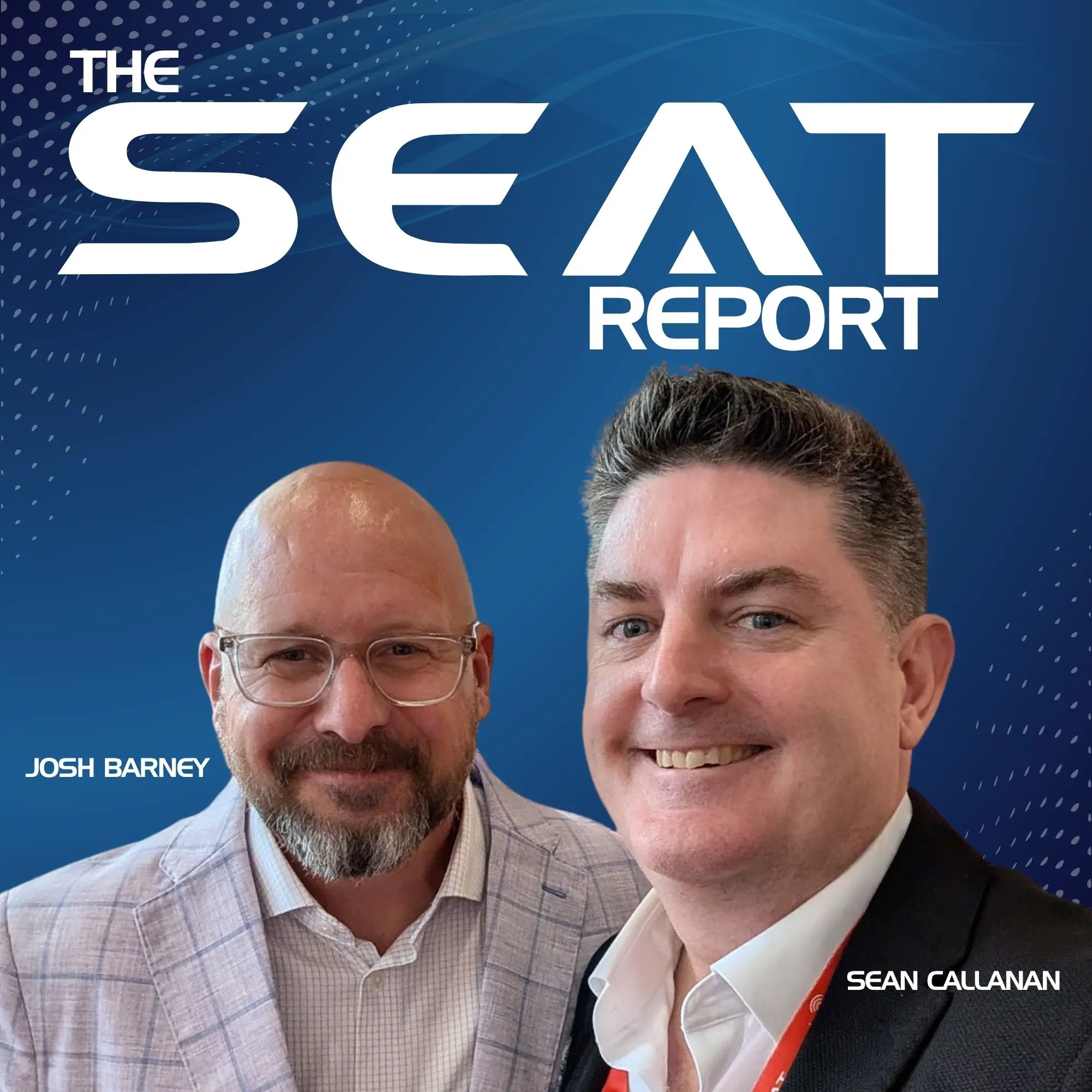
Sean hosts The SEAT Report with Josh Barney. Check it out
Each month, Sean will profile a SEAT partner on SEAT Solves.

Listen To Sports Geek
Recent Sports Geek Reads
- NBA Revenue, Netflix Sports Strategy & AI Marketing ROI
- Euroleague’s €13B Vision, Netflix’s World Cup Deal & Knicks Go Public
- TrackMan Golf, Stats Perform Data & NASCAR’s Tom Cruise Gamble
- NBA Wearables, WNBA’s Evolution & AmEx SailGP Sponsorship
- Sports Rights Hit $66B, Netflix’s Women’s World Cup & Disney’s Dude Perfect Deal
- Private Equity Bets, Dynamic Ticketing & Netflix Layoffs: This Week’s Biggest Sports Business Shifts
Listen to Sports Geek Rapid Rundown daily