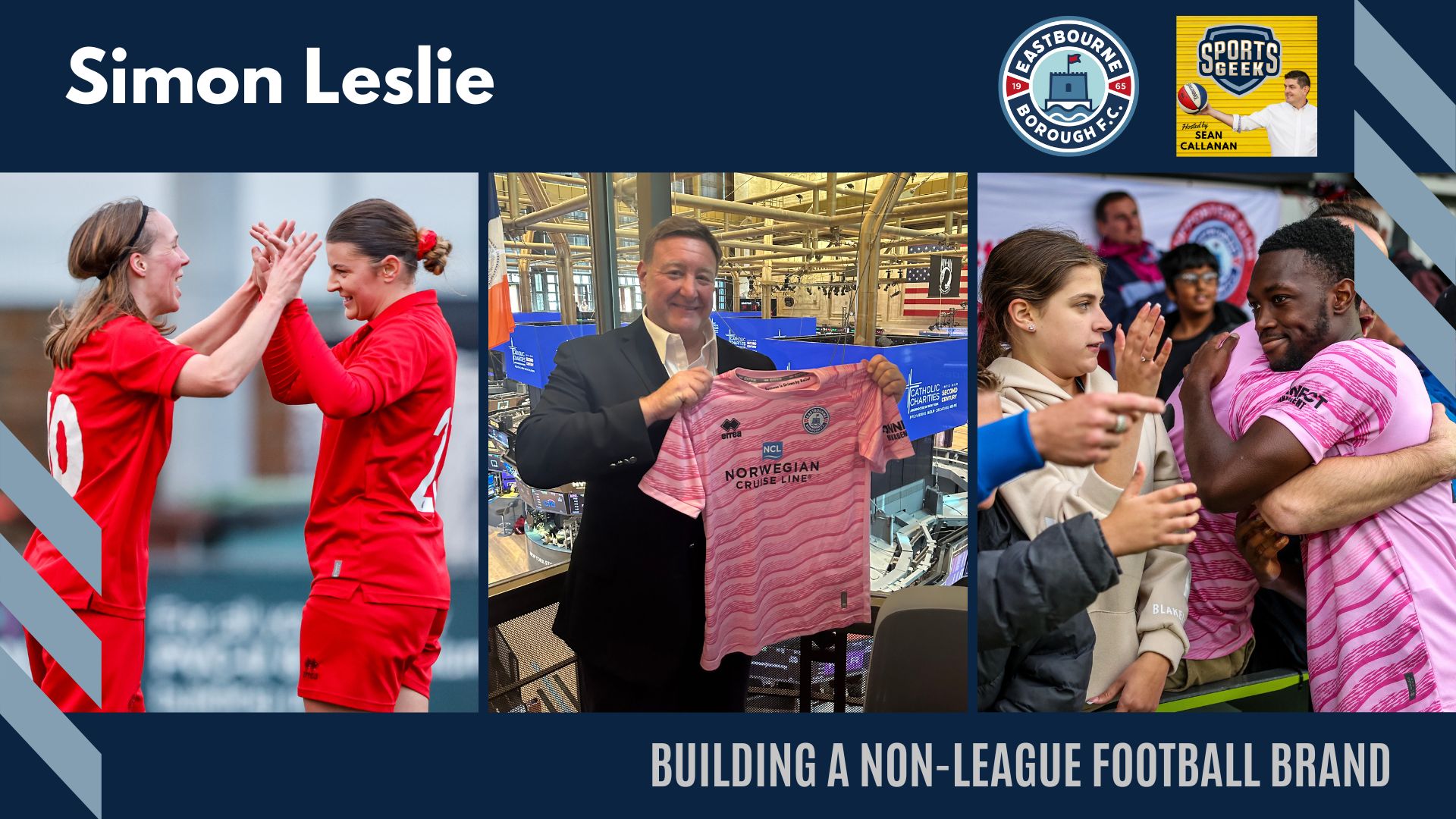
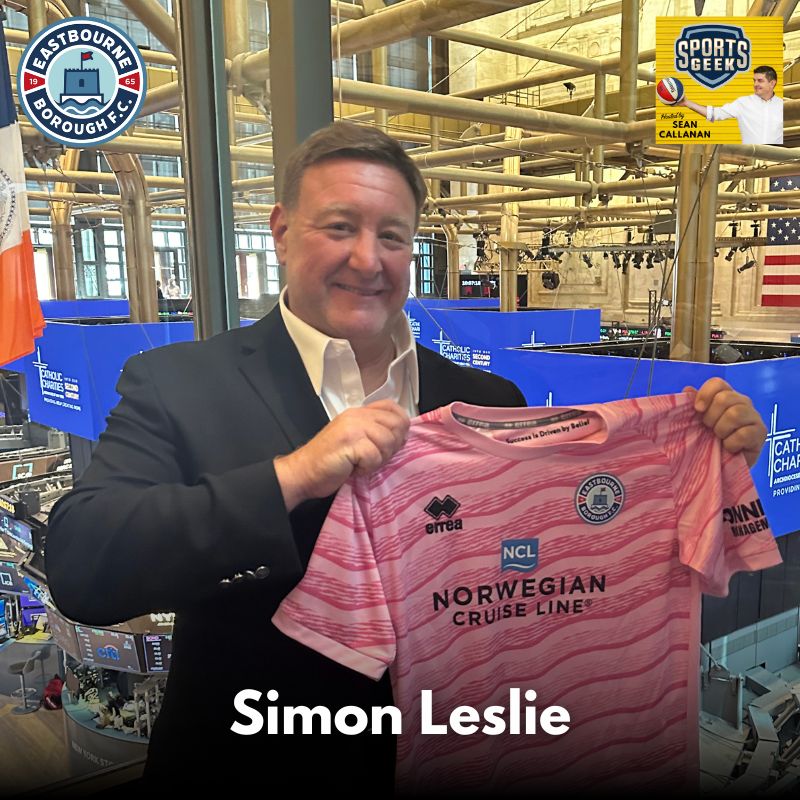
In episode 445 of Sports Geek, Simon Leslie brings his entrepreneurial experience from building a global media empire to share insights on transforming a non-league football club from the ground up.
In this conversation, you’ll discover:
- How the “Wrexham effect” has revolutionised investment and interest in lower league English football
- Why building a social media following that rivals Championship clubs matters for a sixth-tier team
- Essential lessons on the difference between business and football – and why you can’t make up those three points
- How to implement a culture of kindness and development in sport while maintaining competitive standards
- Why Simon views Eastbourne as a testing ground for sports innovation and new product launches
- The challenge of balancing global digital engagement with driving local match attendance
- How pioneering initiatives like private medical insurance for players can set new standards in non-league football
This episode explores the journey of transforming a sixth-tier English football club into a global brand, featuring insights on navigating the Wrexham effect in non-league investment, building championship-level social media engagement from the lower leagues, balancing entrepreneurial business thinking with football's unforgiving results culture, and pioneering player welfare initiatives that set new standards across non-league football.
Listen to Simon Leslie on Sports Geek
Can't see podcast player? Click here to listen
Watch on YouTube
Interview Transcript
Sean Callanan (00:01.74)
Very happy to welcome Simon Leslie. He's the chairman of Eastbourne Borough FC. Simon, welcome to the podcast.
Simon Leslie (00:09.745)
Good, well it's morning for me. Good morning to you, good evening, wherever you are in the world.
Sean Callanan (00:14.766)
It's a podcast. The time is not a consequence. People can listen to this at any time of the day. So where we record doesn't really matter. I always get started by asking people their sports business origin story. How did you find your way in the world of sports?
Simon Leslie (00:35.407)
I came in so many different directions that I don't even know anymore. I guess as a young boy I was excited about sport and I wasn't very good at education so sport was my outlet and I remember as a young boy going to watch a I was from Wales, South Wales in…
Sean Callanan (00:40.173)
Okay.
Simon Leslie (01:00.017)
South Wales, not in England, next to England, where rugby was the main sport. So I got taken to Cardiff City to watch my very first game and I was hooked. I was hooked from that very first moment. I love sport. I love football and I always dreamed that probably as a job that I want to sell the best sports tournaments in the world, the World Cup, Wimbledon, whatever it may be.
Sean Callanan (01:02.51)
Mm-hmm.
Simon Leslie (01:28.347)
And that's what I ended up doing.
Sean Callanan (01:31.566)
So that business was Inc. Travel Media. What was the main goal and guess the remit of that business?
Simon Leslie (01:40.775)
Originally, I started off because I didn't want to get a proper job, as my dad called it. I wanted to have my own.
Sean Callanan (01:45.294)
That's called being entrepreneurial now, Simon. You know, someone who runs their own business. Exactly.
Simon Leslie (01:53.703)
Well, would, you know, I don't know when the word entrepreneur actually kicked in. I don't think it kicked into like 2007. But before that, you were just a business person, businessman. And I wanted to my own business. I had a couple of failures before that. So this was my third or fourth attempt at it. And all of sudden I found that I was quite good at publishing magazines for airlines. And I became the king, the king of the inflight magazine and
I went on to sort dominate that space for about 25 years.
Sean Callanan (02:27.502)
And so then take us to where you are now with Eastbourne. How did you get involved? Why did you get involved? What was the story for that?
Simon Leslie (02:40.967)
You have to go back again. So at 16, I was a shy, retiring, very quiet young man. Some people just don't believe it, but it's very, very true. I I still am, I still probably inside of me is a quiet young geek. And I got sent away to work in Northampton and a friend of my dad's was the chairman of the football club. And I guess that was a little…
seed that was sown at that point where I'd I'd like to own a football club one day. So you go back then, know, the business has been quite successful. We'd sold out to a big American firm and I was a bit miserable. Covid had destroyed the Inflite magazines and I was looking for something else and I said, right, I want to buy a football club. As you do, you wake up and you go, I'm going to do it. And I went on a hunt.
Sean Callanan (03:36.461)
Yep.
Simon Leslie (03:38.203)
And I said, it had to be near one of my homes and one of my homes is down on the South Coast. And I got introduced to Eastbourne Borough and the rest is history as they say, but it was, visited about 15 different clubs, talked to lots of chairman. Everyone said, why do you want to do this? This is a stupid idea. And they were right. And you you go from living the dream to live in a nightmare and watching your kids inheritance go down the drain.
Sean Callanan (04:07.866)
So for the listeners who don't know, I guess what is known as the English football pyramid, where does Eastbourne Barra fit in the English football landscape?
Simon Leslie (04:18.843)
We're in the sixth tier.
So we're two below the main leagues. So we're only two promotions away from Nirvana. This team has never ever been in the league and my ambition is to get them there. And not just the men's but the women's as well.
Sean Callanan (04:43.829)
And so when you started doing, I guess, research, you know, just to find a team, did that really open your eyes up on like, what is the business model of football clubs these days?
Simon Leslie (04:59.885)
But even in the two and a half years that I've owned it, it's changed so much and I don't even recognise it some weeks. know, some of the money that's being thrown at the game is incredible. The investors that are coming in from all over the world, pension funds, know, high net worth individuals who are all saying, well, I want to have a go at this. I think Wrexham sparked off a revolution in English football and I don't think it's going to slow down. I think it's only going to get better.
Sean Callanan (05:04.353)
Mm-hmm.
Simon Leslie (05:30.129)
think this is the opposite of AI. It's real life, real people, real emotions. And I think that's what's exciting about it.
Sean Callanan (05:40.397)
So what's your, I mean, other than that each of, want to own a club, what's your main driver with Eastbourne Borough?
Simon Leslie (05:50.737)
Well, I'd seen my son and some of his friends who'd got to a level. I'd seen how toxic and horrible it was as a sport and how sometimes some of the managers and coaches had treated some of the players. And I said, I want to do something different. want to bring a little bit of maybe the old Ted Lassow way into it, some element of kindness and fairness.
and help some of these kids who've been let down by the game, give them another chance. And that's been the sort of models that's the start. Some things we've got right and some things we've got wrong. And, if you look at us, standing in the league at the moment, we're not doing particularly well this season, but the ethos is still there. And if you add another layer on top of that, I want to bring…
biohacking, wellness, wellbeing education into the club as well. I want to be the first non-league club that has facilities that mirror a Premier League club.
Sean Callanan (07:00.513)
So that's a big cultural shift to come in and say, you know, this is what you're seeing, or this is what you've seen, or you've seen people have either told you, or you know, it's a lived experience through your own son. Change is always hard. Like, did people go, Simon, you want to do something? yeah, we've seen Ted Lasso, let's do it that way. Or was it a real tough to sort of turn that attitude and shift the culture?
Simon Leslie (07:32.519)
they came with open arms and said, here you go son, it's all yours, yeah, you do it your way. Now, of course it was an absolute, literally of hurdles and everyone's trying to trip you up at every instance and it will take time to get right. I think my reputation as a chairman and our reputation as a club is improving.
year on year. Despite what my own fans might think, actually when I talk to managers and I talk to other fellow chairman, people can see the difference that we're making. We've achieved something in social media and in this level of sport that no one's ever achieved before, probably with the exception of Ryan Reynolds. We are putting the story into storytelling as far as a non-league journey goes.
And we're going to keep doing it even if the results don't match the ambitions.
Sean Callanan (08:36.897)
And is that just a bit of a balance of believing in the path and you're doing as much for the new fans? Because you always have the haters or you have the loud, noisy fans who want to complain, but it's like you've got to take those small wins from the fans that are coming on board.
Simon Leslie (08:54.887)
Yeah, I think so. think there's, you know, when you have a coup, you don't need a million people to get a coup. A coup can start with 50 people. And if they're 50 loud enough people, they can make a lot of noise. You know, I have, sometimes I have to remind myself that half these people don't, not even half, five or six of them who make the noise don't even come to the games. You know, they just sit there and they're just having a pop and I'm ruining their club and I'm, you know, I'm…
everything I'm doing is wrong and you know they're all very quick to judge. They're quick to judge my mistakes but they're not they don't want to have a look and you know reflect on some of the some of the changes I'm making.
Sean Callanan (09:39.757)
And some of those are long term, long changing, not quick fixes. So it is hard to see those results. Sports business is a very different business to traditional business. You're in the media game and the travel game and you would have known, there's some rules and some, the way things get done, but sport can be a little bit more chaotic and sometimes runs by its own rule book. What are some of the sports business lessons that you've learned in the last couple of years?
Simon Leslie (10:09.765)
I don't necessarily agree with that. I actually think that the businesses are quite similar. They're people businesses. I think what fans don't realise is they see it as they look at the result of the Saturday. They think if you get another strike, think everything's going to be OK. But it's 40 people who probably work in that club. Some of them will like each other. Some of them won't like each other. You know, they come in and some of them have got challenges and problems outside of their.
just like any working environment and they're coming into work every day and then they're expected to perform for 90 minutes on a Saturday and be the best versions of themselves and sometimes they're not. And it's hard and somebody, I was driving to the game on Saturday thinking, on paper we look great, it's a good team, we've really improved it. But we don't play on paper, we were playing on a pretty muddy pitch and we played a far more experienced side and give us a bit of a beating. And I think that that's…
You can make it up in business. You can't make up those three points in sport. That's the only real difference.
Sean Callanan (11:16.631)
Yeah, I completely agree with that. think that the other difference is, I guess, we don't really have customers in sport. They are fans. And so they come with an absolutely different passion level. Like, no one's a fan of a bank or an airline or a grocery supermarket as much as they are of a football club. you just like your customer, those fans, come with a different passion level, which does make it pretty unique.
Simon Leslie (11:44.199)
Okay, I'm a fan of some airlines. I think everyone's an expert, right? Everyone's a critic and they're very, very common, those people. They've never run a business. They've never had the challenge of motivating 40 different people from 40 different backgrounds to play at their best for 95 plus minutes.
Sean Callanan (11:48.628)
Hahaha
Sean Callanan (11:54.989)
Mmm.
Simon Leslie (12:13.849)
So it's all well and good saying, you know, we know best, we know better, but it, but it is, it's a real hard task for anybody. know, very few leagues do you have like our league last year, there were seven teams competing for the top place on the last day of the season. And I think that that shows you how competitive a league it is. And you know, even at premier league now, it looks like Arsenal might run away with the league, but you never know. They could bottle it again and
We'd be back in the same place. And I say that as an Arsenal fan.
Sean Callanan (12:47.487)
Yeah, I completely agree with you as also as an Arsenal fan. One of the you did mention there was social media and the storytelling again, leaning on your skill set from a media business, launching the series owning eSport. Was that a little bit of, I guess, brand building and storytelling, but also, you know, trying to bring the fans along the journey?
Simon Leslie (12:49.681)
Yeah
Simon Leslie (13:11.399)
giving people an insight in what it's like to run a non-league football. The highs and the lows. I use this VR word which is the Rona. It's crazy emotional idea of highs and lows. The hell are lows and there are highs. Sometimes you've just got to let people know that there's nothing to hide.
We are doing our best, we are all human, we are all decisions which sometimes go well, sometimes go badly. I am judged by my hiring and my hiring in football hasn't been up to the standard that it needs to be because some of those guys have let me down and let the club down.
Sean Callanan (14:05.303)
And so, mean, that is again, a different part of sport, the owner coach relationship and the owner player relationship. is still a people business, but again, it's a slightly different dynamic than an employee, employer in a different business. Have you nurtured and worked on those relationships that you have at the club, both on the pitch and for the staff off the pitch?
Simon Leslie (14:29.307)
Well, I'm still talking to all the managers I've had, and all my fifth manager, I think.
We don't get, says Australian, look, we don't get it right, right? You do your best, you talk to each other. You present me with loads of ideas of how you're gonna play football and your ethos and you tell me this is the way you're gonna do it and you can tell me I'm gonna do this and then you go and do something opposite and I go, but that's not what you promised me. You promised me a…
You promised me results and wins and you deliver me losses and draws. It's so hard. It's so hard because then he's reliant on 20 odd players to do the best for him and they're reliant on everything else. And all I can do is put the infrastructure and the resources in place to help them do the best they possibly can. So I've got sports psych, I've got analysts, I've got best physios I can find.
In this level I've got the best strength and conditioning I can find. And sometimes they're not good enough. So then you've got to go out and find another one. And sometimes they leave and sometimes they get poached. And if your manager's any good and your player's any good, they want to leave. This is the other thing where I think it's unlike business. I have lots of people work with me, who've been with me for 15 years. Because I look after them, I treat them well. Sometimes I don't, but they don't want to leave. In football…
The ambition is to get away from you as quickly as they possibly can to somewhere better. And fans don't like it, but that's the reality of it. They have a very short career.
Sean Callanan (16:09.761)
That's the system, isn't it? That's what it's designed to do. So how do you build a culture that is sustainable, that has that thoroughfare, that churn of whether it be talent on and off the pitch?
Simon Leslie (16:27.615)
We've had seven players go higher up the league, one to the Premier League, one to the Championship, one to the League Two, League One, and even some of the low knees that we've had in, we've made better and they've gone and played better at their teams.
You know, those are quite nice success metrics, but not to the fans. The fans say, well, you you can't keep players. Okay, we've got different measurements of what success looks like. And right now, my ethos is I want to attract young, not even that young, but I want to check talent that's been let down, that's not succeeding somewhere and give them a place.
where they can get better. In the next couple of weeks, we'll have all the equipment in place where we can help them recover better, get faster, fitter, quicker, whatever it is. And I want people to look at Eastbourne and say, well, this is the model of what a football club can look like in the league or at the league because they're doing things differently. They're telling the story, they've opened the window to the business and said, come and have a look, there's nothing to hide.
Sean Callanan (17:43.597)
And so how important is, like we sort of focusing on, I guess, getting that structure right for the playing staff and the coaches to have success either individually for players or on the pitch as a collective, but how important is also keeping Eastbourne connected to the community and getting their volume because then that can be something that is a bit more sustainable because they're riding that journey with you.
Simon Leslie (18:11.487)
It's a great question and it's one that's driving me up the wall. I'm doing so much community work. Every quarter we're getting into more and more schools where we're working with the kids. you know, people will make the decision what club they support around seven years old. Our sponsors are giving kits away to seven year olds. It's something that I'm quite passionate about.
We are the centre for people if they want to come and do things. But what happens is they don't come. They don't, they don't, you know, they come on match days, don't like the results, moan about us, then tell us what a horrible club we are who don't care about the community. We put lots of events on, we put lots of…
This year's the World Cup year. We'll have loads of live screenings of all games. Last year, the Euros were on, we had a great big truck in there, we've got lots of live games, we had picnics, we had people from the community coming out and watching the games. We charge a penny for anything. And I think that we're doing a lot of community work, but…
If somebody on a forum turns out that you're community or you're horrible club and you're horrible people and you don't like us, that's what I have to fight with every single day. And I also get frustrated by the local authorities because if Eastbourne football team, Eastbourne Barra, was a league club and going through the leagues, that brings in bigger, brings more tourism dollars in, it brings more people into.
into club, into the town. You know, we've got more publicity for Eastbourne as a destination. And by the way, it is a beautiful destination, not very far from Brighton, which are a Premier League club. And look what's happened to Brighton in the last 15 years. 15 years ago, these two teams weren't that far apart in league status. And now it's a gulf so wide and a town, Brighton is booming and Eastbourne is still…
Simon Leslie (20:26.737)
probably what it was 15 years ago. So I'm shouting, but they think I'm just aggressive and noisy and just a loud bow from London who just wants to, you know, make a point and make a buck. And, you know, if anyone knows anything about investing in football, there's no quick bucks in football.
Sean Callanan (20:45.549)
So what is your long-term vision or long-term plan and what do you hope eSport is in five to 10 years down the track?
Simon Leslie (20:55.149)
I hope people are coming here to use our facilities. I hope it becomes a place where people pioneer new products. you know, we had, I think last year or the year before there was an Australian cryotherapy wrap that wasn't in the UK. They reached out to me and said, we really want to get in the UK. Can you, you you've got a great social media following. Can we send you some wraps and you can put them in and you can take them on the bus and then the guys can use them.
And they were all right, but they didn't keep cold enough, right? The players moaned at me and said, they're not good enough, they don't keep us cold. I said, but no one else is getting this on their long bus journey home from Torquay. At least you've got some wraps to keep the company and we did some coverage for them. And I think that's the sort of thing that I think will happen is that people from all around the world will launch products and say, where can we get this tested on a professional sports team? Where can we do this? Where can we do that? And I think that's what we'll become, we'll become the guinea pigs.
where we'll be able to launch new products, new equipment, new recovery, know, belts, welts, whatever it is, to make us a place where players go, do you know what? Last year we launched private medical insurance for all the players. No one else was really doing that in our league. Now probably half the league are doing it. So all the things that you pioneer, others copy. And I think that's quite a…
Sean Callanan (22:24.717)
It's a pretty good place to be and that means you're doing something right.
Simon Leslie (22:28.194)
It's a nice thing, Sean, but the problem is every time someone copies something you do, you've got to your bar up again and you've got to raise your game up again. And it's difficult. They're all copying our social media. They're all copying all the things that we're doing. And I've got to keep going back to draw board saying, right, what can I do next? It's just going to give us the edge and make us a little bit better.
Sean Callanan (22:53.101)
But I guess, you know, of the discussion started off, how do you change the culture? But if you're a club that is always pushing the envelope, and wants to be the ones out in front, yeah, everyone else is still going to be copying you because that's what you want to, that's what you're trying to do.
Simon Leslie (23:08.571)
that until you stop doing it, until you stop reinvigorating or reeducating, then you're going to stand still. But also when you trip up, everyone's looking at you and going, you didn't do it right. People are very quick to judge you on your mistakes.
Sean Callanan (23:32.973)
Absolutely. But the internet's full of a lot of people with opinion, they don't have to listen to all of them. But one of the things one of the things I did notice, you know, we're talking about engaging the local community, but I did notice in sort of perusing the, you know, the comments on the YouTube series, how many fans you've got, like, invested in and following the series now following the club from different parts of the world. Was that a nice surprise when you're, you know, as as you're growing the social media following and then doing the series?
Simon Leslie (23:38.695)
Thank
Simon Leslie (24:03.949)
No, because we're sending out kits all over the world. Every single day people are buying the kits and we send a lot of kits to the US, Australia, Middle East, Singapore. So this was a club when I took over that sold 57 kits, I think, in the year that I took over. We're now selling thousands. So I think that the brand of Eastbourne is wider.
than just a small part of East Sussex.
Sean Callanan (24:38.647)
And that's something that's, I mean, we've seen all the Premier League clubs venture outside of the UK to grow fan base in different parts of the world because it's limitless. And that's why they, their leaders in all social media categories is out of the first to really have that global view. Is that something that, and you want to continue for Esports?
Simon Leslie (25:01.127)
Absolutely. I'm really proud of what we achieved in such a short space of time. We've overtaken most of the League Two and League One. We've got the Social Following and the Four Championship Club have been around for hundreds of years. And the fans say, you care more about that than you do about us. And it's not true. I care about everybody equally. You're all my favourite children. I just want you to understand this is…
football is to get right and if it was easy, you'd be doing it. How much money you've got if you look at the top of the game, there's billions of pounds being every month, stars who are flops, but they weren't flops in Spain or they weren't flops in Italy and it's the same with us. just smaller ecosystem.
this kid looks great, he played brilliantly, you know, and also you rely on the manager's judgments. And if the manager gets it wrong, right, it's sat the board, sat the chairman, he doesn't know what he's doing, he hasn't got a clue, and maybe they're right.
Sean Callanan (26:19.501)
Absolutely. Well, Simon, really appreciate you taking the time. I want to get to the Sportsgeek Closing Five. You may have spoiled one earlier, but that's okay. We can go back to it. Do you remember the first sports event you ever attended?
Simon Leslie (26:31.802)
Yes, Cardiff City, Nimmin Park, 1977. A long time ago.
Sean Callanan (26:40.845)
All right. And you would have been a few sports events in your time. have a favorite or a go-to food at a sports event?
Simon Leslie (26:50.321)
The best thing I've had a sport event was at the Lakers.
a toffee apple covered in chocolate.
Sean Callanan (26:59.959)
course I did. sounds like very very LA. Is there a particular dish you would get at Eastbourne Borough Gate?
Simon Leslie (27:01.383)
You
Simon Leslie (27:08.913)
Well, we have a very nice burger. have hot dogs and we have pizza. So I've got plenty of choices at Eastbourne Borough. When we came in, we had pies, pies, pies and chips. And so now we've got a bit more eclectic.
Sean Callanan (27:25.025)
Bit of variety. That's good. That's good. What's the first app you open in the morning?
Simon Leslie (27:31.559)
Apple News.
Sean Callanan (27:34.721)
of it. Is there someone that you follow? might be someone on social media, it might be an author that you've read that the listener should follow and why?
Simon Leslie (27:45.528)
Two people. Tim Grover, who was Michael Jordan's coach.
Sean Callanan (27:49.601)
Yep. Michael Jones, a personal trainer.
Simon Leslie (27:54.983)
Yeah, I loved him. When I was really struggling in the first season, he very kindly came in and talked to the lads. I think some of them didn't know who he was, but we'd got on a bit of a losing streak and he certainly helped me turn that around. And then there's a guy called Charlie Methven, who's probably one of the few people who's made money in football.
I love listening to him. He's a font of knowledge beyond of any sport. It's not a big name, but he just knows his sport and he knows how to certainly have a run of football club and he's been helping me over the years.
Sean Callanan (28:36.461)
And lastly, you can answer this both personally and then also for Eastbourne, what social media platform is your MVP?
Simon Leslie (28:45.721)
Eastbourne loves TikTok and Eastbourne loves Instagram. And Instagram loves Eastbourne and TikTok loves Eastbourne. I'm in business so LinkedIn is my go-to but I spend too much time scrolling and this bloody phone is a bane of my life in business and in sport because…
Once you pick it up, you can't put it down and all it does is give you bad news most of the time.
Sean Callanan (29:18.893)
It does do that. does do that. So we really do appreciate you taking the time. there a way, I always ask people who listen to the podcast to reach out and say thank you if they enjoy the episode. What is the best way? Would it be to reach out on LinkedIn like we connected?
Simon Leslie (29:32.379)
Yeah, please. Richard LinkedIn, say if you liked it, didn't like it. And I would say to everybody, he's never too high, never too low. One of my captains said that to me a couple of years ago. said, look, when we're going well, everyone's going to love you. we're badly, everyone's going to hate you. And you've just got to get comfortable with being uncomfortable.
Sean Callanan (29:56.041)
Absolutely after listening to this they can go check out owning Eastbourne on the YouTube and other platforms. So thank you very much for coming on the show
Simon Leslie (30:05.351)
Oh Sean, thanks for your time and I appreciate you and I hope I paved a little bit wisdom for somebody somewhere in the world.
Sean Callanan (30:13.389)
Cheers.

Turn 15 minutes a day into sponsorable content your partners will pay for
Sports Geek AI is a done-with-you content system that creates daily newsletters, podcasts, and social posts—giving your commercial team new inventory to sell.
Resources from the podcast
- Please connect with Simon Leslie on LinkedIn. Let him know you listened to the episode. Please say thank you if you do connect.
- Learn more about Eastbourne Borough FC:
- Join me at SEAT in Charlotte in 2026.
- Give our new Daily podcast a listen – Sports Geek Rapid Rundown.
- Podcast episodes you should listen to:
- Throwback episodes you may have missed:
Podcast highlights
Highlights from episode 445 with Simon Leslie:
- 03:00 Simon’s sports business origin story – from Cardiff City fan to media entrepreneur
- 04:30 The journey from inflight magazine king to football club chairman
- 06:00 Why Simon decided to buy a football club and the hunt for the right one
- 08:15 Where Eastbourne Borough sits in the English football pyramid
- 09:30 The Wrexham effect and how it’s changed non-league football investment
- 11:30 Bringing Ted Lasso values to real football – kindness and second chances
- 14:00 Business versus football – the lessons learned
- 16:30 Launching Owning Eastbourne documentary series and storytelling
- 19:00 The owner-manager relationship and making hiring decisions
- 21:30 Building culture when talent always wants to move up
- 23:00 Community engagement challenges and frustrations
- 25:30 Eastbourne’s global social media following and merchandise growth
- 27:15 Sports Geek Closing Five
Listen To Sports Geek
Recent Sports Geek Reads
- Claude Clode leak, NFL Media Rights & All Birds sale
- Wrexham’s $450M Rise, NFL Flag Football Investors & Netflix’s NFL Streaming Ambitions
- NFL Microbetting Lawsuits, Spurs AI Studio & MLB’s Personalised Commentary: This Week in Sports
- NBA’s $16B Expansion, Formula 1’s Rise & AI Fluency
- NBA Expansion, Eagles’ new home & AI chatbot delusion
- NBA Expansion, Cost of AI & Sports Betting’s Legal Storm
Listen to Sports Geek Rapid Rundown daily