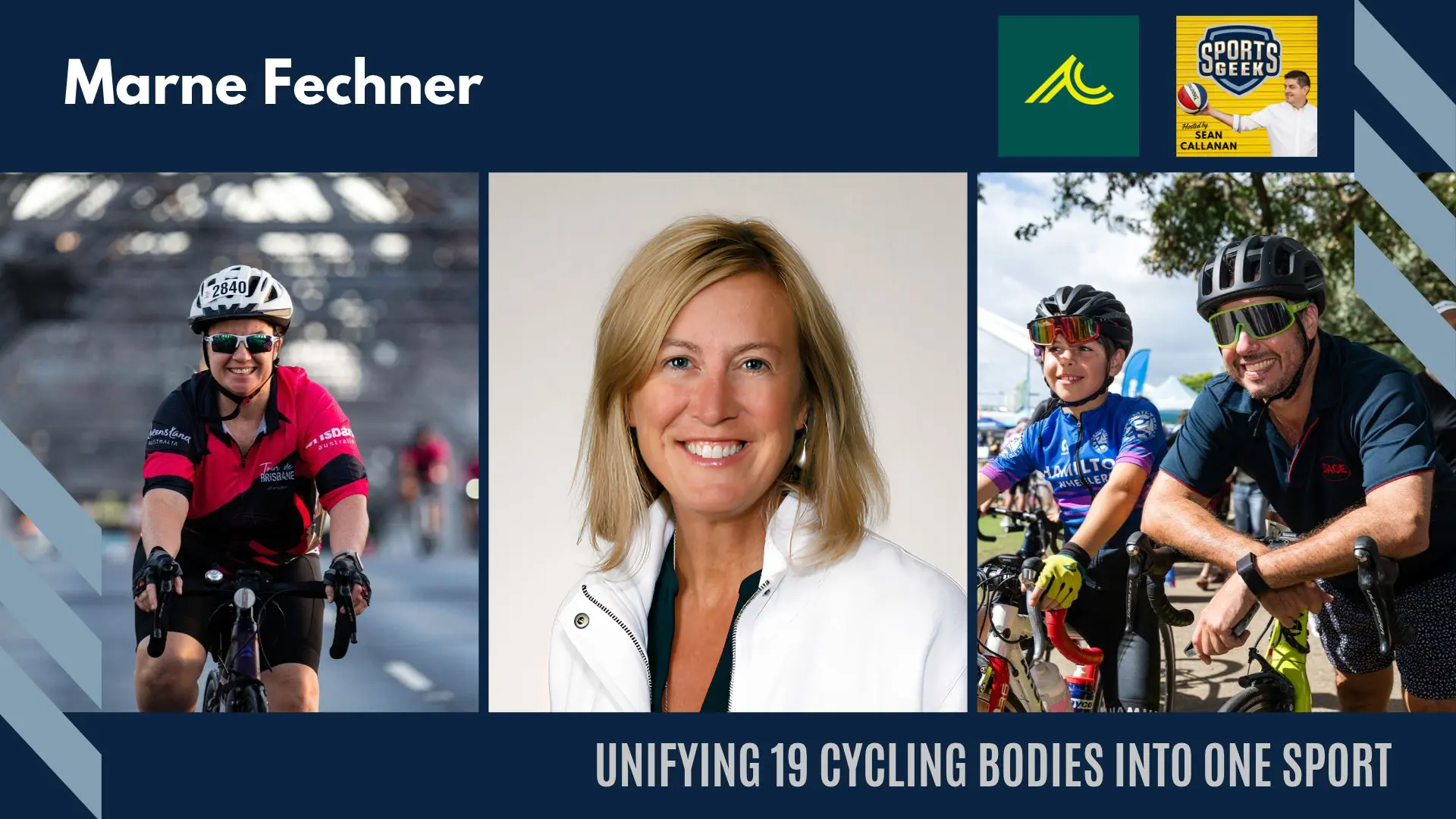
In episode 469 of Sports Geek, Marne Fechner brings the perspective of a former elite netballer who went on to run the Netball World Cup, Netball Australia and now AusCycling to share insights on sport governance, participation and leading for the long term.
In this conversation, you’ll discover:
- How AusCycling brought 19 entities across BMX, road, track and mountain bike into one unitary body, and why the merger didn't solve the sport's underlying challenges
- Why a new structure still needs a reset in how people work together, and what Marne says the merger process missed
- How to think about the infinite game: building an organisation that lasts generations, compared with a World Cup committee that stands itself up and shuts itself down
- Why netball's traditional hard sell wasn't landing sponsors, and how the team worked out its proposition and told the sport's story itself
- How to balance participation and high performance when millions ride a bike each week but most clubs are built around racing
- Why getting kids riding matters after a decade of decline in children learning to ride, and how insurance costs shape the sport's financial model
- Why safety and separated bike lanes come first, and how a sport can advocate for better infrastructure
Listen to Marne Fechner on Sports Geek
Can't see podcast player? Click here to listen
Watch on YouTube
Interview Transcript
This transcript has been transcribed by Riverside.fm, no edits (please excuse any errors)
Sean Callanan (00:01.561)
Very happy to welcome Marnie Fechner. She's the Chief Executive Officer Officer at Oz Cycling. Marnie, welcome to the podcast.
Marne Fechner (00:09.026)
Thanks, Sean. Really good to be here.
Sean Callanan (00:11.247)
Well, technical issues aside, getting this set up and started, I'm really good. I'm really happy to be able to catch up with you. I always start the podcast by asking people how they got their start in the world of sport. What about yourself? How did you find yourself in the world of sport?
Marne Fechner (00:28.266)
I am
I actually came into my career in sports management from being an athlete. So I spent a couple of years up at the AIS, was bouncing around sort of playing elite netball and ended up, although that largely was in Victoria, I got my first job with Queensland Netball. So I made the trip north and that was the start of things. First role was the executive officer for Queensland Netball, so working with the board up there.
and and supporting the growth of that organisation and that just led to other roles within the sport and eventually into that CEO role but that's where it all began, athlete into admin.
Sean Callanan (01:11.633)
So you've got you've fast forwarded a long through a long way through that a long career in in netball because you have you did work at multiple states, obviously Queensland then back to been back to Victoria in multiple roles. Jumping, you know, I I like talking to athletes that go into their, you know, second career. Was it was there a particular thing you wanted to do or in in netball, or was it obviously drawn to the sport 'cause you'd you'd played it, but sort of to find your role and find your space and find the things you'd like to do?
Marne Fechner (01:41.822)
I I think that
I think I go back to high school and I probably was never one of those kids that inherently knew what they wanted to be when they grow up and I probably still don't know what I want to be when I grow up and and so I I did have a really strong ambition to go to the AIS, the Australian Institute of Sport. It was that was probably the one thing I was really ambitious about and at the time I think I was doing athletics and high school led me to netball. so that was really
the journey and and so I think in terms of taking that first role in sports administration was really I wanted to continue playing the game at an elite level. It provided me with an opportunity to move out of home, I think for the second time and and experien get some experience from an administrative side. And obviously working in the sport that you're passionate about is a an easy first step, but it taught me lots. You know it was the it was my first role
working directly with a board and very different to the roles I hold now as chief executives in working with the board but it was a really great experience and understanding and getting a bird's eye view of governance and sport governance and and I look it's always fun. I mean I think we we treat sport really seriously but at the end of the day it's a real privilege and a pleasure to work in something that so many people are passionate about from grassroots through to the elite.
and you're right, I I did step through a whole range of different roles when I was at netball, both in Queensland, came back to Victoria at state body level and national level. I was probably the best job in the world was running the World Cup in 2015 in Sydney in New South Wales. And so there's always been some opportunities that were presenting themselves and probably that's the one thing throughout my career that has just been just say yes and
Marne Fechner (03:43.606)
have the experience and learn and grow from it.
Sean Callanan (03:46.777)
And was it a case of, you know, you sort of had state manager and then marketing manager, then commercial? Was it also a case of learning for you to go, you know, I've done I've done some of this role. I understand, you know, what marketing is is, I know from the athletes' point of view, but then, you know, money makes sport move. So moving to commercial was a natural progression, sort of to try to understand the whole business.
Marne Fechner (03:52.578)
Yeah.
Marne Fechner (04:09.314)
Yeah, it was it was an interesting because I because I was an athlete and full time athlete and at the time in a lot of the national underage teams we traveled around a lot. So I put university degrees on hold to pursue being an athlete and allowing myself to travel. So I came to my formal education later in life, and whilst when I came back to Victoria so I was
I you know I'd been employed for probably not maybe not a decade, but before I came back and I did a the Deakin University graduate diploma in sport management and because I was working in the marketing and brand space I went into RMIT and did a grad dip in in marketing and business management. So it was I I kind of felt I was learning both the theoretical, getting the degree side of things, but also the real practical elements of
The sport. I fell into because that was where the roles initially took me into event management. So you you know, lead leaning into that space, your brand and marketing and commercial becomes a hand-in-glove partner to running successful events. And Netball was really on an evolution. It was launching, there were subsequent launches of national leagues that led then to the partnership with Netborn New Zealand. So there a lot.
Sean Callanan (05:32.774)
Mm-hmm.
Marne Fechner (05:36.86)
happening in that space. So I think that opportunity to learn from others within the industry, but also very much just you know hands on the tools and and understanding what worked for our sport and and what didn't. And the commercial one was really interesting because I think that at the time
the emergence of professional leagues and the growth in sponsorship in sport was was prevalent and a lot of the male dominated codes, but netball was still emerging. And I think what we found was the very traditional hard sell sales component wasn't necessarily getting the outcomes that we wanted. So it was very much about understanding what was the proposition that Netball was going to bring. We're
and still is the sports predominantly female. So it it offered something different to partners and had that very strong grassroots connection right through to the elite. So it was the commercial was an interesting one because it was almost like we couldn't find someone that could that could actually tell the story of the sport in a way that we wanted it told. and so we kind of had to invent what was the best way for for our sport to sell sponsorship and think commercially about it.
Sean Callanan (06:53.49)
And that was, I mean, it's a little bit rewriting sports history, but that was pre the explosion of women's sports, right? Like, you know, Netball was always the was always there, was had a professional league, but that was you're in that commercial space before things like the WBBL win the cricket coming along, the AFLW, the women's rugby league were all coming along in this explosion of women's sports, but netpool was always there. How was that? I guess that period to one.
Marne Fechner (07:01.911)
Yeah.
Sean Callanan (07:22.533)
be or already be in market, be well established as as a as a brand and a sport, but then, you know, have this flood of competition, but then also this momentum of around women's sport as well.
Marne Fechner (07:33.494)
Yeah, it w it was an interesting time I think for sports like netball because, you know, the explosion of the the W game, you know, and and what that meant for women's sport was on one hand you celebrated everything that it bought and we and I think the sport still definitely does that. on another hand it was very curious because here you had a sport that had had really grown its roots had grown out of providing great opportunities, you know, designed by
Women, for women, and you know, still plays a really significant place. So it was interesting, but I think that the the great thing about what we're seeing with the emergence of W codes is that young girls have opportunities for professional careers in sport, whether that's netball, whether that's AFL, whether it's cricket, we're seeing more opportunities for young women that want to pursue an athletic career, which is really what you want, whether that's in the professional codes or
Sean Callanan (08:35.984)
And you touched on there moving into the chief executive role for the first time in that event format, the you know, the the Netball World Championship in tw in twenty fifteen. What were some of the changes you had to make like moving into chief executive in a chief executive role? Because previously you would have been on the tools, you would have been the one out there selling, putting things out to to sort of step back and have that have that role.
Marne Fechner (09:02.026)
Yeah, it was look, I was very fortunate at the time. Kate Palmer, a huge mentor of mine, was CEO of NIPAL Australia and we had gone through the process of bidding for the event. So, you f I felt very connected and it was it was not and I think although it was a yes it was my first CEO role, it was such a privilege and I think unlike some of the roles we've had subsequently
We hadn't had the event, I think it had been twenty four years since we'd had the we'd last hosted the event, so this was really important for us and and everyone wanted to make it successful. So to an extent it was a really a nice, easy not easy, but you know, you know what I'm going from. It was a it was easier role to step into. People we wanted it to be successful. We had great support from the New South Wales government and the federal government. we had a
Sean Callanan (09:50.982)
Yeah.
Marne Fechner (10:01.203)
board and an international body that was allowing us to do some things for the very first time and and that was a real if I look back at it one of the reasons that it was such a fantastic organizing committee to lead was that we were take we were taking the event into really different directions. It had been an event that had been very much about the competition and the athletes and we were seeing a real emergence of fandom in the Australian and New Zealand market for netball.
Digital was emerging
sport entertainment and sport ex presentation experiences was emerging. So we said we could play with this in ways that the event has never really done that before and capitalise on that from a commercial perspective, fan perspective, and br build the brand and build the profile of our athletes. So it was a real pleasure and and when I moved into the CEO role at Netball Australia, it was really important for us to think about when we wanted to bring that event
back and so being part of securing the 2027 events and thinking about what that could do for the sport, you know, I'm excited to see what what will happen next year for it. But memories of what we did for that event, you know, it was a lot of hard work, but I think it left a real legacy for the sport and was just such a joy to be part of something that was such a celebration and changed the game.
Sean Callanan (11:30.423)
absolutely. I wasn't expecting easy, but I understand what you were saying about the familiarity of being in the sport and and the one direction. But being a CEO for an event is very different from, you know, your current current role and previous roles of being of the organizing body because it gives you that that that focus of this is the date, this is the two weeks or the four weeks of of it, and everything culminates. And it is a bit of a beast because you've got this, you know, three, four year runway for this two week period.
What are what are some of the differences of being a an event CEO to a a national sporting or body CEO?
Marne Fechner (12:07.98)
Yeah, it's a really and I think you you hit the nail on the head. I mean, we knew we're an organizing committee that was going to stand itself up and it was gonna shut itself down. And so the responsibility of leaving a legacy for the game of netball in a range of different ways was really important for that. in the Netball Australia CEO role and the and the role that I'm near in now as CEO of Ozcycling, we're paying the infinite game. You know, we want this we want this sport to be sustainable.
The organization to be sustainable and robust enough that it can adapt and change over generations as the sport and as our community changes. So I think that's the from a leadership perspective and from a the way of thinking about the job that we're doing, it's about actually how do we make sure that we're creating really a really robust, joyful organisation that does the best that it can possibly do, whether that's growing participation or performing on the biggest.
you know, the most elite stages, whether that's Olympic or Paralympic or World Championships every year, and how do you create that in a way that advances the sport and and ensures that it's here for the long term?
Sean Callanan (13:22.756)
absolutely. And you mentioned that and we want to get into your current role as chief executive of Oz Oz Cycling. What you after a long career in in Netball, you know, from athlete to to to CEO, what why the change? Why why the move? And and tell us a little bit about Oz Cycling.
Marne Fechner (13:43.574)
Yeah, look, Oscycling is it's such a unique structure and and organization. It was formed six years ago on the back of a major governance, the biggest governance reform in sport, in taking nineteen entities across BMX, road track, mountain bike, and bringing them into one unitary body for sport. So I had I suppose I've most CEOs of national sporting organizations work in a federated
structure and that's the way that Australia works. and and I suppose I was looking at what cycling was doing and thinking there are some real advantages in terms of that ability to
not have to n negotiate your way through the layers of federations and eight organisations that sit between you as the national sporting organisation and the customer base and you're really relying on strongly on relationship capital when you're wanting that structure to work and it can be challenging at times, you know, but that's not to say that the unitary model's not challenging for different different ways. So I was looking at what they were doing. It took a you know it took a good five years
For Australian cycling and all of the bodies to actually form Ozcycling. And when the opportunity came up, and it was in the middle of COVID, it was the most extraordinary time after the first year of COVID, the opportunity came up, and I think as you know, when is there ever a good time to sort of move on from a sport that you've loved passionately, a role that you love passionately, and how do you make that decision?
So it was a massive time, probably COVID and the chaos that was sitting around that, you know, maybe gave me a little bit of energy.
Sean Callanan (15:38.384)
Idea for change.
Marne Fechner (15:39.822)
to do that and get out of the not that there was a comfort zone but just to to try something different. and you know, I made the decision to you you'll never know unless you actually throw your hat in the ring and explore what the opportunity might mean and and so I did that and was fortunate to to step into the role and and that's been, you know, a a really different leadership journey because I technically am not I love riding my bike but I'm not an elite athlete and
Sean Callanan (15:41.479)
Yeah.
Marne Fechner (16:09.775)
I'm not a racer per se. So that was really interesting stepping into a role and thinking about what the organisation needed of me and and leadership and how that's evolved in the last six years.
Sean Callanan (16:22.664)
And so as part of it, I mean, you don't have to learn the sport because everyone, you know, everyone knows how to ride a bike. But was it I mean, there would have been obviously the nuances of all the different groups that have come together. Like again, when people think of cycling, they might think of velodromes, they might be thinking of you know of BMX, they might be thinking of, you know, Tour to Tour de France, that kind of thing, like, but it's all cycling. So what were some the things you had to learn about about cycling and about the industry to sort of
Marne Fechner (16:28.642)
Yeah.
Sean Callanan (16:50.023)
I guess give you that background and foundation to understand the sport.
Marne Fechner (16:54.838)
I I you're so right. It is such a diverse it is such a diverse sport. There's this kind of I o often say that you know, there is a bike for everyone, whether you're a eighteen month old and you're on a balanced bike and that's your first sort of experience with a bike, or whether you n you're an eighty year old and you're on an e-bike or a trike, there is this there's this joy of being able to connect through a bike and find whatever way you want to ride, whether it's tourism, whether it's racing, whether it's
exploring and staying fit and healthy and connecting with your community. So I think that for me, if I think about organizations that I want to work for, it's very much about purpose. You know, why why do I why am I so connected to sport and and what impact it can have on community and opportunities that it can provide if you go through the pathway. And when I look at when I looked at cycling when I came into it, it was really important that I
I suppose sat in the spaces. You know, I'd done a lot of I'd done gravel riding, I'd done road riding, I'd been a triathlete after being a netballer. and but I I think actually immersing myself and understanding from a community perspective and an elite athlete perspective what the experiences and the environments were like. and then I think for me it was really important to try and understand what was going on in in the ecosystem, even though cycling had brought together nine.
Entities, there's whole range of other players within the industry. There's advocacy bodies, you know, industry bodies, and so what role do we all play and how do we connect and not bump into each other? So I think that was a real learning process for me because you know there's always so many things you can look at doing and and having a crack at, but what were the most important things that I could do in bringing the 19 entities together and making sure?
sure that we were I suppose focused on the things that were going to have the most impact for us and play in that space and and really looking at what were the facts, what were the what are the insights and you know sadly and your comment before around you know everyone knows how to ride a bike and but what we when we first started developing the strategy and trying to pull out what were the critical things that we needed to be aware of here was that we'd seen, you know, we have seen a decade of decline in
Marne Fechner (19:24.159)
Number of children learning how to ride bikes. That's a really huge issue for the industry, for health and mobility, for the sport aspect of it. So really diving into those, we know that urbanization is having a really big impact on our road racing because the road is our, you know, it's our MCG or field or netball court, you know, that's they're all of those types of things. So trying to get my head around a very broad and diverse.
Sean Callanan (19:44.616)
Mm-hmm.
Marne Fechner (19:53.952)
sport and understand what were the critical issues that was impacting each of the disciplines uniquely in order to move forward.
Sean Callanan (20:05.847)
absolutely. I mean, when you're in that process of unifying and it's never it's never a hey, we've done it on paper. It's like you can do it on paper, but then it's the actual doing. There would have been a lot of different things that the different bodies or the different types of cycling either do well or don't do well. How do you like we use the phrase steal with pride? Like if someone's doing it well over here, how can we adopt it? Is that one of the key things that you're trying trying to do to sort of take best practice from everybody and
and try to lift like I'm trying to come up with the right analogy. I I can't do the rising tides, but whatever the rising tides lift all boats, but in a cycling form is, how how do you go about sort of taking that best and get those learnings happening across those bodies?
Marne Fechner (20:38.315)
Yeah.
Marne Fechner (20:48.608)
Yeah, it it's it's definitely what we wanted to do and and even culturally that people have to get their head around that in terms of
what is best practice, you know, change in a community sense is always really challenging because it's largely our sport is based like every other sport in this country, largely on volunteers. their time commitments and the compliance and what's required of being a volunteer these days is really tough. So I I think definitely that bringing the nineteen entities together and streamlining and the the duplication that was happening across those is definitely something that
you know, it has happened, but there's what you can't miss when you do that is, you know, people like the way that they worked and suddenly we've got to pick one way of working it which will disrupt others. So I think that that's the, you know, looking back and reflecting and and we're about to we're about to embark on another review, particularly in relation to how do we work how how does this unitary body work most effectively from a community perspective. I think we've done
great job in high performance because we probably have more hands-on control, it's you know structured and focused, but we have a really diverse community. When the merger happened, there were a wide range of expectations. You know, we came in, we unified, we pulled we spent 18 months on developing and consulting around a strategy, but we probably missed the fact that how do we reset the way of working and bring people on that journey.
So that they understand what the new and the next is going to look like and feel comfortable with that. So it's been, you know, a bumpy ride. I think there's been some great things that are happening. And the other reflection, and I did say this a lot early because when I came in, I had I bought a whole lot of new energy, and you needed to actually respect the fact that it had been five years and it had been hard. Like it hadn't always been the
Marne Fechner (22:58.784)
The merger hadn't always been pleasant. And you know, I I remember one director saying, you know, there's a there's a lot of angry tide and almost blood on the floor. We need to bring the sport back together and reset the way of working together. so that's been it that's been a journey in itself. The unification didn't solve the challenges that the sport actually faced. It didn't it didn't deal with the fact that urbanization,
that you know number of cars on the road was making it harder and harder for road to have their road clubs to have their space. That mountain bike trails, even though they're absolutely booming, that there's there's really no maintenance money for mountain bike trails. So volunteers are maintaining these trails, but there's risk associated with that. So a whole range of different things that we needed to needed to think about and and try and slowly solve.
because there's no you know there was no gold at the end of the rainbow and suddenly we were going to be a richer or more robust sport. Those challenges all still exist.
Sean Callanan (24:10.3)
And so part and and part of being a national sporting body is the balancing act between participation, getting more people active, cycling, and then high performance, seeing success, you know, at the Olympics, maybe in LA in twenty eight, and then hopefully in in Brisbane in in thirty two. How do you balance that piece as part of, you know, that looking, you know, talked about before that infinite when you're in the, you know, you're looking forward ahead all the time. How do you balance that piece of I need to get these kids cycling?
and learn how to ride because they might be future Olympic champions, but also they will be healthier when they're seventy if they've been riding all their lives.
Marne Fechner (24:47.083)
Yeah, exactly. And I I think that's one of the
One of the key challenges that we're leaning into, we know that Australians love to ride their bike, and we know that, you know, there's I think there's a r over five million people that ride their bike at least once a week in Australia, which is quite a number. but in terms of what our clubs primarily do, it it is about racing and sport. so an evolution of we know that communities want to come together for connection, we know that they're increasingly loving to do that.
But they may not want to race. So how do we actually evolve as as an organization, as our our network of clubs, which are really the shopfront of the experience day-to-day, and how do we strengthen them and help them take make those changes so that we do have
Those five million people that are cycling see value in being part of a club and the sport infrastructure. So that's really important. And and you're right, we have to have, you know, if we're thinking about 2035 games, because the athletes that are going to compete in 2032 are already in the system. But if we're thinking about successful games in 2035 and beyond.
Sean Callanan (25:59.646)
Mm-hmm.
Marne Fechner (26:04.295)
they're somewhere in our club ecosystem or maybe not even riding yet. So how do we make sure that we're thinking about what is the experience and what's required for those kids to come into it, that they've got great coaching, they've got great support that's appropriate for where they are, that they're they're developing a joy and a love of riding a bike and competing on a bike, but they're not, you know, they're they're on the journey to potentially being an Olympian or paralympian or world champion.
Sean Callanan (26:32.885)
And then from a strategy point of view, like what are some of the things you're you're trying to tackle to, I guess, set the set the North Star for the sport, but then also have that implementation. This is what we want to do, you know, in the next eighteen months and this is what the next five years look like. How do you how do you set that strategy?
Marne Fechner (26:52.238)
it's been I I think a lot of of really when I came in it was well how do we understand how do we understand the system and all of the different parts of it and I I think that was we spent a lot of time talking to clubs and talking to members and understanding what the key challenges were. You know we're very the cost of delivering insurance for our cycling is really, really high. I think sixty five cents of every dollar of membership money comes in
Sean Callanan (27:00.341)
Mm-hmm.
Marne Fechner (27:22.251)
Almost goes straight out the door to ensure the sport. So it's very different in terms of the challenges and the financial model that sits sits around the sport. there was no, you know, there was no OzKIC or NetSet Go or Cricket Blast. There was none of that type of entry-level. If we had 10 years of decline of kids learning how to ride a bike, who was teaching kids how to ride a bike and was that part of our role? so there are a whole range of different
ways but I think that the core things that we're we're really focused on is getting kids riding bikes through our Oz bike program and primarily doing that through that's really focused in schools but trying to create those connections with clubs, helping our clubs become stickier and more attractive to people belonging with them in community and and showing them and working in partnership with them for for that that change. And then thinking about our pathway
One of the things we've done in the last 18 months is review and had a look at the pathway. So if a kid comes into a club and they're starting to learn how to ride or ride with a club and race with a club
What do they need around them and what skills do they need to develop to actually take that next step? And then when they get handed off to that next step, it might be a development academy or become part of an institute program. What are the skills that they need and what's the support that they need? And that's evolving and changing. so making sure that that pathway to our elite programs is really strong, making sure sure that we're developing coaches and officials, and then utilising our our our Australian athletes, the
you know, famously in the green and gold that that that compete across so many world championships but generally overseas. How do we build their profile and the brand of cycling and riding in Australia so that that come whether it's LA games or Brisbane games, that we've sort of got household names that young kids look up to and want to be like them on a bike. you know, we're very fortunate to have Anna Mears who's the chef demission for the Australian Olympic Committee and she's
Marne Fechner (29:35.407)
Such we've got so many great ambassadors for the sport, how do we connect those and have them stay connected to the organisation and the opportunity of, you know, everything that you can do on a bike across a lifetime, which is quite exciting.
Sean Callanan (29:49.565)
And do you see that data of you know Olympics and and com games and high performance and then you know bike sales spiking, interest in BMX clubs or interest in track cycling. So you I mean there's the data there when you see, you know, you see the stars, you you realize the high performances there and and it does drive some of it does drive people into bike clubs or BMX tracks.
Marne Fechner (30:17.154)
Look, I I think that we're probably early days in in measuring in measuring that, Sean. But it is actually, you know, all of these things help and are important to the system. You know, you're not going to have elite performance unless you've got a really strong pathway. So what does that look like? You're not going to have a pathway in clubs unless you've got a heap of young kids learning and having fun on a bike and wanting to do something with their mates on a bike. So there are all of these things that play into it, but I think when we look at what's been really important in other codes
And what's successful in other sports, you know, there is that really strong connection with fandom and profile and connection with participation. So tapping into that, we we do know that Australians, as I said before, Aussies love to get out there on their bike, and from a sport perspective, we want to be connected with them and help them either in enhance their what they're doing on a bike or just enjoy it a little bit more.
Sean Callanan (31:13.717)
And s it I mean it's very similar. I was speaking to Jane Fleming from an athletics point of view, and they were very much talking about embracing everyone who goes for a run, everyone who goes for a walk, who is part of athletics. Is it the same for cycling to figure out how you you know, the the the two guys that go for a ride every Sunday, they get their coffee and they ride back, or you know, the kids that go for a ride around the around the park is it
Is it because it's not is it's not exactly because it's a solo pursuit, it's not exactly the same as being in as a club. How does Oz cycling and the different types of cycling in embrace those people when they're not, you know, part of a netball club or part of a football club or part of a basketball club? Because it's a it's a challenge but also an opportunity because there's so many people out.
Marne Fechner (31:57.107)
it's a huge opportunity and I I think it comes down to
Why do we put understanding why we participate? You know, that in if we look at them, you know, as a well, they are consuming cycling and they are out there riding a bike and they're investing in kit and all of those types of things. But I think a bit like swimming and a bit like athletics, definitely we're in that realm of how do we actually understand what motivates people to jump on their bike and is there something that we can do as the sport to broaden our thinking beyond just sport, because we've got so
Much IP sitting in our organization that can help enhance people's experience on a bike, and we can create community through our 450 club network that are all doing amazing and different things. And you know, there I think there's certainly a bike for everyone out there in terms of depending on how they want to ride and why they want to ride, and and our clubs our clubs are sitting there, so it's how do we unearth them and make them more visible? How do we support them to
Have more volunteers and share the load and think differently about volunteerism in this country. And I think the whole governance model and gives us an opportunity to do that without layers of complication. so very much our focus is on our partnership with the club network as the the boots on the ground that are doing things, amazing things for community, and how do we work more effectively with them to attract more of those.
riders that are the Sunday warriors that get out there and and ride their bike whether it's on beach road or whether it's in the mountains and how do we connect meaningfully with them? And it may not be to race, we're not going to convince everyone to become racers, but how do we actually convince them that we can give them a good community and a great experiences and access to things that matter to them?
Sean Callanan (33:54.225)
Yeah, and I guess the other thing, and this is more of a question from me on understanding it, but you're talking about urbanization and the fact that cities are changing, you know, bike lanes or dedicated bike lanes are are are super important because again, if they don't go anywhere or if they, you know, if they get removed, then as there is nowhere to ride your bike. I'm lucky enough I'm you know, I'm right near the Yarrow and there's a a track and I see people every day riding in riding in to and from work.
because there's that track and they're off off the road, how much is it important for you to have that data to lobby governments, to lobby town planners, you know, as as new stadiums or venues you know, get built that there's there's places to park your bikes and those kind of things. How much is that part of, I guess, your role as, you know, advocating for the industry?
Marne Fechner (34:45.461)
Yeah, it's a really good question and earlier I mentioned still the number of advocacy groups and that's exist within states and territories. when exactly I mean a good example is some recent work that we did in the last probably eighteen months with Bicycle Queensland. Obviously there's a whole range of new infrastructure that's being built that's not cycling related in Brisbane to support the Brisbane twenty thirty two games. n cycling's very lucky. most
Of our infrastructure is actually built. We've got the Anna Mills Valer Drone, we've got a great BMX facility. Our road races are, I think they're going to be up on the Sunshine Coast, and our mountain bike trails are already built. So one of the things that we did in working with Bicycle Network is actually advocating for Brisbane being you know a UCI bike city, a bike city, it's recognized as that. But how could they enhance their infrastructure to make sure that all of the
Bike lanes and accessibility for anything that's not road transport is the best in the world in terms of that games experience, and that's a real legacy for Queenslanders in terms of that type of infrastructure. I think one of the challenges that we face, and we we can all get better at how we work together with the advocacy groups is how do we actually reach down into councils and influence the way that infrastructure is built so that it's connected from council to council.
And that we see bike riding as a form of transport. And think about it when we're building our transport networks and our road networks. We we it'd be great if we could see cycling and riding a bike in the same way. Unfortunately, that's not the case now, but we know that there's there's ways that we can, there's so much information out there now and cities around the world that are leading in this space and changing the culture of the way that people enjoy their riding and and
cycling and commuting because that's what people are using it for.
Sean Callanan (36:49.253)
And are you you know, do you get inspired by other cities? You know, I I know when I went to Amsterdam, that was the way you got around. Like everyone was on a everyone was on a bike and it was just the it was just the way. D you know, do you look at other cities and go, all these pieces of that I wanna see in in Brisbane or in Melbourne or in Sydney and you know, as they build out.
Marne Fechner (37:12.3)
Yeah, there there certainly is an and I we I mean I I always one of the things I do whether I'm travelling for work or whether we're travelling as a family for holidays is, you know, within the first forty eight hours is get out on the bike and whether it's an organized tour or or just, you know, checking things out, always get out there 'cause it's a great way to actually explore and get a lay of the land. And I I think the biggest challenge that we face when we look at other cities and we can certainly learn from them is how do you bring that back in
This really big sprawling nation and think about it in the context of you know cities that are you know really widely distributed, and can how do we connect those? So it's understanding what Melbourne looks like, or what Sydney looks like, or what country towns look like, and understand what might be best practice, and actually getting into the heads of the people that ride bikes. We know that safety is the number one issue for people when they get on.
On a bike, they want to feel safe, whether that's a member of Ozcycling or whether it's a person that rides, there's the it's a the universal it's a universal fact. So when we're thinking about how do we create safe environments, the number one is separated bike lanes or having bike paths that people can ride on. So I I think it's really understanding what is going to what do we need, what infrastructure do we need to put in place and how can we do that consistently across
Local government authorities or you know bigger infrastructure projects, and how do we do that in the way that we know that we'll actually see increased usage of cycling? But also, how do we connect public transport? We probably know if you're in a hilly area, you're less likely to ride more than 10K. So there's all of these sort of statistics that are all out there that can inform planning and the way we think about it that will actually make it easier for people to.
make that choice to get on their bike, which would fantastic.
Sean Callanan (39:15.934)
Well, Marty, I really appreciate you coming on the podcast, learning a little bit bit more about odd cycling. I'm trying to ride my bike a little bit more, but it still still gathers a little bit of dust, but I do get it on every now and again. I want to get to the SportsGeek closing five. do you remember the first sports event you ever attended?
Marne Fechner (39:38.666)
I I'm gonna say the probably the one that sticks out in my mind because I became a a netballer was I went to see Australia versus New Zealand in Festival Hall in Melbourne, which I think now is a con you know, concert venue. and Annie Sargent was playing some legends of the game that definitely inspired me. So that's probably the one that stands out the most in terms of how I felt and just being part of a big crowd.
Sean Callanan (39:51.508)
Yeah.
Sean Callanan (40:05.832)
absolutely. I think I think that's where the Beatles played as well from a from a historic v venue point of view. you would have been a lot of sports events over your time. Do have a favorite food or a favorite food memory at a sports event?
Marne Fechner (40:10.539)
Yeah. It was
Marne Fechner (40:19.762)
Or I
I'm gonna go with nostalgia here and the experience, but I can remember Geelong Katz fan and going to the footy with mum and dad and and we used to actually take our own sort of bring your own hot dog. So there was the thermos and the bread and the sauce, yeah, and and or some sandwiches and and so it was it was probably more around not necessarily what you buy at the venue, but that process of going
Sean Callanan (40:40.467)
Mm-hmm. Famous.
Marne Fechner (40:52.088)
and being part of an amazing game but being with family and doing those fun things. And we we would never eat hot dogs but that was sort of the the one place that we would take them.
Sean Callanan (41:03.399)
No, I used to do the hot dogs in the thermos when I used to take my k little kid when that my kids were little. one for the experience of it, but then also, you know, s saves money when you're when you're deling out for four hot dogs. But it was probably more the experience and packing the sauce and the buns and all of those kind of things. what's the what's the first app you open in the morning?
Marne Fechner (41:19.991)
Yeah.
Marne Fechner (41:24.813)
first app I open in the morning is generally it's for I've there's a local it's called Wild Soul Fitness and if I don't open it every the first thing I do and book in for the week out for my Reforma Pilates cast, I don't get in. So it's become my ritual of get up, book in for the following week every morning. And so that's probably the first app I open.
Sean Callanan (41:50.707)
Well that's that's a good habit to have and the fact that they've trained you to do that i is good on them from a from a marketing and behavior changing point of view. is this is there someone that you follow? It might be a colleague, it might be a former colleague, it might be an author, that the podcast listeners should follow and why?
Marne Fechner (42:00.715)
Sticking me seeing it out.
Marne Fechner (42:10.764)
Yeah, I I follow probably two that popped to mind and you know, talked about the infinite game, but Simon Sinek, I love his books and his thinking and e and leadership and then Brene Brown, I I think that, you know, one of lead stepping into CEO roles is a lot of, you know, authentic leadership and what that means and how you deal with being in quite isolated roles. So they're probably two, Brene Brown and and Simon Sinek are two that I I do listen to regularly.
Sean Callanan (42:40.156)
Absolutely terrific recommendations and have been recommended previously. And lastly, you can answer this both yourself personally and then you can put your cycling hat on. What social media platform is your MVP?
Marne Fechner (42:54.433)
MVP. I I think from keeping up with
what's happening and whether that's my kids or sport or I do tend to use Instagram. I tend to s spend a lot of time on that and I I know I can jump on the Oscycling Instagram because there's never like there's never a dull moment. There's always something happening somewhere. So and athletes competing around the world. So that's always a a good to keep an eye on for for me keeping up with the news.
yeah, they're probably the two that I use most regularly and then just from a professional perspective probably I'll be boring and just say LinkedIn because that's always a good source of truth and it's sort of like the Facebook and Instagram of work these days.
Sean Callanan (43:41.076)
It it it is a bit, it's not boring, it has been voted for before. I'm a big advocate for it, so I'd I I I'll t I accept accept LinkedIn. I think I think the other thing with Instagram is the amount of I'm not gonna call them non-cyclists because they're on a bike, but athletes from other sports that use cycling. You know, and you know, I was just in I was in Malaysia for the Malaysian Grand Prix and Valtore Bottas avoided all the traffic by by by riding his bike.
Marne Fechner (43:59.49)
Yeah.
Sean Callanan (44:08.404)
but all the way from Malaysia to Singapore. So again, that's a spot where, you know, there's a lot of elite athletes that have cycling as part of their fitness routine, their off season, off season piece. So it's another thing. Marty, thank you very much for coming on the podcast and and jumping over the technical issues we had getting getting started. I always ask people to reach out and say thank you. what's the best way for someone to reach out and say thank you to you?
Marne Fechner (44:08.514)
Yep.
Marne Fechner (44:35.973)
like they can find me on LinkedIn or CEO at Ozcycling. you're always welcome for that. And but thanks Sean for having me on, it's been a real pleasure.
Sean Callanan (44:45.531)
Not a problem at all. We'll put a link to your LinkedIn in the show notes so people can reach out. Thank you very much for coming on the show.
Marne Fechner (44:52.225)
Thanks, Sean.

Turn 15 minutes a day into sponsorable content your partners will pay for
Sports Geek AI is a done-with-you content system that creates daily newsletters, podcasts, and social posts—giving your commercial team new inventory to sell.
Resources from the podcast
- Please connect with Marne Fechner on LinkedIn. Let her know you listened to the episode. Please say thank you if you do connect.
- Learn more about AusCycling on its website, their events hub, and follow along on their social media accounts.
- Watch Sean’s episode of SEAT Solves, featuring Ryan McKenzie of Fortinet about Connectivity and Security Are One Problem. Become a SEAT member today.
- Check out the November edition of The SEAT Report – Should Ticketing let AI agents in?
- Listen to our new Daily podcast – Sports Geek Rapid Rundown.
- Check out Digital To Dollars – our self-serve program to help you drive more revenue from your digital fan base.
- Podcast episodes you should listen to:
- Throwback episodes you may have missed:
Podcast highlights
Highlights from episode 469 with Marne Fechner:
-
- 01:58 From elite netballer to sport administration
- 03:11 Saying yes and learning on the job
- 05:39 Studying later in life and moving into brand, marketing and events
- 07:06 Why the hard sell wasn't working for netball sponsorship
- 08:23 Netball and the rise of women's sport
- 10:05 Stepping up to CEO of the 2015 Netball World Cup
- 13:37 Event CEO versus playing the infinite game
- 15:13 Why AusCycling: a unitary model versus a federated one
- 18:24 A bike for everyone and the decline in kids learning to ride
- 21:35 Merging 19 bodies and sharing best practice
- 24:28 What the unification didn't solve
- 25:40 Balancing participation and high performance
- 26:17 Five million riders and the role of clubs
- 28:22 Strategy: schools, clubs, pathway and the cost of insurance
- 31:19 The Olympic effect, fandom and profile
- 32:43 Reaching the Sunday riders who may never race
- 35:24 Advocating for bike infrastructure
- 38:19 Learning from other cities and why safety comes first
- 40:45 Sports Geek Closing Five
Drive revenue from your digital audience
Check out our podcasts with SEAT
We’ve launched two monthly podcasts in collaboration with SEAT.
Sean hosts The SEAT Report with Josh Barney. Check it out
Each month, Sean will profile a SEAT partner on SEAT Solves.

Listen To Sports Geek
Recent Sports Geek Reads
- LIV Golf’s $5 Billion Illusion, Heat’s GTA Merch Bonanza and Jake Paul’s UFC Challenge
- From Netflix’s Women’s World Cup Gamble to Nike’s Formula 1 Deal: The Business of Sport Is Being Rewired
- Women’s Sports Outgrowing Small Stadiums, WSL Rejecting Gambling Sponsors & AI Agents Going Shopping
- Sandpapergate’s Fallout, Disney’s $18.6B Sports Bet and the NFL Rights Freeze
- Miami Heat’s GTA VI Windfall, LeBron’s AI Lawsuit and the Race to Own the Sports Fan
- Australian Open’s Startup Pipeline, LeBron’s AI Betting Lawsuit & ESPN’s Revenue Squeeze
Listen to Sports Geek Rapid Rundown daily