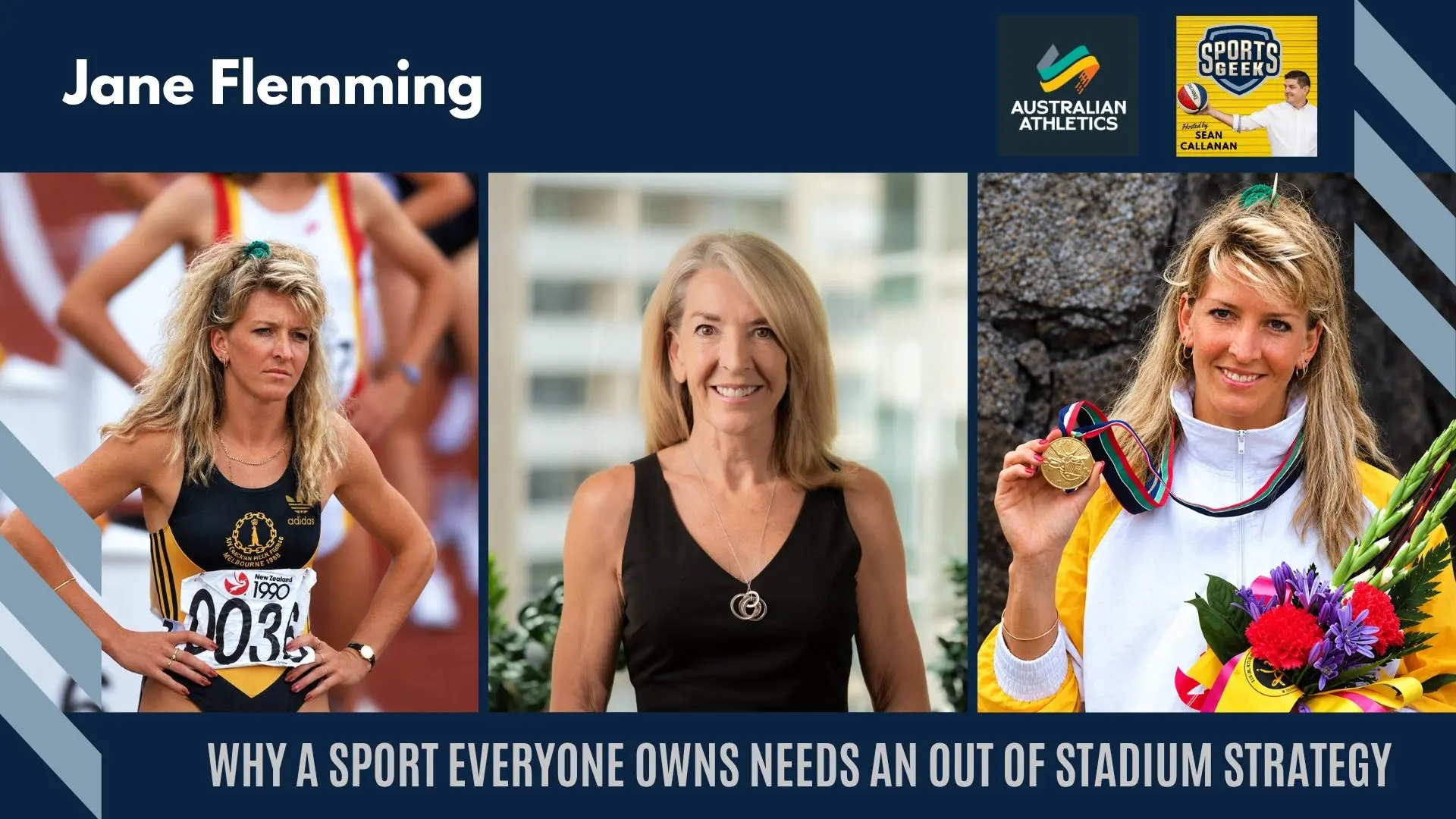
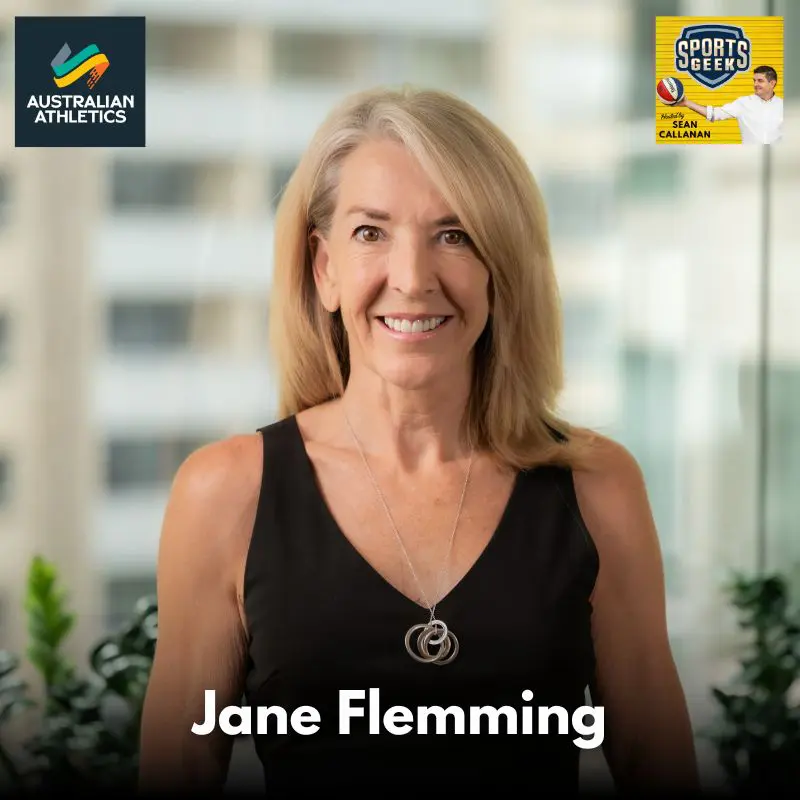
In episode 467 of Sports Geek, Jane Flemming brings the perspective of an Olympic heptathlete, sponsorship consultant, broadcaster and national federation president to share insights on governance, partnerships and growing a sport beyond the stadium.
In this conversation, you’ll discover:
- Why a sponsor is buying help with their own objectives, and how Jane's years on both sides of the sponsorship equation shaped her commercial thinking
- Why Jane kept her client list to a handful of athletes, and how that freed her to make long-term strategic decisions
- How a skills-based board, covering areas like digital, people and culture, community engagement and commercial acumen, differs from a board driven by passion
- How Australian Athletics is widening the sport to include run clubs, fun runs and walkers who never register, and why the name change mattered
- How owning the Sydney Marathon, with 45,000 entries and around 400,000 people on the course, supports an out-of-stadium strategy alongside inside-stadium and community growth
- Why the Little Athletics merger, attempted for 50 years, finally got over the line and what a simple pathway could mean for the sport
- What athletics and racing share, from government relations and stakeholder management to television rights, and why governance skills transfer across codes
Listen to Jane Flemming on Sports Geek
Can't see podcast player? Click here to listen
Watch on YouTube
Interview Transcript
This transcript has been transcribed by Riverside.fm, no edits (please excuse any errors)
Sean Callanan (00:01.154)
Very happy to welcome Jane Flemming. She's the president of Athletics Australia and Olympic athletic and trackville legend. Welcome to the podcast, Jane.
Jane Flemming (00:11.672)
Thank you very much, Sean. Look forward to it. Well, I think I do. We'll wait to see what you ask me.
Sean Callanan (00:14.675)
I I I hope so too. I I I know I'm looking forward to it and I know Lisa as well as well. I always start trying to people understand people's like sports business origin story and being an athlete, I sort of want understand, you know, how you got into your sport and how you got into the world of sports business.
Jane Flemming (00:26.819)
Yes.
Jane Flemming (00:33.454)
So I had a number of things happen to me when I was quite young, in about a six month period. I had three things happen. One is that we moved from a small country town in Victoria where I went to a school of forty-two pupils. I was nearly eight and six, you know, about about yeah, yeah, about a month before that we went to the Shepperton and District Primary School Athletics Carnival.
Sean Callanan (00:50.881)
Up in regional Victoria, yeah?
Jane Flemming (00:59.816)
And I won a heap of blue ribbons at the time. They were like the sack race, the potato race, the beanbag race. but I did win the forty yard sprint, which shows how old I am. I think it was yards. and so that was the first thing. And then secondly, then when we moved to Melbourne, we went to a school of six hundred pupils and we had sports houses. I had no idea what a sports house was in a school of forty two pupils, you don't have them, and they were named after Elliot, Clark, Landy and Du Bell.
And so I started to become very aware of things, all things athletics. And then at around about the same time, the Seven Network put the television programme and it's a really iconic program and films and the filmmaker was as well within sport, by a guy named Bud Greenspan, a thing called Olympic Minutes started to be aired on a Monday evening. And so there I was an eight year old girl allowed to stay up till eleven o'clock at night.
And watch that program with my dad. I'm one of five children, so I but and I do remember sitting on his lap really clearly. It's a very clear childhood memory of mine watching that. And at the same time I came to that primary school, my first friend did Little Athletics. So I ended up joining Little Athletics, and as is the nature of little athletics, you do a little bit of everything, and that's pretty much what I ended up doing. Well, I did a lot of everything.
Sean Callanan (02:15.948)
Okay.
Jane Flemming (02:25.346)
by the time my athletic career finished because I ended I started off really I guess as a hurdling jumper and sprinter and then by the time I finished I added a couple of throws on the eight hundred metres to that to round out the heptahlon.
Sean Callanan (02:40.151)
Yeah, I mean that's as someone who was who did little ath myself, that was one of the I guess one of the first sports that had a real strong youth program. It was like I remember, you know, I think I was in grade two doing little athletes in Packenham and then I probably did it up in Edenhope a as well and won the Peters Pall Award for encouragement because it wasn't the fastest, but I but I tried like crazy. it was one of the things that was really
you know, it was before things like Oz Kick and all of that Milo cricket, all of these youth programs that came along, it was one of the first really broad based kids kids at participation program.
Jane Flemming (03:10.3)
absolutely.
Jane Flemming (03:20.13)
Yeah, and it was founded in Geelong, actually, Little Athletics. And and as I said, I started as as an eight-year-old and when I was I was at a very strong centre, I competed for Knox, so not far from Packenham, where you were. And so I competed for Knox and we had an exceptionally strong age group, particularly for the girls as well. And I think that was awesome. And I came through at that point, Little Athletics I only went to twelve years of age.
And then you went on to seniors, so I joined the Knoxbrook Knox Sherbrooke Seniors Group, but with fifteen other girls my age. And there was a number of them that were better than me at that age, but I was the one I think that really loved it. And so I went on to there and then, you know, nearly gave up, like a lot of girls at the age of sort of around about thirteen, fourteen. And then I grew five inches in one year and went from being the tiny little girl to more capable. And then I I started to get some success and I did have some in little athletics, but
But I kind of had that that no man's land where you're a just becoming a a teenager and you're either competing against fully grown women I was or you're still a little girl, which is what I was. And it's tough to get through those years and I think it's the same for boys as well, because often they're competing at that age against fully grown men and we know by the time they get to year twelve at school, the guy that was the tallest in year seven and the biggest is is he he kind of hit his peak at the age of thirteen and fourteen.
Sean Callanan (04:44.637)
So so you went on there and I as you said, as a hep hept athlete and long jumper and represented Australia at Commonwealth Games and and Olympics. Heptathlon, obviously multiple disciplines, multiple training methods. How did you how did you manage and juggle, you know, trying to strengthen your strengths, but then also work on the on on your on your legs that weren't the best ones for you?
Jane Flemming (04:49.784)
Yeah.
Jane Flemming (05:11.404)
Yeah, I think the the nature of the heptathlon is you can't really have any weak any really weak events. And so given my my size, I wasn't particularly strong in the in the shot put and then I also had to work very hard on the eight hundred and I find it very frustrating because you know I've commentated a lot over the years. I've commentated eight Olympic games now and watching a heptathlete or decathlete
do only nine events properly and they usually leave the fifteen hundred and the eight hundred meters and some of them don't train much for it and they lose the entire competition on that. And I've always had this feeling that it is a seven or a ten event competition. And the one event that really hurts to train for, for a multi-eventer, because we are very power-based athletes, was that one where they threw some endurance in. So for the women the 800 and the men the 1500. And I think we saw that play out actually in 2021.
Sean Callanan (05:41.859)
Mm-hmm.
Jane Flemming (06:04.545)
the 2020 Olympics, didn't we? With our bronze medalist and Cedric Dubler yelling as hard as he could at Ash Maloney to get around that fifteen hundred. And it was obviously by far his weakest event. And he nearly lost an Olympic medal based on that race. So I worked really hard on the 800, really hard on the shot put. They were events I did not miss, but many of them, six of the seven events are str speed and power based. So I had very, very good speed for a Hept athlete.
Sean Callanan (06:06.851)
Mm-hmm.
Jane Flemming (06:32.481)
And I had really good power to weight ratio. I was very strong for my size. So that helped. And then you have a look at the at the score tables. Some events score more points than the others, so you can't afford to be weak in those. So the high jump and the hurdles are particularly are particularly high scoring. And you can imagine the way they use do the points tables is they take the top in the world, and that was the top 10 in the world performances, and then they base the tables down from that.
So as you can imagine, a hept athlete is a lot closer built to a hurdler or a high jumper than they are a shot putter. So the shot put is the lowest scoring event, but you almost do, I guess, a cost and effort and time analysis on how many points you'll get in return for your level of improvement that you'll get for the hours of training that you put in. It sounds complicated, it's not really.
Sean Callanan (07:20.372)
It it well it is and it isn't. But one of the things I did want to discuss is we sort of look at the the business side of sport and while you were an athlete and I was lucky enough to chat to to Natalie Cook and about her journey of being an athlete and and all the work that she had to do not on her craft to be able to continue to be an athlete. find funding, figure out ways to to to have sponsors. What was that like for you to be able to find ways to
Jane Flemming (07:30.359)
Yes.
Sean Callanan (07:50.593)
Fund yourself to to be an athlete, to be able to represent Australia.
Jane Flemming (07:55.48)
Well, I was always I always worked, you know, I moved to the Institute of Sport because I was travelling in an extraordinary number of kilometres. I was at university at the time, at Putzgrade Institute, which is now University of Melbourne, I think, or deacon, one or the other. Anyway, I moved to Canberra and I had always worked part time. But in Melbourne at one point I was I had twenty six contact hours of university. I was working part time and trying to train for seven events and
that recipe just wasn't working for my athletic career, which was my priority. So and indeed one Olympic year I deferred my university degree to try and make an Olympic team. So I moved to Canberra and I worked there as well. But the interesting thing for me when I moved was that I went from an environment where I was at university and when I deferred there was sort of chatter amongst my friends, my non-sporty elite sporty friends and
Perhaps my parents and family, friends and the likes, why wasn't I studying or working full-time? Whereas when I got to Canberra, it was why are you studying and working so much? You know, you need to be concentrating on your training, which was a real lesson for me about the environment that you are in and how much impact that can have in terms of support and the likes. So the first thing I guess I did was move to the Institute of Sport. I was very lucky in that I had my first sponsor at the age of 16, or 15 or 16, and it was a sporting goods company.
And and so I was provided with all my kit and the likes. the level at which I was competing really helped. my certainly athletes nowadays have way more financial support. I do remember my parents raising money for me to go away on my first Australian junior team. And unfortunately the state of sport is still that we at Australian Athletics asked for a levy for our world junior team as well, still, you know, fifty years on. and then
I worked, I've always worked, I've liked working, and I had always worked. So that certainly helped with regards to funding my career, but but also we live quite an austere life, you know, like we train, we train, we eat, we sleep, and other than getting to and from training and if your physiotherapy is covered and your fees to train to get into a track or access facilities are covered, there really isn't.
Sean Callanan (10:02.531)
Yep.
Jane Flemming (10:17.089)
you know, a huge amount of expense if you're still living at home or if you've got your living expenses covered. And I have to say, those years were so joyous as long as we you know, we woke up every day of our lives doing something we loved with a whole series of other people that loved doing what they loved as well. Traveled the world, you know, and I I often talk around how you measure your life and it's not always the currency of money. And certainly in my twenties I was rewarded in many other things.
And then I was lucky, well, not lucky, I I manufactured a lot of it or manifested a lot of it in my kind of early to mid-20s. I won a couple of gold medals. I was always very media savvy, media friendly, and also had a natural marketing brain. And I ended up with a series of sponsors of very large Australian companies that I had relationships with throughout the entirety of my twenties and early 30s. And then I transitioned out of athletics into
full-time sort of work over the period of probably the nineteen ninety-six Olympic Games through to two thousand. I moved from Canberra to Sydney. There were a gazillion opportunities because the Olympics were coming to Sydney. I had started running a corporate sponsorship consulting company. I was managing a few people that were sort of global stars. And then I had a whole series of work myself sponsors, corporate engagements and the like. So
I kind of transitioned out of doing seven events, trained for about a twelve months for one event, and then I was always co I commentated my first commentary gig was nineteen ninety one when I was injured. I had another one when I was injured and then I commentated the Olympics in ninety six when I got an Achilles injury about a month beforehand and that was my final kind of really big hurrah.
Sean Callanan (12:01.249)
And so was that pretty I mean it was a bit of a natural progression because you were you were understanding that sponsorship athlete thing from your own personal experience, having your own sponsors, and then and then seeing that, you know, that horizon of of Sydney 2000, like you said, you know, technical term, gazillion opportunities, because cut everything's everything's coming in. It was just a natural progression for you to sort of move into that sponsorship consulting and marketing sort of space.
Jane Flemming (12:20.181)
Yes.
Jane Flemming (12:28.372)
Yes, it really was. I guess I came, you know, my four my first really big major corporate sponsor was the Australian Meat Lif Meat and Livestock Corporation and that was in the mid eighties. And I really understood that their relationship or their engagement with me was around helping them trying to achieve achieve their objectives. It wasn't really about me and whether that was around the brand alignment or the brand positioning or telling a story. And so I really understood that and then
In the in the early nineties, I also presented sports news for Win TV or Channel Nine in Canberra every night of the week. And I'd been on both sides of the camera. You know, so I'd been on both sides of the sponsorship equation. So from a corporate perspective and an and the sponsored entities perspective, and then I'd been on the s both sides of the media as well, so I understood the comms and you know, there was a whole series of different perspectives that I could bring to the table. But really the thing for me was
was completely having an understanding of what the client was trying to achieve or what the sponsor or the corporate partner was trying to achieve.
Sean Callanan (13:36.131)
I mean, is that and was that also the case when you were working with big athletes? Because some athletes are, you know, I'm on the track, I I you know, I'm trying to run my two hundred meters as fast as I can or my or my fifteen hundred and that's their focus and they don't have, like you said, a marketing brain to go, I've just signed the deal. What do what am I meant to do? Do you think your your perspective sort of helped in in helping them have success in that area?
Jane Flemming (13:53.387)
Yeah.
Yes.
Jane Flemming (14:02.507)
Yeah, although the the people that I was managing had retired. They were like kind of global superstars of sport. And it was really it started with I'm sure that you'll remember the British decathlete Daly Thompson. And Daly's career, his at the end of his career overlapped the start of my career. And he said to me at one point, late, you know, in the sort of just when Sydney won the Olympics, really, in the sort of the mid nineties, we we got awarded them in ninety three.
And I think it was sort of around about ninety seven, I had retired. I think I saw him in Atlanta at the Games there. And he said, Could I get him some work in Sydney? And so and you know, one of the things that I had to say to him is you have to understand that I will know where the market fits you. The demand from when you were an athlete to now in the market will not pay what you used to get paid, but we will earn you some money and we will use and because of my corporate sponsorship.
mind, I was able to actually even go into some corporates and suggest a program to maximize the use of him and his name for that for them to help achieve their objectives as well. So so you know that was the first thing. And then the second thing that really worked and I find this extraordinarily conflicting, the the talent management, and you see it in AFL and NFL and cricket and all sorts of things and even entertainers, I find it astounding that one manager
could manage 50 people that are all after the same market. And I'm like going, that's extraordinary. So so I managed three, three men and one woman. And they were all people I knew, they were all friends. And the really great thing was that I wasn't my company, my sponsorship company was going well enough that I wasn't trying to pay my mortgage out of commissions off those deals. So I could make long term decisions and strategic decisions.
Sean Callanan (15:28.408)
Yep.
Sean Callanan (15:47.299)
Yeah.
Jane Flemming (15:51.297)
that meant overall they would have a better outcome over a number of years as opposed to just this week or next week or the week after. And so that was a really I've always been a long term thinker and quite strategic. And I think that played out well for the mo for the time that I did do some management, which went for about just with those four people, maybe six to seven years. It wasn't my core business. and so I did that for that period of time and it worked out really well.
Sean Callanan (16:12.632)
Yep.
Sean Callanan (16:17.389)
So to looking at longer term and and that and that bigger bigger picture, your your present president of Athletics Australia, tell us tell us a little bit about, I guess, moving into that role to, you know, from a governance point of view, it's different from, hey, I'm gonna manage your sponsorship or I'm gonna do it being being on a board. What were some of the things that you had to potentially unlearn going into a into board roles?
Jane Flemming (16:27.052)
Mm-hmm.
Jane Flemming (16:33.248)
Yeah.
Jane Flemming (16:43.284)
Yeah, I had been on a board on on a board a ch a very successful up here charity board for sixteen years. So from the early kind of early two thousands onwards. And then I'd also I had had a lot to do with directors over my time of companies and the likes, because very often that was the level in which I was working with the decision makers and the like. So I had had a lot to do with them as well. I I joined the board of a federal government health organization called the Sydney North Health Network prior to Australian Athletics.
I'd always been involved on not so much I have tw I have eighteen year old, well we have eighteen year old twin boys and I sort of stepped away from the sport other than me doing a few commercial things like commentary and the likes for a while. And then I, you know, would still see people when I'd go to meets and at worlds and Olympics and com games and the likes, and I was encouraged to apply for the board and I did, and so I was on the board for
a couple of years prior to coming into the role of president. And I was very keen to be part of that. I felt that I could really contribute with all of my background and my deep understanding of the sport and not just national but international contacts as well within sport. And so that was when I stepped on, you know, a few years ago now, I think it was three or four years ago now, into the president's role.
Sean Callanan (18:07.361)
And so like a lot of the times from a that's all right. A lot of the time from a board point of view, and when sports involved, there's lots of lots of passion, you know, whether you whether it's you know, footy clubs and or cricket or you know, athletics and sometimes board members, you know, keep their supporter hat on or their passion hat on. How do you how do you balance that? Because you obviously would still be very passionate about athletics, but you know, being being a board member or being a president means sometimes you have to put that cap to the
Jane Flemming (18:07.945)
And I ha sorry. I and I Yeah, you go, yep.
Sean Callanan (18:36.483)
Kept to the side.
Jane Flemming (18:39.083)
Do you know even being the president, having that passion there is a very good thing, but in a role as a governor, as a board member, as a director, again it's a strategic role. It's it's a long term thinking role. And so there are conversations that you have to have if you're doing your job right, of which you are obliged and legislated to do, then you are acting in the best interest of the organisation.
Now that may not be the best thing to do short term and there are decisions that have to be made and sometimes they're very hard and can't difficult conversations, but I take that responsibility as the president very seriously, and so you have to have those conversations and you have to make those decisions and you're never going to keep all of the people happy all of the time. But the one thing that I can tell you that our board is fantastic, firstly we have a skills based board. So the passion and is not going to be part of it.
You know, so one of those skills is deep high performance knowledge or deep s deep sector knowledge. But we also have, you know, certified public accountant, people and culture, digital, community engagement. We have a whole series of other skills, commercial acumen, and we have a whole series of other skills that make up our board. I think the difficulty when you get to those community based and even really sometimes state based boards.
is that they are, well we are all unpaid, I like to say that rather than volunteer, but they are so based on the passion and not necessarily based on the skills. And indeed, I've seen you know, one of the organizations that I'm on the board of now, we we are having issues with a few of our clubs because they're not skills based and they're not appointed. And so we've lacked some skills and we end up getting the organization ends up getting into trouble because we don't have the requisite skills.
for that club to be successful.
Sean Callanan (20:37.753)
absolutely. And so tell us a little bit about where Athletics Australia is now and putting that long range view, where do where do you hope it to be?
Jane Flemming (20:48.147)
Yeah, so just to to to to not be a s be a smart ass, but to correct you in our Australian athletics. And that was all part we we flipped the br flipped the name a couple of years ago and the philosophy behind that was that we wanted this to be a sport that all Australians own. This is not this doesn't belong to the to the to our Olympic team, it doesn't belong to our organisation. This is a sport that all Australians can relate to.
They've all done it. They've all run, jumped, thrown, rolled or walked is what we like to say. They all still do. And we wanted to start encompassing the whole of what athletics means. So that could be the run club. It could be walking with your friend. It could be throwing a frisbee with your kid down the road. You know, we just wanted to transform the vision of what we are to be what we truly are, which is the biggest participation sport in Australia, but we d we just don't measure them all.
You know, we don't have to they don't have to be registered to participate in our sport. You can go and run a fun run, you can do a a run club, you can jog in the mornings, you can go for a walk, you know, you can do all those things and you're still an athlete. So so we changed the name a couple of years ago and that is part of our vision. We are now very, very focused on two thousand and thirty five, two thousand and thirty-six. We're about to release our new strategy, which goes through to thirty-six because
We saw the sport fall off a cliff after two thousand and we need to we are managing that and we are not going to fall into the same trap. And part of my again sense of responsibility is around leading the sport in a better place than when I found it, but also ready to take advantage of all those opportunities that a home Olympics brings. And so whether that's facilities legacy, whether it's an increase in participation.
whether it's a growth of our out of stadium strategy, whether it's financially sustainable for the years to come. So there's a whole series of objectives that we have. And the 32 Olympics are allowing us to have those opportunities to do those things. And there are some difficult decisions and and programs that we will try to get across the line within the opportunities and the environment that that will offer us. So our merge with Little Athletics, brilliant.
Jane Flemming (23:07.285)
People have been trying to do that for fifty years, different boards. I was on an attempt in twenty twenty one that did not work. So that was extraordinary for us to get that over the line. And the implementation of that is going really, really well. And so you know, we'd love to be able to have a cradle to grave pathway that's super simple, that's really easy to do. So there's a whole series of things that we're looking at, but really it's going through all the way to twenty thirty two, twenty thirty six. Yep, sorry.
Sean Callanan (23:34.713)
And that's that's all right. And so that whole piece of I guess wrapping your arms around like the whole the whole sport must be vital because, you know, again, if we sort of go back to when we did little athletics way back when, there's so many more sports on offer to everybody, you know, both you know, both from from a kids' point of view to to to social sport. And so that was a really big part of that encompassing everyone, the the social run, the run clubs.
Jane Flemming (23:52.437)
Yes, yes.
Jane Flemming (24:03.499)
Mm-hmm. Yep.
Sean Callanan (24:04.733)
you know, the people that are tracking their walking and and everything that in entails athletics.
Jane Flemming (24:11.848)
Yes, it's a very it's a very interesting phenomenon going on at the moment. I I've seen it with my children and a lot of their friends and their peers. People young people are not particularly wanting to be involved in formal sport. So they don't necessarily want to belong to a club. They still want to be fit and healthy and and f s scarily look good, so it's around how they look, whereas I've always thought the way you look is a consequence of the way you behave.
Sean Callanan (24:28.108)
Mm-hmm.
Sean Callanan (24:41.123)
Mm-hmm.
Jane Flemming (24:41.51)
and what you do. But they you know, they're happy to shoot hoops at a court with their mates. They want to go out and play a game of touch footy. They'll kick a f you know, an AFL ball, they'll play kick to kick. So they're not inactive. They're just not necessarily playing informal sport. And I think that's the whole, you know, COVID the gift that COVID gave us was run clubs. And we knew we know as a sport, we've always known how you become really good friends with someone when you exercise with them regularly.
Sean Callanan (25:01.773)
Mm-hmm.
Jane Flemming (25:10.13)
And in particular when you walk or run, because you can still talk. And so you're having these shoulder to shoulder conversations. There's no pressure. And when you have those conversations repeatedly, with no pressure, with no particular agenda, that's how you build a friendship. So we've always understood within our sport the great social and community connection that we can drive. And COVID actually, because that was the only thing you were allowed to do was to walk or to ru or to run. COVID has delivered
our sport that. And yes, we want to s we want to make sure that that doesn't stop. It's easy. The greatest there's a a suite of attributes that athletics has that I think delineates it from every other sport in the world. And it is a really competitive environment as you pointed out. So the first thing is that we're really gender equal. We don't have women's sport women's athletics and men's athletics. We just have athletics.
And the women and the men compete at the same time in the same venues for the same prize money over the same events. Our global federation at council level is gender equal. You go to a run club, they're not just for men, for boys or just for girls or for men or for women. They're generally, you know, just it's a even playing field. It's the cheapest sport you can be involved in. You know, even if you're in a run club, all you need is a pair of runners. You know, it's really easy to do on your own.
Sean Callanan (26:33.89)
Yep.
Jane Flemming (26:37.468)
It's really time efficient. You can run from your front door, you can walk from your front door, you can do anything you want from your front door, so it's very time efficient. It's the biggest global sport in the world. 213 nations are part of World Athletics and compete at the World Athletics Championships. We're the easiest sport for anybody with a disability to get involved in. So we have this like seriously unique set of characteristics that no other sport can deliver.
And I think the greatest part of what we do is it's about human endeavour. And so when you think around who can jump the highest, who can throw the furthest, who can jump the longest, who can run the fastest. And so that is something that is very relatable. And I and I love talking around the competitive nature of what we do, where we have three per country, every country in the world, and every person's trying to run as fast as they can. So when Usain Volt runs across the finish line,
and breaks the world record, what we can guarantee you is he is the fastest human that's ever stepped foot on the planet. So that human endeavor side of things is amazing.
Sean Callanan (27:46.907)
absolutely. And that's why we we we do true tune in when the when the when the top tier, whether it's the track and field championships or or the Olympics or or the COM games, I guess the question I have on that piece of athletics being everywhere, which it is, how does an NSO or and the state orgs be part of that conversation? Because previously it was, you know, you're setting up your your run, you know, your athletics club track meets and
Jane Flemming (27:54.985)
Hmm.
Jane Flemming (28:02.92)
Mm.
Jane Flemming (28:14.142)
Yeah.
Sean Callanan (28:14.551)
And you had to be formally part of a club. And like you said, you know, the youth of today don't want to join a an athletics club or a footy club. They just, you know, just want to be able to play something or be active. So how does an how does an NSO be part of that conversation and help facilitate that?
Jane Flemming (28:25.737)
Yes.
Jane Flemming (28:31.176)
Yeah, well, so we talk about it as being out of stadium. What our sport is out of stadium. I said there's one thing that really has helped us is that we actually own and inherited as a legacy gift the Sydney Marathon. And for that to become for that to become a major has been incredible for us, not only financially in terms of sustainability, but also it started connecting us more formally with that group. So this year there were forty five thousand entries.
There was about thirty-eight that started, there's a number that pull out or that finished, I should say. There's a number that pull out along the way and the likes. But you know what we and also around four hundred thousand people on the course. So what we also know is that those forty-five thousand people also have family members and friends that all know they're doing the marathon as well. So the trickle out effect of that or the ripple effect of that is incredible. So there are those sorts of things that we start to get involved in. And we've got a number of other initiatives, but that's certainly we have, you know.
to go away from sort of too much governance speak, but we have three sort of main main areas of strategy over the next ten years. So one of them is around athletics as we would perceive it now, inside stadium, Olympic Games, high performance, world juniors pathways, that whole thing. The other one is around community and growth. And then our other one is what we call out of stadium. And so that is absolutely something over the next 10 years that we will be we will be working towards.
Sean Callanan (29:56.253)
absolutely. And then the other one I wanted to talk to you about is your I guess your recent or relatively recent joining the ball for for racing New South Wales. What one, how did that come about and what's it been like sort of maybe learning a new sport and learning a new sector?
Jane Flemming (30:06.546)
Yes.
Jane Flemming (30:15.165)
Well, I it's it's been fantastic. It came about I just applied for it and then went through the interview process and was appointed, which is fantastic. I am interested in I'm really fascinated and interested in the governance side of things. and then learning a new sport, yes, in its intricacies, but the systems and the want to have commercial success and sustainable a sustainable industry is is probably many principles of which we have
within Australian athletics and prob probably every other sport really or every other business in a sense around they they are very overlapping. It's extraordinary when you get into the minutiae though, when I watch a horse race, how how incredibly similar it is to what would go on in athletics. And so, you know, the position so when I watched, for example, Kae Ying Rising run a couple of weeks ago, I'm like, no, you've let the leader go too far. That's a long way to catch up. And I've seen that happen in distance runners.
in distance races over the years a lot and particularly Kenyans because they would surge and if you let them too far out. And in fact, funnily enough at the ultimate championships in Budapest that happened in the women's 5K and they let one of the Ethiopians out way too far and it was the race was over before they caught them. And in the end Jess Hull finished second and I think she only lost by two or three seconds. But it was just too much work to make up. And so those sort of things are quite similar. I think
You know, even for for example, the integrity side of the sport. So we have not dissimilar challenges with all of that as well. But it's it's stakeholder management, it's government relations. You know, the Australian athletics is is very, very largely well most Olympic sports get a lot of government money, that's all tied, you have to acquit it, you've got to account for it, you have to pitch for it basically. If I'm being being quite simple about it.
it's not that dissimilar in terms of we are the regulatory body put in place by the New South Wales government. So we have to still look at government relations, branding, our reputation, our external reputation. We have, you know, 120 clubs across the across the state that we have to look after. So, you know, stakeholder management is really important in all of these things. Your your brand, you know, around your branding in terms of who you're who you're willing to align with.
Sean Callanan (32:15.629)
Mm-hmm.
Jane Flemming (32:39.347)
commercial environment, television rights, Australian Athletics has just announced our television rights deal. Racing New South Wales has just done the same thing. So there are many aspects of it that are all very similar. I think the the good thing is that I bring that deep knowledge of the sports sector, but again I bring my comms and commercial hat to both those boards. And I think that's where I have deep knowledge of sport and then I bring those things on top of it. And as I said I do find
the governance side of things really fascinating. I mean I'm never going to be the chair of the audit, risk and finance or the or the finance audit and risk, depending on where you're at, but I do sit on two of those committees with two of my boards. So I understand finance, but I'm not a forensic accountant or an or a or a professional accountant. But you know there are a series of things that that I think I'd bring to the board. The racing industry is so broad.
Sean Callanan (33:16.599)
Yep.
Jane Flemming (33:34.619)
I don't know whether even all the stakeholders understand the breadth of what they have to look after. In New South Wales, we, you know, the industry employs about thirty thousand people. And, you know, we have the same issue as a lot of other industries and sectors where we're not getting enough people coming in the bottom of the tunnel to try and service that whole industry, whether that's track riders or whether it's stable hands or, you know, so there's a whole series of challenges that are quite common.
you know, across across the sporting sector or across in fact across commercial Australia, really the economy.
Sean Callanan (34:09.837)
Well, you're a very experienced board member now. You've been on multiple boards. What do you think what do you think that is the quality of if someone says, Hey, I want to become a board member, what does what does that entail? What are some of the qualities or skills they should be either focused on or or try to have to to be a a competent and rounded board member?
Jane Flemming (34:14.569)
Mm-hmm.
Jane Flemming (34:32.049)
I think you have to listen to the experts around your table. So that's something we really try to do. Certainly within Australian athletics, the attitude of our board is that we try to reflect the attitude of our athletes, where they listen to experts, they don't get personally offended by differing views. it's all about the performance. And
That is something that you live and breathe as an athlete coaching every day, and it's all about the performance and you're taking expert advice. And I think that around a board table delivers a very high functioning respectful board.
Sean Callanan (35:15.921)
absolutely true terrific advice. And the other one, being a woman in leadership across sport and media, what you'll read on where w I guess women in executive roles and board roles is at at a at Australian sport.
Jane Flemming (35:34.845)
Well, the chair of the Australian Sports Commission is female. The head of the institute of sport is female. there's a number of chairs that are female of sports as well.
I have a I have a slightly different perspective, I have to say, because I've come from that sport where it wasn't men and women. And so we all automatically assumed that it's just equal. Yeah. And so I've never been involved in that, I guess I've never been involved in a in a situation where I felt that I was disadvantaged through because of my gender. And
I think that's been a really important lens that I bring to the all the tables that I'm on because I will speak out as much as a man will speak out. And I don't think that there's ever been any issues. I'm one of five children. I have two brothers and two sisters. And again, there was no difference really between the way we were brought up between genders. So I think that's helpful. the other thing that is different for somebody like me when I get to a boardroom table, because I have that O L Y.
at the end of my name, then that I get there is a a degree of difference around that. And I remember having a conversation with some of my female friends around 15, 20 years ago saying, I've not really, for me, had the glass ceiling because every time I walk into a boardroom, whether you're male or female, most people would have liked to have done what you've done. And it's really that aura of the Olympics. And
You know, it's interesting at the moment we're talking to one of our young athletes who has a an ab an ability to choose from two different sports and to value to understand the value that the community and the business community place on that OLY is really being very instrumental in me being able to do some of the things that that I've been or the opportunities that I've been afforded and grateful for.
Sean Callanan (37:34.487)
I mean, you didn't mention it before, like you've said it throughout this interview that you either put your hand up or you're grasp you grasp the opportunity, you know, you appl you apply for the roles you wanted. you put your hand up and you know, you've never had a backward step on on on those kind of things to say, Hey, I want that, I'm gonna apply for it. I mean, the O L Y may help, but it's really been you seeking seeking those opportunities.
Jane Flemming (37:44.478)
Yes.
Jane Flemming (37:54.695)
But don't get me wrong No no. It has, but don't get me wrong, I've applied for a number of boards and not even got an interview. And boards that I thought the job description was written for me. You know, I I can think of a couple even within sport and I'm like, no, it's stunning that I didn't get an interview. But but you know what? Onwards and upwards, you know, the thing that I gain with with sport, you win one week and you lose the next.
So you can't dwell on what's happened, maybe learn from it and then move forward. So so I think that's another thing is e again and and around the board table, don't take it personally.
Sean Callanan (38:32.801)
Absolutely, absolutely. Well, Jane, I really do appreciate you coming on the podcast. It's been very interesting for me. to learn a little bit a lot more about your career. I want to get to the sports geek closing five. Do you remember the first sports event you ever attended?
Jane Flemming (38:40.124)
Thank you.
Jane Flemming (38:45.841)
Yes.
As in as a spectator?
Sean Callanan (38:51.427)
It it can be it can be as a spectator, it can be as an athlete. The the the question is yours.
Jane Flemming (38:54.51)
it would have been yeah, it would have been that Shepherd and District primary school athletics carnival when I was seven years old. My mum drove us twenty six miles to get there.
Sean Callanan (39:04.639)
ter terrific.
Sean Callanan (39:08.997)
and you would have been to a lot of different sports events in your time. Do you have a favorite food at a sports event or a or a or a food memory?
Jane Flemming (39:16.576)
gosh. I'm not really a foodie, so I don't pay attention to that very often. I tell you whether I do learn I tell you what I am though, I'm like a meat I am a sucker for a meat pie. And so, you know, and I have to say at Racing New South Wales, when when we go there in a formal capacity, the afternoon tea is a meat pie, thanks to Peter Volandis, 'cause he loves a meat pie as well. So I'd have to say it's a meat pie.
Sean Callanan (39:25.026)
that
Sean Callanan (39:44.394)
meat pie does get a lot of votes on this podcast when I asked. So that's a completely valid answer.
Jane Flemming (39:47.312)
Yeah. Although although I don't think I've ever been able to find a make pie at an international sporting event.
Sean Callanan (39:54.317)
No, it's something that's definitely you know, I have my international listeners say, Why do so many people say meat pie? I said, Well, it's it's an Australian it's an Australian thing. what's the first app you open in the morning?
Jane Flemming (39:59.484)
Yeah.
Jane Flemming (40:06.944)
two G B.
Sean Callanan (40:09.091)
Catch up with the catch up with the news.
Jane Flemming (40:09.881)
I like catch up with the news. I like to lie in bed for about ten minutes and over whatever the hour or half hour is and just listen to the news. Indeed. Yep.
Sean Callanan (40:19.359)
and is there someone that that you follow that you think the podcast listeners should follow? It might be a colleague, it might be a former colleague, it might be an author.
Jane Flemming (40:27.216)
Yeah. I w I do follow diary I do listen to podcasts with Diary of a CEO. I think he has some really amazing guests on. And there is a guy named and that's sadly his past named Keith Robinson, who was a education specialist in the UK who does amazing like TED talks and the likes. They're really amusing. He was just the most beautiful communicator. He's worth listening to as well.
Sean Callanan (40:34.029)
Yes.
Sean Callanan (40:54.945)
Okay, we will check it out. And lastly I asked people what social media platform is is your MVP?
Jane Flemming (41:02.968)
you know what? It's because I'm old and daggy and you'd say my my kids say this to me as well. I'm a Facebook person and they go, Mum, that is really for old people. I go, Okay, that's me, I'm old now. Yeah.
Sean Callanan (41:14.001)
that is fine. It's there's there's billions and billions of people that are also joining you on that platform, including your children. They might not be using it, but they're still on it. So it's it's still valid.
Jane Flemming (41:20.73)
Yes.
Jane Flemming (41:24.892)
Well, they use a whole lot of stuff I don't use too, so I'm going, Yeah, well you keep yours and I'll have mine
Sean Callanan (41:30.847)
exactly. Jane, thank you very much for coming on the podcast. I always ask listeners to reach out and say thank you. What is the best way for people to reach out and connect and say thank you to you?
Jane Flemming (41:41.66)
Well, they can honestly they can do it through Australian Athletics. I think nearly everyone in Australia has my phone number. I've had the same phone number for thirty five years. or I I am I do do stuff on Facebook, but you know, I'm not I don't post anything about me. Yeah, LinkedIn. LinkedIn, yeah. I don't post anything about me on Facebook. I'll share things that I find really interesting or amusing. but I don't really post much about me there. So it's probably LinkedIn. Yeah, LinkedIn is the go.
Sean Callanan (41:55.618)
LinkedIn perhaps.
Sean Callanan (42:06.935)
Nah, that's all right. Well well, thank you very much. Hopefully we'll I'll catch you at a at an athletics track sometime soon. and all the best for the for the for the up you know, the lead up to both twenty eight and thirty two, which will be an exciting time.
Jane Flemming (42:13.957)
Indeed, yeah.
Jane Flemming (42:22.042)
Yeah, thanks a lot, Sean. I really appreciate your your time.

Turn 15 minutes a day into sponsorable content your partners will pay for
Sports Geek AI is a done-with-you content system that creates daily newsletters, podcasts, and social posts—giving your commercial team new inventory to sell.
Resources from the podcast
- Please connect with Jane Flemming on LinkedIn. Let her know you listened to the episode. Please say thank you if you do connect.
- Learn more about Australian Athletics on its website, meet the Board of Directors, and follow along on their social media accounts.
- Watch Sean’s episode of SEAT Solves, featuring Scott Ahlstrom of SwitchBase on unifying venue operations. Become a SEAT member today.
- Check out the November edition of The SEAT Report – Should Ticketing let AI agents in?
- Listen to our new Daily podcast – Sports Geek Rapid Rundown.
- Check out Digital To Dollars – our self-serve program to help you drive more revenue from your digital fan base.
- Podcast episodes you should listen to:
- Throwback episodes you may have missed:
Podcast highlights
Highlights from episode 467 with Jane Flemming:
-
- 02:03 From a country school of 42 pupils to Little Athletics and Olympic
- 04:10 Little Athletics as one of the first mass kids' participation programmes
- 05:33 Nearly giving up at 13 and the five inch growth spurt
- 06:14 Why the heptathlon has no weak events
- 08:50 Funding an athletic career: work, study and sponsors
- 12:43 From athlete to sponsorship consultant around Sydney 2000
- 13:58 What her first major sponsor taught her
- 15:06 Managing athletes, Daley Thompson and long-term thinking
- 17:47 From athlete to governor: stepping onto boards
- 19:37 Passion versus strategy in the boardroom
- 20:58 Why Australian Athletics runs a skills-based board
- 22:07 Where Australian Athletics is now and why the name changed
- 23:41 Strategy to 2036 and the home Games opportunity
- 24:37 The Little Athletics merger, 50 years in the making
- 25:41 Young people, informal sport and the gift of run clubs
- 27:29 What makes athletics unique: gender equal, low cost, global
- 29:16 How a national body joins the out of stadium conversation
- 30:01 The Sydney Marathon and out of stadium strategy
- 31:26 Joining the Racing NSW board
- 33:25 What athletics and racing share
- 35:39 What makes a good board member
- 36:45 Women in leadership and the Olympic aura
- 39:04 Applying for boards and not taking it personally
- 40:11 Sports Geek Closing Five
Drive revenue from your digital audience

Check out our podcasts with SEAT
We’ve launched two monthly podcasts in collaboration with SEAT.
Sean hosts The SEAT Report with Josh Barney. Check it out
Each month, Sean will profile a SEAT partner on SEAT Solves.

Listen To Sports Geek
Recent Sports Geek Reads
- New Balance Takes On Nike and the 24-Team College Football Playoff
- Why the NFL Wants the Toll Gates, and What $5bn Actually Bought LIV Golf
- LIV Golf’s Collapse, Fox’s $22 Billion Roku Deal & the NRL’s Cleary Inc. Patent: This Week in Sports Business
- MLB’s Labor Fight Echoes 1994 as Football Governance and AI Shopping Agents Shake Up Sports Business
- Team USA’s Olympic Money Machine, LIV Golf’s Collapse & LeBron vs. an AI Betting App
- LIV Golf’s $428m Lifeline Evaporates, Plus Bundesliga and Playmobil Go AI-Powered
Listen to Sports Geek Rapid Rundown daily