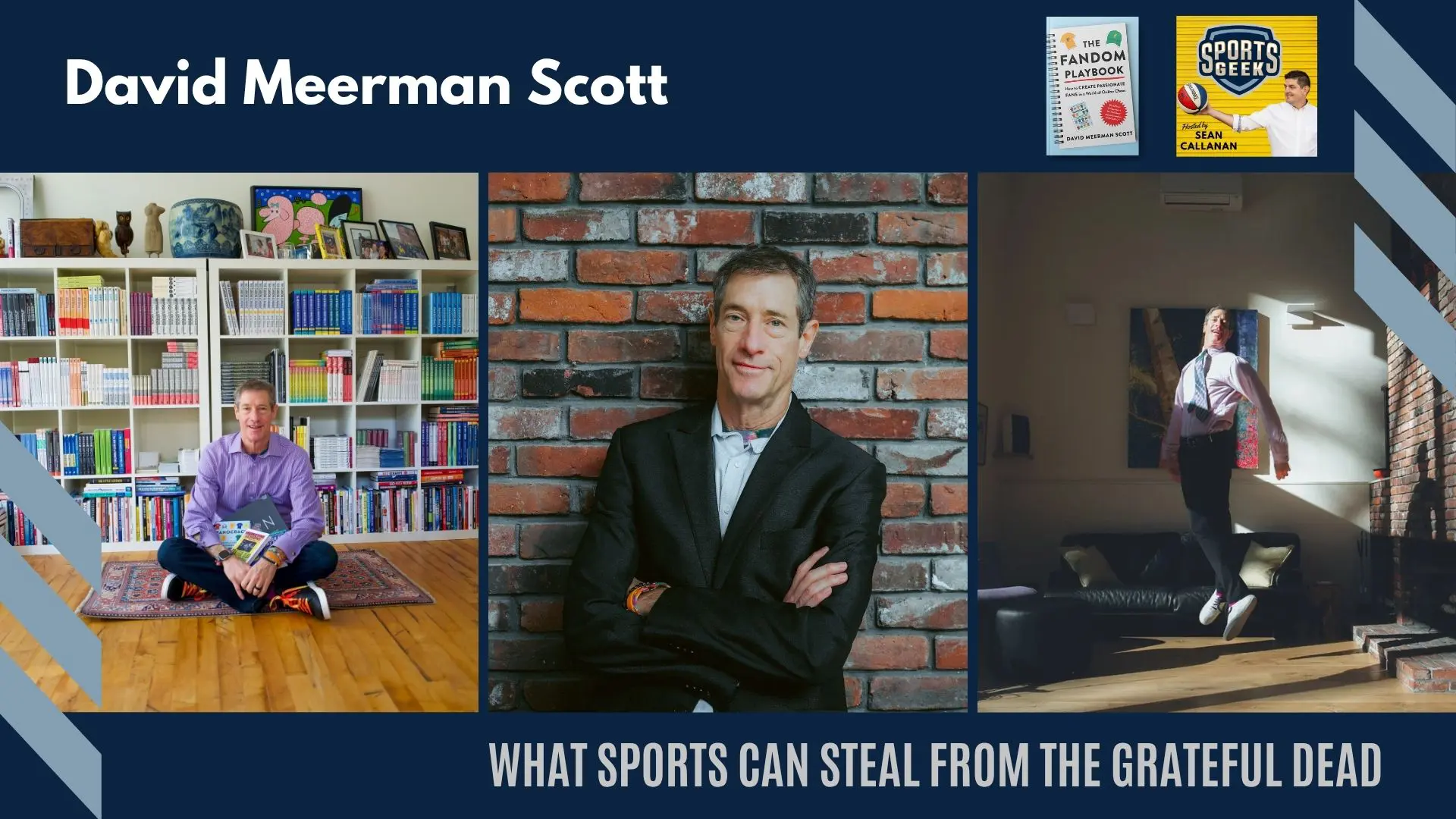
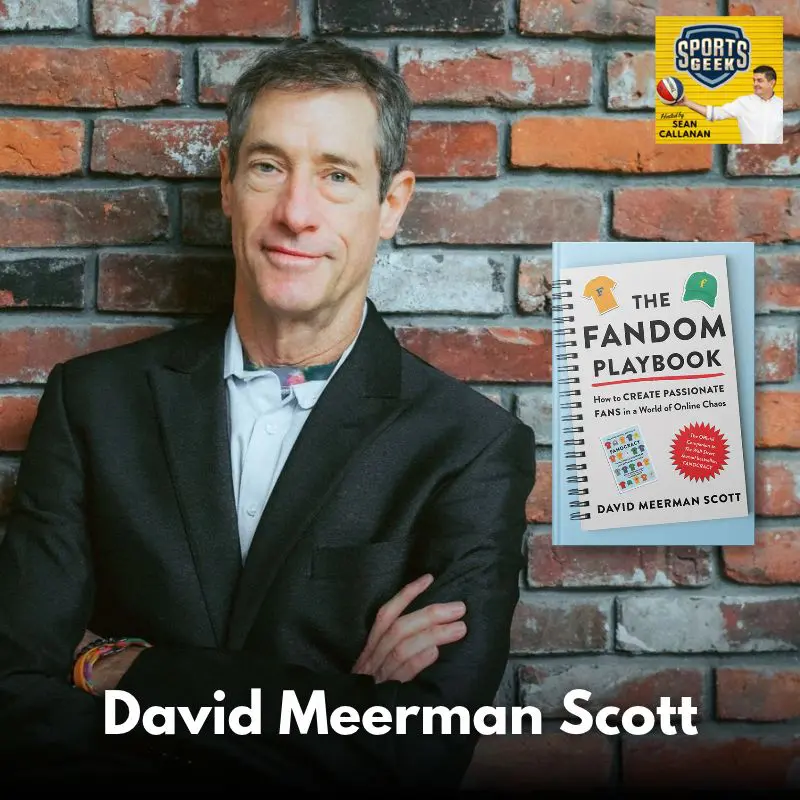
In episode 466 of Sports Geek, David Meerman Scott brings a marketer's view of fandom, built on a lifetime as a fan of everything from the Grateful Dead to Lindy Hop, to share insights on building loyalty that lasts.
In this conversation, you’ll discover:
- How the Grateful Dead's decision to let fans record and trade their shows built an audience that no ticket-office rule could
- Why it is now harder to build a fandom around an organisation than around a person, and how to get people inside your team building their own presence
- Why COVID and an online world of algorithms and AI-generated spam are pushing fans back toward in-person experiences and their tribe
- What a 62-year-old beginner learned about being welcomed into the Lindy Hop community, and what it means for onboarding new fans of any age
- Why David has moved from online social media marketing to genuine human connection, and why his contrarian advice has worked twice
- A practical play from The Fandom Playbook: show your fans what's going on behind the curtain, with examples from a car dealership, a jazz festival and the stadium
- Why giving content away with no gate or registration is itself an act of fandom
Listen to David Meerman Scott on Sports Geek
Can't see podcast player? Click here to listen
Watch on YouTube
Interview Transcript
This transcript has been transcribed by Riverside.fm, no edits (please excuse any errors)
Sean Callanan (00:02)
Very happy to welcome a good mate of mine. I had him on a podcast eleven years ago in 2015 and and great to have him back. David Meerman Scott, author, marketer, speaker, fan. Welcome to the podcast.
David Meerman Scott (00:18)
Eleven years? Seriously? Holy cow. But we did see each other a couple of months ago in person, which is great.
Sean Callanan (00:26)
Exactly, exactly. I invited you to to seat in in Charlotte. But yeah, eleven years ago on Beers Blokes and Business. shout out to Jim Stewart for for making that for making that happen. For for people who haven't weren't in Charlotte or didn't listen to that episode many years ago, I always start my podcast asking people how they got their start in sports. But that doesn't apply to you. You're not in the world of sports, but I want to ask you how you got your start in fandom.
David Meerman Scott (00:51)
so the way I got started in fandom was that I'm a massive fan of The Grateful Dead. And I was always thinking, why did The Grateful Dead figure out ways and how did they figure out to build so many fans, but they're such an obscure rock band? and they did things that nobody else did. for example, they allowed fans to record their.
And that was radical, radical, radical in the 19 s 1970s and 1980s. That you could literally bring these enormous professional grade cassette recorders in and later on digital audio D A T digital audio tape recorders into the venue and they would set up a place right behind the mixing board to plug in your you know, with a power strip to plug it in.
And you can have big professional grade microphones pointing at the at the speakers and like that's crazy. And me and and many of my friends were exposed to Grateful Dead music because of these fan created tapes that we would get from you know, share with people. You're and the and the band allowed you to share them or give them away, but you just weren't allowed to sell them. So that was
my first Grateful Dead concert, I was seventeen years old. That was more than forty years ago. And I was
Sean Callanan (02:18)
Yep.
David Meerman Scott (02:18)
always always thinking about that. So I I I started talking about that with my good buddy Brian Halligan. He is the co-founder and former CEO of HubSpot. And we ended up writing a book called Marketing Lessons from the Grateful Dead all about this
Sean Callanan (02:35)
Yep.
David Meerman Scott (02:35)
topic. And it originally came out about fifteen years ago.
And and I remember when we did a webinar on this topic, which was even before the book came out, it was probably sixteen years ago, something like that, seventeen years ago. It was the the most watched w webinar they had ever done up to that time at HubSpot. So I was like, I got something going on here with fandom. So it really all came from the Grateful Dead.
Sean Callanan (03:03)
that's amazing. And when you look at it, you know, now, like you said, 40 years on, like no one that the term user generated content didn't exist. But that's what they were doing. They were letting letting fans share their fandom and and that helped you know grow their fan base. And like you said, that's how people would would have found the band.
David Meerman Scott (03:23)
And and the other thing that's fascinating about this is that there was a whole subculture of tape traders, which was which was exactly like a social network is today. It was a social network of people, and they generally communicated either by literally telephone or mail, which is nutty, and they traded these cassette tapes in the early days.
and then when the internet came around at very, very early on the in the internet, t nine nineteen ninety-three, nineteen ninety-four, nineteen ninety-five-ish, when very, very few people had internet connections, there was a thriving community of Grateful Dead fans who found each other and then also still traded these tapes. Now of course it's all digital files, but but that's how fans discovered the band, which was and and I was mind bl it was mind blowing to me, you know, that
That every other band said no on the ticket. It said no recording allowed. Grateful Dead said sure why sure why not?
Sean Callanan (04:27)
And so, I mean, just before we hit record, you said, Hey Sean, I'm not I'm not an expert in sports. And and I said, Hey, I want to talk about fandom because a lot of people and begin a lot of my listeners would think of fandom as, you know, putting on the on the face paint or as I call it now, the digital face paint and supporting your team, whether it's the 49ers or the magpies or the or or the sharks or the ducks that are that are behind me. But you've been studying fandom that's either across music, brands.
and even, you know, and even just even those small niches of styles of dance.
David Meerman Scott (05:00)
And and people. and the what's interesting to me now is that that in for many organizations, it's much harder to build a fandom around an an organization, a company, a product or service than it is these days to build fandom around a person.
and that's partly driven by how the algorithms are working these days. I mean, this is just a development in the last couple of years. it's really, really tough to make a go of building fans with with an organizational social media presence. so what I always recommend to people is is have people within your organization develop social presences in order to build fans and then drive people to your organization. Whether
That's the CEO of your of your company, whether that's in the case of technology companies, maybe it's it's a designer, maybe it's the chief technology officer, whatever it is, the the CEO. and and this is a very big change from even just a few years ago where I was advocating that companies focus on their on their organizational counts. and that's not working as well anymore, you know.
Services like LinkedIn and and and the others, Facebook and and so on, are not rewarding organizations like they used to. I'm not sure if that's true of sports, but I suspect it is because it seems to be very systemic within the social networking world. And that would imply that to build fans, it it might be harder to do it for the team.
And a little bit easier to do it for for players and coaches and other people associated
Sean Callanan (06:50)
Yeah.
David Meerman Scott (06:51)
with the team.
Sean Callanan (06:53)
absolutely. That's where we've seen, I guess, the shift from I guess promoting the brand and the team to, you know, the NFL calls the strategy helmet off, like going through the
David Meerman Scott (07:01)
Hm. Yeah.
Sean Callanan (07:02)
players. The players are doing it. But I do agree with you, there's just as much opportunity in the people who work at the team, the people that work in the stadium, you know, sharing their experience because I think I think this is maybe a post COVID thing. We really do, as fans and tribes, like seek an experience. And that's what
David Meerman Scott (07:22)
Yeah. Yeah.
Sean Callanan (07:22)
That's what sport
can offer, that's what music can offer, that's what films can offer. How much is
David Meerman Scott (07:26)
Yes.
Sean Callanan (07:27)
that experience a big piece of fandom for you?
David Meerman Scott (07:30)
Lem let me just actually riff a little bit on what we were just talking about with an observation. my I have two nephews, and one of them is eighteen years old, the other one is seventeen years old. They've ha and they're both lacrosse players. They're good lacrosse players. And both of them started their personal social media pages focused on lacrosse three or four years ago.
You know, so they were like thirteen, fourteen, fifteen years old, and they were doing social media around lacrosse specifically to build fans and specifically so that they would have a presence on those social networks to show college, university recruiters for lacrosse that they were someone who could who could drive fandom.
Of a team if they were chosen to attend a university. Here in this country, it's very common for for athletes to get to make it easier for an athlete to get into a difficult to get into university if they're a good player. And there's even more likely to get into a good university if they have a strong social media presence. so you know, it used to be like, you know, professional sports or or maybe university level sports stars would would would create social networks, and now it's
for for their for their sport of choice. Now it's all the way down to young teenagers in this country at least, which to that's mind blowing to me that my my fourteen year old now he's seventeen, but my fourteen year old nephew is like, Yeah, yeah, I'm starting my Instagram and my TikTok because I need to get my fandom up because I want to go to a good university. and and the older one is now playing lacrosse at Connecticut College. It's a great school. they're very good in lacrosse
And the younger one is getting ready to figure out where he wants to go. So I think that's amazing, right?
Sean Callanan (09:32)
absolutely. And I go also it is also changing like the traditional storytelling and and what we might have said, this is what marketing is fifteen years ago, because they're
David Meerman Scott (09:42)
Yes.
Sean Callanan (09:43)
starting to shape the narrative of this is the content I want, these are the stories I want. And you really have to be paying attention to that, you know, looking at your tribe, what are they doing? Because that's where the new trends and the waves and the and and I guess yeah, the way to communicate with your fans is being developed.
David Meerman Scott (10:00)
Yeah, yeah. And and and I think that's it's so different. In ev even just in a few years it's become so different. So I'm sorry I cut you off and you asked a really great question which I've completely forgotten because I wanted to riff on my my nephews and their lacrosse trying to get into universities through social media strategy.
Sean Callanan (10:21)
No, no, that's okay. It was more about and this whole podcast is about riffing. So I'm happy to be interrupted and and riffing, but it was about that piece of of experience and how people and fans are now, I feel like they're they're seeking the experience more when the experience was taken away for those couple of years with with COVID. Have you sort of seen
David Meerman Scott (10:41)
Yes.
Sean Callanan (10:42)
that across fandoms? How important experience is now?
David Meerman Scott (10:46)
absolutely. Very much so. It it's much more than just the game. It's much more than just the concert, the music part of the concert. it it's much more than just in my case, I'm really into social dancing, much more than just the dance. and I'm seeing that across all different aspects of of what I I study and I and what I talk about. and I I think that really it comes down to two things. You identified one.
which is COVID, you know, we shut down, we couldn't do the things we love. And so when in person came roaring back in 2001, 2002, I mean sorry, 2021, 2022-ish, you know, we all wanted to go and and and begin experiencing again going to live theater, to live music, to live sporting events, and and in my case going out dancing. And and and and it and it quickly became
you know, this is really important now because we couldn't do it for a year or two years. and so so it did become much more of an experience. But the other thing that I think is driving it is the whole online chaos that we've got now. You know, pre-COVID, social media was social. Pre-COVID, we didn't have to deal with artificial intelligence created content.
or artificial and t or or very strong artificial intelligence driven algorithms. it really was social. You know, when you connected with someone, you saw their posts and and y and it felt like a an an online community felt similar to an an in-person community. Whereas today it's really different because of those of those several factors. Number one, you've got AI-driven algorithms
that are putting content in front of you that the algorithms believe you're going to like that aren't necessarily your friends and are not necessarily the people you already follow. And yeah, there can be content in there that you might enjoy, but it it's really a different experience. and and and the same thing is true with with with sort of the whole digital world becoming like just
Chaotic with I I I'm sure you're getting them too, AI generated spam, which looks really much different than it did even just a couple of years ago. and AI created fake content coming out there. So those things are people are sort of throwing their hands up in the air and saying, you know, this whole online world used to be social. Now it's basically like almost like television.
You know, it's just videos coming at you and the social networks are all prioritizing video these days. It's all this video coming at you. And so people are like, okay, I'm I yeah, I'll keep looking at my socials, but I need to get out and have some human connection because this is driving me crazy. So so those two factors, COVID and the rise of AI generated digital chaos is driving people.
To to say, you know what? I want an in-person experience. I want to be with my tribe. So is my tribe people who love to fly go fly fishing? Or in my case, I've got a surfboard over my shoulder here, which I made. it's a wooden surfboard. I went to the factory at Grain Surfboards. I love to surf. That's another tribe of mine is
I have the Grateful Dead tribe, the surfing tribe, then the and the Dancing Lindy Hop tribe. And I wanna be with my tribe. Or or do you wanna be with your tribe because they're this the team that you support? Or the team you play on. and and so people are really spending more time with that than they used to because because online has changed so much.
Sean Callanan (14:54)
absolutely. I mean, yeah, so the experience does help help cut through and I love you talking about the different tribes you're you're a part of and you spoke very passionately about about Lindy Hop dancing and and it's something that you're new to. A lot of marketers are always looking for that for that new fan. Do you want to take us through how you became how you be how you became welcomed into the Lindy Hop tribe?
David Meerman Scott (15:16)
Yeah, yeah. it's it is quite the tribe. So Lindy Hop is the original swing dance. It originated in Harlem in the nineteen thirties in New York City, and it was originally black teenagers dancing to live big band jazz. And big band jazz was the most popular music in the n in the late nineteen thirties, early nineteen forties. You know, think Artie Shaw and and
Ella Fitzgerald and Benny Goodman and and you know, artists like that with you know eighteen piece orchestras and and that was the rock rock you know those were the rock stars of the era. And and those dances, the da it was a street dance basically b that that was done by black teenagers. And it was ver it was very, very popular in the thirties and forties. And then after World War Two it basically it didn't completely die, but it almost
died. And then it it's it's has has quite a bit quite a revival recently. I mean it's still a pretty obscure niche dance, but lots of people are doing it around the world. I bet there's some going on right there in Melbourne too. And and so my wife is a ballroom dancer. So she does waltz and foxtrot and tango and and some of the rhythm dances like salsa and so on. And she was constantly trying to get me to
join her with her ballroom dancing. And I did do it for some number of months. and it and it it it wasn't terrible, but it wasn't my thing. It's clearly
Sean Callanan (16:51)
Yeah.
David Meerman Scott (16:51)
not clearly not my thing. But I I I found myself at one point and I don't even remember how it happened at a at a Lindy Hop dance. And our dances, the the bigger ones are with live big band jazz, with
the st it's still done to live music. And I'm a huge live music fan. So The Grateful Dead I've seen a hundred a hundred and eleven times. I've seen w I have a spreadsheet now suggests that I have seen one thousand one hundred and seven live music shows in my life, the first one
Sean Callanan (17:28)
Wow.
David Meerman Scott (17:28)
being way way back when I was in elementary school. And and so I love live music. And I actually believe that my personal brain
And I think this is true of everyone, but we have different senses sensitivities to this. I don't process digital music as well as I process music that is being done live, it's analog.
Sean Callanan (17:55)
Mm-hmm.
David Meerman Scott (17:55)
and I it's just a different animal for me. It doesn't matter what kind of music, you know, classical or jazz or or or rock and roll, whatever it is. I I I like it better when it's live. and so dancing to live dancing.
Jazz music. made my brain explode. And and so I I was like, I need more of that. So I started taking about two and a half years ago, I started taking private lessons, group lessons, and I go out social dancing at least once a week to a live band. And a couple of a couple of times a week I might go out to recorded music. I don't like it as much, but it's still fun to do the dance. And it's a great community of all different ages, like from
Literally from teenagers to nineties. and and and and I and I and I love the dance, I love the community. It's it's very very, very physical physically demanding dance. So I get a ton of exercise when I do it. and I really dug into the fandom around it. It's people are fans of the bands that are playing this kind of music, they're fans of the great dancers who teach, they're fans of the
Literally they've become fans of ballrooms. You know, I I I
Sean Callanan (19:09)
Yeah.
David Meerman Scott (19:10)
they like to go to a certain ballroom because it has a great dance floor, it has great acoustics. I went to a dance two weeks ago in New York City, which is about three hours from where I live in Boston, took the train, got a hotel room because there was a dance with seven hundred and fifty dancers at at Prince George Ballroom that was built originally in nineteen two, and we had a full on
Lindy Hop Orchestra there. So I love it and I love kind of understanding it from the perspective and the lens of fandom. and it abs that absolutely translates to to the to any kind of experience that people are trying to develop. And, you know, live music is great. I don't see it very often in sporting events. There's
Sean Callanan (19:59)
Mm-hmm.
David Meerman Scott (20:00)
You know, once in a while half time, you know, with an American football game there might be a live l live music, but it's not very common.
Sean Callanan (20:09)
absolutely the reason I asked you for that story is like there are so many sports trying to try to recruit new fans. And a lot of them are looking at, we need to get that younger demographic. But the thing is there's new fans everywhere and you need you need
David Meerman Scott (20:20)
Everywhere.
Sean Callanan (20:21)
to make sure your sport or your your tribe is open and and welcoming to fans, whoever they are. And it's that that initial, you know, if we get technical, that onboarding and how you onboard them, but you but if you can put your arms around them and then let them be fans, like the
David Meerman Scott (20:37)
Yes.
Sean Callanan (20:37)
the the
The long lifetime value if we're doing that as well is immense because once you've got them into the tribe, they become an advocate for you. I you know, I call it, you know, membership marketing where where you just you're guilting someone to say, Well, why aren't you a member? I'm a member. This is amazing. Come and join my tribe. So I think it's a really good case
David Meerman Scott (20:53)
Yeah, yeah yeah. That's right. That's right.
Sean Callanan (20:57)
study to bring people in and let them be your best advocates.
David Meerman Scott (21:02)
And and and w you touched on something that was is interesting. y let them into the community no matter who they are. You know, I I'm sixty five. I was sixty two when I started doing this dance. and there's many, many people the most popular age bracket is is Gen Z, twenty year olds. and and so but they're welcoming welcoming to me. And they bec and and these younger people become my friends and it I really dig that. I like the idea that it's it's it's
it goes across generations. and and I think that's true as well of of any kind of fandom. And and it's not just young people that you want to recruit in. It's any anybody at any age. You know, I I look at my mother, she's ninety one years old. She became a fan of the New York Yankees baseball team in her eighties which I think is hilarious.
So and she watches them every w she watches every game on television.
Sean Callanan (22:02)
Abs absolutely. And that's that's the thing. That is the opportunity for for every marketer. I was looking back at our notes from that Beers Blokes Business podcast eleven years ago, and you talked about reinvention being essential, whether you're a marketer, you're a salesperson, you're a creator. How have you reinvented yourself in the past 10 years? And what does the next 10 years look like for for David Mim and Scott?
David Meerman Scott (22:23)
I in a
in a big way. So when we f when we met at that point, we talked a lot about this book. It's called The New Rules of Marketing and PR. This is my best
Sean Callanan (22:36)
We did.
David Meerman Scott (22:36)
known my best known book. It originally came out in 2007. I think I met our buddy Jim probably around 2008, 2009, something like that. And and it became basically the most
popular book on the planet around about social media. It sold half a million copies. It's in 29 different languages. And I've updated it. It's now in the ninth edition. I update it roughly every two years. And I'm absolutely best known for that book. And I'm best known as being an expert in social media. But when when COVID hit around there and we were talking about this earlier on the show and
The algorithms became so, you know, post-COVID with AI became so algorithmic driven and so much AI content. I didn't enjoy it anymore. And it was moving
Sean Callanan (23:33)
Mm-hmm.
David Meerman Scott (23:33)
so quickly that I felt like I'd have to study for for hours every single day just to keep up with it. I mean, you know, when as as soon as one of the social networks changes its algorithm, they don't tell you they change it.
But you people can feel it and see it, you know that Instagram is behaving differently, you know, it's rewarding video now more than it's requ r rewarding photos, these sorts of things. It wasn't interesting to me. At the same time, I started writing and speaking and thinking and and and obsessing way more about this idea of fandom. So I've now done several books on fandom, and the newest one, this is called the fandom playbook, comes out
in October and October twenty sixth this month as we're recording this. And so I have very much transitioned my work. It's still focused on marketing broadly, but very much focused my my work from what had been online social media website kind of based marketing to being something that's more more sort of in person
Developing fans' genuine human connection approach. And in both, but but but the pat the patterns are similar because in both cases, when I originally wrote The New Rules of Marketing in PR, I wrote it in 2005 and 2006, it came out in 2007. With the fandom playbook, I wrote a also wrote a book called Phanocracy. I wrote this one with my daughter, and Phanocracy originally came out in 2020.
So in both cases, when I was writing and then when it originally came out, the New Rules of Marketing and PR, and then I was writing in late nine late 20 nine eighteen, twenty nineteen, the fa Phanocracy, they were very much opposite of what everybody was saying. In 2005,
Sean Callanan (25:38)
Mm-hmm.
David Meerman Scott (25:39)
2006, everyone was talking about advertising, paid advertising.
You know, buying banner ads, buying email lists, buying trade show booth space, buying television, radio, newspaper ads. And I'm like, don't do that. Just create some great stuff on the web and you'll do fine. And that b that idea, which is one sentence I just gave you, sold half a million books. And now it now everyone's focused on online and I'm saying, you know what? No, focus offline, focus on true human connections.
You know, so it's completely opposite of what the whole world is talking about. And I love that. I love the contrarian ideas that I've put out there. So that's really been a big change for me, Sean. It's kinda weird to like almost say that the stuff you were doing I was doing before isn't as important, you know, than than doing this new thing. but that's where I am.
Sean Callanan (26:34)
absolutely, absolutely. And and I can't wait to get my hands on the book. We briefly discussed it at at seat in Charlotte again, which was that, you know, that in person connection, like the the the knowledge sharing that can happen online is great, but really it does cement both the relationship, the the knowledge, the conversations. They they just carry more weight when you know, when your normal world is, you know, through your phone and delivered by an algorithm.
Those in person that experience pieces, you know, if we're having our own personal algorithm, they get the little ten X and asterisk against them, don't they?
David Meerman Scott (27:11)
yeah. totally. Yeah. so so yeah. So this has been really fun to do this. The n the Fandom Playbook has nine different plays. I always suggest to people maybe do one or two or three. You don't try to do all nine. you know, I don't do all nine. but they're they're very basic ideas on how you can do marketing in a in a new way and and use that to build fans. And I'll give you just one I'll give you an example. We can go into some of them as if some
Sean Callanan (27:37)
Place.
David Meerman Scott (27:38)
more if you want, but one of them that's
Fascinating to me is allow is show your fans what's going on behind the curtain. and I
Sean Callanan (27:46)
Mm-hmm.
David Meerman Scott (27:46)
I've seen this in many different ways. So for example a couple examples. there's a rest a couple of restaurants that I love where you can s see what's happening in the kitchen. What are they doing? Because the kitchen is basically part of the dining experience. We talked about experience before.
Sean Callanan (28:04)
Yeah.
David Meerman Scott (28:05)
So part of the you don't just go to a restaurant, you sit at a table, and the kitchen's behind.
closed doors. The kitchen is right there and you can see what's going on. That's the idea of of opening a curtain and letting us see what's going on behind the curtain. today I ha I I have a a a pretty cool Mercedes-Benz sprinter van and it's it's it's tricked out as a camper van. and
Sean Callanan (28:29)
Mm-hmm.
David Meerman Scott (28:30)
I l I love that I love that thing. But it I had to get it its annual service today. And I took it to the Mercedes dealer down the street that I go to.
and and they they have something I'd never seen at any other car dealer before, which is if you bring your car into service at any other dealer, you bring it in and then they they send you to a waiting room. and if you're gonna wait, I mean of course, and the waiting room you can't see what's going on in the garage where they're working on the cars. But at this Mercedes dealer, there's a there's a big ass glass wall.
Where you can see the the technicians working on the cars. That's really different. That's showing what's going on behind the curtain. So I'm thinking for sports teams or or even for venues, can you show us what's going on behind the curtains? Can fans get part of the experience of of of maybe, I don't know, seeing the locker rooms or or going to a practice.
Or I I'm just thinking of a couple things. I'm sure you can think of many, many more, but can you sh you can you show us what's going on behind the curtain? I I remember once I went I got the the highest level ticket to the New Orleans Jazz Festival. And the the ticket was $1,500 for I think it was a three-day or three or four-day festival. And and
Typically of many festivals they had location closer to the stage for people who had this particular ticket. In some of the other stages, bigger stages, we got seats where other people were standing. But the the reason I bought it was that there were several opportunities to literally sit on the stage for a show. And
And and and I had never had that experience a as a as a customer before. I mean I've gone with bands when I was invited by the band themselves to go backstage. But I never had the experience of literally sitting in a seat on the stage, side stage, you know, looking at the band as they're playing like twenty feet away and seeing the rest of the audience out in the out in the field standing up.
That was amazing. So that's lo that's another one. Like show us what's going on behind the curtain. So that's a play I think that that that all any one of your listeners
Sean Callanan (31:11)
I definitely think that one
David Meerman Scott (31:12)
could embrace.
Sean Callanan (31:14)
I definitely think that's one happening in stadium design, whether it's like I think it's the Cowboys Stadium where the Cowboys actually run through one of their clubs and before they run out in the field. So you're there having a beer pre game and Dak Prescott runs past you like you're you're effectively
David Meerman Scott (31:30)
Nice.
Sean Callanan (31:30)
part of part of the tunnel experience. But even the smaller things of the social media admin walking out to the stands and saying, Can I borrow your phone?
And they grab their phone and walk it into the stadium and walk it into the locker room and do a quick video and hand the phone back to the back to the fan. They're those things have taken them inside.
David Meerman Scott (31:47)
that's cool. I haven't
I haven't seen that before. That's really cool. I love that idea. But but but yeah, that's
Sean Callanan (31:54)
Well, yeah.
David Meerman Scott (31:55)
I mean it and and if you put on, you know, if you put on your your thinking cap and say, Okay, so this stuff works, clearly works. What more can we do like this to develop fans?
Sean Callanan (32:10)
absolutely. One of the phrases I use a lot is is steal with pride. Like what do other sports, what do other entertainment industries, what do other fan groups do? How can you adapt it? I know your books are full of these inspirations. So I want to be pointing people to the book. I know we're we're short on time, and I really do appreciate it taking the time. I want to get to the sports geek closing five. And I'm gonna change this from I
David Meerman Scott (32:33)
okay.
Sean Callanan (32:33)
do you do you remember the first
sports event you ever attended, you can swap this out for a concert if you would like.
David Meerman Scott (32:41)
no, 'cause I d I do remember the first professional sports event I ever attended. it was in nineteen sixty nine. I was eight years old. And it was my my dad said to me, I I I I was a New York Mets a minor New York Mets fan. and my dad said to me, Would you like to go to a New York Mets game? And I said, Yeah, it'd be great, I'd love to go. And one of his his friends got tickets.
And I didn't I wasn't aware enough at that age that that the Mets were in very close to getting a playoff berth and I didn't know that. And this game if they won they would secure a place in the playoffs. And so I we went to the game at Chase Stadium and we had good seats and it was amazing to see a professional baseball game in the stands and the Mets won.
And that got them into the playoffs and they eventually won the World Series that year. The first time an expansion team ever won the the World Series and baseball game baseball series. And and I and a at the end of the game, fans ran on this field and they were ripping up the grass in the field to take a souvenir piece of grass home. And I'm I said to my dad, I
do they always go out in the field and rip up the grass after every single game? And like he's like, No, you're an idiot. Don't you know this is like a really,
Sean Callanan (34:09)
Ha ha.
David Meerman Scott (34:10)
really big day game I've taken you to? So yeah, then nineteen sixty nine New York Mets.
Sean Callanan (34:16)
amazing. Food is something we, you know, we only discussed a little bit and obviously there's lots of fandom around food. Do you have a favorite food memory or a favorite go to food at a sports event?
David Meerman Scott (34:27)
my gosh, you know, I'm such a pizza fan. I I mean pizza anywhere is good. I do tend to do hot dogs at at at s at baseball games or just something about a hot dog at a baseball game, but I'd I'll do pizza when I can.
Sean Callanan (34:43)
absolutely. What's the first app you open in the morning?
David Meerman Scott (34:48)
I I go to a Discord server for
Sean Callanan (34:53)
Okay.
David Meerman Scott (34:55)
for Lindy Hop in Boston. So it's it's literally my tribe of I think there's 500 people on it, and there's probably only a hundred that post on a regular basis, but all the organizations that are part of the Boston Lindy Hop community folk po post there. So you know we've got a lesson coming up on Friday. Here's how you can get we've got a
A a a live band at such and such a ballroom Saturday night. Here's how you can get a ticket, you know, things like that. I go there first thing every morning.
Sean Callanan (35:27)
absolutely. And that's the thing about you know a lot of people Discord is such a it's such a great tool for fandom and and tribes.
David Meerman Scott (35:36)
It it it is.
It it absolutely is. and I think one of the reasons, Sha Sean, for this is that it's it isn't polluted by those terrible algorithms. It is social. You know, you go there and there's the different threads that you can see and it's not being algorithmically driven to you, which is why I quite like it for that purpose.
Sean Callanan (36:02)
absolutely. is there someone that you follow? It might be a fellow author, it might be someone that that that you think is doing a great job that the podcast listeners should give a follow and why?
David Meerman Scott (36:14)
I love Seth Godin's work. You know, he's a marketer like I am. He's also happens to be a friend of mine. He's why I got into what I do now, you know, 'cause I like I I started reading his books. I'm like, this is crazy. This guy is like re writing books and speaking at conferences. This is and I love at I and he's been blogging for mu more than I started my blog in two thousand four, twenty-two years ago, believe believe it or not. And he started his I think about five years before I did.
And and and so I've been kind of following him now for geez, almost thirty years. Amazing.
Sean Callanan (36:51)
as have I, as have I, an absolute terrific recommendation. He has been recommended before, as he should be. And lastly, and this is this comes
David Meerman Scott (36:57)
As he should as he should be. As he should be. And he's a good guy. So there's that too.
Sean Callanan (37:01)
absolutely. And this last question, you can take it wherever you like. What social media platform is your MVP? You get to define what a social media platform is.
David Meerman Scott (37:13)
what do you mean by that, V P what do you mean by I I know it most valuable
Sean Callanan (37:14)
Well, normally it would be,
hey, rank what's the best one, what's the one that you use the most and you gravitate to. but
David Meerman Scott (37:19)
okay. Gotcha.
Sean Callanan (37:21)
but but if you want to pick off the board and say, I'm using this and this is what my social media platform is.
David Meerman Scott (37:27)
I you know,
I've I've changed over the years. You know, I was big on Twitter for quite a number of years. I did Link I've and I'm still on Twitter, X now. I I'm I'm big on LinkedIn. I I I I can't
Sean Callanan (37:38)
Mm. I still call it Twitter. I don't I can't call it X David, sorry.
David Meerman Scott (37:44)
I can't change I can't change. It's still Twitter to me. I I I use I use LinkedIn regul I mean and I go to I go to LinkedIn every day. I go to Facebook every day. But I the one I like the most is is Instagram.
I I I'm s I I'm pissed off at the algorithm 'cause it it tends to show me stuff I don't want and you know, as soon as th it always wants to show me political stuff and as soon as it shows me
Sean Callanan (38:08)
Uh-huh.
David Meerman Scott (38:09)
something like, No, I'm not interested, no. but but despite the fact that I don't like the algorithm, I think Instagram's my my go to.
Sean Callanan (38:20)
Yep. And again, that is a that is a a common one. One question I will ask without notice. I only watched it last week. Have you have you watched, are you planning to watch Aaron Sulkin's latest latest movie, Social Reckoning?
David Meerman Scott (38:35)
haven't heard of that one yet. well first of all, I do not watch television. and I
Sean Callanan (38:41)
Okay.
David Meerman Scott (38:42)
do not and ex except for an occasional YouTube video here and there, I I don't watch long form video on on my computer either. I stopped watching television more than ten years ago. People ask me how do you write a book nearly every year? I've written fourteen, including
a add adding to that nine different editions of the New Rolls of Marketing and PR. Well, if you cut out television from your life, you free up a lot of hours.
Sean Callanan (39:11)
Yeah.
David Meerman Scott (39:12)
and I very rarely will go to a theater. I think I've seen I don't know, I think I might have seen two movies last year. So I might see that one because it sounds intriguing, but I know I'm not sure how and when I will.
Sean Callanan (39:26)
So yeah, so he wrote the first social network again. What was that fifteen years ago? So this is the
David Meerman Scott (39:28)
Yeah, I remember. I did see that. I liked that movie. I I did like that one.
Sean Callanan (39:32)
follow up to that, and it very much goes into a lot
of the stuff that we discussed around the algorithms and the changes to the algorithms and the causes of what those algorithms are. So I think it like I
David Meerman Scott (39:43)
is that out now?
Sean Callanan (39:45)
it is out now. I s I actually saw it last week. it's not as popular as it as it's
David Meerman Scott (39:49)
In a in a the in a theater?
Sean Callanan (39:51)
yeah, I saw it in a theater, but it's not as
David Meerman Scott (39:53)
Okay.
Sean Callanan (39:53)
Not as
popular as when the social network came out because Facebook was at its sort of zenith and it was right in the, you know, the crosshairs of of pop culture. So it hasn't done as well in the box office. but all the things that we discuss of the inner workings of them changing the way the algorithm works and why it does it and why they did it, I think you'd find it interesting. I think most of my listeners will find it interesting.
David Meerman Scott (40:15)
I'm gonna have to I'm gonna have to check
it out. Yeah, I'm gonna check I'm gonna check it out. That sounds like something I need to see. So thank you for that recommendation.
Sean Callanan (40:21)
David, thank
you very much for coming on the podcast. I always ask listeners if they enjoy the episode as much as I do to reach out and say thank you to the guests. We s what's the best place for people to reach out and say thank you to you?
David Meerman Scott (40:35)
So a couple things. My name, I use my middle name professionally, Meerman M-E-E-R-M-A-N. So I'm David Meerman Scott. And if you Google me, you only find me. If you want to get my take on fandom, go to your browser of choice and type in fandom dot marketing, and then that'll redirect to a ton of free content, including a free excerpt of the fandom podcast.
playbook and there's no registration required whatsoever. That's actually an element of fandom. Give people content with no gate on it, no requirement that they register, no requirement that they give up an email address. If you want my content, I have no idea who you are, and you can get it. so those are the two best ways.
Sean Callanan (41:24)
Well, that's very much f to be full circle, that's exactly how Grateful Dead started, handing out and allowing people to record tapes. So true true to your word, David. Thank you very much for taking the time. hopefully we can connect in your part of the world soon.
David Meerman Scott (41:34)
I good good for you good for you for
bringing it good for you for bringing it home by by bringing up the Grateful Dead again. I appreciate that. So yeah, it's always great to chat.
Sean Callanan (41:43)
No worries, mate.
David Meerman Scott (41:44)
I hope I hope next time it'll be in in Melbourne or or somewhere nearby you as opposed to you coming all the way up here nearby me.
Sean Callanan (41:55)
I'm happy to travel when it's catching up with good people. Good to chat to you, mate.
David Meerman Scott (41:59)
Yep, take care. See you soon.
Turn 15 minutes a day into sponsorable content your partners will pay for
Sports Geek AI is a done-with-you content system that creates daily newsletters, podcasts, and social posts—giving your commercial team new inventory to sell.
Resources from the podcast
- Featured image credit: The band at the Warfield Theatre, 1980 — Chris Stone, via Wikimedia Commons, CC BY-SA 4.0
- Please connect with David Meerman Scott on LinkedIn. Let him know you listened to the episode. Please say thank you if you do connect.
- Follow David Meerman Scott’s work and dive into a free excerpt from The Fandom Playbook at fandom.marketing, no registration required.
- Watch Sean’s episode of SEAT Solves, featuring Scott Ahlstrom of SwitchBase on unifying venue operations. Become a SEAT member today.
- Listen to our new Daily podcast – Sports Geek Rapid Rundown.
- Check out Digital To Dollars – our self-serve program to help you drive more revenue from your digital fan base.
- Podcast episodes you should listen to:
- Throwback episodes you may have missed:
Podcast highlights
Highlights from episode 466 with David Meerman Scott:
-
- 02:20 How David got started in fandom: the Grateful Dead
- 04:52 Tape traders, the original social network
- 06:31 Why it's harder to build fandom around an organisation than a person
- 09:04 Lacrosse nephews and fandom through personal social media
- 12:15 Why fans want in-person experiences: COVID and AI chaos
- 16:48 Lindy Hop: joining a new tribe
- 22:31 Welcoming new fans of any age
- 23:45 Reinvention: from social media marketing to human connection
- 28:44 The Fandom Playbook and its nine plays
- 29:09 Play: show fans what's going on behind the curtain
- 32:42 Stadium ideas for going behind the curtain
- 33:57 Sports Geek Closing Five
Digital To Dollars is the five-pillar process pro teams and leagues have used for a decade to turn digital audiences into revenue, and it’s coming soon as a self-paced program. Those on the waitlist will get 20% off upon launch.
Check out our podcasts with SEAT
We’ve launched two monthly podcasts in collaboration with SEAT.
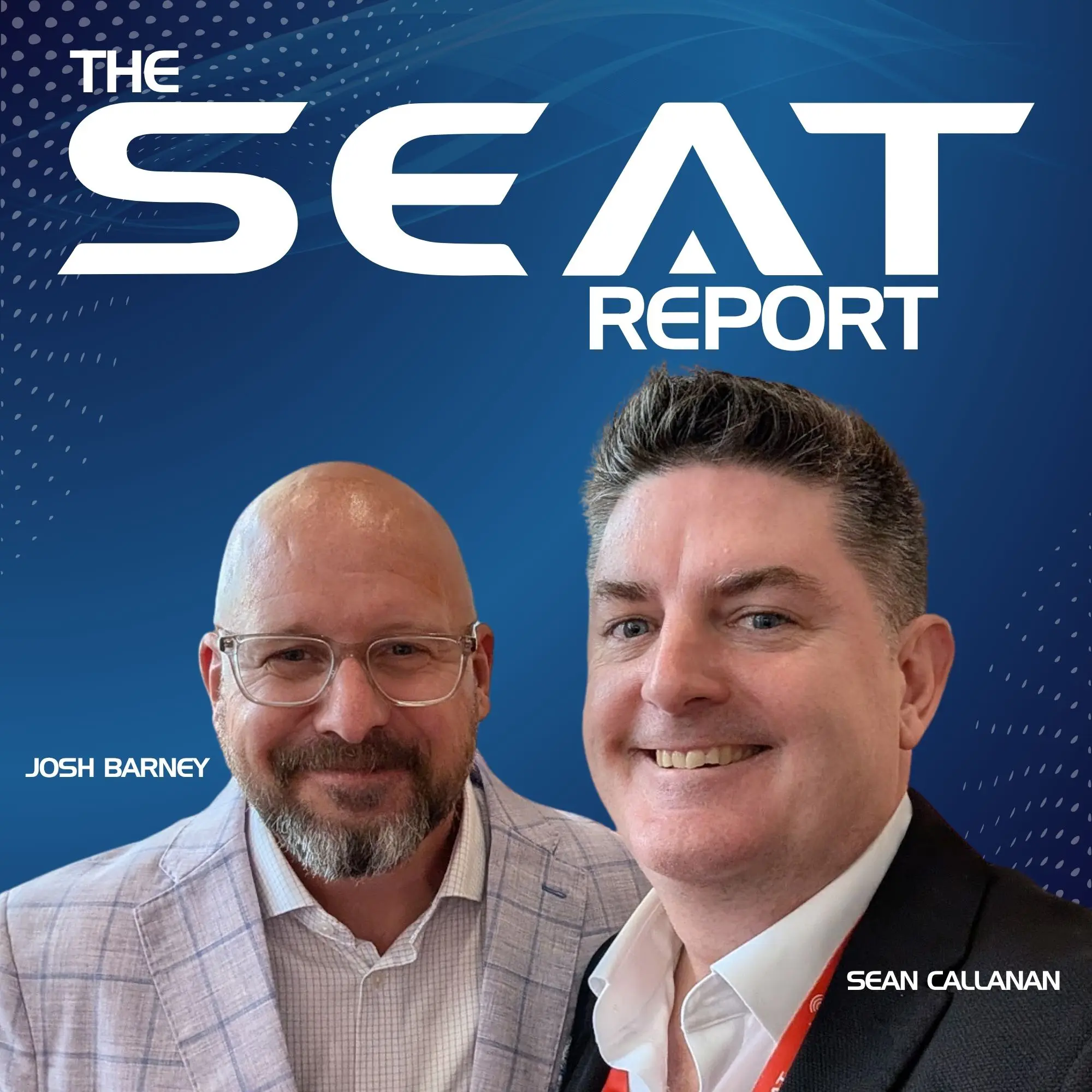
Sean hosts The SEAT Report with Josh Barney. Check it out
Each month, Sean will profile a SEAT partner on SEAT Solves.

Listen To Sports Geek
Recent Sports Geek Reads
- From Valkyries Expansion Blueprint to NFL Antitrust Revival & Football’s Streaming Surge
- LIV Golf’s Bankruptcy Details, Lakers’ $12.5B Valuation & DAZN’s Streaming Launch
- NFL Sunday Ticket Ruling, AC Milan’s €650m Stadium Deal & WNBA Game 7 Records
- Women’s Sport Investment, AI Ad Deals & Playmobil Alt Broadcasts
- From Visa’s Sponsorship Engine to Mbappé’s China Fallout: This Week’s Global Sports Business
- Chernin’s $2.65bn Sports Empire, NBA Prediction Markets & Fanatics’ AI Shopping
Listen to Sports Geek Rapid Rundown daily