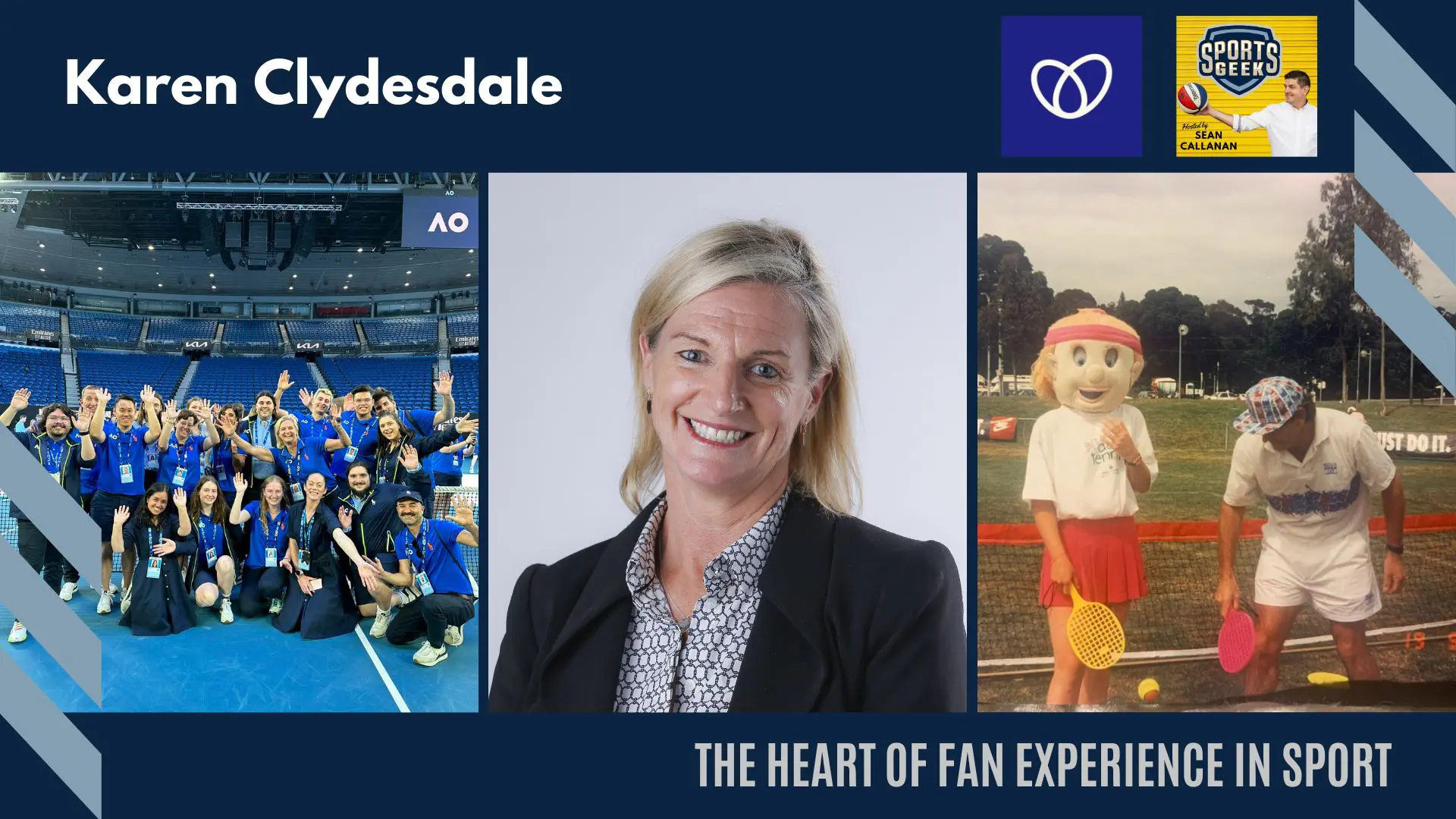
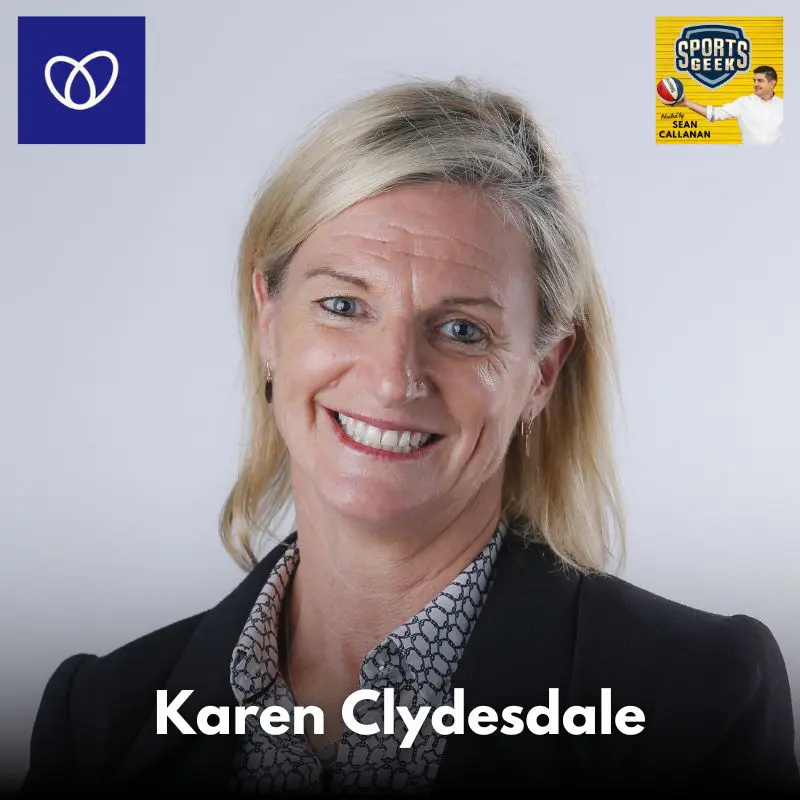
In episode 460 of Sports Geek, Karen Clydesdale (KC) brings close to three decades leading customer experience at Tennis Australia, and a fresh start as founder of HeartCX, to share how great fan experiences are actually designed and delivered.
In this conversation, you’ll discover:
- How to embed a customer-first mindset across an organisation of 15,000 event staff, from the car park attendant to the frontline
- Why the one-percenters, from selfie spots to real-time feedback, often matter more than the big-ticket changes
- How Tennis Australia turned Voice of Customer data into changes made in the moment, not next year
- Practical approaches to designing for international fans, from multilingual wayfinding to Wi-Fi at the gates
- Why KC believes fandom is emotional, not transactional, and what that means for fan loyalty
- How to think about AI in fan experience, and why the person in the middle still matters most
- What the leap from a governing body to her own consulting practice taught her about applying CX beyond sport
Listen to Karen Clydesdale on Sports Geek
Can't see podcast player? Click here to listen
Watch on YouTube
Interview Transcript
This transcript has been transcribed by Riverside.fm, no edits (please excuse any errors)
seancallanan (00:00.927)
Very happy to welcome a good mate of mine. I've been trying to get her on the podcast for a little while now and I'm glad we finally booked in. Karen Clydesdale. She was formerly the head of CX and CRM at Tennis Australia. And now she is the founder at HeartCX. I know her is KC. KC welcome to the podcast.
KC (00:18.808)
Thanks, Sean. Great to be here.
seancallanan (00:21.327)
I always get started trying to figure out people's sports business origin story. how did you find your way into the world of sports?
KC (00:32.544)
Very much a very sporty family, youngest of four. It was football, cricket, tennis, and Sunday afternoon was Wide World of Sports. So it was just always around us. It was the you know country, small country town. Everyone was very much involved and ended up wanting to be a nurse, so wanted to make a difference in people's lives, but then realised that no, maybe I didn't want to do that. So was very lucky that going to a VFL game, I think it was St Kilda Geelong at VFL Park, and my sister said there's a job for.
At the back page of the age, and that was tennis for people with disabilities. And it was lucky it sort of at Tennis Australia. It combined my love for people to make a difference and the love that I'd always played tennis. I'd played as a junior and had a very bad backhand, so I was never gonna make it. so it was just an opportunity for all those sort of worlds to collide, and yeah, I was being very fortunate for doors to open every year or every couple of years at Tennis Australia for the last three decades.
seancallanan (01:06.857)
Mm-hmm.
seancallanan (01:31.463)
Yeah, so we're gonna normally we sort of talk about someone's career and they bounce around at a few different places, but your last thirty years or so has been at tennis. But tennis has evolved over those years and a as you have, you started in the tennis for disability space and then in the participation space. How did you sort of navigate as Tennis Australia evolved being both
KC (01:37.208)
Yeah.
seancallanan (01:57.533)
You know, the the organ national organising body for for participation, but then also the host of of of the Australian Open.
KC (01:57.815)
Mm.
KC (02:06.51)
I think it it was probably organic, right? I mean I was only I was fairly young, I was should say I was about two when I started, but not quite. But I was fairly young and and sport was new and I'd just done the sport the po the masters in sport management and I was in that process. So like compared to what it was now how sport has grown as Tennis Australia has, the whole sport industry has. And I suppose I've just been fortunate to always have my connections and relationships with people along the way and could see doors opening and could always push for change.
I had an insatiable appetite for improvement, hence why CX probably is where I've landed. But I think you know, when there was something like, well, why wouldn't we call it participation? You know, and then we set up the participation national advisory group at the Australian Sports Commission, which was the first time we ever used that word, participation. So I think it was just always seeing those opportunities. And I suppose the last, you know, as leaving Tennis Australia, I've an opportunity to reflect on that journey, and I found the sticker that we created, which was
Tennis so hot it's cool and it was the first sticker, the first promotional thing that tennis had ever done. But I said, well, come on, we should be telling everyone how good it is. I mean, my goodness, how embarrassing is is that now for people listening about now how we're bringing you know sport and entertainment to life. But that's how analog it was.
seancallanan (03:25.328)
And so you sort of worked in that petition sp participation space in the community space and sort of got to understand tennis Australia overall and and understand different functions of the business and then like you said you sort of moved into that customer experience space. I'm always interested in sort of why people end up where they end up. Like people go, I want to work in sports and they don't like either they don't even know that that industry exists or that but or that department exists. But in the case of CX, it it really was
Completely new to both, you know, the industry overall but but sports specifically to say, Hey, what is customer ex what is customer experience? So how did how did that role evolve and how did you find yourself in that in that space?
KC (04:05.038)
Yeah.
KC (04:09.09)
Yeah. I suppose I'd always been intuitively customer centric because I always cared whether I was working with the coaches in coach membership, I cared about I cared about the clubs. I I cared about you know, we rolled out cardio and brought cardio tennis. And why we did that, we did that because we understood what the customers wanted, which was the coaches and the clubs. So I suppose that was why it was just a natural attrition, I think or not attrition, a natural evolvement. But I think what happened then is that well, w probably a bit of a crisis where we we launched a range of
Systems well before minimal viable product. If you know six months later they were only at MVP, and and that created a crisis, which therefore we really had to lean into our customers. So that then allowed us from a customer support perspective, which was a vertical, to then go horizontal. And from then, I then then we did the digital and tech review where we really identified that we needed to bring in human-centered design because we'd made some mistakes, significant ones, bringing technology in without actually thinking.
seancallanan (04:54.499)
Mm-hmm.
KC (05:08.964)
About the customer. And we'd done that time and time again. And I think that was when we went, aha, let's do that. And for me, I think being on that journey and watching the pain for us as a business and for the customers, it was like, yes, this makes sense. Let's slow down, let's understand what our customers want, and let's design experiences for them. Or in some cases, let's delight them and provide something that they don't necessarily know that they want. But at least let's get that methodology and
that g the collaboration across digital and tech and ticketing and operations, which wasn't happening.
seancallanan (05:47.657)
And I guess, you know, coming from participation, you sort of knew the point of view from the the tennis purists, the people who were playing tennis, the people in in club land that would be going to the the Australian Open on a regular basis, but you're also at tennis when it was almost one of the leaders in that advent of festivalisation of of of sports where it became yes, you go to the Australian Open or as it became known, a you just go to AO, right? It became just branded as AO. And you might not actually
you know, going to Rodlave Arena or Jog Cain Arena, you might just be taking it taking it in. H how is that adding that extra layer of, you know, customer experience and and wayfinding and and effectively starting talking to a completely new customer that, you know, not as there they they're not there to see, you know, Serena Williams or or or or Pat Rafter or or anyone, you know, out there. How is that a change to sort of say, hey, we wanna
you know, a festival go where we want someone that's looking for some fun for that you know, that big two weeks that is the Australian Open.
KC (06:53.134)
You could have accredited a lot of that to Craig Tiley and his leadership and and other executives that have been there to have set that vision and they were always very clear that we needed these four pillars, you know, it needs to be about entertainment, it needs to be about food and beverage, let's bring kids and families, let's have that you know real strong music pillar.
I must admit I was always saying, Well, where's the tennis pillar? And I probably still to this day believe that and and our research shows that three and four people come to watch the tennis or to see the tennis. And so I still think that's something you know, Tennis Australia and the Australian Open is grappling with is how do you get more people to actually watch tennis given the limitation with the number of seats. but obviously it's about seats, shade and and and creating more space and screens. So but yeah, the festivalisation just grew and grew and grew, and I think then it's just gained so
much momentum and as a result, you know, 1.4 million people last year and it's just continually growing. which you know in a way is is a challenge because there's only finite space for people to go but which creates challenges with crowds which is another CX you know challenge.
seancallanan (08:00.126)
And then I think, you know, there's always the joke that you must be busy in January, you must have your feet up on your desk for the rest of the the rest of the year when you're working at tennis, but really, you know, you're in planning mode and and adjusting whether it be, you know, how the site is built out, whether it's hey we're gonna build a pop up bar that's gonna be next to this court so people can be, you know, vectorly s having a drink at the bar and looking over and there's a you know, there's one of the bat the back courts which has happened the last couple of years.
KC (08:04.587)
Yeah.
seancallanan (08:30.321)
How much of that is, you know, the the planning, the ideation and then and then then you've got to sort of put that overlay of how do I make sure people can get there, understand it's there, and don't get lost getting there and to and from?
KC (08:45.31)
One hundred percent and I was actually talking at a university yesterday and and we're having this same conversation as that the one common question is well what do you do for the rest of the year? you must be getting busy now. I mean, straight after the AO. It it i and and not even straight after during the AO. We're planning next year's AO or even the one before. We're really now working on a well no not we, Tennis Australia is working on a eighteen month, two year cycle. So there's people working on twenty-seven and twenty-eight now, which is much better as
opposed to just within that one 12-month cycle. But certainly during the event, you're listening to the customer, thinking about changes that you can make the next hour, the next day, and the next year.
and so that continues straight into February and March, and as you say, yes, a lot of co-design workshops, whether that's internally or across many cross-functional teams, and also with partners as well, and working that through that ideation the whole time. I think one thing I'm really proud of from a CX perspective is probably some of the work we did with D and I. Many years ago we sat down and said, look, how do we make sure it's authentic and we embed it within the whole organisation?
And so many co-design workshops where we looked at the end-to-end journey and how do you bring DI in all elements of that. Now we didn't lead it, but we enabled it. And then that was then led by the DI team and the whole business.
seancallanan (10:14.564)
And so how do you because again you're sort of leading and putting those overlays of the design, but you're gonna have people on the front line. And especially when the tournament is on, how do you like embed that those values and and and culture and have them have that same lens? How can I fix the problem for the customer today or and make sure it doesn't happen tomorrow? But also, we wanna be documenting this or we wanna know that this this is either gonna be an improvement or things that we can do different the next year. How do you
KC (10:26.446)
Yeah.
seancallanan (10:43.43)
How do you get your staff 'cause you have that scale up of of staff that come on board around the AO, how how do you go about training them and and prepping them to say, you know, this is the AO way?
KC (10:54.836)
One hundred percent. So we had a make it memorable, which was greet with a smile, know your stuff, be one step ahead. It's very simple, but behind that was so many messages and learnings was part of those three pillars. We developed that collaboratively with Melbourne Olympic Park and at the time it was our food vendor at the time and made all cake stakeholders. It has not changed. it's been embedded now into the whole workforce culture. and there's twelve to fifteen thousand staff, I think it's probably about fifteen thousand now that need to be
Across that. And I it's right from the car parking attendant to the cleaner to, of course, then the real frontline staff. And so we have a lot to do with that frontline staff, the customer experience ambassadors, the patron services, and they're the people that are there when the ticketing may not work or when somebody realizes their you know seats in the shade. We encourage them to make those changes and those right in the moment and empower them. If someone's in the shade and not happy, there's no point worrying hearing about that.
next week or the next day. Fix it and and so that we do empower them and that's part of that training. I'd like to do more, but our people are our strength. They bring the f friendly slam to life and and they fix those problems right in the moment.
seancallanan (12:13.516)
And how is that I mean, again, over the past fifteen years, you know, digital has become more and more prevalent both from the fan point of view, so someone can be posting or tweeting their pleasure or displeasure, but also, you know, the comms of internally is has is a lot easier. You can you know, you can ping someone on on on on a on a on a platform. How has that changed, I guess, how you how your customer service team and that front line act?
KC (12:43.084)
Yeah. And and I think sure this is the challenge. There's so many touch points. It it is the customer support team, it's the people on the ground. It might be the premium experience team. It might be the food and beverage team. It might be the people messaging the app. It as you said, or social media. So what we do during event mode is we actually have a range of checkpoints throughout the course of the day and we're obviously listening through Voice a Customer and l listening through our surveys, which are alive on a dashboard. And it's all good having a dashboard.
But it's about then understanding that insight and then doing act, you know, creating some action, which is going to improve the experience. So, what is actually happening? And I use this example because it's a quite an sort of an unusual one, but we kept on hearing, and it was a couple of years ago, that there was too much noise, you know, and people weren't being they couldn't hear and watch the tennis in Garden Square. Anyway, it was great to my colleague Peter Jackie. He went to him and said, hang on, let's understand what this is. So he had the team go and have a
look at all the speakers and there was one speaker that was on a much you know higher scale of volume.
Guess what? Brought it down, made a huge difference. And so those now there's no way that in the previous, you know, way that you used to collect customer feedback that you would have been able to affect that, make that change. So we had that digital ability, you know, to get that instant feedback and make that instant change. We did that many other times with surprise and delight when people weren't happy as well, and take tickets out to them or or water or or whatever it might have been. but certainly, yeah, that's the key is.
seancallanan (13:53.569)
Yeah.
KC (14:19.266)
Really listening, understanding what it is, and then acting to hopefully improve the experience in the moment.
seancallanan (14:27.231)
And the AO has always had a strong international fan presence. You know, a lot of people travel to come t to see Australia and you know I'm always traveling internationally and they say, Hey, I want to come to Australia, when should I come? I'm like, Well January's a pretty good time, be nice and hot, there's tennis is on and it's great. The AO has made a really concerted effort to sort of position itself as the Asia Pacific Grand Slam and and sort of represent the region, which has brought in more fans from from Asia from Asia B from the Asia Pacific and from Asia specifically.
How how did you was there tweaks that you had to do from your CX point of view to be, you know, more inclusive from a multilingual point of view and and and be accessible because you're getting in, you know, new new fans from different countries?
KC (15:10.092)
Yeah, certainly. And
And the team have done an amazing job with obviously global and that work that that work. That wasn't particularly our team, but certainly as you said, when they arrive, a number of things, making sure we had the right Wi Fi was always a challenge because of course you know they didn't necessarily have their own network here, so Wi Fi was really important, especially get entrances. the other thing is with our sometimes with our virtual queue, with making sure that that had num no international numbers. What we did a number of years ago, which you know, probably going back a well, but it's
It's analog, but is you know a sign with people's names on it, but it actually outlined what they could speak with a flag. And I think you know, once again, that gives that opportunity for someone to go, okay. Well, I do speak Spanish or I do speak you know Korean, whatever that might be, and and that therefore they've got that ability. We also had a system where every staff member that worked on the frontline, as in the CX ambassador team, they we had a list of what other languages they did speak so that it
seancallanan (15:48.628)
Okay.
KC (16:11.32)
there was an incident and you couldn't find someone with that flag because you're not going to look around 200 staff, then that could be called in and that person if they were on duty could be coming out and and assist. So we did do a lot of probably what I'd call 1% but that isn't a 1% for that person who's needing assistance.
seancallanan (16:15.485)
Yeah.
seancallanan (16:25.907)
Yeah.
seancallanan (16:31.3)
absolutely. And and one of the things I love about the A AO, there's lots of you know, big big things that and big changes that you know, that draw you in. But like those one percenters, one of the ones that I've always used as an example was the AO selfie and you and the stickers on the ground with with the with the footmarks and like I literally would go every year and I would see people
Placing their feet on the on the on the sticker where the foot marks were and taking the shot and it was like the best way to show that's where the shot is. There's a great shot behind you, please take your photo there. It must be amazing to one see, or will these stickers work? Putting them there and then seeing people line up to stand on a sticker to take a photo.
KC (16:59.028)
Ha ha ha.
KC (17:15.512)
And I think incredible, I meant a year many years ago saying we need more selfie spots, we need more. And look seriously, the the precinct team that's led by Peter Jack now and and the teams that have done that previously, they have really lent into that and created so many, and as we know, social media, people want to be seen and amplify. Well, you know, I've been here and and share that with their friends and family, and and that's been a great, a great way. And they've done it in really subtle ways now, not just like the big AO and the big grand slam, but the
really subtle, classy, polished ways of people being able to say, yes, I'm here.
seancallanan (17:51.992)
absolutely. We're both lucky to to live in Melbourne, which is known as a major events and a sports town. You know, we've got the Grand Prix in town, we've got the Melbourne Cup, the AFL Grand Final. Just last week we had the NFL roll into town. I always I always see the, you know, all of the major events in Melbourne, sort of looking over the show, what's tennis doing? And then what's the Grand Prix do? How did you go about like learning from others and and sort of seeing, that's what the Grand Prix have done this year, maybe I can include it? Or
I love what the you know, the Melbourne Cup have done. Did you get some learning and stuff through your network and talking to different people across Melbourne?
KC (18:28.398)
Certainly. We had a a Thought Leadership CX team, which I led, so that was a great way of staying connected. So we're always sharing ideas that way. also we had team members that would always go to those events and they'd come back with a a deck of, you know, like we wanted to to make sure that they looked at something in a strategic way. You know, what does it look like before, during and after? What does it look physically and digitally? We'd always be looking at apps, and and not me specifically, probably our teams who are specifically working.
on the app or the web, they would be always looking at that. And not just within Melbourne, they'd always be looking globally. Now whether they can go or whether they can still do that remotely, we'd be always looking at our our
Especially Grand Slams, but also other events such as the Coachellas of the World and the Disneylands. So any work we ever did in CX is always using the double diamond, which is, you know, like we're looking at discovery, and then you start, you know, defining and then you, you know, you then proceed it further with, you know, defining and and and and and really then you know delivering that.
product or campaign and so discovery was always part of our work.
seancallanan (19:36.949)
Absolutely. Yeah.
seancallanan (19:43.511)
absolutely. And we're talking about people that we learned from a a good friend of both of ours, Stacey McGrainer, actually came in and and she was living with us but worked with you at the last Australian Open. And again it must have been unique perspective, you know, with Stacy coming from the US sports scene and how things are done in the NHL and seeing how they're done and then her going in to an AO to an AO and not knowing how it operates, but that fresh set of eyes would have been good for the for the two weeks she was there.
KC (20:12.462)
I think to have somebody who speaks your language and understands it as a colleague was wonderful. And obviously I had experienced designers that did and and other colleagues that worked in digital or tech. But someone that could be there and just seeing it, we were just often correcting ourselves or or saying the same things and going snap. So yeah, and she provided a really lovely perspective, which made my last AO a lot more enjoyable.
seancallanan (20:40.642)
So you said there, your last AO, a long career in career in tennis, but now you've made the leap into your own consulting practice with Heart C X you know, early days, but what are the things you're looking to provide or or or you know help the market with?
KC (21:01.358)
So I suppose I was keen to always set my own consultancy business up. I liked the thought of a bit of variety. Given I've been in tennis my whole life, I felt maybe it would be good to do something different, even though I've had a lot of variety within my roles. And I think it's was I I thought started really thinking about it and everybody always knew that I talked about the heart. And actually someone said the other day, this is what you do. Was it you? No? You go like that. That's the new
seancallanan (21:14.893)
Mm-hmm.
seancallanan (21:23.283)
Yeah, yeah, I I wasn't but yeah the yeah. Yeah.
KC (21:25.582)
I've got to do that anyway. So we'll just screen grab that and we'll use that. So anyway, so it's about the heart and I've often always said to everybody at work, it's about the heart of the customer, the heart of the people and the heart of the problem. And it was I think they probably got a little bit bored of about it, but it it it was really what the essence of everything we did. So then broke it down and once I realized I was starting, you know, to think about leaving, it was like, Well, what is it? And I thought it's about the connection, understanding your customer, really understanding.
what their needs and wants are and then creating experiences that people just fall for and love and and designing those and generally you do it collaboratively you don't do it alone and then that longevity and understanding the data and the insights so that you can always measure that experience and so the cycle. So
What I hope to do, and I've already started with one of my first clients, which is interesting, it's not in sport, but it's certainly in entertainment. And I'm now telling my husband I'm in the film industry. but it's Tropfest. and like it's wonderful because we're looking now at the film journey and improving the journey for a thousand, you know, people who want to become the next, you know, success. and so yeah, we are improving that experience for them, and then of course the fan journey. So it's not dissimilar, it's very transparent.
variable skills and I know there's many other people I'm having conversations with whether it's a membership organization whether it's a small sport or it's a small event or a large event the CX principles of connection love and longevity can be applied either as a module or end-to-end or at the start or the end of a business or of an event.
seancallanan (23:05.877)
So where do you think the biggest CX gaps are in sport right now? Like where does the where's the friction in major events or or even just, you know, the week to week week to week events, where do you think the the main pain point is? Which is a big general question I know.
KC (23:22.008)
Think the
Yeah, no, I understand. And I think look, we all say personalization, and I think if we use that word, we use personalisation all the time within tennis. And I I came through let's what do we actually mean by personalization? So we actually, you know, visualized it in a grading from, you know, one to many, one to all, and then, you know, eventually to that hyper-personalisation. So it was really clear on what we actually meant. Now we at tennis, and obviously one of the you know biggest sports within Australia, we're not personalizing near to the extent that
that we want to be and we're on that journey. And I look behind you with all those, you know, rugby jumpers and you know and all your lanyards and the events you've been to, those events, especially in the States, are way ahead of us with data and personalization. And I think my, you know, where we're at, I think particularly in Australia, we've got to get better at that. And that's a real challenge. We had Adobe do some great work for us in the recently and I think they had about 19 use cases, which they prioritised nine.
And there was no short of ambition. It was the data that was holding us back and getting that in order.
seancallanan (24:30.48)
So it is a matter of, you know, for our American friends we'll call it data, but in Australia we call it data. It is getting that data and getting that picture right, so then you can start making those decisions. But I guess the the beauty of sport or or an event like Tropfest is that my feeling is that customers or just people in general are are seeking a shared experience. They're seeking the live entertainment, they're seeking the things to do together. As much as I'm an advocate for online and
KC (24:35.882)
Mm-hmm.
seancallanan (24:59.676)
You can do a lot online. the fact that people, you know, want to go to festivals, they want to go to concerts, they want to go to major events, they want to, you know, they want to be with people and and experience something. Like to me, that's the you know, and CX is such a big can provide a such a big part of that, you know, whether it's getting in you know, getting into the facility or knowing where to go or knowing where to access the cool thing that you were looking for, like
KC (25:00.375)
Yes.
seancallanan (25:27.173)
And then that's the piece that like like you said before, locks someone in. Like that means they'll come back or they'll come back to the next event or they'll they'll turn up to the next concert at that venue. Like that's the power of CX from my point of view.
KC (25:39.935)
One hundred percent. And it's some we did some research last year during the Australian Open and one of the big f key findings was that people don't necessarily want to look at their phone. Even though we're trying to push the app and get them all connected, they want to look up.
They want to look up and be. And I think we're at Sport Next and I can't remember specifically who spoke about that. It was and I went, aha, that was a very similar message. And and we learned through COVID, Sean, and the pandemic that people just want to belong and be and feel connected. So very true. It's not just about digital and
seancallanan (26:04.839)
Mm.
KC (26:14.42)
Also, I know we've done a lot of research over the years around wayfinding, which you mentioned before. And we often think, let's get this digital, you know, map and how cool is this? We're going to put all the points of interest on it, and they're going to be able to tell us where they go, and you and I can find each other, and how cool is that. But you know what? They actually most people just want to ask someone and say, where do I go?
seancallanan (26:35.354)
Yeah.
KC (26:35.736)
Go to that next pillar, go to the Rolex clock, turn right, and then you'll find Garden Square or you know whatever it is. Like at the end of the day, they wanna be and soak up that atmosphere and be taken away from their general, you know, not saying everyone's life's mundane, but from their, you know, day-to-day life. And that's what they're consuming.
seancallanan (26:50.736)
Yeah.
seancallanan (26:55.373)
And that's pretty much sort of you want to get to that SIC space where someone can be present and when they need it, it it is there. Whether and that whether and that you're right, whether that's the right the signpost in the right spot that tells you where all the key things are, or I'm opening up the app and I'm gonna hit a button and it and my position in line is already reserved or I've put in the order and I'm walking over to get it. Like so it's like mixing what we do at home, you know, when we open up the Uber app and we Hey, I want
My burgers arrive and it says fifteen minutes, like how can that experience be put into, you know, more more major events? I think that's the yeah, and that's the thing. People want to be present, they want to experience and th the time they pull out the phone is probably, I want to record this 'cause this is going on my Insta story or this is I'm telling my mate so in a WhatsApp group to make him jealous. You talked about talk you t sorry, I'll go.
KC (27:44.419)
Yeah.
Sorry, I you prompted me, and I don't know, there's little special moments during the AO that obviously there's thousands of them for for our customers, but also for us as workforce to watch. But even last year, I predominant I you know specifically remember see seeing four women, probably a little bit younger than me, you know, but they all were dressed in the most ridiculous, you know, sort of pajama type clothes. But they're all dressed together. So that tells you so much is that they're laughing, like they were giggling, they were laughing, they were having.
seancallanan (28:10.147)
Yeah.
KC (28:17.384)
champagne but they were connected in what they wore and they were making this statement and they're gonna do that year on year with a different outfit and they're creating that tradition and I think that's a really special part of any event but particularly obviously the Australian Open.
seancallanan (28:33.767)
absolutely. You mentioned there before SportNetts, that was last week where a lot of the Australian sports industry attended, as well as, you know, I was was lucky enough to run into a bunch of Sports Geek alumni. what were some of your takeaways from Sport Next, whether they were from people on the stage or you know, the many conversations that happened in the networking and stuff around it?
KC (28:59.042)
And there were so many, and I it's hard to to then capture what what it was that but I think I I I did post it and I think one of them was that fandom isn't it it isn't transactional, it is emotional, which is what we were just saying, and you can see all those jerseys on your back, you know, like we know that you know, and you can see that now, especially in Melbourne, with their teams, and obviously they're not all Melbourne teams, but you know, that that fandom and that you know i is really important, and it's not just the fandom of following the team, but it's their
Friends and family that are part of that connection, and I think you you know that's that's significant. and I think the other one which I really liked, and I think it was John Harden, and he just talked about, and I actually wasn't in that session, but I heard him say it, and I've heard him say it before: we are not in the venue business, we are in the experience business, and of course that resonated with me because that's what I believe we're all in, and I think that's the challenge for CX's and sport in the future.
is to say, well, this is what it is. It is, it's the experience and all those micro moments, but it's the end-to-end journey and really trying to elevate each of those touch points.
seancallanan (30:10.886)
ab absolutely. I mean again, you know, NFL Melbourne being in town and lucky enough to be working with the Forty Niners, it was a matter of setting the canvas of here's the plan of what we want to do and you know, doing things like having the Forty Niners appear at a bunning saucer sizzle that we which no one knew was happening and the media loved it. But then doing all of those things, but then the execution that that the Forty Niners team did in in covering it with their own socials and pushing it out.
Amplified like it it worked hand in hand with the media to go by the time the game came around, everyone was like the Forty Niners have been everywhere. And and you know, Melbourne really put their arms around them because they made those, you know, six or seven really tactical decisions to these the events we're going to commit to and commit our people to. but it was about it wasn't about, hey, how many views can we get on this? So
KC (30:49.954)
Yeah.
seancallanan (31:06.097)
it was at the events, it was about making genuine connections with the people that were there. and so back to your point, like that heart of the fan. And so, you know, I was lucky enough to speak to a bunch of NFL fans that week and they were like, they were just so thankful that the effort was made in those in those pieces and goes to that point of, you know, you're creating an experience and like I know for a fact, you know, people casuals or I hadn't didn't have a team and like I'm now a 49ers fan. And it could be as simple as
KC (31:06.774)
Mm.
seancallanan (31:34.449)
because they said Melbourne correctly all the way through the week or they you know, they went to my favourite coffee place or or those kind of things that that work really well.
KC (31:37.688)
Yeah.
KC (31:44.461)
And and credit to you, 'cause I know you obviously were very involved with all those activations and I think I walked through on the Wednesday through Melbourne and just feeling that energy and and across the whole town was it was incredible and and yeah, no, credit to you, but also you couldn't actually impact what happened on the on the field, but win win. And I'd love to hear it from you and no doubt you'll if you haven't already, you will share some of the forty nine successes of what they had off the field but then also on the field.
And and their Melbourne story. But yeah, it was certainly took us all by storm and and will only continue to grow.
seancallanan (32:21.97)
Well that that's the thing, like part of Sport Next was the celebration of sport with lucky enough to be able to get the forty niners involved with that with the with the team at T K MKT G and you know, as I both interviews Al Guido and then Jesse Sopolo who's a Super Bowl champ. And, you know, as I said, normally I would introduce him as a four time Superbowl champion, but to me he's the Superbowl champ first Superbowl champ to be turning snags at a Bunnings. And that like everyone in the room w you know, understood what that meant.
And yeah, so for me, Sport Next was you know, for me it's as much the networking and the catching up with people on on the outside, but I thought I thought the venue at Melbourne Conventions centre was a really good one 'cause you sort of felt closer to closer to the city and you can feel the buzz of the city because the Melbourne Park precinct was was taken over by by the NFL. But I thought, you know, it was a trivic trivic venue and then yeah, and then you know, some of the conversations, I think that fandom one was one of my favourite ones.
KC (33:13.59)
seancallanan (33:21.062)
with my mate Nikhil Moraw from he was from the Lakers and out the paces and they were talking about, you know, what is fandom and and the data side of it, but again it still comes down to helping develop it through through through experiences, getting them to a game, making sure they enjoy that game, because then you can level up. It's not gonna be six really well written emails that are gonna make someone become a super fan. It's going to be, you know, that experience, you know, with their with their partner or with their child.
and it's you know, you're trying to do it in a result agnostic world. You know, you can't control what's on the field or the pitch, but you want you wanna go, I love everything around it and that's why I'm gonna be embedded as in into this sport or or follow this team.
KC (34:05.858)
Yeah, one hundred percent. And and we I think it came through loud and clear. It's authentic human connections. And I think that's why, you know, I'm s talking about heart, but I think that's what it really is, is getting to the heart of why actually do we even get up out of bed in the morning? What do we care about? But and the only other thing that I really my session I enjoyed, Sean, was the AI session as well. And I think the the beauty of that was that they provided some real even though it's around futures next and and in the future, well sport next, sorry, in the future, but it's
It's really
that provide some really great examples about what we can be doing now and in the future and I was just reading something before and it was saying something around there's the data as a as an output and then there's the the experience but it's really the gap and AI or the feedback and it's really the AI can help fast track that. That's for an example, and there's so many other examples, but it's it's you're still always gonna have the data and you're still always gonna have, you know, the
seancallanan (35:00.474)
Mm.
KC (35:07.472)
what am I trying to say? Yeah, the data, and then you're gonna have you know the the output and the decision you've got to make, but it will make that decision shorter. and that's the key and I think that will improve experiences in just in a very you know simple example.
seancallanan (35:24.043)
Ab absolutely, but I think the piece that if there's a missing piece of that analogy is is you, is the person in the middle. Like if if you've got to bring you bring your experience, like you can have all the data in the world and you can have all the hey, here's what I want to do. It's the way that you bring your experience whether and again, whether it's using AI or using a an amazing team, it it still needs the leadership and the experience of all that hang on that doesn't either that doesn't quite fit right or that wouldn't have worked.
KC (35:31.576)
Mm-hmm.
KC (35:40.577)
Interpret.
seancallanan (35:52.971)
And you being able to make those changes and identify those changes when you're having that brainstorming session or ideation or trying to flesh out an idea, I do think it will be quicker because you can be doing it. But I think, you know, the people thinking that, we'll just outsource it. AI can do it all. Well, it really can't. That's the same as just going, well, well, you've got a hundred people. Can you give me a hundred people? They can replace those three people. We'll get more output. It's like, well, if those three people have the right experience.
KC (36:09.654)
seancallanan (36:19.415)
and the right knowledge and and a and of live have the lived experience, there's a lot of value there. So that piece of, hey, this is what I know is really important. and that's why I'm like yourself, leaning into AI and using it 'cause I think it is like a superpower. but I think it's a superpower because of the wealth of knowledge and experience that people like yourself and I bring.
KC (36:43.992)
Yeah, one hundred percent. One hundred and I I liked also that the learnings around like get started. You know, it's never gonna be perfect. And I mean that's the same with any type of experience that you're trying to create. Like get a bit, you know, get it do as much thinking as you can, but get started and test and iterate and test small initially so it doesn't go too too large too quickly if it hasn't, you know, been developed and thought through.
seancallanan (37:09.431)
I mean we talked about going to different events and always always be reviewing and watching and and looking at what they do. It's sort of a it's a sort of a professional curse, I I believe. You go you go to any event and you're you really do want to enjoy it but you're also you're taking mental notes, you know, I'll be lucky enough to go into the Malaysia and and Singapore Grand Prix and I'll be doing the same thing or how d h how are people getting in? Or what's the digital implementation there? Or that's a really good activation.
Is are you a bit the same when you when you travel or take in any event or you know, you're going to a loc you're going to a theater, you're like, I really would have done this or or this would have made my experience a little bit better. Is it is it hard to turn off your CX brain?
KC (37:52.589)
Yeah, totally. Everything I do. Everything. Yep. recently obviously had to change all my email addresses and so forth when I left Tennis Australia 'cause I'd been there so long and I mean every, you know, authentication, every user experience. I felt like I wanted to just screen and send them all little scenarios about how they could improve at fr you know, but I I didn't and there was many of them. But yeah, everything I do, whether it's the golf club I'm at or whether I go to, you know, MCG or any restaurant, the service and how people lean in. I always
give them feedback when they do a great job and yeah much to the chagrin of my family also would tell them if they don't so yes that I I don't struggle with it but I think my family does.
seancallanan (38:36.274)
That's all right. That's all right. You're just making the world a better place. getting rid of shitty CX, which I think we all should do. Like I'm the same. if a website's not working, I will exploit it and then go back to them and Hey guys, your website's not working.
KC (38:39.33)
Ha ha ha.
KC (38:48.896)
Yeah, like I I literally was in a car park yesterday and I couldn't get out of it. I literally and I was like, their signage is really bad. And I spoke so I said, The signage here's not great. You know, like same thing. Will I do anything about it? Possibly not, but yeah, anything where you can impr there's always constant improvement with CX. It will never change. So I think it's a a bottomless pit.
seancallanan (39:11.654)
Ab absolutely well Casey, I really do appreciate you coming on the podcast. now I want to get to the sports geek closing five. Do you remember the first sports event you ever attended?
KC (39:23.672)
Well, of course I'm gonna say the first one that I can remember would would have been like it may have been a VFL game, which you know, I barracked for Gerong in those days and I still end up looking, you know, way because we were so bad. So I'm gonna blank that out of my mind because we've been good since then, but we weren't we're not as a child. But the story I do wanna share is my strain open story, and I am a member of Ku Yong and it's a very special place for me, but that's where the home of the Strain Open was. And I particularly remember s
seancallanan (39:41.62)
Yep.
seancallanan (39:45.395)
Mm-hmm.
KC (39:53.569)
Sitting on a grassy knoll and it's still there, and watching John Newcomb and Tony Roach. They were practicing, we were close, so it sets to that real get close to your fans. But what I loved, and I've spoken to John Newcomb about this and told him, I think he probably thought I was a bit crazy, but he was jovial and joking with Tony Roach, having fun, but he's also doing the same with the fans, and I felt connected, and I that has
seancallanan (40:21.125)
Yeah.
KC (40:23.502)
stuck with me forever. And so much so that I obviously told him and I said that's probably one of the reasons why I've ended up where I have and why I cared about the Australian Open because we wanted to get kids and families closer to tennis so that they could then have a love of the game for the rest of their lives. So yeah, that's my little story.
seancallanan (40:41.38)
Absolutely. I mean we all talk about, you know, hero making and and sharing the stories and the of of the athletes and, you know, making that connection early on, you know, locks in a fan and you're a you're a living case you know, for for that theory.
KC (40:57.826)
Yeah, no no, it's it is a really fond memory, so yeah, and I've still got his signature in my you know, what are they called? Y Autograph book which y which I don't
seancallanan (41:03.757)
Autograph book? Yeah, there I've got one of those too with with with autographs from the from Vic Park from Collingwood Collingwood, so yeah, I think I've got b Darcy Moore's dad, Peter Moore, I've got his autograph in that book. so obviously one of the things that has evolved over the years has been the food at sports events. do you have a do you have a favourite food or a go to food or a favourite food memory at a sports event?
KC (41:18.702)
Too funny.
KC (41:31.435)
Yeah. I probably you know what I'm not a big f like I'm a foodie. I love food at a restaurant, but not so much of events. And obviously we did such a great job at the Australian Open with foodie. But I once again
The Q-Yong, I was very lucky once. My dad I don't know, we didn't always have boxes, it was just this one off, but it was on the grass and they had strawberries and cream. I think they were trying to emulate, you know, Wimbledon. But I remember it because it was so special and we were, you know, we weren't a rich family or came from a country town, so that was just super special. But not only that, but what's his name? Brad Druitt, who was my favourite player at the time, and I'm like probably nine or ten at the time, he was like a spunk. So it's
seancallanan (41:54.008)
Yeah, mm, Wimbledon.
KC (42:13.786)
It sort of i it goes hand in hand, the fact that I got a photo with him and so it's the memory as well of the them rather than the actual food, if that makes sense.
seancallanan (42:16.409)
Yeah.
seancallanan (42:24.888)
It makes it makes perfect sense and that's the thing about it's about that i that experience piece. what's the what's the first app you open in the morning?
KC (42:33.154)
Yeah, well that's a funny one. I don't think I open a first one like the same one every time. So sometimes it might be, you know, quick if there are any emails. But the weather or is it the weather because I might be playing golf? Or is it, you know, like who I'm playing with to double check of my membership? Or
If I don't and I'm really disciplined and I don't open my phone up until I go for a run or go to the gym, it might be the ABC sports app and listening to, you know, listening to what's his name? Bob Murphy and and Rochelle. So yeah, so I suppose I'm not a a set app person.
seancallanan (43:00.218)
Okay.
seancallanan (43:08.77)
That's that that's fine. is there someone that you either read or follow they might be an author or a podcaster or or a or a colleague that the podcast listeners should should follow and why?
KC (43:22.006)
Yeah.
Yeah, there's a couple. I obviously love the imperfects. so I listen to those guys. I think it just brings it back to that human element that we're all so vulnerable, and I think some of those stories they share are amazing. Of course, Ben Crow is also one of my faves. I went to uni with him, he spoke at Sport Next. I think he also comes back to, you know, it's all about perspective and passion and and keeping things, you know, in perspective. I love
seancallanan (43:28.994)
Mm-hmm.
KC (43:51.027)
be having those reminders. And I've just got into the CEO of it, at the diary of the CEO, because a few people have said. So I might be into the to the gym and and pop that on and listen about something that I'm really not aware of and it it hopefully makes me a little bit more interesting at parties.
seancallanan (43:53.678)
Mm-hmm.
seancallanan (43:57.582)
Yep.
seancallanan (44:09.166)
well I you're very interesting to begin with, so there's no need to be adding too much more interestingness if that's a word. and then lastly lastly, what social media platform is your VP?
KC (44:23.054)
Mm.
I can't I mean and once again a little bit boring, but LinkedIn is my, you know, that's where I spend my time. And that's, you know, I've been fortunate, like recently, you know, that's how I stay connected with people. And and you know, I was at speaking with a Deacon University key team yesterday. I said, just ping me on LinkedIn, I'll get back to you, I'll help you stay connected. So I think it's you know, from what it was 20 years ago or 15 years ago to now, I think it's an opportunity of of staying connected as colleagues and professionals, and hopefully what I care about is
Helping the new sport graduates have an opportunity like you and I have is to work in something that we believe in.
seancallanan (45:03.76)
LinkedIn is not a boring platform, it is a perfectly valid answer as someone who's a big link LinkedIn advocate, myself, so that that is not a problem at all. I always ask people who are listening to the podcast to reach out and say thank you to my guests. what is the best place to best way to do so? Is it is it to reach out on on LinkedIn?
KC (45:25.346)
Yeah, definitely LinkedIn or you can have a look at my website, HeartCX, and ping me on Let's Talk, but yeah. I'm very accessible and available and approachable.
seancallanan (45:37.642)
A absolutely, I I can vouch I can vouch for that. So go look up Karen Clydesdale on LinkedIn. say that you listen to the podcast. or check out heartc dot com dot AU. K C great to catch up with you last week at SportNX and always a pleasure to catch up with you. Thanks for coming on the pod.
KC (45:40.824)
Mm.
KC (45:55.715)
Thanks Sean. Do a great job.

Turn 15 minutes a day into sponsorable content your partners will pay for
Sports Geek AI is a done-with-you content system that creates daily newsletters, podcasts, and social posts—giving your commercial team new inventory to sell.
Resources from the podcast
- Please connect with Karen Clydesdale (KC) on LinkedIn. Let her know you listened to the episode. If you connect, please say thank you.
- Discover how HeartCX is bringing connection, love and longevity to customer experience for sport and live events.
- Give our new Daily podcast a listen – Sports Geek Rapid Rundown.
- Check out Digital To Dollars – our self-serve program to help you drive more revenue from your digital fan base.
- Podcast episodes you should listen to:
- Throwback episodes you may have missed:
Podcast highlights
Highlights from episode 460 with Karen Clydesdale:
-
- 02:02 KC's sports business origin story, from nursing to tennis for people with disabilities
- 03:01 Navigating Tennis Australia's evolution across participation and the Australian Open
- 05:39 Moving into CX, and the crisis that came from launching systems before they were ready
- 07:17 The festivalisation of the Australian Open and the rise of “the AO”
- 08:23 The four pillars, and KC's case for a “tennis pillar”
- 10:15 Planning cycles, and embedding diversity and inclusion through co-design
- 12:24 “Make it Memorable” and empowering 15,000 event staff
- 14:13 Real-time Voice of Customer, and the Garden Square speaker fix
- 15:57 The Asia-Pacific Grand Slam and designing for international fans
- 18:01 The one-percenters: selfie spots and foot-mark stickers
- 19:21 Learning from Melbourne's major events, and the double diamond
- 22:10 The leap to HeartCX: connection, love and longevity
- 23:30 First client Tropfest, and CX beyond sport
- 24:35 The biggest CX gaps: personalisation and data
- 27:09 What fans really want: to look up, not down
- 27:44 Wayfinding, and why people still ask a human
- 30:03 SportNXT: fandom is emotional, not transactional
- 31:40 NFL Melbourne, the 49ers and genuine connection
- 35:35 AI as a superpower, with the person in the middle
- 38:13 Get started, test and iterate
- 38:39 Not being able to switch off the CX brain
- 40:41 Sports Geek Closing Five

Digital To Dollars is the five-pillar process pro teams and leagues have used for a decade to turn digital audiences into revenue, and it’s coming soon as a self-paced program. Those on the waitlist will get 20% off upon launch.
Check out The SEAT Report
We’ve launched a new monthly podcast in collaboration with SEAT.
Sean Callanan hosts The SEAT Report with Josh Barney. Check it out
Listen To Sports Geek
Recent Sports Geek Reads
- L’Oréal’s Sports Strategy, Olympic Economics & Why Kim Kardashian Matters to F1
- 2036 Olympics, SeatGeek’s Rise & Nike’s Strategic Missteps
- MLB Realignment, WNBA Revenue Records & AI-Powered Ad Targeting
- Consumer-First Sports, Manchester City’s FFP Storm & DAZN’s U.S. Streaming Gamble
- From NRL Fan Data to Super Bowl Streaming: Revenue Innovation in Sports
- Allianz’s $1bn Sports Strategy, Valkyries Hit $100M Revenue & AI Agents Join Your Fandom
Listen to Sports Geek Rapid Rundown daily