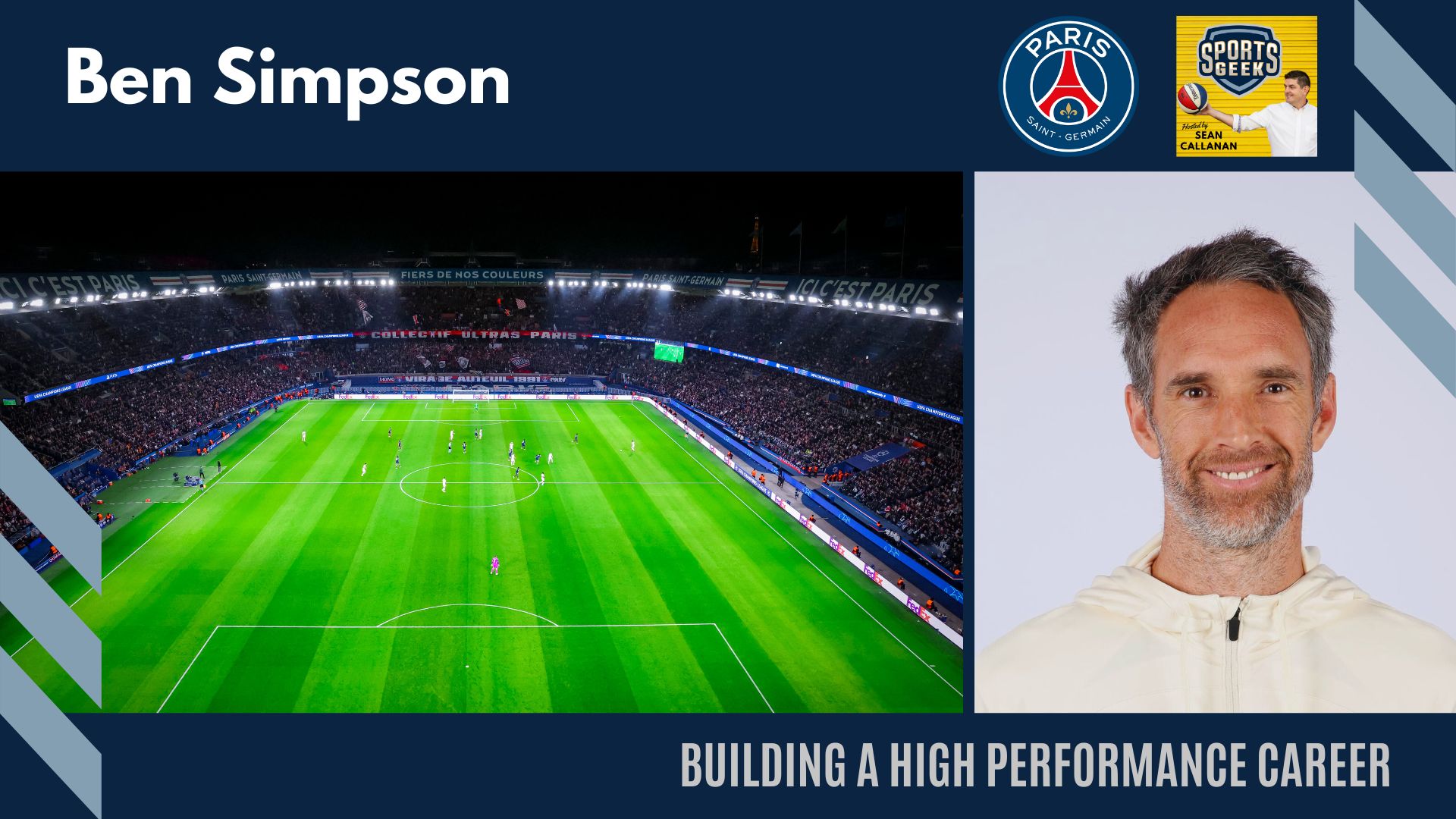
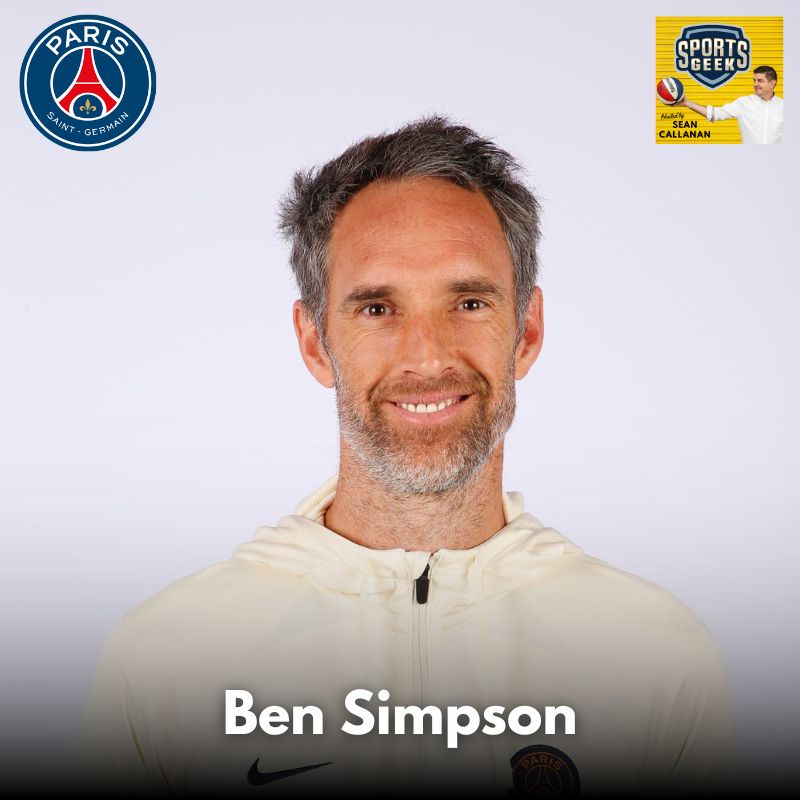
In episode 440 of Sports Geek, Ben Simpson brings nearly two decades of international sports science and high performance experience to share insights on career development, facility design, and what it takes to work at the highest level of European football.
In this conversation, you'll discover:
- How voluntary positions and exploratory roles build the foundation for elite opportunities you can’t predict
- Why relationship-building and going the extra mile opens doors that applications alone never will
- Essential strategies for transitioning between sports science, performance, and innovation leadership roles
- How elite clubs like PSG approach athlete-centred facility design to create competitive advantages
- Practical approaches to building international networks in high performance without compromising competitive edge
- Why humility, curiosity, and realistic goal-setting matter more than rushing to senior positions
- What it takes to navigate career progression from country Victoria to Qatar to Paris Saint-Germain
Listen to Ben Simpson on Sports Geek
Can't see podcast player? Click here to listen
Watch on YouTube
Interview Transcript
This transcript has been transcribed by Riverside.fm, no edits (please excuse any errors)
Sean Callanan (00:00.813)
Very happy to welcome Ben Simpson. He's the Director of Projects and Innovation at Paris Saint-Germain. Ben, welcome to the podcast.
Ben (00:08.226)
Thank you very much, Sean. It's pleasure to be here and thank you for grabbing me at the sports. I can never get that right.
Sean Callanan (00:15.427)
SportsTech World Series, like it's acronym that shouldn't be that hard, but it seems to that it is. Yes, we did catch up at SportsTech World Series at the MCG and you were speaking and I said, hey, I wanna continue some of that conversation on the podcast. So thank you very much for accepting and good to see you back in Paris.
Ben (00:35.938)
Yes, thanks. Thanks for having me.
Sean Callanan (00:37.827)
Not a problem. I always get started asking people how they got their start in the world of sports business. You're now in Paris, but you do not have a Parisian accent. So tell us a little bit about how you got your start in the world of sports.
Ben (00:53.342)
I guess every, every podcast I listened to with someone working in the sports field, there's always that story around. I wanted to be a pro athlete. yeah. You know, like back in, I'm from country Victoria, Wangaratta. So, you know, every kid there has a big passion to, or not big passion, their exposure to sport is, is on the doorstep. so I grew up with a.
Sean Callanan (01:10.435)
Okay.
Sean Callanan (01:19.127)
What was your sport that you were hoping to achieve?
Ben (01:22.67)
Like I had a vested interest in Australian football. Obviously wasn't good enough, but then I thought, okay, there's an option to become a rower. So there's like a talent ID option at the VAS. So I had to do that and got excited about that. But then a job got, I got called for a job in Qatar. And that's kind of where my pathway kind of took off to kind of where I am now.
Sean Callanan (01:34.69)
Mm-hmm.
Sean Callanan (01:44.227)
Mm-hmm.
Sean Callanan (01:50.615)
So I don't like going too fast and skipping over the first steps because it's the first steps that are normally some of the important ones. So what drew you into sports science? Was it a little bit of that, hey, that talent idea and seeing that from a athlete side or was it just something that you were interested in?
Ben (01:56.91)
Sure.
Ben (02:06.924)
I think I just had an invested interest like as a, as an athlete myself or as a amateur athlete, playing others, Murray football, it's like, it's a decent, decent standard. So looking after yourself from a physical perspective, from a, you know, recovery, making sure your nutrition is correct. you know, I, I played with a few guys that had exposure to AFL so we could kind of align a bit. And I found a university.
down in Ballarat, University of Ballarat. Now it's the Federation University. So, you know, I didn't have to go, I went far from Wangaratta, but still it was like a bigger country town. I wasn't going down to the city, so I wouldn't be too lost. So that's where I got my kind of, I wanted to stay in the sports world, but I didn't really know. So this like human movement and sports science degree kind of gave me that capacity. Okay, could I become a teacher?
in physical education, could I work with a elite team? from there, there was an internship at the BIS. I applied for that. Correct. Yeah, I applied for that. was like an ongoing every year they sent a call out to kind of Victoria Uni and the other universities in Melbourne. University of Ballarat. And then a few people were actually surprised that I got the position.
Sean Callanan (03:13.825)
Yep, the Victoria Institute of Sport. Yep.
Ben (03:33.614)
Um, I was forced, don't know. I spoke, uh, I spoke to the, to the guys there, Troy Flanagan and a few other people that were working at the, were running the kind of sports science department at the AES. Uh, and he said, you know, you just had an interest in, as I said, that kind of, uh, trying to explore the sports science world, you know, in my hometown in Wangaratta and, and understand it a bit better. unfortunately it wasn't.
Sean Callanan (03:59.875)
And so was that, mean, it's, I don't want to cut you off, but it's, mean, a lot of the times I'm talking to people who, you know, want to get in and then they, you know, they get in and they're doing inside sales or they're doing operations or they're sitting up, they're sitting up tents and marquees and they're just doing a bit of everything to sort of find their space. We're doing the same thing in the sports science thing, like doing some stuff at footy clubs and figuring out different things with different, different sports. And that curiosity sort of helped you find a space.
Ben (04:15.16)
So.</p>
Ben (04:26.262)
Yeah, I think like across from what like working in a gym to doing PT to working at is think it's SMA Spor
ts Medicine Australia in in in in Melbourne. So that was like a job that you know, I could be exposed a bit to more the commercial side and understand, okay, how do they set up conferences? How do they manage the medical kind of platform in the Victoria Victoria ecosystem?
So there's a lot of exploratory there, but I really wanted to kind of key in and focus on working with team sports. like, field hockey, soccer, football. So that were my kind of key elements when I was at the Victorian Institute of sport and mind you, it a, it was a voluntary position. So that's what, you know, you, you got to reference that to, up and coming practitioners that want, sometimes you have to kind of bite the bullet and.
Sean Callanan (05:04.195)
Mm-hmm.
Ben (05:25.324)
You know, you may not be able to live on the weekends, but you can maybe find find a pathway where down the track you can, you know, have those opportunities.
Sean Callanan (05:28.685)
Yep.
Sean Callanan (05:33.251)
And so what was your pathway like to go from a voluntary position, being a sponge effectively, trying to learn as many things as possible, but at some point they're like, I want to pay a gig. I want a job job as your father would say, when are you going to get a job job, Ben? What was that first proper gig?
Ben (05:51.085)
Hahaha.
Ben (05:57.874)
The, well, I guess the SMA Sports Medicine Australia was, was one of those ones, but that was totally an office job. I normally I'd be rolling to work in shorts and a, and like not a t-shirt, but you know, I could go into the office and take a shower after writing in or, so I wouldn't, yeah, I'm going to say that's my, that was my first official kind of job in that kind of element. But then the Qatar, Qatar gig.
Sean Callanan (06:01.079)
Mm-hmm.
Ben (06:27.182)
came about by just again sending emails to random job shout outs.
Sean Callanan (06:35.555)
And so that was a Spire Academy. Like, that, again, was it just scaring the internet, looking for jobs? Take us through what that role was.
Ben (06:43.542)
I, yeah, I found there was a senior sports physiologist job opportunity come up and obviously I was nowhere near senior capacity. And I just said to the, to the company, to the people, listen, this is my CV. If ever anything comes up that suits my profile, I'm available to talk and see, see what kind of projects you guys are offering. And long and behold, the person came back to me and said,
Listen, we're not hiring for anyone now, but maybe down the track. And two months later, he actually came out for one of our SMA conferences in Melbourne, a Finnish guy who used to work at the Australian Institute of Sport in TID. So I said, okay, I need to do as much as possible for this guy. So I drove out to the airport to make sure he got like a VIP service. And, you know, we spent a bit of time and, and next thing he said, okay, come over.
Sean Callanan (07:21.249)
Okay.
Sean Callanan (07:27.181)</p>
Mm-hmm.
Ben (07:41.582)
for a job interview in two months later. And kind of the rest is history. So the job was kind of offered there and then on the spot.
Sean Callanan (07:51.137)
And so t
hat was talent ID. what did that entail? Like what did that entail? Like bringing in your sports science piece?
Ben (07:54.476)
Yeah, so that was the talent ID. Yeah, talent ID officer.
Ben (08:02.21)
Yeah. So identifying kind of local talents within the Qatar, Qatar kind of talent pool. So going out to schools, let's just say high school, high school in Australia, you'd go out to all the schools in, in, in Australia or in Victoria, because Qatar is such a small, you know, population pool is quite small. So we could easily target all the schools in the country. We'd go out there and we do a three stage testing, testing kind of a
platform, so like a bronze level, civil level, and then a gold level, which would be held at the Aspire Training Center. then classic physical profiling, anthropometric profiling. And then when you get to the later stages, you kind of involve the coaches to get their insights on the aspects of the more athletics. So it was more around athletics, kind of Olympic sports there we were kind of targeting from a talent ID angle.
Sean Callanan (08:59.224)
Mm-hmm.
Sean Callanan (09:02.721)
And so at your time at Aspire, you sort of, because you're in the organization that is all about developing talent and it's high performance, you sort of got to move around the organization and I guess spread yourself professionally.
Ben (09:16.162)
Yeah. after four years in the TID role, talent identification role, I moved across to the football, the soccer department. One of my Spanish colleagues, said to me, don't waste your time in that talent ID kind of position. You need to come across the football because if you want to go into Europe and explore that kind of world, then you need to kind of jump ship now.
I'm looking for someone so similar kind of aspect but more like working directly with a team. So anywhere from under 14 to under 18. So it's kind of like the Aspire model is essentially the national team. The kind of that is training and going to school at the center. So, you know.
Early days, we've kind of spread the load a bit in terms of doing sports science, doing SNC, doing nutrition. But as a spy grew, you could kind of there was more siloed roles. So I would be a bit more specific to the sports science aspect. And then you'd have a strength and conditioning coach come in. So and it's just it's growing and growing.
Sean Callanan (10:29.803)
And was that sort of like, if you were starting to see your path was, you know, did you have the goal in mind of, you know, like your friend that said, come out of talent ID and get in, get into football to go, what does sports science look like at the pro level to potentially somewhere in Europe? Is that sort of what you started sort of chipping away at that goal and sort of building out the skillset to be able to fill out the CV?
Ben (10:51.714)
Yeah, I guess I was kind of fortunate enough to cross paths with some of these key people within my trajectory. not trajectory, just my kind of life pathway. So, you know.
Sean Callanan (11:02.819)
Yeah, I mean, but it shows the importance of these, I guess, it's not really networking, it's like making these meaningful connections along the way that you don't know that will pay off later. And it sounds like you've had a few of those that have definitely paid off.
Ben (11:12.706)
Yeah.
Ben (11:18.296)
Yeah, exactly. You know, a couple of good friends still and you can always lean on them for any any support that's that's needed that they're still going to be the key mentors in in my in my book. You know, one one guy is a Spanish guy and other guys is a French guy. So they they have very potentially different different ways of looking at things. But when you bring the both of them together, it created really a strong
a strong, strong kind of a collective, collective working group. So again, it goes back to some necessarily how much you know, but it's who you know, and how you kind of treat those relationships.
Sean Callanan (12:00.311)
Yeah, I think it's that second piece, like how you treat them and how they remember you and you're memorable for a reason. And you've made that impression. Because it's not just a matter of having everyone's name in the list. It's like they've got to know you. So 10 years ago, you know, just over 10 years ago, you make the move. How did the move to Paris Saint Germain come about?
Ben (12:04.728)
sure
Ben (12:12.088)
Sure. Yep.
Ben (12:22.118)
I guess one step before, so the former colleague and good friend Martin, Martin Boucher, he, he made the move in 2014 to take on the head of performance role at PSG. so he was a former colleague in Qatar. We used to live together, run together. So, you know, a very good friend. And, and again, he's, he's one of those, those key mentors.
we I made the decision to finish in Qatar at the end of 2014 to go and live with my wife in Sweden. So there I was just kind of exploring, okay, residency, where I could work, what I could do in Sweden. But in the meantime, I kind of had in the back of my mind that Martin from PSG was like, okay, I'm going to try to bring you into into PSG, but just be patient. Had to go.
Sean Callanan (13:16.195)
Mm-hmm.
Ben (13:19.054)
had to go back to. So yeah, Martin made the call in say, June ish 2015. Then I had to fly back to Australia to spend three months to get my visa. Took a bit of time with the bureaucracy and all the politics around getting a visa and having everything translated to French. And then by the start of October, I was I landed landed in Paris and was starting a new new adventure and a new role there with the
Sean Callanan (13:30.36)
Mm-hmm.
Ben (13:48.93)
with obviously an elite sporting club organization.
Sean Callanan (13:52.267)
And going into a place like PSG and the new guy and like effectively, it was like starting at the bottom, but also looking at, here's all the opportunity ahead.
Ben (14:04.758)
Yeah, I guess one I didn't my French was was very poor, nearly non existent. And then it's it's an it's a very interesting landscape, especially I'm sure that most elite organizations have their interesting aspects. So it's a bit complex when you when you arrive kind of not necessarily mid season, but into the season. So you don't want to disrupt the
You know, the players, technical staff, the other staff around. So we made sure that we were a bit kind of conscious of that and weren't too, and that kind of goes back to my personality as well. I'm not someone that's going to jump on, you know, jump on players. don't have an interest in being befriending players. so we kind of worked a bit more on the side to create some, different processes, some different reporting and that, that could kind of help.
evolve the club on a kind of sports science, sports performance aspect.
Sean Callanan (15:08.323)
And I'm guessing, I mean, much like all other parts of the business that have been transformed by, you know, more, more data and more tech. It's like that must be also almost tenfold in the, on the sports science thing. Like I'm looking at from the business and the ticketing and the marketing point of view. But you know, a lot of the tech and a lot of the important tech is, you know, on field, like how, can we analyze, you know, we've, you know, we've seen in other sports, you know, money ball and deep analytics and those kinds of things. It must.
The past 10 years must be an absolutely exciting time to be in sports science.
Ben (15:43.458)
Yeah, good, good, good question. guess like we tried to kind of speak on, speak on that and at the recent conference in Australia and then I was at a conference last Friday and some, sometimes, you know, the, shiny gadgets out there that we can or cannot use are not necessarily going to always be the answer. And I guess that's what we tried to build at PSG with Martin and with a former colleague, Matthew Lackham was ensuring that our processes were
was super tight. We kept it simple, but then we were also open to exploration. So I think the whole model arounds because sometimes we're still talking about the same stuff that we spoke about say 15, 20 years ago. And if we can't do certain elements correctly and, and, and well, a lot of, a lot, there's, there's a lot of noise in there. So we just, that's where we were just really maintained the simplicity approach to, to, really
Sean Callanan (16:42.275)
But it's a really good framework to have because you're right. Like there is always a bright and shiny thing that says, hey, this is the tool that will work. What are some of the, I guess, what's the questions or the matrix that you put some of those things through to go, well, know what, you know, we've got our framework. We know what works. We've got what it is, but can it, you know, can we bring this in and can it add? there, are there things that you do to question and I guess validate what potentially gets pitched?
Ben (17:12.184)
Yeah, good question. I think like discussions with peers and that it's, it's, it's first and foremost, it's a, making sure that there's a question to be answered. So is there something missing that we can potentially answer with a, with a certain innovative change or is it a human element? Is it a technology element or is it an organization perspective? So to kind of answer that question.
It's, yeah, it's, it's, it's a complex one because nowadays all the, all the tech and tools on the market are probably much more fast pace. You've got a lot that, that wants it, that, cause they just want to be on the market and they, they want to make sure it's, it's, it's up to speed with their competitors. So we just have to have the, do the due diligence to make sure the product is reliable, valid, and actually giving us the information that
that we're after.
Sean Callanan (18:13.283)
I mean, it must be a tough one with having innovation in your title and effectively having, you know, that, I don't to say slow approach, you know, approach, cause innovation normally is fast and fail fast and think things where it's like, well, actually we want it to be considered. Can innovation be considered? Can it be slow? Can it be structured?
Ben (18:23.736)
Sure.
Ben (18:30.496)
Yeah. Yeah. Good one. guess Sam Robinson spoke a bit about it at the conference as well. And yeah. And then, and then I've got, the, colleagues on, on more the business side, the commercial side, that that's their approach, you know, so we just have to try and find a happy medium there where, okay, can we go fast, but slow at the same time? You know, a certain elements that we, where we can probably push a bit. So
Just comes back to framing it all, you know, being clear from the get go. Okay. Is this product something that can be, you know, you can work on it quicker or is it something that we need to take our time? So, how, how pressing is the issue?
Sean Callanan (19:12.931)
And is that part of what PSG Labs is, is sort of to give that structure to be able to push something through and pull different levers to make it go fast, but still have those checks and balances.
Ben (19:28.034)
Yeah, speaking kind of primarily from the performance arm, I guess that's where we just have to be. Normally the concept is, like a, it's like a, like a bootcamp. So application process, go through the due diligence contracts, et cetera, et cetera. Then implement the product within the PSG ecosystem, wherever it may be within, what vertical work it's kind of coming into.
Sean Callanan (19:41.453)
Mm-hmm.
Ben (19:58.294)
work with the, the, the staff, the representative within that vertical, see if it's something that is useful and how practical it can be to actually answering the question. And then essentially, okay, let's, let's write a white paper or create a case study based on that. So, but from the performance angle, okay, sometimes maybe we need a bit more time to, to test and, and validate the product. So it comes back to okay.
Sean Callanan (20:27.469)
So it's all dependent on the department or the vertical it's working with. It's high performance. It's got to meet the standards you've got and meet the, you know, and those, if that takes longer, it takes longer. But like you said, if it's commercial or fan engagement and it's a bit of a test and learn and you can run it at an event or on a weekend, it can be done because it's, you know, it's not, it's a high risk and those kinds of things.
Ben (20:39.214)
Sure.
Ben (20:46.446)
Sure.
Exactly, yeah, you've nailed it. You've hit the nail on the head there.
Sean Callanan (20:54.739)
So building out the lat like a lot of teams, you know, spoke to you, spoke to Robert Tenniss about, you know, saying we want to do innovation, but is it, you know, you really have to have some structure like PSG Labs to be able to do it. Otherwise you sort of, sort of like just getting an idea and running off in different directions and you really can't gauge its success. You know, again, if you're looking at all four verticals in your business, we're all doing something different.
and you're not qualifying it, you really do need some structure in that place to be able to make innovation work, I guess is what I'm saying.
Ben (21:30.008)
Sure, yeah, sure. I guess there's gotta be that centralised point. And I guess it kinda goes back to that just framing from the beginning. Sometimes it's a bit of like, maybe this is not the best approach we could take, so we just have to kind of trial and error. But also, like in some cases or some clubs that I've heard is maybe one of the support staff or a goalkeeper from…
from one of the teams, he's bringing in a tech that he's thought was could be impactful. He's gonna use it and wants to try it with his players. But if you don't have the proper frameworks in place that it can easily kind of not slip through, but because in the end, they're just trying to do what's best for their athletes. it comes back to also educating the practitioners as well about best practices. So I think that's where you just have to.
Sean Callanan (22:27.767)
And I'm guessing in the past 18 months, one of the things is going through PSG Labs, both on all sides of the business is AI. How, you know, because a lot of tools are just, you know, now with AI, little bit of last tricks on them or, or they're fully fledged AI pieces. are you looking at AI as a sports scientist and high performance person?
Ben (22:44.79)
Exactly.
Ben (22:53.038)
I know that some groups are probably more further than, than where we are speaking with some MBA teams have managed to kind of set up some agents within to, you know, they're not generating reports anymore. They each practitioner can come in and ask their own kind of questions and, get it. So you don't spend, I think the simplest way to put it is just, okay, it's going to be time. It's going to take away that time.
of that kind of creating the time you spend on treating data, importing data. Whereas now we can probably start to talk to the coaches, have those meaningful discussions. So and it goes back to that kind of people skills piece. Without those, there's that gap between okay, between data and between the coaching staff. Sometimes some coaching staff, they understand it well, some some coaches don't. So
You need to have that person in the middle that can ask those right questions to offer key insights around, okay, why are we doing this? What are we getting from it? And, and, or how can we kind of make change? So I think it's, it's, it's, and on the flip side, on the backend of all of that is how I think there's a classic saying, you know, garbage in equals garbage out. So you have to be very conscious of, okay, the
the data is well treated and the information that you are actually putting into the system. So, and sometimes you, obviously got to miss miss points, but how can you catch up on that? And how can you get like a 24 hour kind of monitoring system of the athlete to really offer those, you know, for example, like the injury injury kind of, um, if we can predict injury at 87%, but if you're missing some key elements of the, the player,
then it's very difficult to say, you know, I can see when this injury is going to happen.
Sean Callanan (24:54.403)
But it is, mean, you just sort of spoke about it then. It's a lot like other businesses and other people that are using it is, how can I save time? Where's the manual labor? How can I be better querying, getting those reports in a different fashion and I'm not picking up bits of Excel and redoing them, which is every business. That's the first piece that frees you up to be able to tackle some of those bigger problems.
Ben (25:13.774)
sure.
Ben (25:22.124)
Yep, correct, correct.
Sean Callanan (25:24.963)
Um, and you know, you obviously spoke at, uh, sports innovation week and the sports tech world series, sorry, yeah, for tech world series. There you go. I mucked it up. Um, in, Melbourne and you, you, you know, at another conference recently, where do you, where do you see the, your, industry heading as far as high performance and, know, obviously injury prevention and, and try, you know, that play a health piece and, know, then there's the specter of, you know, where's all that data go and all of that kind of stuff.
Ben (25:33.111)
Hahaha.
Sean Callanan (25:52.823)
where do you sort of see the future of high performance going?
Ben (25:57.71)
Yeah, good question. I think going back to all the topics that we've kind of spoken about, I think we also have to reference that it needs to be athlete centered as well. So we need to some way, first and foremost, educate them. And that's why I spoke a bit about the cultural piece about Australian athletes versus maybe the athletes of the world who have kind of been born with this kind of
sports science or this high performance exposure along the way. And it's just ingrained in the culture there. So I think that athlete centered approach is key. Going forward.
Sean Callanan (26:38.519)
Do you think that's even more so? Like the athletes are more aware and they understand their bodies more. They're leaning into the tech. We're the reports of Lebron James spending a million dollars. We've still got Ronaldo running around at 40. And part of that is all the different things they're doing. Some of them would just be the trends that are on TikTok at the time, but some of them will be science-based that they go, this is what I want to do nutrition-wise.
Ben (26:59.817)
Sure. Bye.
Sean Callanan (27:06.719)
And, you know, sleep wise, you've obviously got a more educated athlete, you know, 10 years down the track.
Ben (27:12.542)
I definitely definitely like some of that place that I've not necessarily worked directly with but seen them and how they operate and the longevity. It just goes back to that, you know, they're willing to probably maybe one point is that, you know, sport is life for them. So they also appreciate the outside element too, but sport is really ingrained in what they do and what their pleasures are. they spend every
kind of minutes of the day, making sure that, you know, as you said, they're eating correctly, they're training properly, they're recovering properly. so I guess just giving, I don't, I still don't know how much, how far we can go with, cause obviously every person on the planet now has a mobile phone, but because we've probably got 100 or plus applications on there, sometimes they just get lost. So how can we make that
much more intuitive and smarter to offer key insights to the athlete on a daily basis. You also, as I said, you want it athlete-centered, so you want them engaged in it, but you also, so you don't want to put it on a plate for them either. So where's the balance there?
Sean Callanan (28:31.171)
Yep. It's sort of getting them, giving them enough information for buy in today, to that they know, supplementing what they what they do. But also, you've got you've got more data to quantify that it's that has happened. Whereas, you know, 1015 years ago, you would have said, I, you know, I need you to have this sleep or I need to do these runs. And now you've actually got the data and the dashboards and the reports to back that up.
Ben (28:53.774)
Sure, sure, correct. Yeah. So, and then, you know, everything is around context as well. So, and that's where it kind of comes back to those relationships and, you know, just having a simple discussion. So sometimes, you know, if we're asking a wellness questionnaire to some of the players, not just here, but around the world, it can be just like a standardized response. But if you can have that…
Sean Callanan (29:19.395)
Mm-hmm.
Ben (29:21.388)
capacity to engage with the athlete and then, okay, last night, you know, I had a fight with my wife, so I didn't sleep so well or fight with my partner. that's where, okay, if you can build that trust and build that relationship with the athlete, I think you're going to go much, much further with having them brought into the program.
Sean Callanan (29:44.099)
Yeah, I mean, I mean, it's, it's not a role like you need that human side, because it's not a role that can be replaced by computers. Like it can't just be cool with, you know, you're wearing a whoop on one hand and a Apple watching the other and a heart monitor and yeah, you're good to go. We'll, we'll put, you know, sensors on your bed. You're right. You still need to be able to have an understanding of that human side and be able to interpret that data. yeah, super, super important part. I always ask people,
Ben (29:50.542)
Yeah, exactly.
Ben (29:55.881)
Hahaha.
Ben (30:07.15)
Sure, sure.
Sean Callanan (30:13.603)
what excites them about their job and what they're doing in the next 18 months, two years.
Ben (30:23.822)
Uh, I guess this is, this is a bit like exploratory for me, this whole element of kind of working much more because of obviously the last 10 to 15 years of being athlete facing. So, um, and you, you, you really like ingrained in the day to day practices, but now it's like a, okay, let's take a step back. Let's take that kind of bird's eye view.
Sean Callanan (30:28.567)
Mm-hmm.
Ben (30:51.902)
and understand, how does it look in three years time? How does it look in five years time? So it's much more a strategic kind of orientated role and a lot of that's a bit kind of refreshing. and then, you know, then you…
Sean Callanan (31:06.487)
Yep. I mean, again, cause you're, when you're in it, you don't know what the other departments are doing. You just sort of see the inputs coming into your, your area and they're either good or they're annoying and you're just trying to focus on your job. But sort of that stepping back, you can sort of see, I guess the gears of the, PSG moving and sort of seeing where there might be a squeaky wheel.
Ben (31:13.486)
sure.
Yeah.
Ben (31:25.858)
Yeah, exactly. Exactly. Just like a small example is just having some more discussions with the commercial side, know, for sponsoring, for example, being able to talk to them about, okay, this is probably some sticky points and how can we address that? And I guess that's where the PSG labs component really comes into play as well. you know, covering right across the club. So, you know, obviously, as I said, I'm purely the performance side, but
you also can hear, okay, what's happening in the other departments and whether they need support or not necessarily support, okay, certain kind of elements that can kind of help them. so yeah, that's exciting as well.
Sean Callanan (32:10.743)
Well, definitely, mean, learning a new part of the new part of the business, but also you that change of perspective would do that. Ben, I really appreciate you taking the time. I want to get to the Sports Geek Closing Five. Do you remember the first sports event you ever attended?
Ben (32:18.424)
Sure.
definitely.
Ben (32:26.744)
Okay.
I think it was a Madison Cycling Race in Bendigo. So I don't know if you're familiar with the Madison.
Sean Callanan (32:38.051)
The Madison, that's the one where they just keep, it's confusing as hell and they just keep doing laps and then someone rings the bell and then they just go like the clappers.
Ben (32:46.446)
It's two cyclists on fixed wheels on a track and they sling each other. So obviously my father and then my mother a little bit to have a track or cycling history. So I think our first, you know, we'd often go across to the Madison in Bendigo, spend the night there and enjoy the races.
Sean Callanan (32:51.201)
Yep. Yep.
Sean Callanan (33:02.433)
Okay.
Ben (33:13.434)
Or I think Optus Oval was like a big one was Optus Oval, Richmond versus Carlton back in the day, sitting in the, standing in the stands. So.
Sean Callanan (33:19.747)
Back in the day, exactly, would have been Opticeye. Well, probably would have been Princess Park maybe even at that stage.
Ben (33:26.841)
Princess Park, correct. Because what is it now? It's eight? No.
Sean Callanan (33:30.438)
it's something else. yeah, I think there's still signs up for Optus Oval. I think a lot of people still call it Optus Oval. it would have been a lot of different sports events in different parts of the world. And the food scene's definitely changed. You have a favorite food or a go-to food at a sports event.
Ben (33:31.893)
Okay.
Ben (33:36.118)
Okay, there you go.
Ben (33:46.83)
it's tricky because I'm vegetarian, so that's…
Sean Callanan (33:51.971)
So at least there's becoming, there is some options now, like again, 20 years ago, or even 10 years ago, there wasn't any options. So do you have a favorite veggie food memory at a sports event? Has there been an event that actually has catered for you?
Ben (33:58.136)
Yeah, sure.
Ben (34:05.528)
Well, yeah, because I would say that probably the Australians probably do do that. Here in France, it's a bit, it's either nachos and cheese, but if you go to the counter too late, it's not in stock anymore. I was recently at a Las Vegas Raiders match, but more just the pathway to buy anything from the food and beverage.
is pretty impressive, you know, how they've set it up a very automated and I didn't eat anything or drink anything there. So I can't comment, but it'd be that.
Sean Callanan (34:41.795)
Do you find yourself now in the current role? Like I do talk to a lot of people sort of in the same when they go to a sports event, they do watch a bit of the game, but then they're sort of grading, like you said, the food and the concessions and the flow and what's happening on the scoreboard. You're finding you're doing more of that now in this role?
Ben (34:59.598)
yeah, I guess I like it, not a bit of both. I think, you know, you always like to see, okay, what's happening down at ground level with the coach, what's happening with the, warmups, what are the, know, what are the players doing on the sidelines? and then, you know, obviously the, whole spectacle around fan engagement and that, especially like in the U S so, you know, it's also present in, in Europe, but
Sean Callanan (35:00.652)
Or you've always done that?
Ben (35:27.49)
the US kind of that whole concept of around coming in and being a big spectacle. And so that was that was interesting. And, you know, even visiting training facilities, it's you know, it all goes back to how's the best athlete, athlete flow, you know, how can you maximize where your athlete kind of goes and passes throughout their journey on a training day.
Sean Callanan (35:50.947)
And some of that, mean, some of that is specifically a high performance, like that's where the pool is, and that's where the cold pool is, and that's where the treatment room is. But then it's also that wellness piece. like, you know, it was in the Detroit Pistons one, and they've got a dedicated barber shop. And, you know, and then they've got another, you know, another players area that's players only no one else can get to it. It's all about their comfort. And, you know, so they're comfortable to come to work. So, like, you know, all the performances are just, you know, what's the, you know, the dumbbells and what machines you have.
Ben (35:59.968)
you
Yeah, sure.
Ben (36:12.91)
show.
Ben (36:20.814)
Yep, no, definitely, definitely like a, that's obviously a lot more thought. It's not just the, the architects or ownership trying to kind of create a, what they think is, is the best, the best practices. So, you know, you need to stab everyone, everyone on board and everyone kind of having their kind of particular say, but you know, someone that's driving, driving the, the project as well. yeah, but, but it's better.
Sean Callanan (36:47.843)
And it's back to what you said, it's like that athlete focus too, like the athletes want to go, this is a place I want to come to work, this is a team and a club I want to play for. And so it makes it pretty important. I always ask, is there someone that you follow? It might be someone online, social or an author or like that the podcast should give a follow to.
Ben (36:55.214)
Sure, exactly. Yep, yep.
Ben (37:09.134)
guess there's two, there's a few too many out there that I'm, not necessarily like I'm, I've got my social footprint is next to zero. I, I guess, you know, going back to Martin, Matthew Lacombe is, is a, is a key one as well. yeah, more like on a, on a wellness kind of perspectives, like Sam Harris.
Sean Callanan (37:39.628)
Okay.
Ben (37:40.142)
Yeah, I was pretty deep into the five minute workday. What's his name again? I've forgotten his name. Sorry, five, five minute workday or the, yeah, it'll come back to me. So, so you.
Sean Callanan (37:53.677)
That's alright.
Sean Callanan (37:58.915)
Well, I'll Google it and I'll put it in the after interview show notes. Larsa, you said you've got a small social footprint, but is there a social media platform that is your MVP that keeps you connected with people?
Ben (38:04.632)
Sure.
Ben (38:14.706)
I guess like LinkedIn, LinkedIn is probably the easiest one for me. I got an application where be present that I use to not be, you know, it's like a five minute window three times a day where you don't get onto that doom scrolling. So, you know, like for a, for a couple of, you know, I don't use Instagram or barely on Facebook and that. So
When you do go onto a certain application rather than just scrolling all day, know, there's, limits on there as well.
Sean Callanan (38:44.973)
Be intentional, check in with the right people and respond to the people that have reached out. Cool.
Ben (38:48.654)
Sure, sure. But then again, there's so much out there that sometimes, one, you can get lost, but two, you can also be a little bit behind the ball as well. And that's where it's important about having these type of calls or setting up calls with people on the other side of the planet to make sure that, okay, what are you up to? What have been?
Sean Callanan (39:08.885)
I mean, I always joke like, you know, I'm working in digital marketing or fan engagement or commercial. And I always find it funny when teams, people who work in those teams get competitive with the other people. It's like, well, you're not on the pitch, you know, you're just fighting for sponsorship dollars or, you know, I'm not, you're not going to convert a, you know, a Collingwood fan to an Eston fan or, but in high performance, like you, it is on the pitch. Like it is, you are, you are, you are part of the team and trying to
Ben (39:28.558)
Sure.
Sean Callanan (39:38.019)
into get that win. How does networking and professional development and reaching out to colleagues, like how does that, does it work? when you're competing on a weekly or regular basis.
Ben (39:56.312)
think it's like a lot of a lot of elements what we are doing is not necessarily, you know, rocket science, not gonna say it's like we're not saving lives. So if you look at that, at that aspect, you know, of course, the people that saving lives are going to be sharing as well.
Sean Callanan (40:14.721)
Yeah. But it's more about, mean, yeah, I guess I have spoken to people like in the tech space that, you know, roll out certain tech that does give their team a home advantage. So they don't tell anybody. But, but, know, so you're to have your own secrets. then there is that case of you still still build out that network. You're still trying to keep up with latest trends. You're not, you're not calling up someone for hamstring, the awareness theories, because you've got to play with hamstring problems. It's that's not how it works.
Ben (40:23.896)
Sure, Yeah, this.
Ben (40:33.676)
Yeah.
Ben (40:40.3)
Yeah. Yeah. I guess like, it's, goes back to, okay, you can share everything that you, you are aren't doing. And then it's, it comes back to how you implement that. So it's not just a copy and paste. So that's where it kind of sits. I think people are probably open to sharing, but in actual fact, how you implement that exactly. So, and that's where I think a lot of people are probably more and more open and visible.
Sean Callanan (41:01.995)
It comes into execution. Yep.
Ben (41:10.454)
So to, cause they, understand that, okay, I've nailed this, maybe certain elements I can improve on by talking to this person or that person, but people just can't necessarily copy and paste.
Sean Callanan (41:22.787)
Absolutely. mean, yeah, ideas are easy. It is the execution that's hard bit. Ben, were a sports mad teenager in Wengereta and now you're at PSG. What advice do you give that sports crazed teenager now that says, hey, I want to work in sport. I want to work in sports science. I want to be in high performance. What's your advice?
Ben (41:27.854)
sure
Ben (41:35.15)
You
Ben (41:47.47)
I think from a personality perspective, know, don't cheat your personality and be humble. First and foremost, everyone, you know, that's always going to, you can't hide that. If you know, just be curious and drop, send emails to everyone. Doesn't matter, you know, they'll either answer with a yes or no. You never know. They may not even answer. And just be willing to kind of offer your services.
Probably like I think someone said it the other day, know, you're working in one department within the organization, you know, lower, lower tier, but the goal is to become a president, you know, that, takes time. So you don't want to, you need to be a bit more realistic. So rather than say, okay, I want to go and work at a sporting organization as the head of performance.
find other elements along the way if you're just starting out in your career. So I just…
Sean Callanan (42:49.621)
Absolutely. I link to your LinkedIn, the show notes, because it shows that the, you know, the slow burn, the years that you did at Aspire, the years you did at PSG and now you're in the current role. It's not a two or three clicks and you're there. You got to put in the hard yards. So Ben, I really do appreciate you coming on the podcast and sharing your story. Thanks a lot.
Ben (43:04.238)
Sure, Yep.
Ben (43:13.484)
No, thank you very much. been, it's been great conversing and I wish you all the best for the upcoming podcasts and your career that you've created there. So good job. Thanks.
Sean Callanan (43:23.747)
Cheers mate.

Turn 15 minutes a day into sponsorable content your partners will pay for
Sports Geek AI is a done-with-you content system that creates daily newsletters, podcasts, and social posts—giving your commercial team new inventory to sell.
Resources from the podcast
- Please connect with Ben Simpson on LinkedIn. Let him know you listened to the episode. Please say thank you if you do connect.
- Join me at SEAT in Charlotte in 2026
- Give our new Daily podcast a listen – Sports Geek Rapid Rundown.
- Related podcast episodes you should listen to:
- Throwback episodes you may have missed:
Podcast highlights
Highlights from episode 440 with Ben Simpson
- 03:15 – From Wangaratta to Sports Science – Early Career Foundations
- 05:45 – The Value of Voluntary Positions and Learning Opportunities
- 08:03 – How a Job Application in Qatar Changed Everything
- 10:30 – Building Relationships That Open Unexpected Doors
- 13:45 – Eight Years at Aspire Academy – Talent Development in Qatar
- 18:20 – The Transition from Sports Science to Performance Leadership
- 22:15 – What It Takes to Work at Paris Saint-Germain
- 26:40 – Creating Elite Athlete-Centred Training Facilities
- 31:25 – Innovation Leadership and Special Projects at PSG
- 36:15 – Designing Spaces Athletes Want to Come To
- 39:30 – Networking in High Performance – Balancing Collaboration and Competition
- 41:50 – Advice for Sports-Mad Teenagers Wanting to Break Into the Industry
- 43:00 – Sports Geek Closing Five
Listen To Sports Geek
Recent Sports Geek Reads
- Formula 1’s Global Media Machine, Travis Kelce’s Contract Twist & ESPN’s Origin Story
- WNBA’s $7M Salary Cap Revolution & NCAA social highlights limited
- Portland Blazers Sale, WNBA CBA & Vibe-coded podcast gets 100K downloads
- Cricket’s Gambling Controversy, MLB Private Equity Targets & the WNBA’s New CBA Deal
- Ohtani’s $125M Sponsorship Empire, WNBA’s New CBA & AI Content access
- F1 Parasocial Bonds, NBA Expansion & AI Agent Learning
Listen to Sports Geek Rapid Rundown daily