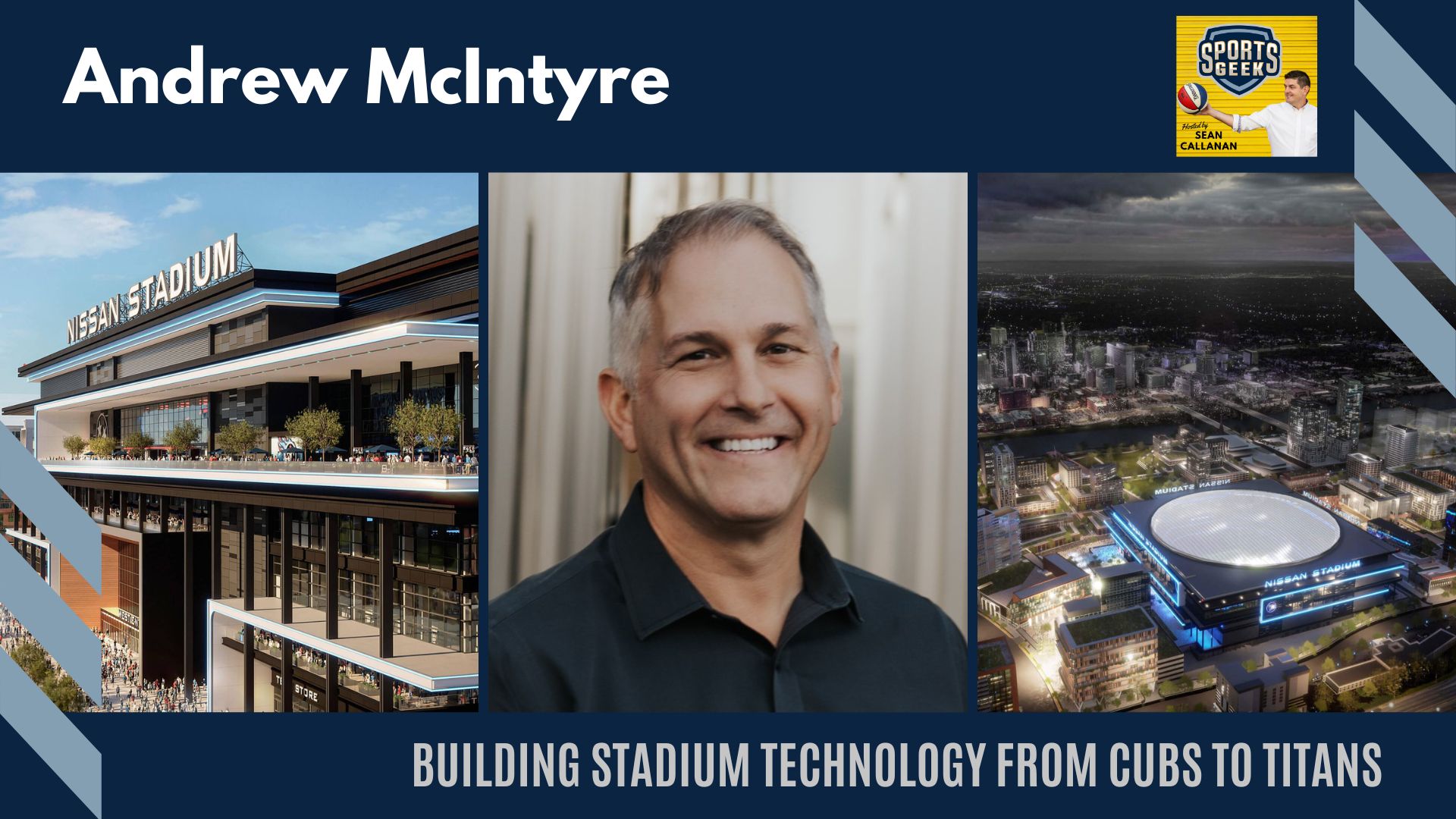
In episode 434 of Sports Geek, Andrew McIntyre brings unique cross-league perspective from transforming technology at the Chicago Cubs, Tampa Bay Lightning, and Tennessee Titans.
In this conversation, you'll discover:
- How to navigate complex stadium restoration projects while maintaining operations, learned from five years rebuilding Wrigley Field
- The critical differences between MLB, NHL, and NFL from a technology perspective – from game frequency to adoption challenges
- Strategies for building software development teams in sports organisations that traditionally outsource technology
- Why vendor relationships and creative problem-solving are essential when dealing with historic venues not built for modern technology
- The balance between maintaining current stadium operations while planning for next-generation fan experiences
- Essential lessons about being a “builder” versus an “operator” and matching your leadership style to organisational needs
Listen to Andrew McIntyre on Sports Geek
Can't see podcast player? Click here to listen
Watch on YouTube
Interview Transcript
This transcript has been transcribed by Riverside.fm, no edits (please excuse any errors)
Sean Callanan (00:01.324)
Very happy to welcome Andrew McIntyre. He's the Senior Vice President of Technology and Innovation at the Tennessee Titans. Andrew, welcome to the podcast.
Andrew McIntyre (00:10.918)
Sean, thanks for having me. Excited to be here.
Sean Callanan (00:13.71)
Not a problem at all. It was good to have a seat, catch up with you in seat Nashville. I want to sort of dive into your career. As I always start, I always ask people how they got their start in the world of sports business. What about yourself? What was your first gig in the world of sports?
Andrew McIntyre (00:28.464)
Yeah, I got the opportunity to join the Chicago Cubs back in 2011. Kind of a really interesting time for the Cubs. They had just been purchased by the Ricketts family two years previously, and they were looking at doing a major transformation of their front office. And so the Cubs had pulled in a management consulting organization to evaluate the different areas of the business and start to look at what might be
a good fit for them moving forward and also to actually like model what type of leader they were looking for. And so one of my good friends now was the target of what that role was going to look like. And so the management consulting firm then helped lead the recruiting process and evaluate different people out in the marketplace. But one of the things that stood out was actually someone from outside the sports organization. The Cubs are pretty adamant. They wanted someone with a different
view and a different experience so that they can apply those best practices from other industries to the Cubs and then leverage that to hopefully help them transform and become a better organization as a whole. The model, go ahead, Sean.
Sean Callanan (01:40.974)
So there's a lot of people that do look at sport and say, do I get in? So what was your background prior to being recruited for that role?
Andrew McIntyre (01:53.532)
Yeah, so I started my career in consulting. I'm gonna age myself a little bit, but I started at Anderson Consulting before it actually went through the name change to Accenture. Did that for several years and then family life made me get off the road a little bit. So I was working in a mid-sized financial services firm with multiple locations based out of Chicago as well as Carmel, Indiana. So my background was a little bit consulting, a little bit financial services.
leveraging those best practices. And then when the Cubs were looking for someone, they were looking for someone with a similar background. And so it was nice for me to come in, albeit, I don't know if I was fully prepared for the role, but they kind of also knew that going in and they had some really good people internally that had the business context and understood the industry of sports. And obviously my job was to learn as quickly as possible and then really help kind of drive the change that they needed to take them to the next level.
Sean Callanan (02:51.768)
So that initial role at the Cubs, was effectively new and guess exciting, but there was that remit to, I guess, make some change and roll out some technology.
Andrew McIntyre (03:04.551)
Yeah, so the Cubs had built out a multi-year roadmap and that roadmap included really driving towards being the best on the field and off the field. They had three major goals. One was the win in World Series for their fans because it was over a hundred years since they had last won. The second was to save Wrigley Field and the third was to be a great neighborhood champion and really support all of Chicago and all the neighborhoods that Wrigley was at. And so
My role was on the technology side was to help them with a key piece of that vision, which was to help them with their infrastructure needs, specifically of the saving Wrigley field, but also looking downstream at the spring training facility, which was a bit of a challenge at the time when I joined and then really what they were doing in the Dominican Republic. And so we had basically three major construction projects lined up.
and then additional ones got added along the way. it was building a training academy in the Dominican Republic. It was rebuilding a spring training or building a brand new spring training facility in Mesa, Arizona. Then five years of restoration of Wrigley Field. And then along the way, we kind of expanded that to be more of an entertainment district, too. And so I got to work on not just the infrastructure, but also all the systems and applications that were supporting our business. So it was was an amazing time to be there. And obviously,
very successful both on and off the field during my tenure.
Sean Callanan (04:34.894)
Yeah, I mean, that's when we first met when you were first to the Cubs. And I remember some of the conversations between yourself and people like Steve Connolly at the Red Sox, when you're working at these historic old venues that weren't built for technology, it takes some ingenuity and some innovation and some problem solving to get some tech into some of those, into that old stadium.
Andrew McIntyre (04:59.654)
Yeah, I mean the stories from Steve Conley, we became very quick friends when I first joined the league and just a great individual, but like him sharing his stories at Fenway. And then really for the Cubs, we were looking at Boston as kind of a blueprint of how do you look at doing major renovations, but staying in the building and then expanding outside of it. And obviously they're a couple of years older than Wrigley. So there was a nice
tied to not just saving a historic ballpark, also building out into the entertainment district around it as well. And then Wrigley, mean, it's a wonderful place to watch a game, but back in the days, we had stories of rain hats, which don't really exist, but basically just things that when it rains in your data center, where you push the water and just other fun things like that, that nowadays you don't see those in modern buildings. But, you know, Wrigley was built so long ago that they didn't have any idea what the technology would be and where it is now.
Sean Callanan (05:46.382)
Yeah.
Andrew McIntyre (05:56.848)
So it was extremely fun to be a part of like, not just learning those things, but then getting creative with, you know, how do we work around it over five years of restoration? Cause we effectively had to rebuild Ripley five times. So, and doing that in the Chicago winter. So fun times.
Sean Callanan (06:13.582)
And definitely it's also, it must really test and really fortify your vendor relationships when you say, I don't know, I need these, but I need them in this size or I need to be able to install them here or I need these to be more waterproof than that you're saying they need to be waterproof. What was that backwards and forwards with different vendors that you're rolling out things at Wrigley and during that restoration period.
Andrew McIntyre (06:35.738)
Yeah, I mean, I remember a couple of key conversations and a key relationship. So one of the things that became really mission critical was building a strong relationship with our low voltage electricians. And so we had a local group that we got to know very, very well. And effectively, they were our eyes and ears on the project during construction and would run back to us if they ever felt like something was off with regards to where a cable tray was landing or where a condom was getting pulled.
what that would impact to us for rebuilding the network and those things. And then on the vendor side of the house, it was always about just recognizing that opening day is not moving. So even though we're rebuilding the network every year, we have to be as quick and as nimble as possible to execute because you just don't have time. Everything has to be ready to roll and you can't necessarily open up opening day at Rigby Field for the Cubs and not have something working.
That was one of the fun challenges and also like the worst. Like I think I used to have actually a decent set of hair and not gray and it was, there's some, it's almost like my family jokes. There was my pre Cubs, then there was when I left and they compare it to like a presidency. If you ever see a US president, when he goes in, he looks all nice and shiny. Then when he comes out, he's like ready for retirement. Like that's, that was kind of my Cubs experience.
But no, the vendors, think remembering Peak Electric and Rick Lavier is a key piece to our success. And even today, some of the design firms and some of the architects are like, if we didn't have Rick on your team, Andrew, there's no chance you guys are going to pull this off. And then other vendors, obviously, there's tons of really great ones who we use for our cellular infrastructure, what we are doing on the Wi-Fi side. We specifically put one of our Wi-Fi.
vendors we were debating about going under seat, which we decided not to, but we were debating about it. And I remember a key conversation about peanut shells. And they're like, what are you talking about? I'm like, you have to make sure the enclosure does not capture peanuts shells because with water and everything else, they start to smell. So it becomes like this, not a technical issue, but it's like a fan experience issue of make sure that you have a peanut shell catcher in your enclosure or else there's no chance that this thing is going to work.
Sean Callanan (08:54.382)
And one of the other things that are sort of looking into what you did, you know, rolling out all that technology and the rise and the, and the demand for more software development and bespoke systems, you started building out that software development team at the Cubs. What was that experience like? Because again, sports team becoming software development houses isn't a natural leap. And it's always something a bit of a, how do you go about it? Do you bring other, know, do you throw it to an agency or a partner or do you do it in house? How did you find getting that model right?
Andrew McIntyre (09:23.804)
Yeah, no, I think this is one of the interesting parts and they give a lot of credit to the leadership at the Cubs. So my career outside and consulting and financial services, primarily software based, it was developing software, leading software teams, leading software teams in multiple locations, all around supporting enterprise business. And so the Cubs saw that and they knew that they did not have any of that currently in the organization and they wanted to bring that in. So I came in with all of that skill and capability.
Where I was lighter was really the infrastructure side. And even though our roadmap was heavy, heavy infrastructure, that's where we had people on the ground that had those skills. really strong people. You might know Sean True, currently with Oakview Group. Sean and I partnered together in building one of our first projects, which was our first front office relocation. We had to move out of Wrigley so that we could actually build and work in Wrigley. So we had to relocate everyone across the street.
And so Sean and I were working together on the infrastructure. And I remember out of the gate, he was like, you don't understand any of this stuff. And I'm like, well, that's why you're here, Sean. Like, we're going to do this together. While I was working on building out like our CRM, building out our enterprise data warehouse, starting to overlay the infrastructure that we'd use for analytics. But that's what they had envisioned for me is, hey, we know you know the software. can build teams, can integrate consulting partners, you can accelerate this. And they saw the sports industry as.
this has been outsourced or not as a primary focus, we need you to do this right out of the gate. So that's what was exciting for me. It brought in an outstanding individual to lead that team and that individual is now leading the Cubs right now. it was fun to have that knowing I had that in my back pocket, then all the infrastructure projects was a great thing to learn and to build around.
Like I normally credit most people as technologists is you just have to be able to learn and learn fast and sports keeps you moving. And you can't just be one thing you learn. You're learning everything all the time. So it's, that is one thing that I really enjoy is walking into an organization that already had a mindset of we need software, we need more intelligence around our data. We need to focus on this because it's become a competitive advantage and we're going to need it as we continue to evolve our operations.
Andrew McIntyre (11:44.965)
The infrastructure is obviously something that is mission critical too, but also a little bit more tried and true, even though it evolves over
Sean Callanan (11:52.079)
Absolutely. And, you know, we both have similar backgrounds. You know, I do believe that the ability to be a sports geek is really important to bring that geek skill into the world of sport. You did say, and you did touch on it, I don't want to brush over it. Obviously had some some success on field at the Cubs. And you know, it's one of the unique things about sport, like if you're running infrastructure and software teams at a bank, you don't get this
you know, love from the entire city when the team is playing well on the field. What was it like, you know, working in the front office during that run and during that historic run and that drought-breaking run to win the World Series?
Andrew McIntyre (12:32.583)
Yeah, I mean, it was unbelievable. It's something hard to put into words. But what I would say is when I joined, and my first full season with the Cubs, we had lost over 100 games. So my expectation of on-field success was actually pretty low. historically speaking, the Cubs are always the level of losers. So I never actually went in with the assumption of like, we're going to be successful on the field, but we had all these major
you know, goals that we had to shoot out for. it was like, yeah, winning the World Series is one of them. But I think for me as a skeptical sports fan, was like, that's the Cubs. So I don't know if that's going to happen. And then they hired Theo and then they hired the rest of Theo's gang. And then very quickly, it went from not if we're going to win, it's when are we going to win. And you could actually start to see and like almost trace the growth pattern of success on the field.
with the number of people we were drafting and developing and then adding to the team. And it just kept building, building, building. And you could just feel inside of the organization that everyone was kind of pulling on the same rope to try to get us to win the World Series. And the World Series itself, obviously, there was a classic when it comes to being down 3-1 and then coming back and winning 4-3. And every game and everyone had its own little like…
soap opera drama series that could be made from it. So like every game you're on the edge of your seat and as soon as you think you're too low, then you get back to high, then you're back low again. Just, mean, just an emotional roller coaster. And I'm really good friends with with my counterpart at the Indians, now the Guardians, Neil. And we had a nice little obviously up and down roller coaster ride on both sides. And we still talk about it and just how magical that was. Obviously, very happy that we came out ahead, but
You know, Neil is very deserving too, so I'm always rooting for him. But no, was an amazing time. Being able to make it to the World Series, we had an outstanding party and enjoyed that. And then when we won, just the outpouring of the fans with all of the writings on our brick wall on the outside of the outfield and chalk, if you've ever seen pictures of that, was just amazing. And stories about people who had been lifelong Cubs fans, generational fans.
Andrew McIntyre (14:57.082)
And their parents had been fans, but never were able to see or experience a World Series and having people tell stories about having a radio at their visiting gravestones and like listening to the game with their with their parents. Just unbelievable tearjerk, you know, stories. And then for me, being able to enjoy not just the win, but then the celebration afterwards. And I remember the bus rides through downtown on the double-decker buses with the open air and
able to have my wife and my three boys with me and just the parades and everything that happened in the city was just unbelievable. So I'll have those memories forever. it's, yeah, I don't know if anything is ever going to connect to that level ever again.
Sean Callanan (15:39.375)
Yeah, I mean, and that's, you know, that's the unique thing about working in sport. It sort of makes all those long, long days and early mornings and, you know, it really can fill your cup for both yourself and everyone and, you know, everyone under you and all your staff to go, you know, wear it with pride. And, you know, and I do remember you, you know, showing off your World Series ring at Seat quite proudly as you should. Yeah, amazing, amazing experience.
Andrew McIntyre (15:58.866)
Hahaha
Andrew McIntyre (16:02.557)
Yup.
Andrew McIntyre (16:06.46)
Yeah, no, I think that's one of those things that you never really take for granted is you can always look back at the pictures. You can look back at the memories. You have the most amazing historical artifact that you can carry around with you whenever you need to. And even now, like there's still people that were like, were you there? I'm like, yeah, I was there. I remember where I was. I remember funny little stories along the way when we beat the Dodgers to get to the World Series. I remember walking onto the field and seeing the celebration and
And right next to me, I see another celebrity walk into the field because they're excited as well. And I look over and it's Eddie Vedder. And I remember giving Eddie Vedder a high five as we were like going to the World Series. It was unbelievable. So you just have these stories, Charles Barkley in a hotel bar right before game at the end of game six, just goofy things like that. They don't remember me, but I remember them. just, yeah, those are stories that they'll cherish.
Sean Callanan (16:58.702)
Yep. Don't discount that they might be telling the same story to their grandkids one day. It's like Gertie Vedder to say, yeah, I high-fived Andrew McIntyre. So from the Cubs, you moved down to Tampa Bay with the sports group. was the impetus for that change? then also, what was the key for that role?
Andrew McIntyre (17:07.304)
Hahaha
Andrew McIntyre (17:21.064)
Yeah, so on the Tampa Bay Lightning side of the house with the Vindic Sports Group, a couple of things. One, when I had joined the Cubs, we had laid out that roadmap. And so that last off season, which was the off season in between after the 2018 season going into 2019, was really the final phase of the restoration of Wrigley. So what I had committed to my boss and really committed to the organization, I felt like I had.
Completed what I had signed up for and I didn't want to leave before it was done So I was very very adamant about that. The other thing was I wanted to make sure that my team Was well suited to continue on so it wasn't like I was leaving it like a house of cards It was we had great leadership that could step up into roles that could continue to run and continue to make the Cubs prosper So, you know, I felt really good about how I had taken the team where I brought it where they set up for success in the future
And then for me, was now after eight years of build, build, build, we were going to be shifting from a build mode to an operate mode. And for me, and knowing my own personality is I'm more of a builder than an operator. And so as we looked at what are the next major things the Cubs are doing, what I saw were things like a regional sports network, extremely exciting, major impacts to revenue lines for the Cubs.
Sean Callanan (18:29.111)
You're a builder.
Andrew McIntyre (18:46.31)
It was the build out of the marquee sports network, but the role that technology played and what we did was actually very minimal because it was all going to be outsourced to Sinclair and that whole crew. The other major thing was gambling was coming on. So major deal with DraftKings building out the sports book on campus. But again, our role was kind of smaller. So it really was moving into more of finding tuning what we are doing for the team and less about these massive
I mean, I was eight years of construction projects across multiple cities and even countries. So for me, it was a little bit of a chance to look back and say, what did I want to do moving forward? Also knowing that there was another point in time with my family where my older two boys that are twins, they were in college and my youngest was in junior high school. So my wife and I had spent the bulk of our lives in Chicago and we love Chicago.
Sean Callanan (19:20.909)
But yeah.
Andrew McIntyre (19:45.106)
But those winters really wear you down. And so it was right around that time where we said, if we're ever going to make a move, now might be a time to consider it. And then for me, it was, I have to make sure that there's an opportunity that's worth considering because it is the Cubs. is Chicago. It's such an amazing place to be. And so I just happened to be doing some casual passive scanning of what was happening in the marketplace.
Sean Callanan (19:48.163)
Yep.
Andrew McIntyre (20:11.612)
and looking at locations that we might be interested in from a work life, lifestyle change. And right around that time is when I noticed the opportunity down in Tampa. And as I started reading about the opportunity, you start to see very similar storylines where major change happening with the Lightning with the introduction of a brand new owner in Jeff Vinick. Jeff had been a part of the Fenway Sports Group. He'd sold out of the Fenway to buy the Lightning.
our head of strategy at the Cubs actually was with the &A firm that helped Vinik buy the Lightning. So there was already some like well-known knowledge about how forward thinking Jeff is, how committed to Tampa Jeff is, and they were already having a lot of success. The other thing that they were working through was the potential expansion outside of the arena and to another entertainment district. So all things that I had done while I was at the Cubs. And so…
looking at the location, looking at the ownership, looking at their commitment to their fan base, to the community. There's a lot of parallels. And so my wife and I are both, live in this mindset of life's pretty short. we have a great opportunity to stay in Chicago, but this could be one of those opportunities to try something new and different and continue to grow. And so that's what kind of led me there. in addition to that, you know, one of the things that I played a minor role in at Wrigley.
was really on a lot of our AV and a lot of our production. And so we had hired some really great people to run out the evaluation of the video boards and the implementation of our AV systems throughout the buildings. And so this was an opportunity for me to say, you're moving from a ballpark to an arena. Now you get to learn the arena world. Now you get to learn all the AV production broadcast components of the arena. Now you get to flip the building. And so to me, there was lots of learning. There was a growing city.
a great location, great owner. There's just so many positive things to be thinking about. And again, as a person who loves to build and loves to learn, it just seems like, this is something I can wrap my head around. So we made the move to Tampa.
Sean Callanan (22:23.298)
Absolutely. You sort of touched on it there, the differences between MLB and NHL. I one being the, you know, just the way the stadium is configured and why the entertainment is. What were some of the other things that, you know, coming in, you know, getting to learn a new sport and some new operations and how things worked in the, in the NHL.
Andrew McIntyre (22:43.558)
Yeah, a couple of things that were very attractive and not to be negative to MLB, but the relationship with the league is that the, the Imra, if you will, if you're familiar with that, the media rights are primarily controlled by the league. So there's a little bit of a constraint on what you can do on a local level within your ballpark and within your fans, because the league is running that websites, anything related to mobile applications and those things.
NHL is set up differently so you as an individual practitioner can participate more in and those experiences and those technology and the other things so that was very exciting for me to look into and obviously that just opens up more opportunity when it comes to what you're doing with your data how are you interacting with your fan base what you can do to kind of drive experiences kind of across the board so that was one piece on the positive side now
There are negatives, or not negatives, just differences in approaches, but the NHL takes a pretty hands-off view. So there are some great programs that the MLB did that NHL did not replicate. some of those are, they have a cyber security, very, very robust cyber security program at Major League Baseball. There's really nothing, or at least nothing that we experienced when I was with NHL, so the teams are all on their own.
That's one thing where I feel like a common area that should be done on behalf of the league. Shared services would really make sense to have that together. Yeah. So that was an unfortunate one. Kind of a drawback, put more pressure on us to drive. I think there's some other things related to assistance from the league with league wide purchasing. you know, the MLB does a great job. Hey, here's a solution that could benefit everyone.
Sean Callanan (24:13.378)
Like where those shared services make sense that it's like,
Andrew McIntyre (24:37.732)
let's all benefit from pulling our resources together to get the best pricing for everyone. Very little is happening on the NHL side. And so not saying right or wrong, just differences in approaches. And those are things that I think as you talk to those different leaders at those leagues, they can provide more context on. I was more of a practitioner of saying, well, I either get the support or I don't. Now I have to make changes and decisions to go one way or another.
But at the arena level, and I think this is the part that was really fun, is you really get to see all the other events that take place. So the number of concerts, you know, at Wrigley we'd have, I think our max year when I was there was probably like 10 concerts, a very different concert experience at a ballpark. Well, arenas are built for it. So just the number of concerts that we were having coming in and out of the place and just the ability and speed and efficiency of how they turn that house, like really, really interesting to learn that.
Sean Callanan (25:12.568)
Yep. Yep.
Andrew McIntyre (25:33.638)
And then the AV side, just because you become now a service to the building, which then supports all these events, you're constantly reworking your resource models to make sure that you're optimized for whatever event is coming into the building and you have the right resources to do that. The last thing, I don't think this was planned, but obviously just kind of happened, was related to COVID. So during COVID, the…
Canada had enforced some specific rules around crossing the borders and the NBA had identified that this would be a challenge for the Toronto Raptors to basically be in teams to travel back and forth to Toronto. So Toronto effectively had to pick another location and we were selected as that alternative location. So for one season, now not only am I learning hockey and the NHL, but also all of the arena business, but then I also get a full year of
the Toronto Raptors, albeit not with all the fans in place, but at least understanding operationally what does it mean to put on an NBA program and then learning more about their league. So I feel like I keep getting these great opportunities to learn, compare what is good, you know, what are things that can be improved on and just keeps adding to my my own knowledge base, but also my ability to talk with multiple people from different leagues and compare kind of the pros and cons of each.
Sean Callanan (26:36.972)
Yep.
Sean Callanan (27:01.486)
Absolutely. I guess also, you you said that that variety of content that come through the arena also means a variety of content and patrons come through that entertainment precinct. So it gets it's like the design and the flow of it is completely different to an entertainment precinct that's based around a baseball stadium that, like I said, most of time that is, you know, baseball folk going through that sort of give you that that variety in helping build out that piece around the lightnings venue.
Andrew McIntyre (27:19.271)
Yep.
Andrew McIntyre (27:30.332)
Yeah. So, Water Street Tampa, which was the development that was happening around the arena, really started to come alive while we were there. And so, the Lightning and Vinx Sports Group wasn't directly tied to that development, but our owner, Jeff, it was as part of the SPP, strategic property partners. And so, we got to see what was happening with new hotels popping up, what was happening with new restaurants, how did that impact our own business? How do we try to like work together?
So that was exciting to see because with Wrigley, was already like an established in a neighborhood. There was already major businesses working around you. This was a arena in the surrounded by surface lots. And then all of a sudden an entire entertainment district like arising around it. So that was very exciting. Now, I will say what's interesting is all venues now tend to be like trending towards this 365 day kind of event schedule.
And even Wrigley, when we finished it, we had this very massive open air area called Gallagher Way, where they do movies in the park and yoga in the park. And there's a Christmas series and stuff like that. And so everybody is now turning into this, you know, 365 venue thing. But I will say is like the ballpark is, you know, is really set up to be a ballpark and it can transform. They've had football games there, Northwestern, Illinois football games there.
Sean Callanan (28:44.344)
Yeah.
Andrew McIntyre (28:58.12)
They've done some other things, but I would say it's a little bit more challenging because it's sight lines and other things. Even, think they did the NHL hockey games at Ridley as well. But when you go to those, you really start to see like, yeah, this is for a ballpark. It struggles to put those other sports on. Even like inside of an arena, it's built for the hockey arena. And when you put basketball, you have all of the sideline that needs to kind of come in. You can see the shape isn't like ideal for it, but it still works.
Sean Callanan (29:27.299)
Yay.
Andrew McIntyre (29:27.868)
So you can make those adjustments, but you know it's not optimized for that performance. I'll put it that way.
Sean Callanan (29:35.032)
So you're at Tampa for five years, is that right?
Andrew McIntyre (29:38.994)
That's right. Yeah, I joined in 19 and then left back in July of 24.
Sean Callanan (29:45.142)
And so you're now at the Titans. Was it another being enticed in that builder role with the new stadium down the line that was something that drew you to the Titans?
Andrew McIntyre (29:55.782)
Yeah, that's exactly right. wasn't Tampa did nothing wrong. It was one of those where I have a close friend of mine that I had worked on Wrigley with who was part of the CAA icon group. So operating as an owner's rep. He was reassigned after Wrigley to build out Geodes Park, which was Nashville soccer clubs venue. And then he was hired by the Titans to help them with their new stadium development.
The leadership at the Titans had been looking at what they wanted for their technology leadership. And they have really strong people in a lot of good places, but they wanted someone who had the experience through construction, had the ability to talk through IT infrastructure, had the ability to do software development, had the ability to do the AV and the production and those pieces. And someone just to kind of sit across all those groups. And so when they were looking out, they crafted a brand new role.
And a friend of mine actually tapped me on the shoulder and said, hey, the Titans are looking for a new leader and you're the first person I thought of. And so huge credit to my good friend who was looking out for me. And as I was looking into it, yeah, I mean, the opportunity to build a brand new football stadium is pretty unbelievable once in a lifetime in your career. And then obviously working inside of the NFL, working for a team that's
going through a major transformation with regards to new football leadership. Obviously brand new players coming in to help us chase down our goal of winning the Super Bowl, which is something this franchise has not been able to accomplish. So again, there's a lot of like flavors back towards that. It's a build opportunity. It's a team that hasn't necessarily had the success that they've wanted, but they've been knocking on the door, but haven't been able to get through it.
to be a part of that and then in another great amazing location like Nashville, some of those things you just, if you're lucky enough to get those opportunities to take them. And so I feel very, very grateful for having this opportunity.
Sean Callanan (32:04.78)
And so is your role like very much forward looking and looking at the new stadium or what was your first thing when you came in? Do you sort of look at what current I would say Nissan Stadium, but you would say Nissan. That's all okay. Like, did you do a initial audit of like what was happening at the current stadium and then started looking at the plans and what was in place? What was your sort of first remit when you came to the Titans?
Andrew McIntyre (32:27.516)
Yeah, so I had hit the ground running. They had already, all the funding for the new stadium was occurring and they had already broken ground. So it wasn't like they were thinking about the new building. was, they already had major design drawings in place. And so it was Andrew, you got to get caught up as quick as possible. We had already hired great design engineers. had great integrators that we've already selected. Some of our corporate partners that will provide technology solutions were in place.
but there's still a lot of decisions that still need to be made easy as of today. And our goal is to basically have all of our technology decisions done before the end of 2025. And some of those are going back to some of the original decisions of, where are we gonna locate key strategic technology rooms? Is this in the right spot or does this need to be relocated? And then if we do it now versus a year from now, what are the cost implications and those things? So.
It was very, very quickly getting into the major pieces of Nissan to make sure if there was any critical changes we had to make, let's try to get on those right away. But then more importantly, was, or just as important, I should say, was looking at the current team and saying, hey, we're about to change from an open air stadium to a closed environment, which is a lot more arena-like versus football stadium-like. We're going to be moving our operations to 365. We'll be having
I entertain the district built around us similar to Tampa. We will have an open air activation area, just like Gallagher Way. So there's all these similarities again that you can tie back to my experiences. And then it's like, well, what is the team that we need? So what do we need for IT infrastructure, ops and cyber? What do we need for software development and DevOps, which did not exist in the organization? And then what do we need for AV production broadcast, especially as we scale up to this new building? And so it was a lot of.
looking at current team, doing some forecasting and what we call meet the moment, as well as then, hey, let's make sure that the building is going to be optimal for what we're trying to achieve. And then obviously, the season doesn't end. We have a season coming up. Our first game is Sunday. So let's get going on current state to make sure that we're up and running and optimized for this upcoming season. And we want to win at Super Bowl every year. So it's not like we can say out in the future, it's no.
Andrew McIntyre (34:48.434)
That's what are we doing right now to be prepared for taking the next steps to get better on the field and hopefully getting to our ultimate prize.
Sean Callanan (34:56.728)
Well, you've obviously got your own experience, you know, with those builds, but coming into the NFL, the NFL is its own base and it's giant on the landscape domestically and growing internationally. From a new stadium build, did you sort of look around at some of the recent builds, whether they be, know, SoFi, Allegiant, and these other stadiums that have come online and sort of, you know, picking the best of, or here's the pieces that I want, even with the, you know, the build started.
Andrew McIntyre (35:26.632)
Yeah, no, I think organizationally they had taken many tours at different venues. And then for me, it was, have to learn the league as quickly as I can. I have to learn my team as quickly as we can. I have to learn new Nissan Stadium as quickly as I can. And then also look out for the gotchas of, okay, what can we learn from previous? So last year we played the Chargers on the road down at SoFi. So we spent the weekend down there during that weekend visit. Not only did we spend lots of time touring SoFi and
And thank you to all the people that did the behind the scenes tour before our game of SoFi itself, just to understand how they went about their decision making process and what they did and what are the great things that we can take from their building, but also some of the things that we can improve on for our building. We also took a look at Intuit Dome, did a tour of that as well, which obviously is another fantastic facility. Great things that they're doing down there with the Clippers and what's happening.
with Balmer and team. We also went out to Allegiant Stadium. Allegiant is actually very similar to a lot of the things that we're doing with new Nissan Stadium when it comes to Manica as our architect and things that we're doing with regards to the shape of the bowl, driving people closer to the field itself. So we're taking little pieces from all these buildings. And then even me looking back to Wrigley of saying, hey, we don't have all the space that we want at Wrigley. So how do we get creative with things like
control room placement and does it need to be field facing or behind the scenes and then going back to Nissan Stadium to say, we were able to accomplish these things here. Let's maybe revisit some of those decisions of does this need to be sitting here or can it be relocated? And what does that do for forward our future? I'm not gonna say future proof because I don't think that exists, but at least to be forward thinking or I think one of my WGHW guys has said,
Future flexibility, which is his key word on that one. either way, are good statements towards of, you're not going to say you got it perfect in the future, but hopefully at least you got some thoughts about how do we make sure we grow and expand going forward. But those buildings are great. I got a couple more lined up. Planning on being out in San Francisco when we play the 49ers. I was lucky enough to go to that Super Bowl that they had and so excited to see Costa and the rest of the guys and check out what they've been doing over the past several years.
Andrew McIntyre (37:51.426)
And then I got a couple more up my sleeve. think I might be hitting up Chip up in Seattle and seeing a couple other people as well.
Sean Callanan (37:59.287)
Absolutely. And it's sort of a it's a blessing and a curse when you work in the sports industry, you walk into a stadium and all you're doing is looking at power points and charging stations and and people like and you know, taking all these mental notes, even though it's not your stadium, we go up or you find something that they're doing really well. You're like, got a right mental note, write that down. Well, we'll steal with pride. We'll put that in our stadium. But it's something you can't turn that off. Can you?
Andrew McIntyre (38:22.522)
No, no, I remember when I was interviewing at the Cubs and one of the individuals I was interviewing with, he made a statement to me at the end of our interview and he said, you know, you know, I hope, you know, if you get this job and we're lucky to work together, he's like, you know, there is a negative. And I'm like, what do mean? He's like, you're never going to go to a sporting venue and, and, and, and kind of see it the same way because you will always be looking up instead of down.
So you're never gonna be looking at the pitch or the field or whatever of the sheet ice. You're gonna be looking up on the rafters and looking for antennas. You're gonna be looking for speakers. You're gonna be looking for how they did everything. And it's gonna slightly take away from the experience because you're not so focused on the actual game itself. It's gonna be how do they pull this off? So I will say that he was 100 % right with that prediction. And it is, I don't know if it's a curse or not, but it's definitely something that…
At least for the first half an hour to an hour of whenever I go to a new venue, I'm always looking up, not down. And that's usually everything you train for fans is to look right at the field. So it's kind of the opposite.
Sean Callanan (39:28.366)
Absolutely. I was lucky enough to check out Titans house, the preview suite of what the new stadium will look like. It looks amazing and I think it does a really good great job of bringing the season ticket holders and people who are wanting to know what the new stadium looks like. How do you explain the vision of what the new Nissan Stadium will look like?
Andrew McIntyre (39:52.808)
How do I explain that's a tough one? I would say I'm definitely not the marketing guy. So what I see is intimacy and efficiency. And so it's a very much a focus on fan experience and it's trying to remove the pain points. So right on ingress, is it easy to get into the building and get around to your seat? So helping to streamline that process when it comes to food and beverage, you know, stealing from the playbook of Intuit Dome.
frictionless markets everywhere for speed of getting your food, getting your drink and being able to get back to your seat to cheer on the team. And then when I say intimacy, I think there's another level of care in the design of the seating, the seating bowl, the clubs, the suites, and bringing everybody that much closer to the field. So, you we would argue there's not like a bad seat in the house because everyone feels like they're in their living room right on top of the field.
And I think that's what's gonna make it so exciting is that you're 38 % closer in general across the entire stadium. And I just feel like that's gonna be such a huge force when it comes to cheering on our Titans and being that extra man on the field to hopefully give them a little bit more support when we need it during the game.
Sean Callanan (41:12.088)
That was my takeaway as well. mean, it is really the brief now for stadium designers overall is you're competing with the living room, with the lounge room, with that comfort and feeling close. It's like, well, how can you replicate that? And things like bringing the seats in and sort of being on top of the field and that feel that I definitely got just from a small preview. And I think I was doing a tour with someone who was a season ticket holder and he's like, I'm so…
excited my seats are here and this is what they look like and I can't wait to go in there and and then the other part is you know from a technologist point of view is like how can you put all the technology in and no one knows there.
Andrew McIntyre (41:42.813)
Yeah.
Andrew McIntyre (41:54.972)
Yeah, that is a big focus of ours is it should just blend to the back. It shouldn't be a tech forward building. It's a fan-focused building. But we will have things like our audio system is designed and built so it's super bold ready right out of the gate. Not necessarily something that needs to be supplemented. We're already having standards from the league be evaluated to make sure that we're ready to roll there.
Our LED, you know, we're not trying to be the number the biggest board out there But we know we're going to be in the top three for LED across the league So we're excited about the audio side of it. We're excited about the video side of it Obviously, we're music city. They have a stage built into one of our end zones so we'll be obviously leaning in heavily to the music scene and and bringing new artists and whether they're releasing new
songs or if it's a new artist, but there are going to be a big emphasis on music tying into our entire game presentation. So we're excited about elevating that experience. And then obviously all the other operational efficiencies of just getting in, getting around, getting to what you want to get to. And so that you can just enjoy yourself. We have this amazing design for our rooftops, which is obviously playing a little bit of the inside outside. But we claim to have, or at least we're designed to have the largest rooftop in the US.
or at least we're gonna put our name on that one. So that's a great way to experience not just in the building, but also like just be able to look downtown to Broadway and really just feel like you're a part of the community.
Sean Callanan (43:30.926)
Absolutely. that, you know, that very much is sitting the stadium design into the design of Nashville. The fact that you will have people on game day streaming from Broadway, you know, right into that, right into the precinct, right into the stadium, you know, following or watching the game either, you know, from different parts, but sort of having that connectedness to, to Broadway is really important.
Andrew McIntyre (43:51.718)
Yeah, no, I think Broadway in itself is an entertainment district all by itself and people come just for Broadway. Having that, and obviously we had the draft there and you saw like when the NFL had the draft in Nashville, was the whole streets were shut down. It was amazing. So knowing that we have the ability to leverage that, we have the pedestrian bridge, we have the other bridges that help you get across the water, but being able to see it in the background, if you will, of like everything that we're doing, knowing it's.
It's a great pregame place, it's a great postgame, but obviously we wanna bring people closer to the stadium and then build around the stadium as well. Just a major extension of that entire entertainment component. But it's exciting, mean, seeing the amount of people and the excitement as they cross the bridges to come into the building is really, really fun. So we're really excited about being able to keep that moving forward in the new building.
Sean Callanan (44:43.926)
Absolutely, was actually lucky enough to experience some of it in a short amount of time when I was in Nashville for SEAT. And I think you took the title at the conference for the most panel appearances. So congratulations, we'll send you the trophy soon. what were some of your, mean, SEAT's all about the takeaways from the conversations that happened on the panels or in the networking space. What were some of your takeaways from conversations at SEAT?
Andrew McIntyre (44:55.302)
You
Andrew McIntyre (45:10.396)
Well, first off, I want to congratulate Josh for putting on a great conference. I I unfortunately wasn't able to attend the first out in Utah and the second one in Vegas just because of family and other dynamics. But just really excited to see that Seek, to me, is back and back in a big way. I thought the Nashville experience was outstanding. And just seeing all the teams leaning in.
So from the Predators and having events at Bridgestone and all the great things they're doing to out at Geodes Park and Nashville SC. So to me, just, I was so excited to just be back together with the community and having all the venues lean in to let them use the venues to be a part of SEAT, which I think is such a huge piece of it. For me, I love to chase down my peers and find out what is the latest and greatest thing. And just to make sure that we're doing everything that we can as we prepare for the launch of Nissan Stadium.
And some things I think we're going to hit the mark perfect and other things I'm like, well, you know, we're going to have to continue to be on our feet and be future flexible, if you will, for and be prepared to make those changes. But, you know, to me, seeing what Oakview Group is doing and knowing how they're changing the game on that front, I saw some really great vendors that I always try to spend some time with when I'm out at seat, just because Josh does a great job of making sure that there are relevant
and pertinent people that, if you don't know, you should know. And so I usually spend some time with the vendors. And then again, just the camaraderie of all the different people that you work with. There's so much to learn from everyone. Katie, Steve Reed, like the names go on and on. And so there's just a wealth of information there that you can pick up if you're new to the industry. And I use Seed specifically to kind of launch my career. That's where I met Steve Conley.
That's where I really got to build my MLB network and then eventually networks outside of that. To now just being, it's like a reunion. So it's so much fun to be able to be a part of that. And so happy that was in Nashville because it was obviously in the backyard. That's why I went for the title of most panelists. So anyway.
Sean Callanan (47:15.022)
Yeah, exactly. It be a tough one to be but really do appreciate your contributions. I did ask Steve Reese this on a panel and then recently on a podcast because he has worked in NFL, MLB and NBA and you're the same with three leagues and four if we count your cup of coffee with the Tampa Bay with the Raptors. But what are some of the differences between the MLB, NHL and NFL?
Andrew McIntyre (47:33.557)
Yeah.
Sean Callanan (47:41.986)
that now you've at least worked with them in some capacity.
Andrew McIntyre (47:46.12)
So one of the things that I think less on the business side of it, but more on the lifestyle side of it, which I think is interesting is so I started in Major League Baseball. That's 162 regular season games. So very long season, obviously 81 at home and the focus is baseball, baseball, baseball. And then you got spring training and you name it. Moving down the hockey, you got 82 games, 41 at home, hopefully you get playoffs and other things like that.
now I'm in the NFL and it's like 17 games and you you got eight or nine at home and so that trajectory of games shrinking has been really eye-opening because you know in baseball if you lose a game during the regular season it's one game. If you lose a series you're like that's not good and then if you lose a home stand you're like okay now we have a problem. each individual game is arguably
They're all important, but maybe not as much. As you get down to football, like one game in one week could be a whole season. And so it, every week is that much more impactful and you can feel it. You can feel it in the front office. You can feel it on a daily day basis. And, and so, you know, last year we were not very successful on the field. And so you could just feel it for those weeks where, you know, the team was not performing.
And he didn't really feel positive about the team, about the season, about a lot of things. And it's really hard to shake that because you get one chance once a week and it just has such a ripple effect through the culture. other leagues, obviously, I was there for a lot of good years, but one game doesn't necessarily make a week and there and now it definitely does.
Sean Callanan (49:35.363)
And also that, I mean, it is that with the less games that is the stakes. So you're talking about that, you know, that deadline of opening day. It's like in the NFL, you've, you've got eight of those opening days that are, that are the stakes of that high, whether you're rolling at a new project or testing a new phase of a project or rolling like it's all on that one day. It's not like you can test over a six, you know, two weeks and eight game period and run all the tweaks and the AB testing. It's, it's, it's all in every time.
Andrew McIntyre (49:45.318)
Yeah.
Andrew McIntyre (50:04.07)
Yeah, I think when it comes to like adoption of new technology or a new process or new concept is, you know, in baseball, we used to call it the Petri dish. You got 81 times to try new things and get feedback and keep optimizing. Now you have eight to nine and you're like, that's it. So now we're onto the next season. Was that successful or not? Should we continue with that? So the data points and the number of interactions become much, much smaller and your ability to be quick to like, let's just make sure we have that change for the next game. Well, I mean,
Okay, got eight games or nine games, so it better be perfect out of the gate or else it's really hard. I think technology adoption is a bit harder in the NFL because you just don't have as many opportunities to get people to move in that.
Sean Callanan (50:46.4)
Absolutely. Well, Andrew, really do appreciate you taking the time. I want to get to the sports gate closing five. Do you remember the first sports event you ever attended?
Andrew McIntyre (50:56.444)
Aside from like attending my older brother's games, but first professional sports event was attending a Chicago Bears game with my father and it was freezing cold. We are bundled up to the nth degree sitting in the end zones, but it was an amazing event and obviously something I'll cherish for forever.
Sean Callanan (51:15.936)
Absolutely. And at a sports event, do you have a favorite food memory or a go to food at a sports event?
Andrew McIntyre (51:23.068)
I'm a hot dog guy. to me, you know, whether it's at Wrigley and you're grabbing a hot dog, whenever I go to any ballpark, it's usually a hot dog. Second to that is peanuts. I'm still working on my game when it comes to kind of hockey and football, but usually I'm a hot dog guy all the way.
Sean Callanan (51:42.496)
Absolutely, absolutely. What's the first app you open in the morning?
Andrew McIntyre (51:47.656)
This might be a little sad, but I usually go right to work So I'm usually checking my email or I'm checking my text messages to see did anything blow up Do I need to be reacting to anything right away or can I actually enjoy my morning? So I usually go there if it's for fun. I'm usually hitting one of the Usually Titans app just to see what's what's the latest and greatest coming out of Titans?
Sean Callanan (52:11.886)
Now, that's fine. Sometimes it does bring a, you know, the shoulders slump and I check my email, but that's fine. That's part of work and part of life. Is there someone that you follow? It might be a former colleague, it might be an author that the podcast listeners should follow and why?
Andrew McIntyre (52:17.81)
Hahaha
Andrew McIntyre (52:29.128)
Yeah, you know, this is is interesting. I will admit that I don't tend to push a lot of my own thoughts and philosophies on others, but something I've been doing with my sons is there's some really good interesting articles out there on stoicism. And so I do follow, of course, I'm going to I should have wrote down his name before I jumped on with you. But there's some really good interesting articles, emails that come out as well as
A lot of stuff online that just talks about the methodology and the theories of it and just how you can like make decisions that way. And so that'd be something that I would push. I'll try to get that name for you, Sean, and I'll send it over.
Sean Callanan (53:09.304)
Send me a link and we'll put it in the show notes. Not a problem at all. And then lastly, I ask people what social media platform is your MVP? What's your go-to or your platform of choice?
Andrew McIntyre (53:23.408)
Yeah, I'm kind of an Instagram guy. I think it's more for the comedy and the short, you know, little pieces there. I still do a little bit of Facebook. I feel like I'm the old guy who doesn't, I'm more of a reader. I'm not very much a contributor and same thing for Instagram. just, the comedy is just too good. So I'm usually sending clips to my old buddies, whether college or high school, or even my family, just all the, all the good stuff that comes out of that.
Sean Callanan (53:47.232)
Exactly. The algorithm will make sure it finds you. Andrew, I really do appreciate you taking the time and especially a hosting seat in Nashville. It's really good to catch up with you again. I always ask listeners to reach out and say thank you for you sharing your time and insights. What's the best way for people to do that?
Andrew McIntyre (54:07.368)
I'm a big believer in LinkedIn. So if you are interested in getting connected, feel free to reach out, reference the podcast and be happy to connect and talk.
Sean Callanan (54:18.008)
Thank you very much and all the best for the upcoming NFL season.
Andrew McIntyre (54:22.546)
Thank you very much, Sean. I really appreciate you having me on the show.
Pick my brain
Want some help on a campaign, sponsorship or content but don’t know where to start? Book a time with Sean Callanan for a Pick My Brain session.
The Pick my brain session is a two-hour video consulting session where you can get Sean’s thoughts and opinions on ticketing or sponsorship campaigns, campaign development and digital content review.

Resources from the podcast
- Please connect with Andrew McIntyre on LinkedIn. Let him know you listened to the episode. Please say thank you if you do connect.
- Learn more about the Tennessee Titans' new stadium development at titans.com
- Give our new Daily podcast a listen – Sports Geek Rapid Rundown.
- Episodes you should listen to:
- Throwback episodes you may have missed:
Podcast highlights
Highlights from episode 434 with Andrew McIntyre
- 03:15 Journey from Finance to Sports Technology at Chicago Cubs
- 08:24 Five-Year Wrigley Field Restoration Technology Challenges
- 14:32 Building First Software Development Team at Cubs
- 19:18 Winning the 2016 World Series – Front Office Perspective
- 24:45 MLB to NHL Transition – Key Differences
- 29:33 Tampa Bay Lightning and Multi-Property Management
- 34:21 Joining Tennessee Titans – Vision for New Stadium
- 39:12 Balancing Current Operations with Future Innovation
- 44:28 Cross-League Insights – MLB vs NHL vs NFL
- 48:15 SEAT Nashville Takeaways and Industry Connections
- 51:54 Sports Geek Closing Five
Listen To Sports Geek
Recent Sports Geek Reads
- Netflix’s Sports Streaming Boom Meets Meta’s Thread Podcasts: Paywall Future?
- From Netflix Avatars to F1’s Apple Deal: Sponsorship’s Dot-Connecting Future
- Media Rights Reshaping Sports Valuations
- World Cup Prize Money Soars to $655M
- Financial Fallout: Grand Slam Track Bankruptcy & FIFA’s Ticket Price Shift
- From WNBA Entrepreneurship to F1’s Concorde Agreement
Listen to Sports Geek Rapid Rundown daily